Staff name badges in a hotel: what to print, in which language and what to do with lost ones
Define what goes on a hotel staff name badge, including names, titles and languages. Learn the correct printing rules for Turkish characters and the process for handling lost badges.
AI draft · awaiting editorial review
Contents
Key takeaways
- A badge carries three things: the name the person answers to, the guest-facing job title, and only the languages they can hold a service conversation in.
- Print in Latin letters with correct Turkish characters, and send the printer the exact upper and lower case you want, because automatic uppercase turns İ into I.
- A flag is a country, not a language: use words or short codes, and only for languages the person can actually serve in.
- Every badge carries a number recorded in an issue log; a lost badge becomes a log entry and a retired number.
- Contractors, trainees and seasonal staff need a written rule about which badge they wear, agreed before the season starts.
A hotel staff name badge is a small worn identifier that carries the name the person answers to, a guest-facing job title and, optionally, the languages they can actually serve in. Print it in Latin letters with correct Turkish characters, issue every badge against a signed log, and treat a lost badge as a logged security event with a retired number.
A guest arrives after a long transfer, reads the badge of the person checking them in, and uses a name that is not the name on the badge. Nobody at the desk knows who printed it, when, or what happened to the last one. After reading this article you will be able to write a one-page badge standard: what goes on the badge, in which script and language, who wears one, and what happens when one is lost.
What is a hotel staff name badge actually for?
It does three jobs at once: it tells a guest who is helping them, it tells colleagues who to ask, and it tells the hotel who was where if something goes wrong.
For the guest, the badge is the first piece of information in a conversation. A name and a role let the guest say "Ayşe at reception said" instead of "the person at the desk", which is what makes a complaint or a compliment traceable. For colleagues, the title does the routing. A badge that says "Front Desk Agent" tells a housekeeper who to call about a room change; a badge with only a first name tells them nothing.
For the hotel, the badge is an accountability tool only if it carries a number. A number ties a person to a shift and a date; a badge without one cannot be traced when it turns up in the wrong place. The badge is not a security credential. It does not open a door, prove identity or replace an access card, and it should never be treated as one.
The cost of getting it wrong is small but repeated. A misspelled name makes a guest hesitate, a missing title makes them ask twice, and an inconsistent format across departments makes one team look like a contractor. The decision rule is simple: if a piece of information does not help a guest start a conversation or help the hotel trace a person, it does not go on the badge. The name a receptionist gives at check-in is part of receptionist training: a skills list with sign-offs, not an afterthought; the badge simply makes that name visible.
What should a hotel staff name badge say?
A name, a guest-facing job title and, where the hotel chooses, the languages the person actually speaks. Everything else is optional or belongs off the badge.
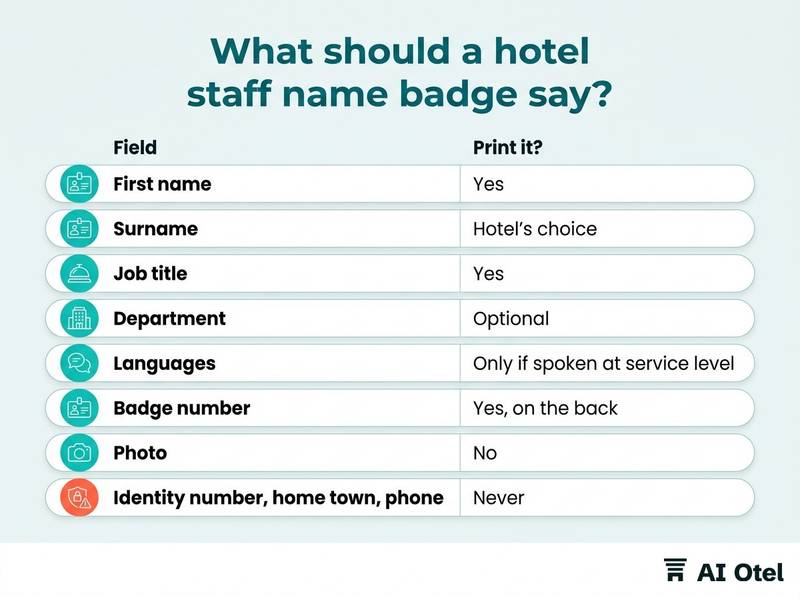
Ask the person to write their own name by hand and print from that, not from the HR record. The HR record holds the legal name; the badge holds the name the person answers to on the floor. Decide once whether surnames appear, and apply the decision by department rather than by person. A property where managers wear full names and the front desk wears first names is fine, as long as the rule is written down.
Take the title from the job description and pick the guest-facing version. If the description lists three titles, the badge gets the one a guest would understand, which is one reason to start from writing job descriptions for hotel roles. Set a character limit with the supplier before the first order: long titles wrap, shrink or get abbreviated by the printer without asking.
Use the back of the badge for the badge number, the property code and one line asking the finder to hand it in at reception. That single line is what makes a lost badge recoverable. Keep personal data off the front. No photographs, no identity numbers, no home town, no phone number: the badge is worn in public and photographed by guests, and staff data is personal data too. One format for the whole property; a badge ordered separately by one department, in a different font or size, reads to a guest as a different employer.
| Field | Print it? | Note |
|---|---|---|
| First name | Yes | The name the person uses at work, written by the person |
| Surname | Hotel's choice | Decide by department, not by person |
| Job title | Yes | The guest-facing title, not the internal grade |
| Department | Optional | Useful in large properties |
| Languages | Only if spoken at service level | Words or short codes, never flags |
| Property or group logo | Yes | Small |
| Badge number | Yes, on the back | The traceability key |
| Photo | No | Personal data, and it ages |
| Identity number, home town, phone | Never | Nothing a guest needs |
| Return line on the back | Yes | "If found, please return to reception" |
Which language should a hotel name badge be printed in?
Print it in the script guests read at the door, which in Türkiye means Latin letters with correct Turkish characters, and add other languages as words or short codes rather than flags.
Turkish letters change names. Şule printed as Sule, Öztürk printed as Ozturk, or Çağla printed as Cagla reads to a guest who reads Turkish as a typing error, and a typing error on a badge suggests the same care elsewhere. Watch the dotted and dotless i. The uppercase of i is İ in Turkish, and a supplier's automatic uppercase will produce IREM or Irem from İrem. Send the badge text in the exact case you want printed and ask for a proof before the run.
Check the font, not just the text. Not every badge printer font carries ş, ğ, ı or İ, and a missing glyph often appears as an empty box only after printing.
A flag is a country, not a language. English is not one country, Arabic is spoken across many, and a guest who reads a flag as a promise will test it in the first minute. Use words or two-letter codes instead: Türkçe, English, Deutsch, Русский, العربية, or TR, EN, DE, RU, AR. Codes are compact, neutral and survive a small badge.
List only languages the person can hold a service conversation in. A badge language is a promise about check-in, complaints and directions, not about school grades. Record who checked the level: a short spoken check by the front office manager, noted in the training file, is enough, and it gives the hotel a reason when a language is removed later.
Watch outFlags are the most common badge mistake
A flag on a badge is a promise the staff member may not be able to keep. Replace flags with language words or codes, and remove a language the moment the person leaves that role.
Who gets a badge, and who does not?
Everyone a guest can mistake for hotel staff wears one, and nobody who is not staff wears something that looks like one.
Front of house first: reception, guest relations, food and beverage, housekeeping, spa, pool, bell and valet. These are the people a guest stops in a corridor. Back of house needs a badge too, but for a different reason. Kitchen, laundry, maintenance and office staff cross guest areas; their badge should be built to survive heat, water and laundry, and it should be worn whenever they are visible.
Contractors and outsourced housekeeping are the hard case. Decide in the contract whether they wear the hotel's badge or their own, and accept the consequence: the hotel's badge is a promise the hotel cannot fully control, and a visibly different badge tells the guest this person is not hotel staff. Trainees and interns need a deliberate choice, because a badge marked "Trainee" changes how guests ask questions, which can protect a guest from bad advice and can also make a capable trainee seem junior.
Managers can wear the same format. A different badge for managers is useful only if the difference is explained to guests; otherwise it just looks like a better badge. Nobody wears a badge off duty: the badge stays at the hotel with the uniform, and a staff member in a bar after a shift is not representing the property. Seasonal staff follow the same rule as everyone else from their first shift, which means the badge has to be ready before the season starts, not in the second week.
Where the badge sits, and how it meets the uniform rule
The badge belongs on the chest, above the pocket line, on the same side across the property, so a guest's eye goes to one place. Where it sits belongs in the same written rule as the rest of what staff wear, alongside hotel dress codes for the restaurant, pool and lobby. A badge pinned to a belt or a lanyard turned backwards loses most of its value, because the guest cannot read it.
How do you issue, return and replace badges for seasonal staff?
Issue against a signed log, number every badge, and make return part of the exit checklist rather than a favor someone remembers to ask for.
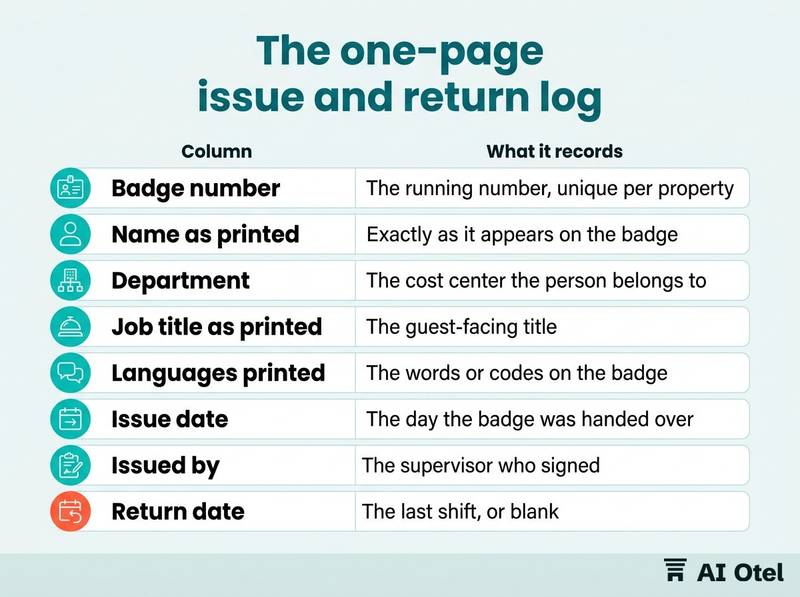
Number badges in a running series per property. The number, not the name, is what the hotel searches when a badge is found in a corridor or handed in by a guest. Record the exact text printed, not just the person, so that when a badge is reprinted six months later, the log shows what the previous one said, including the languages.
Issue at the start of the season with the onboarding pack, so the badge arrives with the uniform and the handbook rather than after the first guest complaint. This pairs naturally with seasonal staff onboarding: a first-week training checklist. Collect on the last shift as a line on the exit checklist, signed by the person and the supervisor; a badge collected "later" is usually a badge lost.
Retire the number instead of reusing it. A retired number keeps the log readable years later; a reused number makes two people share one entry. Set the replacement rule in writing: same-day replacement for a cracked holder or a failed pin, next-day for a lost badge, and a clear statement of who pays. Put it in the staff handbook so it is applied the same way in every department, and keep a small stock of blank holders and pins at the property. Most badge problems are a broken clip, not a lost badge.
The one-page issue and return log
| Column | What it records |
|---|---|
| Badge number | The running number, unique per property |
| Name as printed | Exactly as it appears on the badge |
| Department | The cost center the person belongs to |
| Job title as printed | The guest-facing title |
| Languages printed | The words or codes on the badge |
| Issue date | The day the badge was handed over |
| Issued by | The supervisor who signed |
| Return date | The last shift, or blank |
| Returned to | The person who took it back |
| Status | In use, returned, lost or destroyed |
| Replacement number | The new badge issued after a loss or a break |
What do you do when a staff badge is lost?
Report it on the same shift, log it, retire the number and issue a new one. The badge itself matters less than the record that it is gone.
The chain is short and should be written: the person tells their supervisor, the supervisor tells whoever keeps the log, and that person marks the number retired with the date. Search the obvious places first, because most losses are not losses: the locker room, the laundry bag, the pool changing room, the uniform pocket, the car park. A badge found this way is returned to the same number, not reissued.
The record is the point. A badge carrying a hotel name and a person's name, in a stranger's hands, is a small impersonation risk, and the log is what lets the hotel say the badge was cancelled on a date. Reissue with a new number, never the old one. If the original turns up afterwards, destroy it rather than putting it back into service.
If a guest hands a badge in, reception logs the find, thanks the guest and returns the badge through the supervisor; the guest is not put in touch with the staff member. Read the pattern before reading the person: three losses in one department in a month is usually a fitting problem, a holder problem or a uniform problem, not a discipline problem. Keep the log for the same period as other staff records, so a question months later has an answer.
ChecklistLost badge steps
- Staff member reports to the supervisor on the same shift
- Supervisor searches the locker room, laundry, changing rooms and uniform pockets
- If not found, the log entry is updated to lost with the date
- The badge number is retired and never reused
- A replacement is printed with a new number and recorded
- If the original is returned later, it is destroyed
- The department's loss count is reviewed at the monthly meeting
What to do next
Write the one-page standard this week: the fields that go on the badge, the language rule, the numbering scheme and the lost-badge chain. Then walk the building and check every badge against it. The badge is small, but it is the first thing a guest reads, and a hotel that gets the small things consistent gets the larger ones believed.
Frequently asked questions
Is a name badge legally required for hotel staff in Türkiye?
This article sets no legal duty here; whether staff must wear a badge is a question for the hotel's own written policy, and a hotel that wants certainty on its own position should confirm it with a legal adviser. What can be said plainly is that a badge is an operational choice with guest, colleague and traceability benefits. Write the rule into the staff handbook so every department applies it the same way.
Can a badge show a nickname instead of the legal name?
Yes, if the person chooses it and it is the name they answer to at work. The badge should match the name used at check-in, on the phone and in guest correspondence, because a guest who is given one name and reads another loses confidence. The HR record keeps the legal name; the badge carries the working name.
What about a staff member who speaks only a little of a language?
Leave it off. A badge language is a promise about check-in, complaints and directions, and a guest will test it immediately. List only languages the person can hold a service conversation in, and record who checked the level. Remove a language when the person changes role or leaves.
What should we do with badges when an employee leaves?
Collect the badge on the last shift as part of the exit checklist, mark the number retired in the log with the date, and destroy the badge. Never reissue the number to a new starter. If the badge is not returned, record it as lost rather than leaving the entry open.