AI-drafted pre-arrival offers: which message, which guest and who approves
Draft pre-arrival offers with AI using reservation facts, then have a named person approve each message. Learn which guests to target and how to set stop rules to avoid errors.
AI draft · awaiting editorial review
Contents
Key takeaways
- A pre-arrival offer earns its place only when the guest still has a decision to make, the reservation supports the offer, and the hotel can deliver it at the hour it is accepted.
- Send one offer per stay, to guests whose booking carries the signal that offer answers, and keep opted-out guests and channel-restricted bookings out of the queue.
- The AI writes the draft and a named person approves every message, because a message already sent to a guest cannot be undone.
- Write the stop rules before the first send: a reply, a price change, an open complaint or an opt-out takes the guest out of the queue without anyone having to remember.
- Judge an offer by accepted offers against messages sent, per offer, not by how good the copy reads.
A pre-arrival offer is a priced extra, sent between booking and arrival, that the guest can accept in one step. Draft it with AI from the reservation's own facts, send it only to guests whose booking the offer fits, and have a named person approve every message before it leaves, because a sent message cannot be recalled.
The reservation is in the system, the arrival is nine days away, and the better room is still unsold. Someone has to decide whether to write to the guest, what to say, and who presses send. This article gives you that decision in three parts: which AI upsell message before arrival is worth sending, which guests should receive it, and who approves it before it leaves.
What is a pre-arrival offer, and what makes one worth sending?
A pre-arrival offer is a priced extra, sent to a guest between the booking and the arrival, that the guest can accept in one step and that lands on the bill. It is worth sending only when the guest still has a decision to make and the hotel can keep the promise.
Set the window first. It runs from the moment the reservation is confirmed to a cutoff some hours or days before arrival. The cutoff exists for one reason: housekeeping, the kitchen or the transfer driver still has to be able to deliver after the guest says yes.
ChecklistBefore any offer enters the queue, apply three tests
- The guest still has a decision to make about this stay: room type, arrival hour, meal, parking.
- The reservation record supports the offer: room type, arrival time, party composition, length of stay.
- A named person can deliver it at the hour it is accepted, and the price is already in the system.
The offer must carry a price and a way to accept. "Contact us for details" is a note, not an offer, and it moves the work onto the guest. An accepted offer also has to reach the guest's bill. If it does not, the hotel loses the revenue and the guest meets a surprise at checkout.
Separate two kinds of message before you write anything. A service message is about the booking the guest already made. A marketing message is about something else. They carry different consent expectations and different rules, so the hotel should decide which one it is writing first, and write that decision down.
Offers that fail the tests are easy to name: blanket discounts, welcome notes with no ask, and anything the hotel cannot confirm within the hour.
Which three offers are worth sending?
Pick at most three offers, each tied to a fact in the reservation and each with a named person who delivers it. Three is a working limit, not a target: a hotel that cannot deliver a fourth offer should not write it.
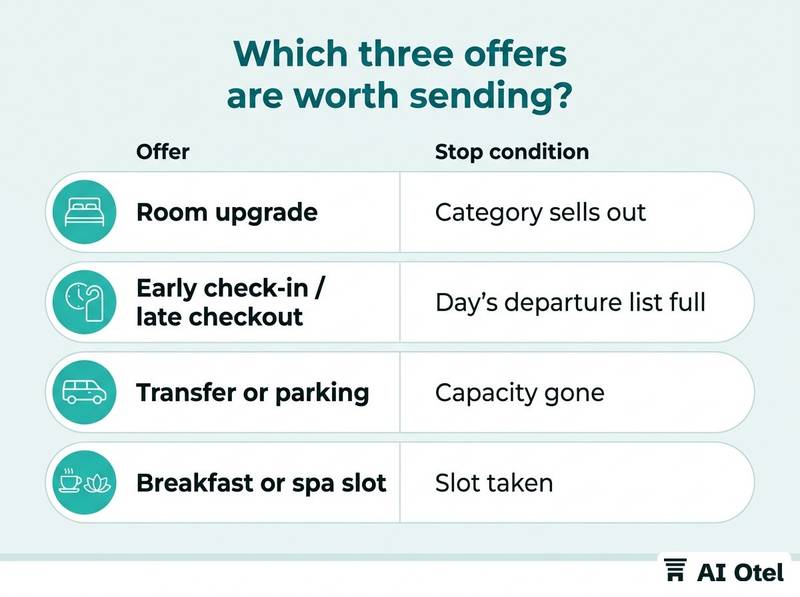
The room upgrade is the classic. Send it only when the higher category is genuinely free on those dates and the move does not displace another booking. Say plainly that the new room type is confirmed on acceptance, not before.
Early check-in and late checkout are common requests and the easiest to break, because housekeeping capacity decides. Set the policy first, then let the offer follow it; the article on setting the early check-in and late checkout policy before you offer it covers that decision in detail.
Transfers, parking, breakfast and spa slots each need a capacity check at the exact hour offered. A spa offer for a slot that is already sold is worse than no message.
| Offer | Guest decides | Hotel confirms first | Stop condition |
|---|---|---|---|
| Room upgrade | Whether to move room type | Higher category free, move possible | Category sells out |
| Early check-in / late checkout | The hour | Housekeeping capacity for that hour | Day's departure list full |
| Transfer or parking | Pickup time or a space | Driver or space available | Capacity gone |
| Breakfast or spa slot | A time | Slot and price | Slot taken |
One offer per message. Two offers in one message halve the clarity of both and double the number of things the approver has to check. Retire an offer after a fixed number of sends with no acceptance, and keep the text with the record so the next person knows what was tried. Write down what happens after a yes: who books it, where it is recorded, and how it reaches the bill.
Which guests should receive an offer?
Send to guests whose reservation carries the signal the offer answers, and keep everyone else out of the queue. The signal is in the booking, not in a guess about who the guest is.
Useful signals are concrete: length of stay, arrival hour, room type booked, party composition, what the rate plan already includes, and whether the guest has stayed at the property before. A guest arriving at 23:00 raises an arrival-hour question, not a departure-hour one.
The keep-out list is just as concrete: guests who opted out, bookings where the channel or the agency holds the guest's contact details and its contract limits direct contact, corporate rates with negotiated inclusions, groups travelling with a tour leader, and guests who already bought the extra.
Watch outTwo checks before the first send
For every guest in the queue, check the opt-out flag on the reservation record, and whether the hotel is allowed to contact this guest directly under the channel or agency contract that brought the booking. If either answer is unclear, the guest stays out.
Hold one offer per stay, plus a fixed cap on how many messages one guest can receive in a period. A second message is a new decision, not a reminder. The reservation record, not the marketing tool, should hold the opt-out flag: if the flag lives only in one tool, it disappears the day the hotel changes tools. Where the contact came from matters too; a booking made through an agency may not give the hotel the right to write to the guest directly, so read the contract before the first send. Segment by what the hotel knows, never by assumptions about nationality, age or spending. The same caution applies to messages sent later in the stay; the piece on consent and clear rules when messaging guests during the stay works through the same questions at the in-house stage.
How do you draft the message with AI without sounding like a machine?
Give the AI the reservation's facts and the hotel's own sentences, then edit by hand. The draft is raw material, not the message.
The input is fixed: room type, dates, price, deadline, what is included, what the guest already has, and the language of the booking. The instruction is just as fixed: use only these facts, invent nothing, promise no scarcity the hotel cannot prove, and write no exclamation marks.
The structure holds at five lines: one reason the offer fits this stay, one offer, one price, one action, and one line on how to decline.
TipBuild a fixed fact sheet
Give the drafting tool the same fields with every request: guest name, arrival and departure dates, room type booked, the offer, its price, the deadline to accept, what is included, what the guest already has, and the booking language. Anything not on the sheet does not appear in the draft.
Keep a house style sheet of about ten approved sentences so the tone stays steady and does not change with whichever model is used that month. Write in a language the hotel can answer in: a reply nobody on the team can read is worse than no message at all. Check four things by eye every time: the guest's name, the dates, the price and the deadline. These are what go wrong, and they go wrong quietly. The same discipline applies to every guest email, not only offers; the guide to drafting reservation emails with AI without making wrong promises covers the fact sheet and the checks in more depth.
Who approves a pre-arrival offer before it is sent?
A named person approves every message, and the approval is recorded with the message, because a message already sent to a guest cannot be undone.
The chain is draft, review, send. The reviewer is a role written into the procedure, not a person's goodwill on a busy morning. Approval is per message: a screen that shows many drafts at once still shows each message, and each one gets a decision.
ChecklistThe reviewer signs off four checks
- The price matches the system.
- The room, slot or transfer is still available for the offered hour.
- The deadline to accept is still in the future.
- The guest is still eligible: no opt-out, no open complaint, not already holding the extra.
Record who approved, when, the exact text that went out, and which facts it was built from. Without the text, the hotel cannot explain a promise later. The AI never sends on its own: sending to a guest is one of the most sensitive actions in the system, so it waits for a person, and the most sensitive actions need two confirmations. If nobody is free to approve, the message does not go. Silence costs an opportunity; a wrong promise costs the guest. The wider question of which hotel actions should be irreversible and which should wait for a person is covered in irreversible actions in hotel AI: messages, refunds and invoices.
What are the stop rules, and how do you handle opt-outs?
A stop rule is a written condition that removes a guest or an offer from the queue without anyone having to remember. Opt-outs are the first stop rule and the one that must survive every change of tool.
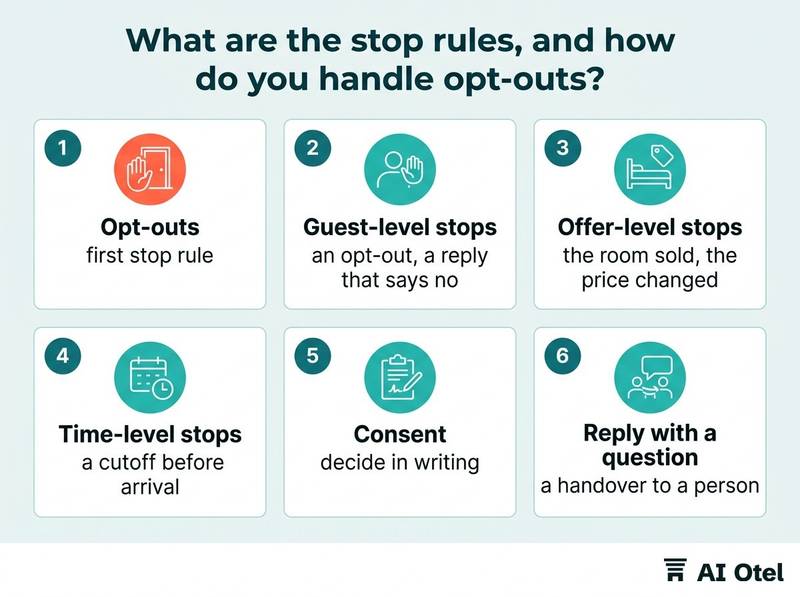
Guest-level stops: an opt-out, a reply that says no, an open complaint, or a request to speak to a person. Offer-level stops: the room sold, the price changed, the deadline passed, the slot filled. Time-level stops: a cutoff before arrival after which no offer goes out, so nothing lands while the guest is travelling.
Key pointOne page, before the first send
Write the stop rules on one page before the first send: opt-out, a reply saying no, an open complaint, a request for a person, the room or slot sold, a price change, the deadline passed, and the pre-arrival cutoff. Each rule names who applies it and where it is recorded.
On consent, decide in writing whether a given message is a service message about the booking or a marketing message, and what the hotel does with the guest's data in each case. Whether a particular message counts as one or the other depends on the hotel's own reading and its contracts, so confirm that reading once with a legal adviser.
Two mechanics finish the job. The opt-out must be recorded on the reservation and carried into any new tool, because a flag that lives in one system is a promise the hotel cannot keep. And a reply with a question is a handover to a person, not a prompt for another automated message.
How do you know whether an offer worked?
Count accepted offers against messages sent, per offer, and compare with a period when that offer was not sent. The average across all offers hides the one that is annoying guests.
Keep four counts per offer: sent, accepted, declined, no reply. Add two costs: complaints and opt-outs. Read the numbers per offer, never as one campaign total, because one strong offer can carry three weak ones and hide the damage.
| Measure | What it tells you | What it hides |
|---|---|---|
| Accepted against sent | The offer answers a real decision | Whether the guest enjoyed the message |
| Declined | The guest read it and said no | Why |
| No reply | The message did not reach a decision | Whether it annoyed |
| Complaints and opt-outs | The cost of the offer | The revenue it brought |
| Accepted offers that reached the bill | The promise was kept | The guest's later stay |
Store the exact text with the record, so the hotel knows what was actually tested rather than what it remembers writing. Set a minimum number of sends before judging anything: a handful of replies is a conversation, not a result. Retire on a rule, not a feeling; a fixed number of sends with no acceptance, or a rise in opt-outs, ends the offer. Publish no conversion figure the hotel cannot rebuild from its own records.
What to do next
Write the stop rules and the four approval checks on one page this week, then send one offer to ten eligible guests and read every reply yourself. The three decisions in this article fit together in that order: the offer decides what the message says, the guest list decides who receives it, and the approver decides whether it leaves at all.
If you want software that carries this flow rather than a spreadsheet, AI Otel's guest app is built: every hotel gets its own guest app, installed from the browser with no app store, and upgrades and extras are offered before arrival and during the stay, with an accepted offer going straight onto the guest's bill. You can read about the hotel operating system behind it, built and working, ahead of launch, or the wider platform. To see how it fits your property, request a briefing.
Frequently asked questions
Can AI send pre-arrival offers to guests on its own?
No, not in a hotel that wants to keep its promises. The AI can draft from the reservation facts, but a named person approves each message, because a message already sent to a guest cannot be undone. Record who approved, when, and the exact text.
How many pre-arrival offers should a hotel send per booking?
One offer per stay is the working default, with a fixed cap on messages per guest over a period. A second message is a new decision, not a reminder, and it needs its own reason, its own approval and its own stop rule.
Do we need the guest's consent to send a pre-arrival offer?
It depends on whether the message is a service message about the booking the guest already made or a marketing message about something else. The hotel should write down which it is, record the opt-out on the reservation, and confirm its own reading and its contracts with a legal adviser.
Which guests should not receive an upsell message before arrival?
Guests who opted out, guests whose booking came through a channel or agency whose contract limits direct contact, corporate rates with negotiated inclusions, groups with a tour leader, and anyone who already bought the extra. The reservation record is the source of truth for eligibility.
What should a pre-arrival offer message contain?
One reason the offer fits this stay, one offer, one price, one action to accept, and one line on how to decline. No invented scarcity and no exclamation marks. The approver checks the name, dates, price and deadline before it goes.