An AI assistant as a practice guest: running front desk training scenes with a person watching
Use an AI assistant as a practice guest to run front desk training scenes. Learn to write briefs, score replies on a four-point card, and keep real guest data out of the exercise.
AI draft · awaiting editorial review
Contents
Key takeaways
- The assistant plays one guest in one scene; the trainer writes the brief, watches, and decides what a good reply was worth.
- A brief has five parts: who the guest is, what happened before, what they want, how they behave, and what they must never do.
- Five minutes of scene and three minutes of debrief beat a long unscripted conversation, because the trainer can still remember the exact line that mattered.
- Score four checks on a 0 to 2 card: acknowledge, establish, boundary, close. The same card across months is what makes the scores mean anything.
- Every fact in the brief is invented. No real name, folio, message or recording goes into the tool.
An AI practice guest is an AI assistant briefed to play a hotel guest in a short scripted scene, such as a billing dispute, while a trainer watches and scores the staff member's replies. It supplies the friction, not the judgment: a person writes the brief, runs the debrief and keeps real guest data out.
A trainee is standing at the desk at 23:40 with a guest who says the minibar was never touched, and no trainer in the building wants to play that guest for the fourth time this month. A written brief and an AI assistant can take that role, as long as a person stays in the room to watch and score. After reading this you will be able to write a practice-guest brief, run a five-minute scene, score it on a four-point card and turn the whole thing into a monthly routine with no real guest data in it.
What does an AI assistant actually do in a front desk practice scene?
It plays one guest in one scene, and nothing else. The trainer writes the brief, watches the exchange and decides what the reply was worth; the assistant only supplies a counterpart who answers back. This kind of AI role play training for hotel staff works only when the division of labor is this clean.
The scene is a conversation the trainee answers as they would at the desk, either typed or read aloud. The practice is about wording and sequence, not software: what you say first, what you establish second, what you promise at the end.
The assistant holds one role, one problem and one mood for the length of the scene. It does not coach, grade or step out of character to explain itself mid-scene. If it starts offering the trainee advice, the scene is over and the brief needs a firmer prohibition line.
The standard belongs to the hotel. What a good reply contains is written down before the scene runs, not generated afterwards from whatever the assistant happened to say. Because the brief is a written file, the same opening line can be given to every trainee, which is what makes two scores comparable at all.
The assistant never touches the property management system, the reservation book or a real guest record. The scene is a separate conversation that happens beside the operation, not inside it. It is not a coach, not an assessment and not evidence of competence: a person who watched the scene is the only one who can say the trainee is ready for a live desk.
Key pointWho does what
The assistant supplies a counterpart. The trainer supplies the standard, the observation and the judgment. The trainee supplies the reply.
How do you brief an AI practice guest?
Write five things and one prohibition: who the guest is, what happened before the scene, what they want, how they behave, how the scene ends, and what the guest must never do. The brief is the whole craft of the exercise; the tool is interchangeable. If you want a grounding in prompt writing generally, see writing prompts for hotel work: a simple method with examples.
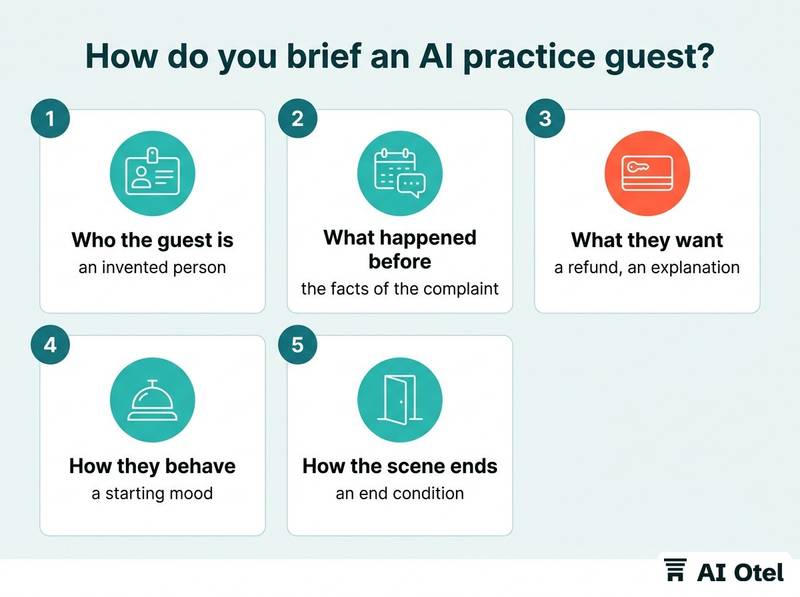
The five lines every brief needs
Who the guest is: an invented person with an invented reason for being in the hotel. One or two lines is enough; a biography makes the guest behave inconsistently.
What happened before: the facts of the complaint in invented numbers, such as a charge for two drinks when the guest says there was one. The trainee needs something concrete to establish.
What they want: a refund, an explanation, a room move, or an apology. A guest who wants nothing gives the trainee nothing to work with.
How they behave: a starting mood and an escalation ladder, for example calm, then sharp, then asking for a manager if the reply dodges the question. The ladder is what makes the scene move.
How the scene ends: what the guest does when the reply is good, and what they do when it is not. Without an end condition the scene drifts.
What to leave out of a brief
Never invent a hotel policy: the guest may misquote one, but the assistant must not assert a refund rule or a late check-out condition the hotel does not have. Never offer a real card number. Never break character. Never accept the first offer within two turns, and stop when the trainer says stop.
Name the language of the scene and cap it at five minutes, so the trainer can still hold the whole exchange in mind during the debrief. Keep every brief in one shared file with a name and a date. A brief that lives only in a chat window cannot be reviewed, corrected or reused next month.
ChecklistBefore running a scene, tick every line
- Guest and facts are fully invented
- The guest has one clear want
- A starting mood and an escalation ladder are written
- The prohibition list is in the brief
- Language is named and the five-minute cap is set
- A stop instruction is included
- The brief is saved to the shared training file with a date
How long should a scene run, and who does what?
Five minutes of scene, three minutes of debrief, and one trainer who does not intervene while it runs. Anything longer and the trainer stops being able to quote the exact line that mattered.
Setup takes about thirty seconds: the trainee reads a short situation card, not the full brief, so the guest's hidden limits stay hidden. The trainer sits slightly out of the trainee's eyeline and writes down exact lines rather than impressions. The debrief is only as good as the notes.
The assistant stays in role for the full five minutes. If the trainee goes quiet, the guest pushes; silence is part of the scene, not a failure of the tool. Three stop rules apply: the trainee asks to stop, the scene reaches its natural end, or the five minutes run out. A scene that drifts past five minutes stops teaching and starts performing.
The debrief runs in a fixed order: the trainee says what they would do differently, the trainer reads back two or three exact lines, then one line is replayed with the correction. Replay is where most of the learning happens. Running the same thirty seconds twice, with the trainee changing one sentence, is worth more than a second full scene.
| Role | Does during the scene | Does not do |
|---|---|---|
| Trainer | Writes exact lines, keeps time, runs the debrief | Intervene or coach mid-scene |
| Trainee | Answers as at the desk, may ask to stop | Read the full brief |
| AI practice guest | Holds the role, pushes on silence, escalates on the ladder | Grade, explain or invent policy |
How do you score the replies with a four-point card?
Score four checks from the transcript, zero to two each: did the trainee acknowledge the problem, establish the facts, state the boundary, and close with a next step and a time. The transcript, not the memory, is the record you score from.
Acknowledge: the guest's problem is named back before anything is defended. A reply that opens with policy scores zero here even if the policy is correct. Establish: the trainee gets the specific facts, such as which charge, which night, which room, and confirms what the record shows before deciding anything.
Boundary: the trainee says plainly what they can do, what they cannot do, and who can. Vagueness is the most common failure and the easiest to score. Close: a next step, an owner and a time, said out loud to the guest. A reply that ends on an apology with no action scores zero.
| Check | A passing reply does | A failing reply does |
|---|---|---|
| Acknowledge | Names the problem back before defending anything | Opens with policy |
| Establish | Confirms which charge, which night, which room | Decides on the guest's word alone |
| Boundary | Says what they can do, cannot do, and who can | Stays vague about authority |
| Close | Names who will call the guest back and when | Ends with an apology and no owner |
Score the reply, not the person. Two trainers scoring the same transcript with the same card should land within one point; if they do not, the card is unclear and needs rewriting. Keep the card identical across scenes and months. A card that changes with each scene produces numbers that cannot be compared with anything.
How do you keep real guest data out of a practice scene?
By inventing every fact in the brief and never pasting a real folio, message, recording or reservation export into the tool. The safest practice scene is one built entirely from categories and invented details.
Reduce a real complaint to its category before writing anything: a minibar dispute, a late room, a noise complaint, a transfer that did not arrive. The category is not personal data; the record behind it is. Invent the name, the room number, the dates and the amounts. A scene about a charge of two drinks works exactly as well with an invented figure as with the real one.
Use the hotel's business account for the tool, not a personal login, and agree in writing which settings the hotel accepts before the first scene runs. Decide where the transcript lives before you generate one: deleted after the debrief, or kept in the training file with the trainee identified by a role label rather than a name. For the account and settings questions, choosing an AI chat tool for hotel staff: a business account checklist covers the decisions in order.
If a trainer wants to work from a real case, that is personal data and the hotel's own written rule applies. Confirm the retention and the basis for it with your legal adviser before the first such scene, not after. The trainee's own replies are also a record: say in the training policy who may read them, how long they are kept, and that they are not used in performance decisions without the person present.
Watch outNever paste into a practice scene
Guest names and contact details; reservation numbers and folio screenshots; identity documents or KBS guest identity notification data; card numbers; recordings or transcripts of real calls; staff names attached to scored replies.
Where does an AI practice guest fall short?
In tone, culture and silence: it stays polite, it answers in turn, and it gives in too easily. Knowing these limits is what keeps the practice honest.
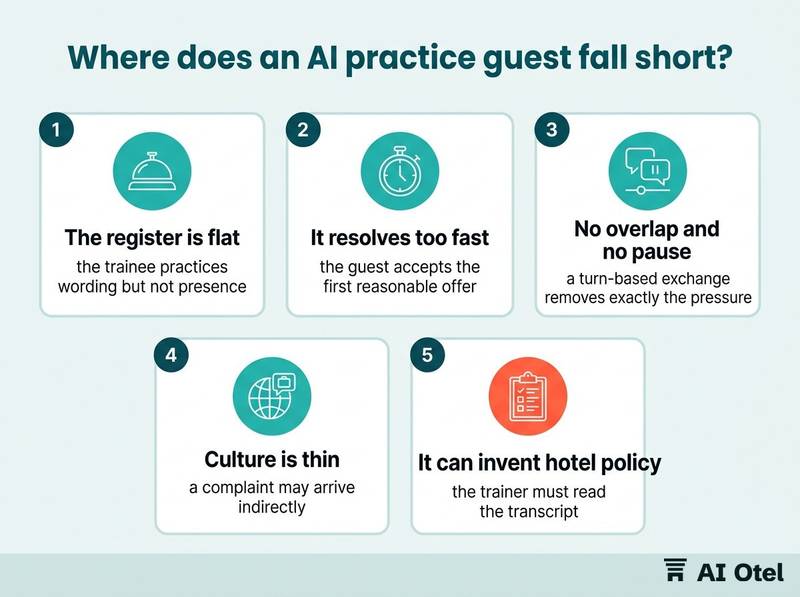
The register is flat. A real complaint at a desk carries volume, pace and a face; a written scene carries none of that, so the trainee practices wording but not presence. It resolves too fast: left alone, the guest accepts the first reasonable offer, which teaches the trainee that one sentence is enough. The brief has to forbid that explicitly.
There is no overlap and no pause. Two people at a desk interrupt, wait, sigh and repeat themselves; a turn-based exchange removes exactly the pressure a new trainee needs to learn to hold. Culture is thin, too. A complaint may arrive indirectly, through a tour representative, a review, or a colleague rather than the guest, and a scene written in a neutral register will not rehearse that path.
It can invent hotel policy. An assistant asked to be difficult may produce a refund rule or a late check-out condition the hotel does not have, so the trainer must read the transcript for invented facts before scoring it. For why assistants invent facts and how to catch them, see AI hallucination in hotels: why assistants invent facts and how to catch them.
The trainer supplies the friction the tool cannot: a second guest in the queue, a policy the guest misquotes, a demand the hotel genuinely cannot meet, and a colleague who gives the wrong answer first.
NoteThree frictions to add by hand
A queue forming behind the guest. A demand the hotel cannot meet and must refuse. A second staff member who contradicts the trainee in front of the guest.
How do you turn practice scenes into a monthly routine?
Pick three scenes a month from the complaint categories the hotel actually saw, run one twenty-minute session per person, and keep a one-line log of each. The routine, not any single scene, is what changes how the desk sounds.
Choose the scenes from categories, not from records: what came up at the desk last month, stripped of names and numbers, becomes next month's brief. One twenty-minute session per person per month is enough to hold a habit; new hires run weekly for their first month and then join the monthly round.
Keep the log short: date, scene name, the four scores, and one line of feedback written by the trainer. A long form stops being filled in by the third month. Rotate the trainer every quarter: one observer's scoring drifts, and a second observer exposes a card that was never clear.
Review the briefs quarterly against what the desk is actually seeing. A brief that rehearses a problem the hotel no longer has is a wasted twenty minutes. Feed the results back into written procedure: when three trainees fail the same check, the fault is usually in the procedure or the card, not in the three people. If your procedures themselves need refresh material, turning hotel SOPs into training material with AI: cards, quizzes and translations covers that step.
ChecklistThe monthly round
- Three scenes chosen from last month's complaint categories
- Briefs saved with dates
- One twenty-minute session booked per person
- Scores entered on the four-point card
- One line of feedback per person
- Log reviewed by the front office manager
- Briefs reviewed quarterly
What to do next
Write one brief this week, for the complaint your desk handled worst last month, and run it once with one trainee while you watch and score. The brief, the five-minute scene, the four-point card and the invented facts are the whole method; the tool only plays the guest, and the routine is what turns a single rehearsal into a front desk that handles the same complaint the same way whoever is standing there.
If you want to see where practice scenes could later plug into the systems themselves, read about a hotel operating system and the wider platform it belongs to.
Frequently asked questions
Can an AI assistant replace a front desk trainer?
No. It plays a role and answers back; it does not set the standard, observe the trainee or decide readiness. The trainer writes the brief, watches the scene, scores the transcript and runs the debrief, and the trainee's readiness for a live desk stays a person's judgment.
Is it safe to put hotel training scenarios into an AI chat tool?
It is safe when the scenario contains nothing real: invented names, invented room numbers, invented amounts, no screenshots and no exports. Use the hotel's business account with settings the hotel has agreed, decide where the transcript is kept, and keep trainee replies under the same written rule.
What is a four-point scoring card for front desk practice?
Four checks scored zero to two each: acknowledge the problem, establish the facts, state the boundary, close with a next step and a time. It is scored from the transcript, by the trainer, with the same card across scenes and months so the scores can be compared.
How many practice scenes should a front desk team run?
One twenty-minute session per person per month holds the habit, with weekly sessions for new hires in their first month. Three scenes a month, chosen from the complaint categories the desk actually saw, is enough variety without turning training into a schedule nobody keeps.
Does a practice scene count as processing personal data?
If every fact in the brief is invented, there is no personal data in the scene. If a trainer works from a real complaint, the record behind it is personal data and the hotel's own written rule on retention and basis applies, which is a question for the hotel and its legal adviser.