Beach and pool safety terms for hotel staff: flags, lifeguard post, depth marks and more
A glossary of beach and pool safety terms for hotel staff, covering flags, rescue equipment and incident logs. Learn how to standardize words in Turkish and English.
AI draft · awaiting editorial review
Contents
Key takeaways
- A flag, a depth mark and a roped line are the hotel's own written rule made visible; if the rule is not written down, the sign means whatever the nearest guest thinks it means.
- One term, one meaning: the Turkish word and the English word sit side by side on the same sheet, and staff use the same word in the log as on the sign.
- Every piece of rescue equipment has a named home at the post and a check at the start of every shift.
- A near miss goes in the incident log with the same care as an injury, because it is the cheapest warning a hotel gets.
- Signs support people; they never replace the person at the post.
Beach and pool safety terms are the fixed words a hotel uses for its flags, lifeguard post, depth marks, roped swimming areas, warning signs and incident records, each with one meaning in Turkish and English. New staff learn them on day one so a shouted word, a sign or a log entry means the same thing to everyone on shift.
It is the first morning of the season. The wind picks up, the flag goes to red, and within ten minutes three guests ask three different questions: can I swim, can my child swim, and who decided this. The answer only works if every staff member on that beach is holding the same words. This glossary gives you those words, in Turkish and English, together with the staff action behind each one, so a new hire can be walked through the pool and the beach and be useful on the first shift.
What do the beach flag colors mean, and what does staff do about each?
Flags are the hotel's own way of showing one decision, whether the water is open, limited or closed, and each color carries a fixed instruction for staff, not only a warning for guests. Treat the color scheme as common practice, not a universal standard: hotels and beach operators vary, so the hotel writes its own scheme on one page and posts it at the post and at the beach entrance. For a fuller routine around rough conditions, see a beach routine for rough sea, red flags and jellyfish.
Name one role per shift who may change a flag, usually the lifeguard lead or the duty manager, and record the time of every change in the post log. Announce every change to the front desk and to the pool bar, so a guest who phones from the room gets the same answer as a guest standing on the sand. Coach staff to explain the rule and offer an alternative, the pool, a shaded area, a later slot, instead of arguing about the sea with a guest.
Common flag colors and the staff action behind each
| Flag (as commonly used) | What guests usually read it as | What staff does |
|---|---|---|
| Green (water open, normal conditions) | Safe to swim | Normal scanning, zone unchanged |
| Yellow (caution: wind, chop, current) | Swim with care | Shrink the roped area, whistle earlier, warn at the waterline |
| Red (water closed) | Do not enter | No swimming, walk the waterline, offer alternatives, log the time |
| Two red flags or red over red (closed, area cleared) | Stay out and stay back | Clear the sand near the water, inform the duty manager |
| Black and white checkered (craft zone) | Boards only | Keep swimmers out of the marked lane |
| Purple (marine life hazard) | Something in the water | Close the zone, brief the post, log it |
The scheme is common practice; the hotel's own written rule decides.
Who may change a flag
One named role per shift decides, and the decision is written down with its time. Check the pole, the flag cloth and its fixings at the start of every shift; a faded flag reads as a different color in strong sun.
What is a lifeguard post, and which rescue equipment words should a new hire know?
The lifeguard post is the fixed station a lifeguard works from, with a clear view of the zone, the rescue equipment in known places and the log open; the tower or chair is only the raised part of it. Separate the words: the post is the station and the responsibility, the tower or chair is the furniture, and the zone is the water that post is answerable for.
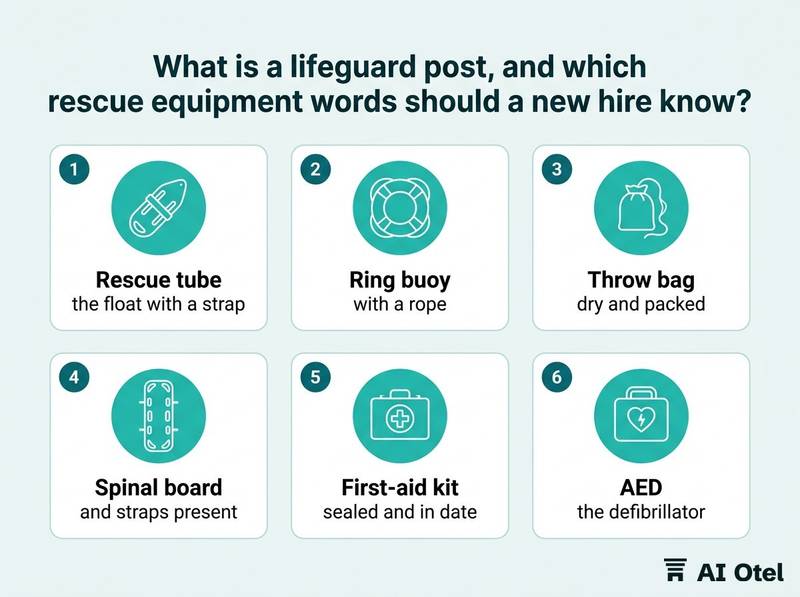
Teach the equipment by name and by home: rescue tube (the float with a strap, Turkish: kurtarma tüpü), rescue board, ring buoy with a rope (Turkish: cankurtaran simidi), throw bag, fins, whistle, spinal board, first-aid kit, and AED, the defibrillator. Keep the post log at the post: who is on, when, visibility, wind, flag state, and anything that happened.
Whistle signals and post rotation
Agree the whistle signals locally and write them down: one blast for attention, two for a colleague's help, three for a full call-out. Set a scanning routine rather than a gaze: sweep the zone in a fixed pattern, count heads at fixed intervals, and rotate posts on a written schedule so attention does not flatten.
ChecklistStart-of-shift post check, ticked and signed
- Post clean, shaded, with a clear view of the whole zone
- Rescue tube in its holder, strap sound
- Rescue board and paddles present
- Ring buoy and rope coiled and free
- Throw bag dry and packed
- Fins, mask and whistle with the on-duty lifeguard
- Spinal board and straps present
- First-aid kit sealed and in date
- AED indicator green, pads in date
- Post log open, previous shift signed off
- Radio or phone charged, on the agreed channel
- Flag raised and matching the written decision
- Access route to the water clear of sunbeds and umbrellas
The check happens before the first swimmer, so a missing tube is found at 08:40 and not during the first rescue.
How do you read depth marks and roped areas in a pool or on a beach?
A depth mark states the water depth in meters at that exact point, and a roped area marks the boundary of the zone the hotel allows, so staff read both as instructions rather than decoration. Place depth marks where the guest decides: at the pool edge above the waterline and on the wall below it, at the shallow end, mid-pool, the deep end, and at any sudden change of depth. Give that sudden change its own word, the drop-off, and mark it before the guest reaches it, not beside it.
Let the hotel set its own deep-water threshold in writing, for example the depth above which a weak swimmer is asked to stay in the shallow zone, and apply that threshold on every shift instead of each guard's judgment. A roped line or buoy line marks a zone; it does not stop a current, a swell or a boat, so staff still watch beyond it. Before the season opens, work through the four weeks of pool checks before the first swimmer.
Beach words: swimming zone, no-swim zone, boat lane
Name the beach zones the same way every day: the swimming zone between two markers, the no-swim zone near rocks or a harbor mouth, and the boat lane kept clear. Learn the words guests use when they report a problem, ladder, gutter, drain, tile edge, so a report reaches maintenance with the right term the first time.
TipWalk the pool with a tape measure
Walk the pool and the beach once with a new hire and a tape measure or a depth stick, and have them read every depth mark aloud in both languages. A mark that is wrong by twenty centimeters is a complaint waiting to happen, and the walk finds it in ten minutes.
Which signs should a pool or beach carry, and in which languages?
A pool or beach carries signs for the rules a guest must know before entering, written as a pictogram first and words second, in the languages the hotel actually receives guests in. Choose the languages from the hotel's own arrival mix, not from a guess, and review the list each season. Keep one wording per rule across every language, and have each version checked by a native speaker who also knows the pool, so the Turkish and the English say the same thing.
Place the sign at the decision point: the depth and the rule at the pool edge before the steps, the flag scheme at the beach entrance and at the post. Version the sign set with a date in the corner, so staff can tell at a glance whether the sign on the wall is the current one. Keep the sign list short: a wall of twelve notices is read as none of them. More on wording and placement in pool rules and the signs guests read and signs in several languages: pools, emergency exits and house rules.
ChecklistSign set to confirm before the season
- Lifeguard hours, or no lifeguard on duty where that is the case
- Children must be accompanied by an adult
- No diving in shallow water
- Depth marks at shallow end, mid-pool and deep end
- No glass at the poolside
- Shower before entering
- Pool closed hours
- Flag scheme at the beach entrance
- Swimming zone and no-swim zone at the beach
- Emergency assembly point and the route to it
- Emergency number and the nearest telephone
- Access route kept clear for an ambulance
First aid and call-out words: what does each one commit you to?
Each first-aid and call-out word names a specific action and a specific person, so staff should learn the word together with what it obliges them to do and whom it brings. Separate assist from rescue: an assist is a hand to a tired swimmer in shallow water, a rescue is an entry into the water with equipment, and the log records which one happened.
Agree one call-out phrase that brings help from the whole team, and make sure every new hire has heard it out loud before the first shift. Name the emergency access route and keep it clear of sunbeds, umbrellas and parked service carts, because the route is used at the worst possible moment. Know where the AED is and who on shift is trained to use it; the word is useless if the location is a guess.
Words for the handover: call-out, assembly point, access route
Use the handover words with the ambulance crew: what happened, at what time, what was done, and what the guest said afterward. Treat spinal precaution as a word that stops movement: staff keep the guest still and call the trained person rather than improvising a lift.
Watch outWords, not treatment
The glossary gives staff the words, not the treatment. Every first-aid action follows the hotel's own first-aid training and the protocol the trainer taught; a staff member who has not been trained says the words, calls the trained person and stays with the guest.
What goes into the incident log, and which words does it use?
The incident log records what happened, when, where, who saw it and what was done, in plain factual sentences, and it uses the same vocabulary as the post and the signs. Record a near miss as carefully as an injury: a guest who slipped at the pool edge and caught the rail is the warning that arrives before the accident.
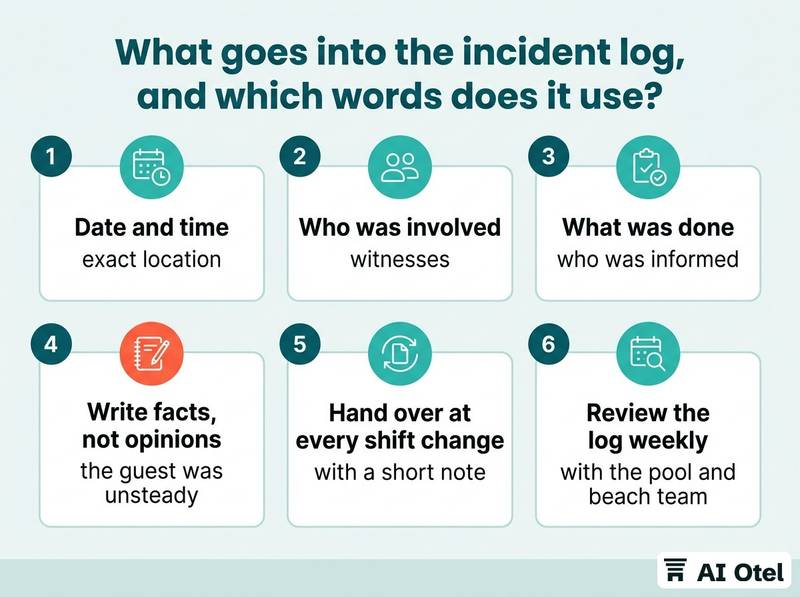
Fix the fields once and use them every time: date and time, exact location (pool, shallow end, beach zone, flag state at the time), who was involved, witnesses, what was done, who was informed. Write facts, not opinions: the guest was unsteady on the wet tiles, not the guest was careless. Hand over at every shift change with a short note, so a complaint that starts at 09:00 does not meet a blank page at 17:00.
Name who may read the log and how long it is kept, and keep that rule in writing; guest personal data in the log follows the hotel's own data rules. Review the log weekly with the pool and beach team, and turn every near miss into one concrete change: a mat, a sign, a moved sunbed.
NoteWhat the log is
The log is a hotel record written by staff for the hotel's own use, and it does not replace any record the hotel is separately required to keep. It is not a place for blame. Write it as if the guest, a colleague and a manager will all read it, because they will.
Put the glossary on one sheet before the season starts
Put every word in this glossary on one two-column sheet, Turkish on the left and English on the right, with the staff action beside it. Post it at the lifeguard post and at the pool edge, hand it to every new hire on day one, then walk the pool and the beach together and read the marks, the flags and the signs out loud. The words only protect a guest once every person on shift is holding the same ones. If you want the same discipline in the systems behind the pool, a hotel operating system, built and working, ahead of launch, keeps reservations, front desk, housekeeping, billing, restaurant sales, reports and compliance in one place; read more about the platform before the season starts.
Frequently asked questions
Is a red flag a legal ban on swimming?
The flag is the hotel's own warning made visible, and it carries the hotel's written rule. What happens on that beach on that day follows the hotel's rule and any instruction the local authority gives the hotel. Staff follow the rule and call the duty manager rather than debating it with a guest.
Who decides when the flag changes?
One named role per shift, usually the lifeguard lead or the duty manager, decides and records the time. The change is announced to the front desk and the pool bar so every answer a guest gets matches the flag.
What is the difference between a near miss and an incident?
A near miss is an event that could have hurt someone and did not, such as a slip caught by a rail. An incident is one that did. Both go in the log with the same fields, because the near miss is the cheaper warning.
Do pool and beach signs need to be in every guest language?
No. The hotel chooses the languages from its own arrival mix, reviews the list each season, and leads with a pictogram so a guest who reads none of the languages still reads the rule. Keep one wording per rule, checked by a native speaker.
How deep is deep water?
The hotel sets its own threshold in writing and applies it the same way on every shift; the depth marks state the depth in meters at each point. Staff use the hotel's threshold rather than a personal judgment, so a weak swimmer gets the same answer from every guard.