Rough sea, red flags and jellyfish: a beach routine for hotel staff
This guide sets out a complete hotel beach routine: who checks the sea, how flag levels are defined and changed, the exact sentence staff use, and how to log incidents. It ensures the lifeguard and front desk never contradict each other.
AI draft · awaiting editorial review
Contents
Key takeaways
- One named person checks the sea at fixed times and writes down what they saw, so the flag is a decision with a record behind it.
- Guests read color faster than text: the flag board must define each level in the hotel's main languages, and only the duty lifeguard changes it.
- The beach and the desk use the same sentence, written once and translated, or guests will keep asking until they get the answer they prefer.
- A jellyfish report is a beach condition, not a single animal: confirm it from the post, mark the area, change the level, tell the desk, and keep hands off.
- Every incident ends with a note of times, roles and actions, plus a three-line handover the next shift reads before the first guest reaches the sand.
A beach routine fixes four things: who reads the sea and when, which flag level is up and who may change it, the exact sentence the desk says in the hotel's main languages, and the written note after every incident. Guests then get the same answer from the lifeguard and the front desk.
At 11:00 the wind picks up and the lifeguard raises the red flag. A family walks past it into the water, because the desk told them at breakfast that the sea was calm. One beach, two answers. This article sets out a complete hotel beach safety flags and jellyfish routine: the sea check, the flag ladder, the sentence the desk says, the jellyfish response, the call chain and the handover. Each piece is short enough to run on a busy morning, and together they make sure the lifeguard, the beach bar and reception stop contradicting each other.
Who checks the sea at a hotel beach, and how often?
One named person, on a fixed timetable, with a written line for every check. The check is a reading of conditions, not an opinion about the weather.
Name the post in writing: the duty lifeguard checks the sea. When no lifeguard is on shift, the beach manager or the duty manager does it, and the log records which of them it was. Fix the times: at opening before the first guest, at the two busiest points of the day, and at closing. Add an extra check whenever the wind changes direction or strength, because that is what turns a sheltered bay rough within minutes.
Read the same items every time: wind, wave height against a fixed marker such as a rock, buoy or post, the current at the break, water clarity, floating debris, jellyfish at the waterline, and how many people are in the water. Then write it down: time, name, the readings, the flag level chosen and any action taken. A log with no readings is a diary, not a check.
Keep the check short enough to survive a busy morning. A two-minute check that happens four times a day beats a thorough one that gets skipped. Accept the trade-off: more checks cost staff time at the peak hour; fewer checks mean the flag lags behind the sea, and the desk ends up explaining a decision nobody recorded. The same discipline applies to heat on the beach and around the pools, which has its own plan in a heat wave routine for rooms, pools and outdoor staff.
ChecklistThe sea check, item by item
- Wind direction and strength
- Wave height at the fixed marker
- Current at the break
- Water clarity
- Floating debris
- Jellyfish at the waterline
- Number of people in the water
- Flag level chosen
- Time, name and signature of the person who checked
What do the beach flag colors mean, and who is allowed to change them?
The hotel writes its own short ladder of levels, prints what each one means in the languages its guests speak, and gives one person the authority to move it. A flag nobody can explain in one sentence is a flag guests will ignore.
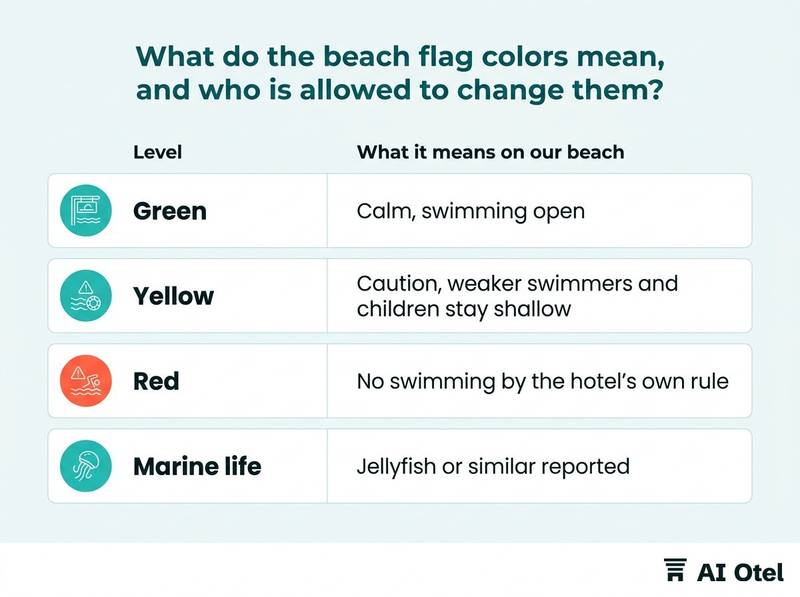
Choose three or four levels and keep the wording identical on the beach board, in the guest app and in the desk script. Consistency matters more than the number of levels. A workable ladder is green for calm, yellow for caution, red for no swimming, and a separate level, often purple, for dangerous marine life such as jellyfish. The hotel decides and writes it down. If the hotel uses that separate level, it needs its own sentence on the board, or guests read it as decoration.
Decide what red means on this beach, a ban or a strong warning, and write it down. Staff will be asked at the towel desk, in the lift and by phone, and they must not improvise. Give the authority to the duty lifeguard, with the beach manager as the only person who may overrule. Nobody else touches the flag, including a manager who thinks the sea looks fine from the terrace.
Announce every change: a short word at the beach, a line to the desk and to guest relations, so the two do not diverge within the hour. Log each change with the time, the new level and the reason, so the day's flags can be reconstructed later. For the vocabulary staff share with guests and each other, see beach and pool safety terms: flags, the lifeguard post and depth marks.
| Level | What it means on our beach | What the lifeguard does | What the desk says |
|---|---|---|---|
| Green | Calm, swimming open | Watch the water | Nothing beyond the normal greeting |
| Yellow | Caution, weaker swimmers and children stay shallow | Patrol the waterline | Mention the caution when asked |
| Red | No swimming by the hotel's own rule | Keep the post manned, stop entries politely | The standard sentence, offer the pool |
| Marine life | Jellyfish or similar reported | Mark the section, keep hands off | The marine-life sentence, name the open area |
How does the desk tell guests the sea is rough without an argument?
With one sentence, written once, translated into the hotel's main languages and used by everyone who speaks to a guest. Improvised warnings invite negotiation.
Build the sentence in three parts: what is true now, what we ask of the guest, and what we offer instead. Use the same words on the beach board, at the desk, in the guest app and on the phone. A guest who gets two versions will keep asking until they reach the one they prefer. Train the stop: staff say the sentence and stop. They do not add a personal view such as "it looks fine to me", because that becomes the hotel's position the moment a guest repeats it.
Write the hotel's own policy for the guest who insists on entering the water, and apply it the same way every shift. The policy is the hotel's decision, not the lifeguard's mood. Reach the guests already on the sand with a walk along the beach and the announcement, not a shout from the tower that half of them will not hear. Keep the sentence short enough to say in one breath and to translate without losing the request. The same discipline of one written text applies to notices for closed pools, water cuts and other bad news.
TipThe three-part sentence
What is true now, what we ask, what we offer instead. For example: "The red flag is up until the lifeguard says otherwise. We ask you not to swim today. The pool is open and beach service continues." The same text goes on the board, in the app and into the phone answer on the same day.
What should staff do when a guest reports jellyfish?
Treat it as a beach condition: confirm it from the post, mark the area, change the level, tell the desk, and keep everyone's hands off the animal.
Confirm without wading in. Look from the tower or the shore, and note how many, roughly what size, and where along the beach they are. Mark and separate one section of water and the sand in front of it, with cones, tape or a staff member standing there. One marked section is far easier to explain to guests than a whole beach closed. Change the level and say the sentence within minutes, so the desk, guest relations and the beach give the same answer.
Hands off: staff do not pick up jellyfish, alive or stranded, with bare hands, and do not lift one with a towel and then handle the towel. Use gloves and a tool, or leave it in place and mark it. First aid stops at calling. Staff call the hotel's medical contact and, when needed, the emergency line. They do not give treatment advice of their own, do not offer home remedies, and do not tell a guest what a sting "usually" does. A single sting is an incident with a record, not a beach-wide announcement, unless the level itself changes.
ChecklistThe jellyfish report
- Time
- Position along the beach
- Count and rough size
- Who confirmed it
- Area marked
- Level changed and announced
- Desk and guest relations told
- Medical contact called if anyone was stung
- Reopening time and the name of the person who reopened
Who calls whom when something happens in the water?
A written chain with one number per step, printed at the post, at the desk and in the beach office, and tested before the season starts.
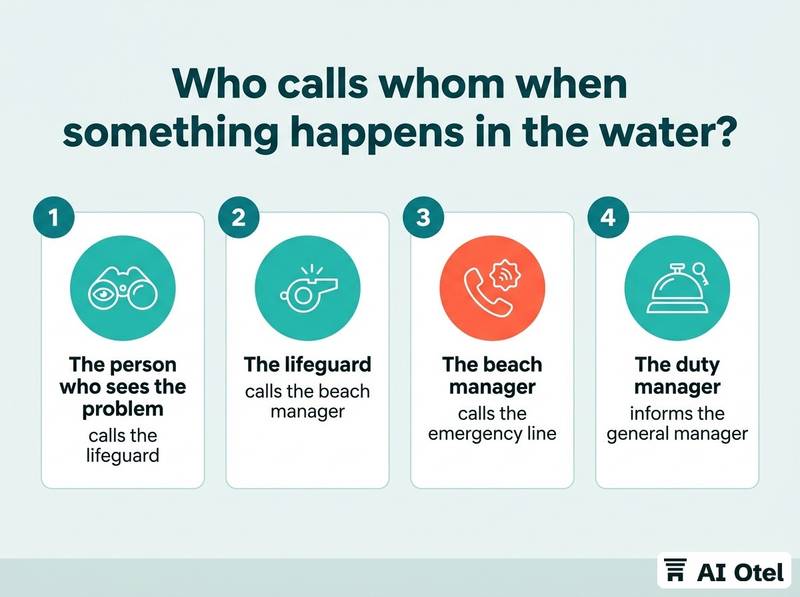
Set the order: the person who sees the problem calls the lifeguard; the lifeguard calls the beach manager and the hotel's medical contact; the beach manager calls the emergency line when the medical contact says so or cannot be reached; the duty manager informs the general manager. Print one number per step. A seasonal worker's phone is not a call chain, and a number saved only in someone's contacts disappears with the contract.
The beach manager writes the incident note within the hour, and keeps it to facts. No diagnosis, no blame, no guess about what the guest did or did not do before entering the water. Follow up with the guest the same day, by the person who took the report, and add a line to the note about what was said. Review the chain after every use: which step was slow, which number was wrong, which person did not know they were in the chain. When the incident is an illness rather than a rescue, the wider routine is in the response to a guest falling ill, from the first call to the follow-up.
NoteWhat the incident note holds, and what it does not
It holds time, place, people by role, what was seen, calls made with times, actions taken and follow-up. It does not hold diagnosis, guesses, blame, or a guest's medical detail, which belongs in the medical record and is shared only with those who need it.
How does the beach close for the day and hand over to the next shift?
With a closing check, a signed log and a three-line handover the next shift reads before the first guest reaches the sand.
Announce the last swim time the same way every day, and take the flag down or replace it with the night board at a fixed hour. Run the closing check: tower, rescue equipment, radio batteries, first aid kit seal, cones and tape collected, the marked section cleared, the log closed and signed. Write the handover in three lines: what happened today, what is still open such as a report or a guest follow-up, and what to watch tomorrow such as wind or a jellyfish report from further along the coast.
Re-check the sea in the morning before the first guest arrives. Yesterday's flag says nothing about today's water. Use the same routine on changeover days, when seasonal staff rotate and the log is the only memory the beach has. Keep the season's log and read it before the next one. Patterns show up in the record, not in memory.
ChecklistClosing and handover
- Last swim announced
- Flag down or night board in place
- Rescue equipment and radios checked
- Marked area cleared
- Log signed
- Three-line handover written
- Morning check scheduled with a named person
What to do next
Write the four pieces on one page today: the check times, the flag ladder, the sentence in each of the hotel's main languages, and the fields of the incident note. Post it at the lifeguard post and at the desk, run it for a week, and only then change anything, because the log from that week will tell you which part of the routine the beach actually uses. A hotel operating system that keeps reservations, front desk, housekeeping, billing and reports in one place, built and working ahead of launch, gives every shift the same written record, and the wider platform is built so that reservations, front desk and housekeeping sit in one place. If you are a traveler rather than hotel staff, you can find a hotel in Türkiye (opens in a new tab) with the beach setup you expect.
Frequently asked questions
What does a red flag mean at a hotel beach?
It means the hotel has decided the water is not safe for swimming today. The hotel's own written rule should say whether red is a ban or a strong warning, and every member of staff gives that same answer. The duty lifeguard changes the flag, and the change is logged with a time and a reason.
How often should the sea be checked?
At opening, at the two busiest points of the day and at closing, plus an extra check whenever the wind changes direction or strength. Each check is written with the time, the name and the readings, so the flag has a record behind it.
What should staff do if a guest is stung by a jellyfish?
Call the hotel's medical contact and, when needed, the emergency line, and stay with the guest until someone takes over. Staff do not give treatment advice or home remedies of their own. The beach manager writes the incident note, and the guest is followed up the same day.
Should jellyfish warnings go into the guest app as well as on the beach?
Yes, with exactly the same sentence used at the desk and on the board, updated when the level changes. A warning in the app that contradicts the beach teaches guests to ignore both.
What belongs in a beach incident note?
Time, place, the people involved by role, what was seen, which calls were made and when, what was done and who followed up. It does not hold a diagnosis, a guess about the guest's behavior or any blame, and medical detail stays in the medical record.