Kitchen storage terms for hotel teams: FIFO, FEFO, cross-contamination, par and more
Understand FIFO, FEFO, par stock, and cross-contamination in hotel kitchens. Learn how to label stock, rotate inventory, and manage counts to reduce waste and ensure safety.
AI draft · awaiting editorial review

Contents
Key takeaways
- FIFO sorts stock by when it arrived; FEFO sorts it by when it expires, and FEFO wins whenever a date is printed on the pack.
- A storage label earns its place only if it carries a product, a date and a person, because a date without a name cannot be traced back.
- Cross-contamination is the transfer of harmful bacteria, allergens or chemicals from one food, surface or hand to another, and much of it happens in storage rather than on the stove.
- Par is the quantity a storeroom should hold to cover normal use between deliveries; the reorder point is the level that triggers the next order, and the two are not the same number.
- A variance is the gap between what the storeroom records say and what the count finds, and every variance has a cause worth naming.
FIFO means first in, first out: the stock that arrived first leaves first. FEFO means first expired, first out: the pack with the earliest use-by date leaves first, whatever its arrival order. A hotel kitchen needs both, plus a label that carries a date, because rotation without a date is guesswork.
A delivery arrives at 07:40 and the storeroom is already full. Someone puts the new boxes in front because that is where the space is, and the older ones sit behind them until a cook finds them a week later. Nobody did anything wrong, and the loss is real. This page gives the FEFO FIFO kitchen storage terms in plain words, so your team can name what went wrong and fix it with a label, a shelf order or a number.
What do FIFO and FEFO mean in a hotel kitchen?
FIFO (first in, first out) means the stock that arrived first is used first. FEFO (first expired, first out) means the pack with the earliest use-by date is used first, whatever order it arrived in. Both are rotation rules, and both need a date to sort by.
FIFO is based on the receipt date. It fits goods whose life the hotel sets itself, such as dry stores decanted into a house container. FEFO is based on the date printed on the pack. It is the safer default for anything carrying a use-by date, because a late delivery can arrive with an earlier date than stock already on the shelf.
Where the two rules disagree
The two rules only disagree when dates and arrival order point in different directions. When they do, FEFO wins and the older-dated delivery goes to the front. For example, a yoghurt delivered on Tuesday with a Thursday date goes in front of the same yoghurt delivered on Monday with a Friday date.
Why the new delivery goes behind
Rotation is physical before it is administrative. The new delivery goes behind the old one on the shelf, so a hand reaching in meets the old one first. A shelf that is rotated by position rather than by date is not rotating at all, because position fails the moment someone shelves in front.
| Term | What it sorts by | Where it fits | How it fails |
|---|---|---|---|
| FIFO | Receipt date | Undated dry stores, in-house decants | A delivery is shelved in front |
| FEFO | Printed use-by date | Chilled, frozen, any dated pack | The printed date is not read at the door |
| Both on one shelf | Date first, then receipt | Most storerooms | Staff apply one rule to the whole room |
The check takes ten seconds: pick the front item on a shelf at random and ask a cook why that one is at the front. For the wider picture of shelf layout and receipts, see running a hotel storeroom.
What should a storage label carry?
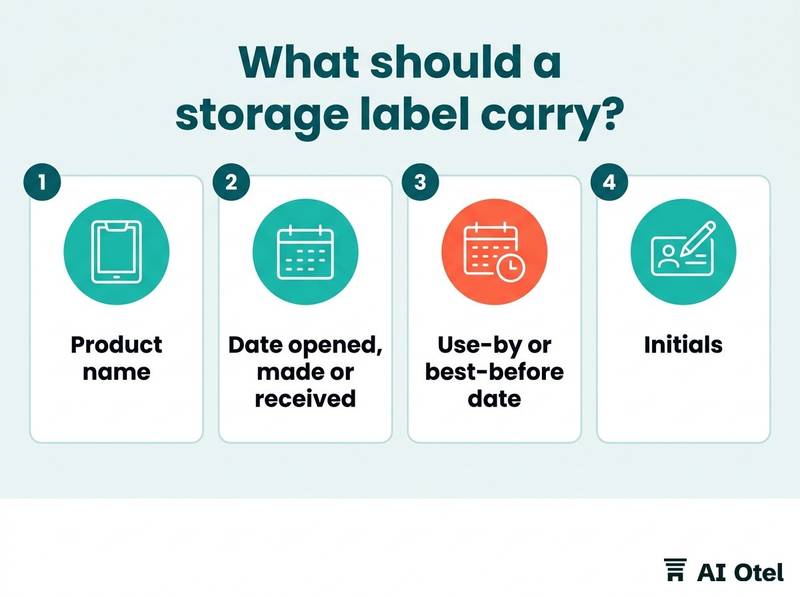
A storage label carries four things: what the item is, when it was opened, made or received, when it must be used by, and who wrote the label. Words worth knowing around it: production date, opening date, use-by date, best-before date, day dot, batch or lot code, allergen note, initials.
Use-by against best-before
Use-by and best-before are not the same word. Use-by is about safety and best-before is about quality, and the hotel's own written rule decides what happens when each date passes. The second date matters most: the supplier's date describes the sealed pack; the kitchen's date describes the pack after it was opened or decanted, and that is the date the line cook needs.
Labeling a decanted container
Decanting into a smaller container means copying the original date and batch code onto the new label. Without the copy, the trace back to the delivery is lost. A day dot suits a single service day; a printed label with a date and initials suits anything that crosses days, which is most of a hotel storeroom. For example, a tub labeled "sauce, opened 12.05, use by 15.05, A.K." can be traced to a person and a day. A tub labeled "sauce" cannot.
Checklist
- Product name as written on the storeroom sheet
- Date opened, made or received
- Use-by or best-before date
- Batch or lot code where the pack carries one
- Allergen note where the recipe or the pack changed
- Initials of the person who labeled it
- Original date and batch copied across when decanting
- Old label removed and replaced when refilled, never written over
What is cross-contamination in a storeroom?
Cross-contamination is the transfer of harmful bacteria, allergens or chemicals from one food, surface or hand to another. Storage is where much of it happens, because raw and ready-to-eat food share the same shelves and the same air.
Direct and indirect routes
Direct contamination is raw food or its liquid reaching cooked or ready-to-eat food. Indirect is a knife, a board, a cloth, a container or a hand carrying it across. The vehicle is whatever carries contamination from one place to another, and naming the vehicle is what makes a corrective action specific instead of general.
The storage rules that follow: raw below ready-to-eat and never above, everything covered, categories on separate shelves, nothing on the floor. Chemical contamination belongs on the same list: cleaning chemicals kept in the food room, or decanted into a drinks bottle, are a cross-contamination route with a serious outcome.
Allergen cross-contact
Allergen cross-contact runs on the same mechanism with a different consequence. A trace amount matters, so a shared scoop, a shared tub or a wiped-down board is enough to matter. Color coding is a storage and prep control, not decoration: the board color and the container color must match the food category, or the code teaches staff nothing. The set-up is covered in color-coded cutting boards and knife storage.
Watch outRaw above ready-to-eat
Raw food stored above ready-to-eat food is a serious storage fault in a hotel kitchen. A drip travels downward with gravity, so shelf order is a control, not a preference, and it is the first thing to fix after any delivery.
The check is a walk-through: open the cold room and look at what sits above what, then look at what is uncovered.
What is par stock, and how is it different from a reorder point?
Par is the quantity the storeroom should hold to cover normal use between deliveries. The reorder point is the level that triggers the next order, and it sits above zero by the lead time.
Par is set from usage, delivery frequency and available space, not from the supplier's case size alone. A case size that does not divide into the par is a decision, not an accident. The reorder point is the expected use during the lead time plus a safety margin; lead time is the gap between placing an order and having the goods on the shelf, and it includes the receiving step. For example, if a kitchen uses two cases a week and the supplier delivers in three days, a par of two cases runs out before the next delivery arrives.
Setting a par from usage
Par belongs to an item and a season. A menu change, a new supplier or a shift in occupancy pattern changes it, and a par set once and never reviewed drifts into stock-outs on one line and dead stock on another. Those are the two failure ends of the same wrong number, which is why they are reviewed together.
Why shelf life caps the number
Shelf life caps par. Holding more than the kitchen can use before the date is a loss dressed up as a buffer. The maximum is the space and cash limit; the minimum is the level that should never be crossed; par usually sits between them.
| Term | Plain meaning | What sets it |
|---|---|---|
| Par | What the store should hold between deliveries | Usage, delivery frequency, space |
| Minimum | The level never to be crossed | The risk the hotel will not accept |
| Maximum | The most the room or cash will carry | Space, shelf life, budget |
| Reorder point | The level that triggers the order | Lead time plus safety margin |
| Lead time | Order to shelf, including receiving | Supplier and transport |
| Safety stock | Cushion for a late or short delivery | How unreliable supply has proved |
| Stock-out | Zero when the kitchen still needs it | A par or lead time set too low |
| Dead stock | Stock nobody is using | A menu change or an over-set par |
More of the buying vocabulary sits in purchasing terms for hotel teams.
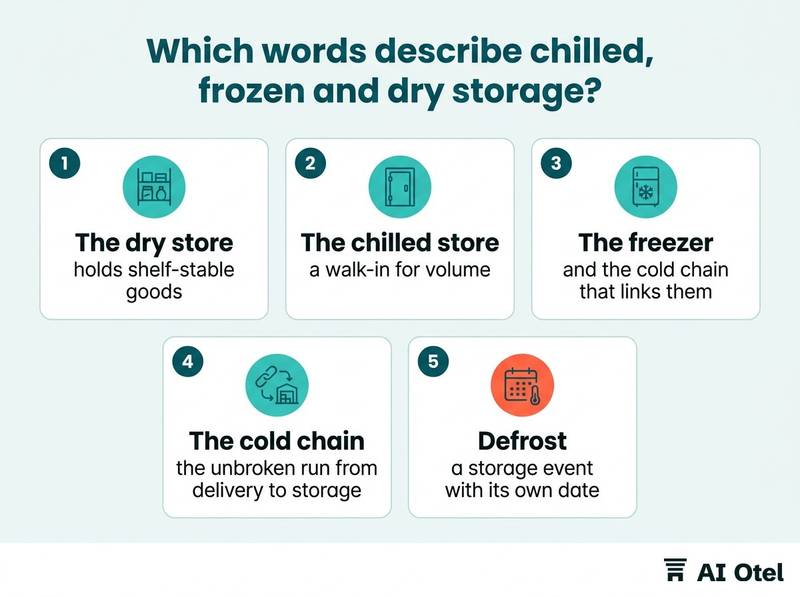
Which words describe chilled, frozen and dry storage?
Storage words describe where an item lives and how long it may stay there: the dry or ambient store, the chilled store, the freezer, and the cold chain that links them to the kitchen. The dry store holds shelf-stable goods, kept closed, dark and off the floor; its enemies are moisture and pests rather than heat alone. Chilled store and cold room are the same idea at different sizes: a walk-in for volume, a reach-in for service, and both need the same discipline about covers and shelf order.
The cold chain and the loading bay
The cold chain is the unbroken run from delivery to storage to service. A break is any moment an item sits outside its storage condition, and the loading bay is where most breaks happen. Freezer and deep-freeze differ in what the hotel's own plan allows and for how long, not in the word printed on the door.
Defrost as a storage step
Defrost is a storage event with its own date and its own rule. The hotel writes that rule, and the label carries the date it started. A blast chiller brings food down quickly before it goes into storage; the term belongs to the process, not to the room it stands in.
NoteTemperatures belong to your plan
This page names the terms and the actions each one implies. The temperature and time limits themselves belong to your hotel's food safety plan, and the value of the log is that it shows the team worked to that plan rather than to memory. For the rounds themselves, see fridge and cold-room temperature logs.
What do count and variance words mean on a storeroom sheet?
A count compares what the records say with what is physically on the shelf. The variance is the difference between the two, and naming its cause is the whole point of the exercise. Book stock is what the system says should be there after receipts and issues; physical count is what a person finds on the shelf at a stated moment.
Issue, transfer and wastage
An issue is stock leaving the storeroom for a department. A transfer is stock moving between departments or outlets, and it needs a signature at both ends or it becomes a variance later. Wastage, spoilage and breakage are separate words because they have separate causes and separate fixes; collapsing them into one line hides the pattern. Yield is what the kitchen gets out of a raw item after trim and cooking, and a change in yield explains a variance that otherwise looks like something worse.
Why blind counts work
A blind count means the counter records the shelf before seeing the book figure, which stops the count from being fitted to the expected answer. Count frequency follows value and risk: high-value and fast-moving lines often, slow and low-value lines less often, and every line on the same day of the week each time. For example, a variance of one case on a fast-moving line is worth a question about receiving; the same variance on a line counted once a quarter is worth a procedure.
TipCount the same way every time
Same unit, same shelf order, same time of day, and write the count down before looking at the book figure. A count that changes method between months cannot be compared with itself.
What to do next
Pick one shelf today and apply the whole glossary to it: write the date rule on a label, put the new delivery behind the old one, check what sits above what, and note the par and the count against it. The terms are not separate subjects. Rotation depends on labels, labels make counts meaningful, counts correct the par, and par decides what the shelf holds in the first place. If your records live in spreadsheets and the counts take an afternoon, a hotel operating system built and working, ahead of launch, can hold reservations, front desk, billing and reports in one place; the wider set of tools is described on the platform overview.
Frequently asked questions
Is FEFO stricter than FIFO?
FEFO sorts by the printed date and FIFO by arrival, so when dates and arrival order agree they give the same answer. When they disagree, FEFO wins for anything with a use-by date, because the pack with the earlier date has to leave first. FIFO still earns its place on undated goods such as dry stores decanted in-house, and most storerooms run both rules on the same shelf.
What is the difference between use-by and best-before?
Use-by is a safety date and best-before is a quality date, and the supplier prints both. The hotel's own written rule decides what happens when each date passes, and that rule should be the same across outlets. The kitchen's opening date is a third date, and on an opened pack it is often the one that decides.
Who should date a label, the supplier or the kitchen?
Both, because they answer different questions. The supplier's date describes the sealed pack; the kitchen's date describes the pack after it was opened, made or decanted. When decanting, copy the original date and batch code across, and add initials so the entry can be traced to a person.
How often should par levels be reviewed?
Whenever the menu, the delivery schedule, the supplier's lead time or the occupancy pattern changes, and at the count rather than in a separate meeting. A par that is never reviewed turns into stock-outs on fast lines and dead stock on slow ones. Reviewing it beside the variance gives the number a reason to move.
Can a kitchen rotate stock without labels?
No, because rotation needs a date to sort by. Without one, staff rotate by position, and position fails the moment a delivery is put in front of older stock. A label carrying a product, a date and initials is the minimum that makes FIFO or FEFO checkable by anyone walking past the shelf.