Color-coded cutting boards and knife storage in a hotel kitchen: a set-up checklist
A color code only works if every board has a home and a spare. This checklist covers station maps, drying rules, wear checks and shift-end knife counts.
AI draft · awaiting editorial review
Contents
Key takeaways
- A color code only holds when each color has one station, one storage home and one clean spare.
- Boards are retired on wear, not on age: deep grooves, dark staining, warping, splitting or a smell that survives washing.
- Air-drying on edge with space on both sides does more against cross-contamination than any extra sanitizer step.
- Honing straightens an edge and sharpening removes metal; a steel used as a sharpener shortens blade life.
- A knife count signed at the end of every shift is the cheapest safety check a kitchen has.
A color-coded cutting board is a board assigned to one food group by color, so raw meat, raw fish, cooked food and produce never share a surface. No single scheme is universal: the kitchen chooses one, writes it into a station map, posts it at the rack and keeps one clean spare per station.
The color chart is laminated on the wall and everyone has read it. At 21:40 the green board is under a raw chicken and the fish knife is in the sink, because the green board was in the wash and the rack had no spare. The chart was never the problem; the station was. After reading this you will be able to draw a station map, write the one-page sign, run the cleaning and drying sequence, retire boards on wear and close every shift with a knife count.
Which color cutting board should be used for which food?
There is no single color scheme that every kitchen uses. What matters is that your kitchen picks one scheme, writes it down as a station map and posts it where boards are picked up, not where managers sit.
A common convention, and only an example: red for raw red meat, blue for raw fish, yellow for cooked meat and poultry, green for salad and fruit, brown or white for bakery and dairy. Copy it or write your own, but write only one. Two schemes in one kitchen means no scheme.
Assign each color to a physical station, not to a person: butcher, fish, garde manger, hot line, pastry. The color then follows the food through the shift, whoever is working. Count boards per station, not per kitchen: one in use, one clean and hanging, one in the wash. A station without a spare will reuse a dirty board at the busiest hour.
Choose two sizes per color: a large board for protein prep and a small one for garnish and finishing, both able to fit the sink and the drying rack. Keep raw animal protein and ready-to-eat food on separate boards even after washing, because a scored surface holds residue a brush cannot reach. If cross-contamination is new to part of your team, start with the definitions in kitchen storage terms: cross-contamination, FIFO and par.
Write the scheme as a one-page matrix: color, food group, station, storage hook, who replaces it. That page is also the training document and the audit document.
| Color | Food group | Station | Spare kept where |
|---|---|---|---|
| Red | Raw red meat | Butcher | Butcher rack, slot 1 |
| Blue | Raw fish | Fish station | Fish rack, slot 1 |
| Yellow | Cooked meat and poultry | Garde manger | Cold kitchen rack |
| Green | Salad and fruit | Garde manger | Cold kitchen rack |
| Brown or white | Bakery and dairy | Pastry | Pastry rack |
| Purple (if used) | Allergen or gluten-free | Dedicated slot | Separate sealed shelf |
These rows are an example of a convention, not a standard. If your kitchen runs an allergen station, the last row is where it belongs; agree the rule with your food safety lead first.
Where should boards and knives live between jobs?
Between jobs, a board lives on the rack of the station that owns it, and a knife lives on the rack, in a guard or in the hand of the cook who signed for it. Nothing lives loose on a bench, in a drawer or in a sink.
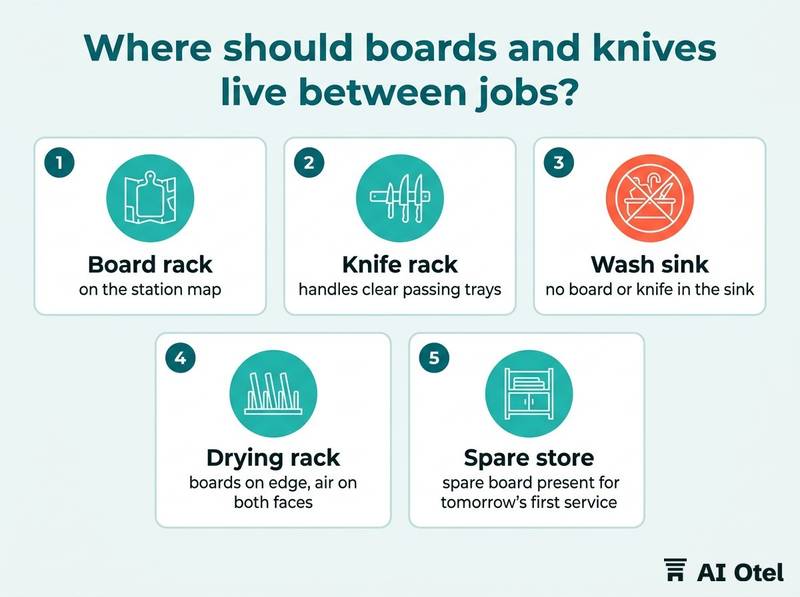
Draw a station map of the kitchen and mark five things on it: board rack, knife rack, wash sink, drying rack, spare store. Every board and knife then has exactly one home. Store boards on edge in a slotted rack with air on both faces. Stacked flat, the bottom board stays wet; leaned behind equipment, it stays invisible until it smells.
Mount knife racks at a height where handles clear passing trays, and never above a heat source or a fryer. A knife block with narrow slots traps moisture and debris and cannot be cleaned inside. If you keep one, it must be empty, dry and washable, or replace it with a magnetic rack.
Carrying a board to a buffet or a prep room means carrying it flat with a blade guard on the knife, not under the arm with the knife loose in the other hand. Nothing on the floor, nothing under the sink, nothing on top of the pass. Those three places are where a board goes to be ruined.
ChecklistEnd-of-station check
- Board washed, sanitized and standing on edge in its own slot
- Knife washed, dried and on the rack or in the roll
- No board or knife in the sink
- Spare board present for tomorrow's first service
- Rack wiped
- Anything scored or cracked moved to the retire shelf
The station sits next to cold storage in most kitchens, so fold this check into the same round as your fridge and cold-room temperature logs and one walk closes both.
What is the cleaning and drying sequence for boards and knives?
Scrape, wash with detergent at the dilution on the label, rinse, sanitize, then air-dry standing on edge. Drying is the step kitchens skip, and it is the step that decides whether the next food touches a clean surface.
Scrape solids into waste before the board reaches the sink. Washing a loaded board dilutes the detergent and spreads the residue across the surface. Use a brush that reaches into the grooves, not a cloth, which smears material from one part of the board to another.
Sanitize after washing, never instead of washing, and hold the contact time printed on the label. A quick dip is a gesture, not a step. Air-dry on edge in a rack with space on both sides. Never stack wet boards and never towel-dry a board, because the cloth carries material from the last board to the next.
Wash knives by hand, dry at once with paper or with a cloth kept for blades only, and keep wooden-handled knives out of the dishwasher. Color-coded cloths used on boards follow their own scheme and their own dilution, and a board cloth never doubles as a bench cloth; the dilution rules are the same discipline as color-coded cloths and cleaning chemical dilution. Put the sequence on the cleaning schedule with a sign-off line, so the drying rack is checked and not assumed. The schedule itself belongs in your hotel kitchen cleaning schedule with a sign-off form.
Watch outThe wet stack
Two boards stacked while damp keep the contact faces wet for hours. The board at the bottom of the stack is the one that goes out first at the next service.
When should you retire a cutting board?
Retire a board when its surface can no longer be cleaned: grooves a brush cannot reach, dark staining that survives washing, warping, splitting, delamination or a smell that stays after sanitizing. Age alone tells you nothing.
Run a fingernail across the surface at a right angle. If it catches in a groove, the board is a candidate for retirement or for a lower-risk station. Check the edges and corners for cracks, chips and separation between layers, because those are places a brush never reaches. Rock the board on the bench: a warped board makes the knife rock with it, which is a cutting injury waiting for a busy service.
Walk the boards once a month with the steward, dated, one line per board. Replacement then becomes a budget line instead of an emergency in July. Rotate instead of discarding everything at once: the worst board leaves, the mid-life board moves to a low-risk station such as bakery or dry prep, and the new board goes to raw protein. Mark the board when it enters service, by stamp or by a sticker, so its age is visible on the rack and not remembered by one person. The monthly walk belongs with the records in the HACCP file for a hotel kitchen.
Key pointThe wear check in one line
Fingernail across the grain, then edges, then rock, then smell. Any catch or crack moves the board off raw protein the same day.
How do you store, sharpen and count knives?
Store knives on a rack or in a guard, hone them on the steel through service, sharpen them on a stone on a named schedule, and count them at the end of every shift.
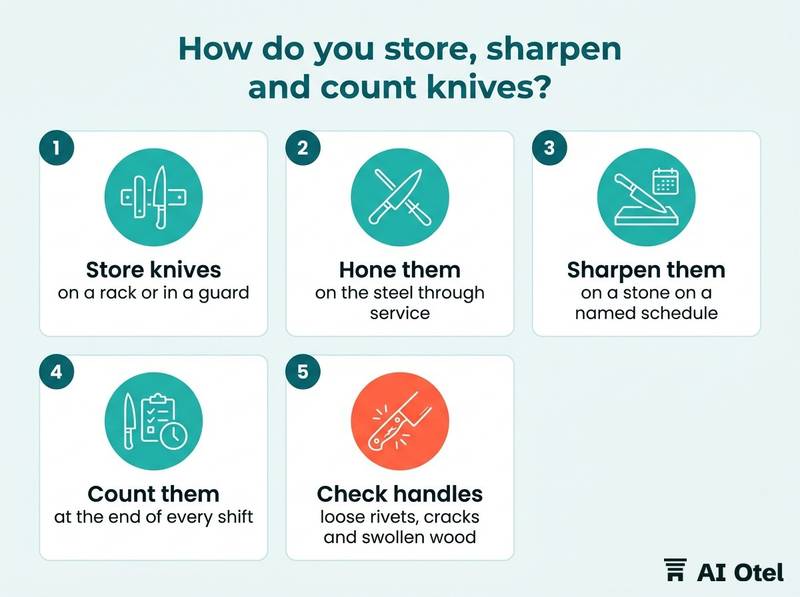
Honing straightens a rolled edge; sharpening removes metal to form a new edge. A steel used as a sharpener takes years off a blade and gives the cook a false sense of a sharp knife. Set a sharpening schedule by station, done by one named person or by an outside service, and log the date. A dull knife slips, and a slip is how hands get cut.
Count knives at the end of each shift against the issue list and sign it. A missing knife is searched before the kitchen closes, because a blade in a bin bag or under washing-up water is an injury waiting for the steward. Choose one issue model: house knives on a peg board with a count, or personal knives in a named roll. Mixing the two is how a knife disappears without anyone noticing.
Check handles at the same time: loose rivets, cracks and swollen wood are a break waiting to happen, and a broken handle turns a blade into a loose blade. Never leave a knife in a sink, in washing-up water or on a board at the end of service. The rack is the only place a knife is put down without being watched.
How do you train new staff on the color code in ten minutes?
Show the wall sign, walk the station, and ask three questions back. Ten minutes is enough if the sign exists and the station is set up correctly; an hour will not fix a station with no spare board.
The one-page sign carries five things: color, food group, station, where the board hangs, and what to do when a board is scored. Nothing else fits on a wall sign people actually read. Walk, do not tell: stand at the rack, hand the new cook the correct board for the first task, and let them hang it back in its slot at the end of that task.
Ask three questions back: which board for this food, where does it go when you finish, what do you do if it is scored. The answers tell you whether the station or the person needs fixing. Have the station lead sign and date the training line, and spot-check one question per shift through the first week. Repeat the ten minutes at every menu change, because new dishes bring new prep and the old habit does not cover them.
Check the spares before you check the people. If the green board is missing, the cook will use red, and no amount of training changes that.
TipA ten-minute script
Read the sign together, walk to the rack, do the first task together with the right board, then ask the three questions back and sign the line.
What to do next
Draw the station map and post the one-page sign this week, then put the monthly wear walk in the calendar with a name against it. The color code, the storage rule, the drying sequence and the knife count are one system: the map decides where things live, the sign teaches it, the wear check keeps the surfaces cleanable, and the count closes the shift.
Frequently asked questions
Can color-coded cutting boards go in the dishwasher?
It depends on the board material and on what the manufacturer's instructions allow. Long, hot cycles warp many plastic boards, and a warped board rocks under the knife. If you machine-wash, still air-dry on edge and check for warping at the monthly walk. Wooden boards and wooden-handled knives are hand-wash items.
Do we need a separate board for gluten-free or allergen prep?
A separate, clearly labelled board with its own storage slot reduces the chance that crumbs and residues reach an allergen-free plate. Whether your kitchen needs one follows from your menu and from your own allergen procedure. Agree the rule with your food safety lead and write it into the station map so it is not left to memory.
Is a color code a legal requirement?
A color code is a management tool, not a fixed scheme handed down from outside. It works when the kitchen writes it, posts it and follows it, and when the spares exist to make following it easy. What your own kitchen must document and demonstrate is set by your food safety plan; confirm your own case with your food safety adviser.
How many cutting boards should a hotel kitchen keep?
Count by station, not by kitchen: one in use, one clean and hanging, one in the wash, plus one spare for each raw-protein station. The number follows the station map. A kitchen that buys boards by color but not by count ends up short at the busiest hour.
Do magnetic knife racks damage knives?
A magnetic rack holds the blade flat and is fine for most knives, provided the blade is dry when it goes up. The real risk is moisture trapped between blade and rack, so wipe the rack daily and never hang a wet knife. Keep the rack away from heat and above the height of passing trays.