Fridge and cold-room temperature logs: reading rounds, alarms and what to do at the wrong number
A temperature log is only useful if rounds are fixed, signed, and paired with a clear wrong-number rule. Learn how to design the sheet, decide on sensors, and review monthly data to prevent repeat alarms.
AI draft · awaiting editorial review
Contents
Key takeaways
- A temperature log is a record of where and when a reading was taken, not just the number: unit, position, time and initials are what make it usable.
- One fixed round per shift, signed by the person who took the reading, beats three rounds written from memory at closing.
- When a reading is outside the limit, the order is move the food, find the cause, call the two people who decide, then record the decision.
- Sensors add coverage, not judgment: without a named person who answers the alarm at night, they only document the failure more precisely.
- The monthly review is where the log pays for itself: repeat alarms become maintenance tickets and replacement decisions.
A temperature log is a signed record of each cold unit's reading at set times. It works only when rounds are fixed by shift, each reading is signed by the person who took it, and a written wrong-number rule says who moves the food, who checks the unit and whom to call. The limits come from your own food safety plan.
The cold room reads high at 07:00. Yesterday's log is complete, tidy, and signed by one person at 23:00 in a single sitting. Nothing in it would have told anyone that the door had been propped open since the six o'clock delivery. A hotel kitchen fridge temperature log filled in from memory protects nothing. After reading this you will be able to set the rounds, design the sheet, write the wrong-number rule, and decide whether a sensor is worth adding.
What should a hotel kitchen fridge temperature log record?
Every line should identify the unit, the position inside the unit where the reading was taken, the reading itself, the time, and the initials of the person who took it. A log without the unit and the position is a number without a meaning.
Identify the unit, not the room. Give each unit a number on the door, for example soğuk oda 1 or buzdolabı 3, that matches the maintenance list and the asset register, so a fault can be traced to a piece of equipment and not to a corner of the kitchen.
Record the position as well. Air temperature should be read at the warmest point: the top shelf of an upright fridge, near the door, or high up in a walk-in, because cold air falls. Product temperature, as a separate column, is the reading from a pack that has stood in the unit overnight. Keep the unit's own display reading and your probe reading as two columns: when they disagree, the probe wins, and the gap becomes a maintenance ticket for the display or the sensor.
Measure the food, not the air. A thin-tip probe placed between two packs, or in a sample pack, shows what the food has experienced. An infrared gun reads surfaces only and is a screening tool, not a record. Clean and sanitize the probe between units, so the round does not become a cross-contamination route from raw poultry to the pastry room.
Add a column for the action taken, initialed. A log that records only what was seen tells a reader nothing about what was done. Include every cold unit that holds food, not only the walk-ins: bar coolers, breakfast display units, pastry and butcher rooms, and the minibar fridges, which are small, opened many times a day and usually have no display at all. For the wider storage vocabulary your team needs, see kitchen storage terms for hotel teams.
| Field | What goes in it | Why it matters |
|---|---|---|
| Unit ID | door number, matching the asset register | a fault traces to one machine |
| Position | top shelf, near door, between packs | readings become comparable |
| Time | clock time of the reading | shows the gap to the response |
| Air reading | the display or the probe in the air | catches a failing unit early |
| Product reading | probe inside or between packs | the number the food decision rests on |
| Initials | the person who took the reading | a record, not a claim |
| Action | what was moved, checked or called | the reader sees the response |
Air reading or product reading
The air reading tells you whether the unit is working. The product reading tells you whether the food is safe. They answer different questions, so they sit in different columns, and the food decision always rests on the second one.
Which units belong on the same sheet
Group by who walks the round, not by geography. If the night shift covers the cold rooms and the freezer room, those units sit on one sheet; the bar coolers on another; the minibars on a third, checked during room cleaning.
How many rounds per shift, and who signs the sheet?
At least one fixed round per shift, at a clock time written into the shift plan, signed by the person who took the reading and countersigned by the supervisor on duty.
Anchor the rounds to the moments the units are under most stress: for example before breakfast prep, after the delivery window, and at close once service has finished. Fixed clock times are what make a missed round visible.
The person who reads signs. A sheet filled in at the end of the shift from memory records a habit, not a temperature, and it will not survive the first serious question about a delivery. A missed round is written as missed, with a short reason and an initial. It is never backfilled with an estimate, because an estimate in a signed column is worse than a gap.
Name the owner of each round on the roster. Days off, holidays and sick leave are covered by a named person, not by whoever happens to be there. The supervisor countersigns daily and initials every correction. Corrections are struck through once so the original stays readable, never erased, whited out or rewritten on a fresh sheet.
Building the round into the shift plan
ChecklistA round, unit by unit
- Read the display and write it.
- Probe the air at the warmest point.
- Probe one product pack.
- Look at the door seal and the hinge.
- Check the coil for ice and the drain for water.
- Confirm nothing is stacked against the vents or above the air line.
- Check date labels on opened packs.
- Sign and time the line.
- If anything is out of range, start the wrong-number rule before leaving the unit.
What do you do when a reading is outside the limit?
Move the food first, then find the cause, then call. The reading is a symptom and the food is the thing at risk, so the stock leaves the unit before anyone starts diagnosing it.
Move: shift the stock to a working unit, label it with the time of the move, and keep it separate so nothing from that batch is sold or served while the decision is pending. Check: door left open, a defrost cycle running, the unit overloaded, vents blocked, a failed gasket, a pulled plug or a tripped breaker, a condenser matted with dust.
Call two people, not one: technical service for the unit, and the person responsible for food safety for the food. The person who found the problem does not decide its outcome alone at the door. Measure the product, not the air: the decision rests on the food's own temperature and on how long it has been in that condition.
Decide and write it down: keep, use immediately under a named instruction, or discard, with the reason and the name of the person who decided. Record the timeline: time of the reading, time of the move, time the unit returned to range, time the stock was released or discarded. That timeline is the part an inspector or a guest claim will ask about.
Never silence an alarm and walk away. An alarm cleared without a decision is the same as no alarm at all, and it teaches the team that the sound means nothing.
Watch outThe wrong-number rule, posted inside the cold room door
MOVE the stock to a working unit and label it with the time. CHECK the door, the defrost, the vents, the gasket, the power. CALL technical service and the food safety lead. DECIDE with the food safety lead, on the product temperature and the time. RECORD the reading, the move, the call, the decision and the name of the person who made it.
Who decides about the food
One named person, the food safety lead or their written deputy, decides keep, use or discard. The cook who found the problem records it; the named person decides it. That split is what makes the record defensible.
What the timeline must show
Four times and two names: the reading, the move, the return to range, the release or discard, and who decided. If any of the four times is missing, the record shows a gap, and a gap invites the worst reading of the rest.
Why does the same unit keep alarming?
Repeat alarms are usually behavior and maintenance, not a failing appliance: the same door propped open, the same overloaded shelf, the same blocked evaporator, week after week.
Door habits are the most common cause: a door held open through a delivery or a prep session, a strip curtain missing or torn, a door that does not close on its own because the hinge has dropped. Warm loading is next: stock brought straight from the delivery bay into the unit lifts the whole cabinet for hours and looks like an equipment fault on the next round.
Blocked air comes from boxes pushed against the back wall and the evaporator, or stock stacked above the air line, so the cold air cannot reach the food it is meant to protect. Defrost faults show as a cycle scheduled at the wrong time, or a defrost that never completes and leaves ice on the coil, which then shows up as a rising reading every afternoon. Wear adds perished gaskets, loose hinges, a blocked drain, a dusty condenser coil, or a unit standing next to the oven in a hot, unventilated corner.
Minibar fridges deserve their own line in the pattern: small, opened many times a day, no display and no alarm, so the check belongs to room cleaning and is recorded per unit, not per floor or per block. For the wider discipline around those units, see hotel minibar control: stock, charges and late postings.
| Cause | What you see on the round | What to do |
|---|---|---|
| Door habit | condensation, warm top shelf, door will not swing shut | repair hinge or curtain, retrain the delivery routine |
| Warm loading | sharp rise after the delivery window | split deliveries into smaller loads |
| Blocked evaporator | ice at the back, warm front, cold rear | clear the wall, mark a keep-clear line |
| Defrost fault | rise at the same hour daily, ice on the coil | call technical service, do not chip the ice |
| Gasket and drain | water at the bottom, frost at the door edge | replace the gasket, clear the drain |
| Placement and condenser | dust on the coil, a hot corner | move the unit or clean the coil on a schedule |
Reading the pattern instead of the single alarm
One high reading is an event. The same high reading at the same hour, on the same unit, for three weeks is a diagnosis, and it is sitting in your own sheets waiting to be read.
Manual rounds or sensors: which does a hotel need?
Manual rounds first, sensors where the risk is high or nobody is near the unit. A sensor that nobody answers only records the failure more precisely.
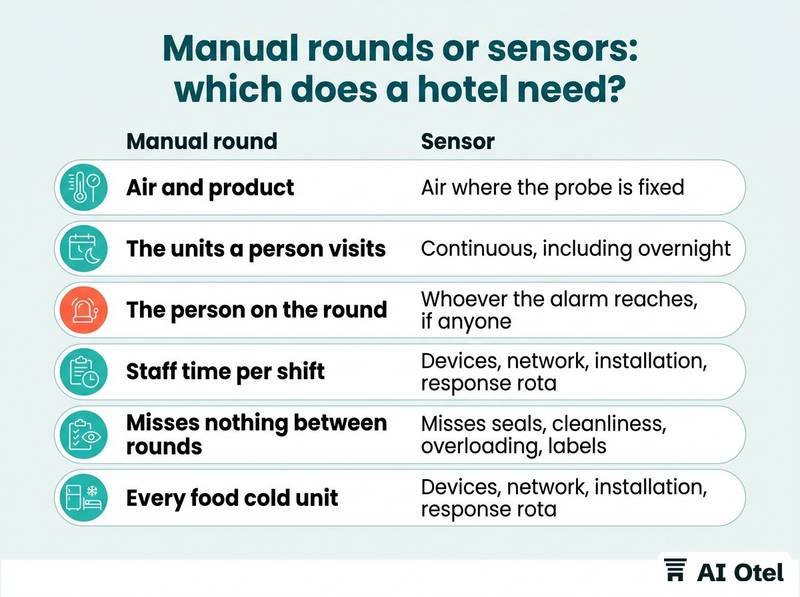
A sensor logs continuously and alarms at a threshold, but it measures where its probe sits, not the food. Its position matters as much as the position of a hand probe, and it needs the same check. Sensors earn their cost on walk-in cold rooms, remote bars, cellars and off-site stores, and on any unit that runs unattended overnight.
The manual round still covers what no sensor sees: seals, cleanliness, rotation, overloading, date labels, and the state of the door. The real cost of a sensor is not the device but the alarm path. Decide who receives the message at 03:00, what that person is authorized to do, and what happens if they do not answer. Test the alarm path on a schedule: trigger a test alarm, confirm that a named person received it and acted, and record the test next to the round.
A workable hybrid is a sensor on each walk-in plus a manual round twice a day, with the sensor's log attached to the same monthly review as the sheets. Minibar blocks rarely justify a sensor per room: a check during room cleaning plus a spot check of a sample of rooms is the cheaper control, and it catches the guest who left the door open.
| Manual round | Sensor |
|---|---|
| Air and product where the probe is placed | Air where the probe is fixed |
| The units a person visits, when they visit | Continuous, including overnight |
| The person on the round responds | Whoever the alarm reaches, if anyone |
| Staff time per shift | Devices, network, installation, response rota |
| Misses nothing between rounds | Misses seals, cleanliness, overloading, labels |
| Every food cold unit | Walk-ins, remote stores, unattended units |
The alarm path is the design decision
Before buying the device, write the answer to one question: when the alarm fires at 03:00, whose phone does it reach, and what are they allowed to do about it. If the answer is nobody, the sensor is a more expensive version of the unread sheet.
How long do you keep the sheets, and what should the monthly review show?
Keep the signed sheets for as long as your food safety plan and your adviser require, and read them once a month. An unread log is a filing exercise with a signature on it.
Store the signed originals by month and by unit. Corrections stay struck through and initialed on the original; nothing is retyped onto a clean sheet later. The monthly review counts four things per unit: readings outside the limit, repeat offenders, missed rounds, and the time between a reading and a response.
Use the review to decide maintenance and replacement, not to grade staff. A unit that appears three months running is a capital decision, not a training problem. Compare the log against the maintenance tickets: an alarm with no ticket behind it is a gap in the system, and it is the first thing a serious question will find. Feed the findings into the cleaning schedule and the food safety file, so the three documents name the same units and tell the same story. The review sits inside the wider framework described in the HACCP file for a hotel kitchen, and it should drive the same units listed in the hotel kitchen cleaning schedule with a sign-off form.
Where the plan is silent on retention, confirm the period with your adviser once and write the answer into the plan, so the next supervisor does not have to guess.
NoteThree documents, one story
The temperature log, the maintenance ticket and the cleaning schedule should name the same units with the same numbers. If a unit appears in one and not the others, the paperwork is describing three different kitchens.
What to do next
Write the wrong-number rule today, print it, and post it inside the cold room door. Then put the round times into the shift plan with a named person against each one. The form, the rounds, the alarm response and the monthly review are one loop: the sheet only protects food if someone reads it, and someone only reads it if a decision is waiting on the number.
Frequently asked questions
Can the temperature log be filled in at the end of the shift?
No. A reading written from memory is a claim, not a record, and it cannot show when a unit started to drift. Fill the line at the unit, at the time, and sign it there. If a round was missed, write missed with a short reason and an initial, because a gap is honest and an estimate is not.
Which thermometer should a kitchen use for fridges and cold rooms?
A thin-tip probe thermometer for product and air readings, checked on a schedule against an ice-point reference, cleaned and sanitized between units, with a spare and spare batteries kept in the kitchen. An infrared gun is useful for a quick surface screen but does not replace a probe reading in the log.
Do minibar fridges need their own temperature record?
If your food safety plan covers them, yes, and they are the easiest units to forget: small, opened many times a day, usually with no display. Check them during room cleaning and record per unit, not per floor. A sensor in every room is rarely worth the cost; a check plus a spot check of a sample of rooms is the cheaper control.
The reading was out of range but the food still feels cold. Do we throw it away?
Not automatically, and not on the air reading alone. Move the stock to a working unit, label it with the time, probe the product itself, and let the person responsible for food safety decide on the product temperature and the time involved. Record the decision, the reason and the name of the person who made it.
Who should sign the temperature log?
The person who took the reading signs the line, and the supervisor on duty countersigns daily. Corrections are struck through once and initialed so the original stays readable. A sheet signed by one person for a whole day of rounds is the clearest sign that the round is not actually happening.