Breakfast headcount: reconciling covers, in-house rooms and board types each morning
Reconcile entitled guests, door counts and production each morning to spot process faults. Learn to match covers to board types and set kitchen quantities from weekly averages.
AI draft · awaiting editorial review

Contents
Key takeaways
- Three numbers, not one: guests entitled by board type, guests counted at the door, and portions produced each answer a different question.
- Count at the door once per person against the room number, so the count can be matched to the in-house list instead of only totalled.
- A gap between entitled and seen is normal; a gap that repeats in the same direction every day is a process fault, not guest behavior.
- The same-weekday average over four weeks, not yesterday's number, is what the kitchen should order and produce against.
- A wrong board code is corrected in the reservation record, never annotated on the breakfast sheet.
A breakfast cover count is the number of guests who actually eat breakfast, counted once per person at the door. Each morning a hotel reconciles three numbers: guests entitled by board type and room, guests seen at the door, and portions produced. The differences point to outside visitors, wrong board codes and guests who skip breakfast.
The door host counts heads, the kitchen produces against last week, and the front office list of guests entitled to breakfast sits in another system. By ten o'clock three numbers exist and nobody has put them side by side. This article shows how to run a daily hotel breakfast headcount that connects all three: how to count at the door, how to match the count to the in-house list by board type, how to read the gap, and how to turn the result into production quantities.
What are the three breakfast numbers a hotel should count each morning?
Three: guests entitled, guests seen, and portions produced. They are recorded in three different places, by three different teams, and only mean something when compared on the same business date.
Guests entitled is built from the in-house list: for each occupied room, the number of guests recorded on the reservation multiplied by the board code attached to it. A room with two adults and one child on half board entitles three breakfasts, not two. Guests seen is counted at the door, one stroke per person, against the room number. It measures appetite, not entitlement. Portions produced is what the kitchen sent to the buffet or plated for the service, written down by the kitchen at the time, not reconstructed afterwards.
One number alone misleads. The reservation book counts promises, the door counts people, the kitchen counts food. Only the difference between them describes the morning.
| Number | Owner | Where it is recorded | What it answers |
|---|---|---|---|
| Guests entitled | Front office | In-house list, room by room, with board code | How many breakfasts the hotel has promised |
| Guests seen | Restaurant, at the door | Door sheet, one stroke per person per room | How many people actually ate |
| Portions produced | Kitchen | Kitchen's production record for the service | How much food left the kitchen |
Give each number an owner: front office for entitled, restaurant supervisor for seen, kitchen for produced. A number without an owner is not checked by anyone. Close all three after service on the same business date; a comparison assembled next week is an audit, not a daily control.
How do you count breakfast covers at the door?
Count each guest once, at the entrance, against the room number, and record the room number rather than only a stroke. A bare tally tells you how many ate; a room-number sheet tells you who, which is what makes reconciliation possible.
Three methods exist and they answer different questions. A plain tally is fast and anonymous. A room-number sheet is slower and matchable. Collecting a card or voucher works for outside guests and package arrangements. For the daily breakfast headcount, the room-number sheet is the one that supports reconciliation.
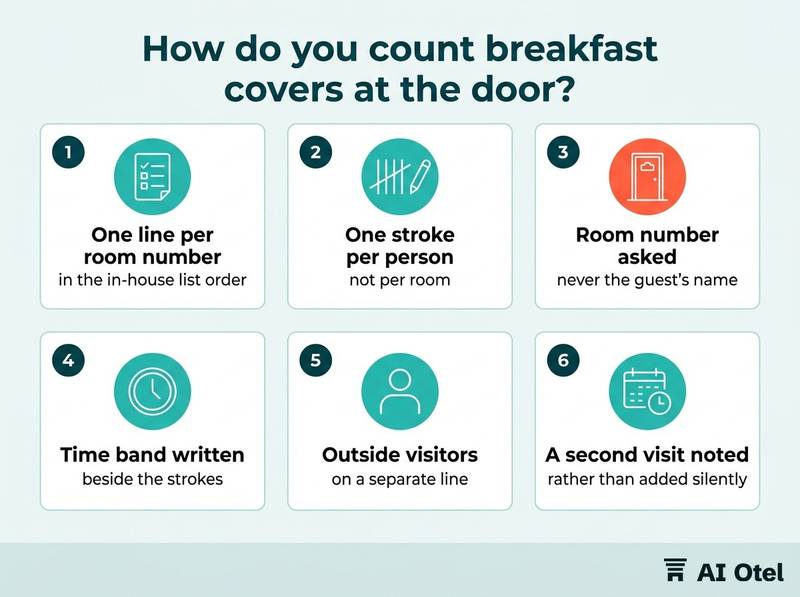
One stroke per person, not per room. A family of four is four strokes on one line, and the line carries the room number so the entitlement for that room can be read beside it. Ask for the room number, not the name: names create discussion at the door and cannot be matched to the list quickly. Keep the sheet in the same room order as the in-house list, so matching becomes a straight read down two columns instead of a search.
Record a time band beside the strokes, for example 07:00 to 07:30. It shows the peak, separates early breakfast from late, and gives the kitchen a shape for the morning. Handle the exceptions on the spot: a guest with no room number, a guest whose room is under another name, a guest who comes back a second time. Each gets a note, not a silent extra stroke.
The count needs a room number, and only a person at the door can ask for one. That is why the door host is the control point, not a form left on a table.
ChecklistDoor sheet routine
- One line per room number, in the in-house list order
- One stroke per person, not per room
- Room number asked, never the guest's name
- Time band written beside the strokes
- Outside visitors on a separate line with who authorized them
- A second visit noted rather than added silently
- Sheet signed and handed to the front office at the end of service
How do you match the door count with the in-house list by board type?
Turn each in-house reservation into a breakfast entitlement using its board code and guest count, then compare that figure with the strokes recorded against the same room number. Compare room by room, not only in total.
Build the entitlement from the reservation record, not from the room type. Board code plus the number of adults and children on the reservation is what the hotel has promised. Board codes drift during the day: an upgrade at check-in, a change sent by an agency, a room move. The breakfast entitlement follows the reservation record, so the record has to be corrected the same day, not the sheet. If you are unsure what a code should include, start from a clear explanation of hotel board types, from room only to all inclusive.
Agree the children rule once and write it down: from which age a child counts as a full breakfast. The reservation, the contract and the door must say the same thing. Where the board code comes from a contract with an agency or a tour operator, the contract's wording decides what is included; read it with the other party before the season, and see the guide to board and meal terms in Turkish hotel contracts.
Totals can match while two errors cancel out. One room seen without entitlement and another entitled but absent produce a clean total and a dirty sheet. One sheet carries the comparison, and the note column is where the explanation lives, in a few words. For example:
| Room | Board code | Guests | Entitled | Seen | Note |
|---|---|---|---|---|---|
| 214 | Half board | 2 adults, 1 child | 3 | 2 | child ate in room |
| 215 | Breakfast included | 2 adults | 2 | 3 | one outside visitor, authorized |
| 216 | Room only | 1 adult | 0 | 1 | board code wrong, reservation corrected |
What does the gap between entitled and seen actually mean?
A gap is a signal, not an error. It separates into four causes, and the direction of the gap, plus where it appears, tells you which one you are looking at.
Outside visitors are people who eat but are not staying: paying walk-ins, tour guides, drivers, contractors or staff. They show as seen without entitlement and must be recorded and charged or authorized. A wrong board code shows as the same room entitled but not seen, or seen but not entitled, usually because a reservation changed and the record did not. Late sleepers and early departures are entitled, not seen, no fault: the guest skipped breakfast or left before service began. A children rule applied to adults only shows as seen exceeding entitled across the whole house by roughly the number of children in-house.
Key pointFour patterns, four causes
Outside visitors: seen above entitled in a few rooms, with a note missing. Wrong board code: differences that pair up inside the same room. Late sleepers and early departures: seen below entitled, scattered across many rooms with no pattern. Children counted as adults only: seen above entitled, spread evenly across the house.
Read the direction over a week, not a morning. Seen above entitled all week points to unrecorded visitors or a children rule; seen below entitled all week points to board codes promising a breakfast the hotel does not actually serve, or a service that ends before guests come down. Check a sample before you conclude: two or three rooms with a difference, confirmed with the front office against departure times, settle most of the question in minutes.
How do you turn the weekly average into production quantities?
Use the average seen count for the same weekday over the last four weeks, not yesterday's number, and adjust it for the groups and departures you already know about.
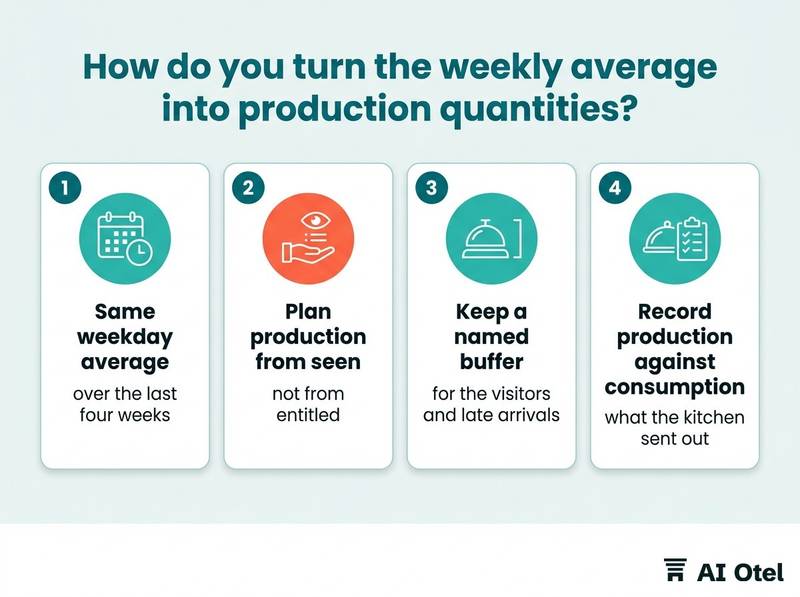
Same weekday beats a seven-day average. Tuesday and Saturday behave differently, and a four-week same-weekday average removes most of that noise. Plan production from seen, not from entitled: entitlement is the ceiling the hotel has promised, seen is what the kitchen should cook for. Keep a named buffer for the visitors and late arrivals you can predict, such as a coach departure or a day-use booking, and write down what the buffer was so next week can judge it.
Record production against consumption: what the kitchen sent out and what came back. Without that second number the headcount plans volume but never learns. Separate volume from mix: the headcount sets how much bread, egg and hot food to make; which items to make comes from the item-level record of what was taken. For the food side of this, see measuring buffet food waste and planning quantities from covers and the breakfast buffet item list, set-up and refills at peak.
TipThe four-week rule
Take the seen count for the same weekday over the last four weeks, average it, add the known buffer for that day, and compare the result with what was produced. If produced exceeds seen by the same margin three weeks running, the production figure is the thing to change.
Review weekly, not daily. One quiet morning is weather or a coach that left at six; four quiet Tuesdays is a planning error.
What should a hotel do when the mismatch keeps repeating?
Write the rule down, give one person the reconciliation, and fix the record at its source instead of adjusting the count.
Name the owners. The restaurant supervisor produces the sheet, the front office corrects the reservation record, the F&B manager reads the weekly trend. Nobody owns a number that three departments share informally. Fix the source: a wrong board code is corrected in the reservation, not annotated on the breakfast sheet, otherwise the same room is wrong again tomorrow.
Write the outside-visitor rule: who may eat, who authorizes it, how it is charged, and where it is recorded. Verbal permission at the door is how counts drift. Write the children rule once and apply it in the reservation, the contract and the door; three versions of the same rule produce a permanent gap. Set a tolerance for the property and review only what exceeds it: a daily difference of a few covers is normal in any hotel, and chasing it every morning costs more than it saves.
ChecklistMonthly review
- A named owner for each of the three numbers
- Board codes corrected in the reservation on the day
- The outside-visitor rule written and applied
- The children rule identical in reservation, contract and door
- The tolerance agreed and stated
- The production plan uses the four-week same-weekday average
- Last month's corrections visible in this month's sheet
Review monthly with front office and kitchen in the same room, on the same sheet, so the conversation is about one set of numbers rather than three. Hotels that run this reconciliation inside a single system, rather than across a paper sheet and a separate property system, remove one whole class of copying errors; an overview of how a hotel operating system (the system: built, ahead of launch) can carry reservations, board codes and restaurant records in one place is on the platform pages.
What to do next
Start tomorrow with one sheet: room number, board code, guests on the reservation, entitled, seen, difference, note. Keep it for four weeks, then set production from the same-weekday average. The count is worth little on its own; it is worth a great deal when the front office, the restaurant and the kitchen read the same line and correct the record behind it.
Frequently asked questions
Should breakfast be counted per room or per person?
Per person. A room with three guests on half board entitles three breakfasts, and counting per room understates production while hiding children entirely. The room number is only the line the strokes sit on.
How do you count breakfast for guests on all-inclusive or full board?
The board code sets the entitlement and the door still counts people. All-inclusive guests may eat in a second outlet or take a late breakfast, so the sheet needs a line for each outlet and the totals are added before reconciliation.
What is a normal difference between the in-house list and the door count?
There is no universal figure; every property sets its own tolerance from its own four-week history. Direction and repetition matter more than size: a small gap that always points the same way is a process fault, a larger gap that moves around is usually guests.
How do you account for guests who skip breakfast?
They cannot be counted directly; they appear as entitled minus seen. Confirm the inference on a sample by checking departure times and early check-outs with the front office, rather than assuming every missing guest slept in.
How does the breakfast headcount help with food waste?
The seen count is the production base, and the difference between produced and consumed is the waste measure. Both belong on the same weekly sheet, so the kitchen adjusts quantity from evidence rather than habit.