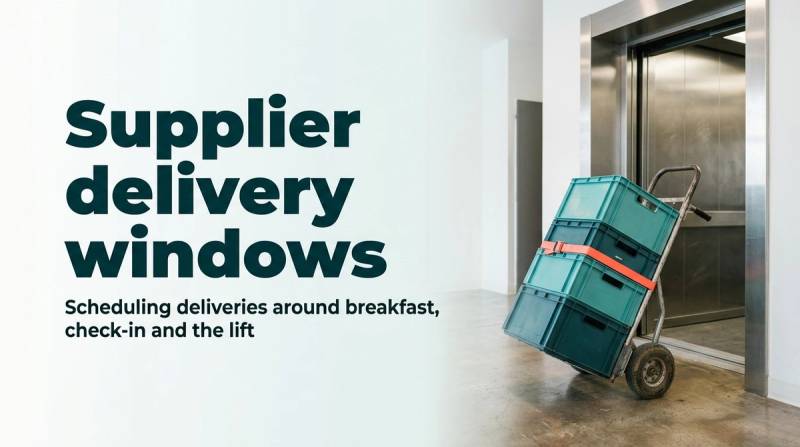
Supplier delivery windows: scheduling deliveries around breakfast, check-in and the lift
A supplier delivery window is a fixed slot where a named person receives goods at a specific door. This guide shows how to build a weekly grid that protects service moments and handles late arrivals.
AI draft · awaiting editorial review
Contents
Key takeaways
- A delivery window is a promise about three things at once: a door, a time and a named person who signs.
- The real cost of an off-window delivery is not the delay; it is the second person pulled off the floor to deal with it.
- Choose windows where the receiving person, the service entrance and the goods lift are all free, not just where the kitchen is quiet.
- Write the off-window rule before the first supplier tests it, and give one person the authority to refuse.
- A miss can only be reviewed if the hotel wrote down in advance what counts as one.
A supplier delivery window is a fixed time slot in which a named person receives goods at a named door. Hotels set supplier delivery windows around three fixed points: breakfast service, the check-in peak and the goods lift. Everything else, from the weekly grid to the off-window rule, follows from those three.
It is 08:40. The breakfast buffet is at its busiest, the goods lift is carrying housekeeping trolleys, and a refrigerated truck is at the service door with nobody free to open it. Every hotel that receives goods has lived some version of this. After reading this article you will be able to build a weekly delivery grid from your own delivery notes, place every supplier in a slot that protects breakfast, check-in and the lift, and handle the driver who arrives outside it without negotiating at the door.
Why does a late delivery cost more than the hour it takes?
Because receiving is a person-bound task that lands inside someone else's job. The hour is not lost from the delivery; it is taken from service, from check-in or from housekeeping.
Receiving cannot be done in parallel with anything else. Someone must open the door, count the cases, check temperature, sign the delivery note and move the goods to the storeroom before they warm up. That someone is usually a second person: the steward leaves the buffet line, the front-office clerk leaves the desk, the housekeeping supervisor leaves the floor. The cost of the miss lands on whichever job was nearest the door.
The three fixed points of a hotel day
Hotels have three moments in the day that a delivery cannot be allowed to touch. The first is breakfast service, when the steward is on the buffet and the service corridor is in use. The second is the check-in peak, when the front of house is closed to anything that needs a signature from reception, and a driver waiting in the lobby becomes a guest-facing problem. The third is the goods lift, which has its own peak in mid-morning when housekeeping trolleys are moving: a pallet holds the lift for minutes at a time while the trolleys queue behind it.
Cold goods add a fourth clock. A chilled delivery waiting on a warm loading bay is a food-safety problem before it is a scheduling problem; the cold chain starts at the door, not at the fridge. The knock-on is what hurts most: a late delivery pushes put-away into the pre-lunch prep window, and the next truck arrives before the last one is stored. Without a written window, every late arrival becomes a negotiation at the door, and the person at the door rarely has the authority to end it.
Key pointA window protects service, not the supplier's round
A delivery window protects service, not the supplier's round. If the window does not protect a service moment, it is not doing any work.
What receiving actually takes: count, temperature, signature, put-away
Count, temperature, signature, put-away: the four steps that make receiving a real job with a real duration. A signature is an acceptance, not a greeting, so the count and the temperature check come first. Put-away is part of the window too, because goods sitting on the bay are neither in the storeroom nor safe. For the temperature and paperwork side in detail, see the article on the cold chain in a hotel kitchen from receiving onward.
How do you list suppliers, days and usual arrival times?
From your own paperwork, not from memory: take the last month of delivery notes and goods received notes and record what actually happened, supplier by supplier.
Group suppliers by category as well as by name. Fresh, frozen, ambient, beverage, linen, chemicals and maintenance each need a different kind of receiving: a chilled van with a temperature probe is not the same job as a pallet of bottled water. For each supplier, record the delivery days, the time they actually arrive rather than the time they promise, the vehicle type and size, whether the load is chilled, who signs today, and how long unloading takes.
Record the reverse flows on the same door and the same lift: laundry out and back, waste collection, empty kegs and crates, and the return of rejected goods. These compete for exactly the same resources as deliveries, and a grid that ignores them will fail on its first Tuesday.
Separate the suppliers who already keep a slot from the ones who arrive whenever the round allows; the second group is where a grid earns its keep. Ask the driver once: some arrive early because the route is built that way, and a later slot costs the round nothing. Keep the vocabulary straight between the purchase order, the delivery note and the goods received note, so the grid and the paperwork describe the same event; those terms are explained in purchase order, goods received note and lead time.
What to write down for each supplier
Checklist
- Supplier name
- Category: fresh, frozen, ambient, beverage, linen, chemicals, maintenance
- Delivery days
- Usual arrival time, from the notes, not the promise
- Vehicle type and size
- Chilled, frozen or ambient
- Unloading time in minutes
- Who signs today
- Whether a delivery note always arrives
- Reverse flows on the same door
- Notes from the driver
Separating cold, ambient and bulky loads
Cold and fresh loads set the rhythm: they want the earliest window that still has a receiver. Ambient and bulky loads are more flexible but heavier on the lift, so they belong where the lift is free, not where the kitchen happens to be quiet. A load that is both bulky and chilled, a frozen pallet for example, is the hardest case and deserves the most protected slot.
How do you choose the slots: quiet hours and lift use?
Pick the windows where the receiving person, the service entrance and the goods lift are all free at the same time. A quiet kitchen is not enough on its own.
Breakfast service is closed to any delivery that needs a receiver. The check-in peak closes the front of house. The mid-morning housekeeping lift peak is the worst moment for a pallet, so move bulky ambient loads to before breakfast or to after the rooms are serviced. Cold and fresh goods want the earliest window that still has a receiver, so that put-away finishes before the kitchen's prep starts. Beverage, linen and chemical drops are bulky and can take the quieter late morning or early afternoon, when the lift is less contested.
Never put two large suppliers in one window: unloading time is additive and the door is single-lane. Two vans of fifteen minutes each are thirty minutes of door, not fifteen.
Mapping the lift, not just the kitchen
Draw the day of the goods lift, not just the kitchen. Housekeeping trolleys move in waves, waste and laundry go out at set times, and a maintenance contractor may book the lift for an hour. A window that is free on the kitchen's clock can be fully occupied on the lift's. Also check what the building and the street allow: a shared service yard, a loading restriction or a noise limit can remove a window entirely, and that is a question for your building management and your local authority.
The reverse flow: laundry, waste and returns
Laundry out and back, waste collection and returned crates use the same door and the same lift. Where possible, pair them: a linen supplier window that coincides with the laundry going out turns two lift movements into one. Where they cannot be paired, keep them out of the delivery windows, or the grid will be blamed for a collision it never scheduled.
TipTest a window before you publish it
Run it for two weeks with one supplier, time the unload, and watch whether the lift queues. A window that looks free on paper often is not.
What goes on the weekly delivery grid on the receiving-door wall?
One page, one week, every supplier in a fixed slot, with the receiver's name in the row. It goes on the wall beside the door, not into a folder.
Rows are time windows and columns are days; each cell holds the supplier, the category and the receiver. Print the receiver's name and a named deputy, so no driver is ever told that nobody knew about the delivery. Add a block underneath: the off-window rule, the receiving phone number, and where rejected goods are held.
Keep it current. A grid that is a month out of date teaches everyone, drivers included, to ignore grids. Put a second copy where the receiving person works and a third in the kitchen office, because the kitchen feels a miss first. The grid doubles as the review document: the misses you log against it are exactly what you take to the monthly supplier conversation.
Reading the grid at a glance
| Day | Window | Supplier and category | Receiver |
|---|---|---|---|
| Monday | 06:00-06:45 | Fresh produce, chilled | Storekeeper |
| Monday | 10:30-11:15 | Beverage, truck in yard | Storekeeper |
| Tuesday | 07:00-07:30 | Frozen, van at door | Duty chef |
| Wednesday | 14:00-14:30 | Linen, laundry out same run | Housekeeping supervisor |
A weekly goods-in grid, for example. The supplier types stand in for the hotel's own list; the point is that every cell has a window, a load and a name.
Keeping the grid honest
The grid is honest when the times on it match the times on the delivery notes. Review it whenever a shift pattern changes, a supplier is added or a miss log shows a window that keeps failing. A grid that is corrected in public, on the wall, teaches the whole building faster than a memo.
Who receives the goods, and what happens off-window?
One named receiver per window with a named deputy, and one written rule for arrivals outside it. The rule is decided before the situation, not at the door.
The receiver checks count, temperature and paperwork before signing, because a signature is an acceptance, not a greeting. The detailed checks, temperature, dates, lot numbers and rejected goods, belong on the food receiving form.
The two-outcome rule
Off-window arrivals get two outcomes only. Either the goods are accepted with a written note, when the load is chilled and the alternative is a lost service, or the delivery is refused and rebooked into the next window. There is no third outcome called "argue at the door".
Give one person, usually the storekeeper or the duty manager, the authority to refuse. A rule nobody can enforce is a suggestion. What to say to the driver: name the window, name the next window, and hand over the grid. Log every miss on the spot: supplier, date, scheduled window, actual time, reason given, who handled it. Never let a driver unload into the kitchen unaccompanied; goods go to the receiving area, not to the line.
How your own agreement with a supplier treats repeated misses is a matter for your terms and your adviser, so settle that reading once rather than at the door.
Watch outAccepting chilled goods off-window without a check
Accepting a chilled delivery outside its window without a temperature check turns a scheduling problem into a food-safety record. If you accept it, write down why.
What the receiver checks before signing
Count against the delivery note, temperature of chilled and frozen goods, condition of packaging, dates on perishables, and the presence of the delivery note itself. Only then the signature. If any check fails, the goods go to the rejected-goods area named on the grid, not back onto the truck in an argument.
How do you review misses with the supplier each month?
Count them, show them, and agree one change. A short monthly review with the grid and the miss log does more than a complaint at the door.
What counts as a miss
Define a miss in writing first: early by more than the agreed margin, late by more than it, wrong vehicle, no delivery note, wrong temperature, or a partial delivery with no notice. Without that definition, the monthly conversation is a matter of opinion, and opinion does not change routes.
Turning a review into a slot change
Review by supplier and by window. A supplier who misses the same window repeatedly usually has a routing problem, not a discipline problem, so bring the grid and propose a different window instead of asking for better behavior. A slot change is something a supplier can actually act on. Treat a single miss as a conversation and a pattern across months as a decision about the slot or about the supplier. Share the outcome with the kitchen and housekeeping, because they absorb the cost of every miss before purchasing hears about it, and fold the result back into the purchasing and receiving procedure so the next new supplier is slotted by the same rules.
NoteKeep the log with the grid
Keep the miss log on the same page as the grid. A review that needs preparation does not happen every month.
What to do next
This week, take the last month of delivery notes and build one line per supplier: days, real arrival time, vehicle, whether the load is chilled, and who signs. From that list, choose the windows where the receiver, the service door and the goods lift are free, publish the weekly grid at the door with a name in every row, and write the off-window rule before the first driver tests it. The monthly review then has something to measure, and the grid has something to correct. If you want the receiving paperwork to live inside the same system as purchasing and kitchen records rather than in a folder, read about a hotel operating system, built and working, ahead of launch, and the wider hotel platform it belongs to.
Frequently asked questions
What is a good delivery window for a hotel kitchen?
A fixed slot with a named receiver, placed outside breakfast service and outside the housekeeping lift peak. Cold and fresh goods take the earliest window that still has a receiver; bulky ambient, beverage and linen loads take the quieter late morning or early afternoon. Two large suppliers never share one window.
Should a hotel accept a delivery that arrives outside its window?
Two outcomes only. Accept with a written note when the goods are chilled and the alternative is a lost service, after a temperature check. Otherwise refuse and rebook into the next window. One named person holds the authority to decide, and every case goes into the miss log.
How many delivery windows should a hotel have in a day?
As many as the receiving roster can actually staff with a named person, which usually means tying windows to shift starts rather than to supplier convenience. The count matters less than the fact that every window has a name against it and a deputy behind that name.
Does the delivery window belong in the supplier agreement?
It is a term of the trading relationship, so it is worth writing down rather than agreeing at the door. How the agreement is worded and what follows a repeated breach is a question for the hotel's own terms and its adviser, settled once rather than argued per delivery.
What do you do with a supplier who always arrives before the kitchen opens?
Early is a miss too, because the door is not open until the receiver is there. Hand the driver the next window and log the arrival. If early arrival is systematic, the window is wrong for that round: move it earlier rather than asking the supplier to wait.