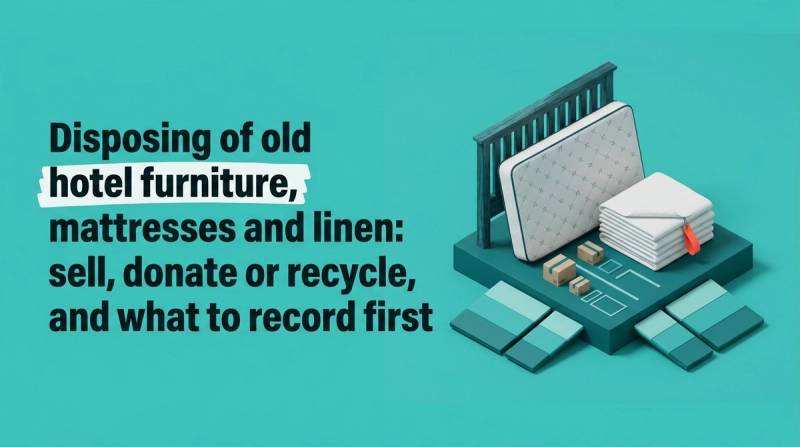
Disposing of old hotel furniture, mattresses and linen: sell, donate or recycle, and what to record first
This guide explains the four disposal routes for hotel furniture, mattresses and linen. It details how to price bulk lots, handle hygiene-sensitive items and maintain accurate fixed asset records.
AI draft · awaiting editorial review
Contents
Key takeaways
- Four routes, one record: resale, donation, recycling and waste each need the same entry, the item, its asset tag, the room it came from, the date it left and the name of whoever released it.
- A lot sold at one price to one buyer usually beats selling item by item, once you count the labor of carrying it out and the floor space it blocks.
- Anything holding a memory, a guest name or a key card leaves through the data route before it can join the furniture lot.
- Decide the route for a mattress or a stained item while it is still on the floor; once it is in the waste container it can no longer be sold or donated.
Disposing of old hotel furniture means moving every item through one of four routes, resale, donation, recycling or waste, after it has been listed, photographed and matched to the fixed asset list. The record comes first: what it is, its tag number, where it stood, where it went and who released it.
The contractor needs the floor on Monday, and the corridor is already full of mattresses, headboards and three bags of bed linen that nobody has counted. The question is not whether the old furniture leaves, but whether anyone can say afterwards what left, where it went and who let it go. This article gives you the working method: the disposal file to open first, the four routes and how to sort between them, how to price a whole lot, how to get mattresses and linen off the site cleanly, and how to close each line on the fixed asset list.
What should you record before anything leaves the building?
Open one disposal file per project before the first item moves, with a line for every item and a photograph for every line. The file is what the asset list, the contractor and your accountant will all read later.
One line per item, or per matched set, carries the same fields every time: description, asset tag number, room or area, quantity, condition in plain words, route, receiver, date out, amount or zero, photo reference and the signature of the person who released it. Plain words matter for condition. "Table leg cracked, top marked" tells a buyer and an accountant more than "fair" does.
Photograph with the asset tag visible and something in frame for scale. One photo per lot is enough for low-value items; photograph high-value pieces individually. The photograph is your proof of condition on the day the item left your care, and it settles disputes about damage in handling.
Match each item to the fixed asset list before removal, not after. The physical tag is the only reliable link between a chair standing in a corridor and a line in the accounts. If your asset list is thin, build it first: a hotel fixed asset list by room, lobby and kitchen is the document the disposal file writes against.
Check drawers, wardrobes, bedside tables, minibar shelves and safes before the furniture leaves. Guest folios, registration slips, luggage tags and key cards belong to the data route, not the resale pile. Strip hotel branding, room numbers and signage from anything that leaves; a resold item carrying your name and a room number is a security and identity problem, not a bargain for the buyer.
Name one person who signs items out. A single release signature ends the argument with a buyer or a contractor about what was actually collected. Keep the disposal file inside the renovation file, so the handover checklist and the asset list are looking at the same list of items.
ChecklistThe disposal file, line by line
- Item description
- Asset tag number
- Room or area
- Quantity
- Condition in plain words
- Route (resale, donation, recycling, waste)
- Receiver name
- Date out
- Amount or zero
- Photo reference
- Release signature
- Note of any branding or guest data removed before release
How do you sort old hotel items into sell, donate, recycle and waste?
Sort by condition and by what the receiver will accept, not by what the item cost when you bought it. The route decides how the item must be handled before it leaves the floor.
Resale fits solid case goods, mirrors, lamps, banquet chairs, crockery and cutlery in usable condition. Trade buyers usually want a matched set from one floor or one block, collected in one visit. Donation fits clean linen, towels, blankets, working small appliances and furniture a receiver can use without repair; ask the receiver what they accept, in what quantity and in what condition, before you load a vehicle.
Recycling fits metal frames, springs, foam, textiles past use and broken items with recoverable material. The recycling or waste contractor's acceptance criteria decide what goes in the container. Waste is the last route and should be the smallest pile. If it is the biggest pile, the sorting happened too late or too coarsely.
Decide the route at the item, on the floor, with a label or a colored tag. A mixed pile at the loading bay costs a second sort and usually a second vehicle. Keep the four piles physically apart from the moment of removal, or the clean load and the waste load will merge in the corridor.
Judge condition against the receiver's standard, not yours. A chair you would not put in a guest room may still be a good chair for a staff canteen or a training room.
| Route | Typical items | What the receiver needs first | What you record |
|---|---|---|---|
| Resale | Case goods, mirrors, lamps, banquet chairs, crockery | A written lot list and a collection date | Buyer, price, release signature |
| Donation | Clean linen, towels, blankets, working appliances, usable furniture | Prior agreement on quantity and condition | Receiver, receipt, date |
| Recycling | Metal frames, springs, foam, worn textiles, broken items | Material separated and accessible | Contractor, material, weight or volume as given on their paperwork |
| Waste | Stained, infested or unusable items | The item wrapped and the route clear | Contractor, collection date, paperwork reference |
How do you find bulk buyers and price a whole lot?
Price the lot against the cost of carrying it out, not against what the furniture cost new. The labor, the container and the blocked floor space are part of the price you are really being offered.
Trade buyers of used hotel furniture work in lots and by collection. They want a floor, a block or a whole property, and they normally dismantle and carry it out themselves. Ask every buyer what the price includes: dismantling, carrying, loading, and the collection window. That difference is often larger than the difference between two offers.
Put the same written lot list and the same collection date in front of at least three buyers, so the offers can actually be compared. Value the alternative honestly: the staff hours to carry, the container cost, and the floor space the items occupy while they wait for a buyer who may not come.
For example, a 40-room block of case goods, headboards and bedside tables offered as one lot with collection in the same week is a different sale from the same items offered room by room over a month, even at the same total price. The one-week lot clears the floor for the contractor; the month-long sale does not.
Agree in advance who signs the release note and that the vehicle is loaded against a signed list, item by item or lot by lot. Do not let a buyer take the good pieces and leave the rest without re-pricing the lot. That is how a sale quietly turns into a waste bill.
TipThree questions for every buyer
Does your price include dismantling and carrying out? What is your collection window, and what happens if you are late? What happens to the items you reject on the day, and who pays to remove them?
How do you get mattresses and bedding off the site cleanly?
Decide the route before the mattress leaves the room, because hygiene decides whether it can be sold, donated or only recycled. A mattress that fails inspection takes the whole load with it.
A mattress with staining, odor, tears or an active infestation is not a donation candidate. The receiver's inspection standard is the test, and a receiver who finds a problem can return an entire delivery. Wrap and label each mattress before it enters a corridor or a lift; wrapping protects the clean items in the same load and keeps guest areas presentable while the work is running.
Bed linen needs washing, counting and separating before donation. Pull out stained, torn and branded items first, because a receiver who has to sort your linen will stop accepting it. Count mattresses and linen by room block at removal and again at the loading bay. The difference is what you chase that afternoon, not next month.
Keep the waste or recycling contractor's paperwork with the disposal file: what was collected, how much, when, and by whom. Never leave a mattress in a guest corridor overnight. Book the lift and the loading bay as a scheduled task, the same way you book a room out of order. If the renovation is running while guests are in the building, the same scheduling discipline applies to the whole project: renovating while the hotel stays open works only when noisy work, room moves and removals share one schedule.
Watch outThe rule that saves the load: route before removal
Once a stained or unwrapped mattress is in the shared container, the sell and donate routes are closed for it, and the clean items around it are at risk too.
When should disposal sit inside the renovation schedule?
Work backward from the contractor's start date and treat removal as a scheduled task with a window, a lift booking and a named owner. The contractor needs an empty floor, not a tidy one.
The removal date is set by the renovation program, not by when a buyer happens to be free. A buyer who cancels costs you the floor and the contractor's day. Sequence each floor the same way: photograph and tag, remove, strip the room, then hand over to the contractor.
Book the lift, the loading bay and the corridor route in the same schedule as the noisy work, because guests use those same spaces at the same hours. Leave a buffer between the last removal day and the handover date, so a slipped collection does not push the program.
Keep a small reserve of spare chairs, lamps and mirrors from the outgoing stock for the snagging period, when a damaged item after handover is easier to replace from your own store than from a supplier. When that handover comes, a snagging checklist for the renovated block is the next document the same file feeds.
Agree in writing with the contractor who removes what. Demolition waste and reusable furniture are different streams and often different contractors, and the boundary is where items get lost.
How do you take an item off the fixed asset list?
Close the line on the day the item leaves, using the tag number and the disposal file, so the list matches what is physically in the building. Do not delete the line; mark it.
The asset list is an operational document before it is a financial one. Purchasing, housekeeping and the next renovation all read it, and a list that still shows 120 rooms of furniture after the floor is stripped misleads all three. Mark the line as disposed with the date, the route and a reference to the disposal file. Keeping the history tells you how long a furniture type actually lasted in your building.
Items moved to another property in the same group are a transfer, not a disposal. Record the receiving property and the date, and keep the line alive in the group list. Items held in store as spares stay on the list with their location changed, so the reserve you kept for snagging is visible to purchasing.
Anything with a memory leaves through the data route first, wiped and signed off, before it can appear in a furniture lot. The same discipline covers more than furniture: wiping PCs, printers and phones before they leave the building is the equipment-side half of the same rule.
How the loss is treated in the accounts, and what documentation your accountant needs for it, is a question for your accountant. The disposal file is the evidence you hand over.
What to do next
Open the disposal file today, before the first item moves: one line per item, one photograph, one route, one release signature. Every other step in this article, the buyer offers, the donation, the recycling container and the asset list entry, hangs off that file, and the file is the only thing that will still exist once the floor is stripped and the contractor has started.
If you want the record-keeping side to be less manual, a hotel operating system built and working, ahead of launch, holds reservations, rooms, housekeeping and reports in one place, while the disposal file stays a document the hotel keeps itself. A wider hotel platform is built so that one room inventory feeds the hotel's own website, travel agencies and AI assistants at once. Whatever holds the data, the discipline stays yours: the record comes first.
Frequently asked questions
Can you sell used hotel mattresses?
Sometimes, to a trade buyer who inspects and accepts them, but hygiene decides the route before price does. A mattress with staining, odor, tears or an active infestation goes to recycling or waste, not to a buyer or a receiver. Record the route and the receiver either way, so the disposal file and the asset list agree.
How do you price a lot of used hotel furniture?
Price the lot against the cost of carrying it out: staff hours, container cost and the floor space it blocks while it waits. Put the same written lot list and the same collection date to at least three buyers, and ask each one whether the price includes dismantling, carrying and loading. A lower offer that includes removal can beat a higher offer that leaves you the labor.
Does donated hotel furniture still come off the asset list?
Yes. Donation is a disposal route like resale or waste, so the line is marked as disposed with the date, the receiver and a reference to the disposal file, and you keep the receiver's receipt. How the loss is treated in the accounts is a question for your accountant; the file is the evidence you give them.
What should never go into the furniture lot?
Guest documents, registration slips, key cards, luggage tags, anything with a memory inside it, and any item still carrying your brand or a room number. These leave through the data route first, wiped or destroyed and signed off, and only then can the item itself be sold, donated or recycled.