Did the price change work? Comparing the weeks before and after without fooling yourself
Compare pickup, average daily rate, rooms sold and cancellations over equal windows. Account for holidays and competitor moves to see if your price change truly worked.
AI draft · awaiting editorial review

Contents
Key takeaways
- Compare equal-length windows measured at the same distance before arrival, not the same calendar dates.
- Four numbers decide the question: pickup, average daily rate, rooms sold and cancellations.
- A holiday, a local event or a competitor's rate move can produce the same four numbers as your price change, so name the confounders on the day.
- If the movement falls inside the week-to-week swing you already see in your own numbers, the data cannot answer the question.
- Write the metric, the threshold and the review date before the change, so the review becomes a decision instead of an argument.
A price change worked if the four numbers that matter, pickup, average daily rate, rooms sold and cancellations, moved in the direction you predicted over equal-length windows, after you account for holidays, events and competitor rates. If they did not move beyond normal week-to-week noise, the honest answer is that you cannot tell yet.
You raised the rate on a Tuesday, and two weeks later the booking curve looks different. The trouble is that the curve always looks different, and your price is only one of the reasons. This article sets out a method for measuring hotel price change effect honestly: which four numbers to compare, how to build the windows, what to do about holidays and competitor moves, and how to recognize the moment when the data simply cannot answer.
What does a before-and-after price comparison actually measure?
It measures the gap between what happened after the change and an estimate of what would have happened without it. The second half is never observed, so the method has to be built rather than found.
Name the counterfactual out loud. You never see the no-change world, so you substitute a proxy: the weeks before the change, the same weeks last year, or a comparable set of dates. Each proxy carries its own bias, and writing down which one you used is half the honesty. The weeks before share your current market and competitor set but sit in a different part of the season; last year shares the season but carries a different calendar and price level.
Define pickup precisely: the rooms already booked for a future date, counted at one fixed moment. It is the earliest signal a hotel has and the noisiest, because it moves every time a group blocks or releases rooms. If you want to go deeper on this number, see reading booking pace day by day in the pickup report.
Separate the measurement question, did anything move, from the decision question, should this rate stay. They have different answers and different review dates, and mixing them is how a review turns into an argument about the rate itself.
Record everything you changed on the same day. A price change usually arrives with a new minimum stay, a closed channel or a promotion, and after the fact nobody can separate them. Check the record before you check the result: if you cannot state the rate, the restriction and the channel mix for every date in both windows, the comparison has no floor to stand on.
Accept the trade-off in window length. Longer windows average out noise but let more confounders in; shorter windows are cleaner but noisier. Pick the window by how much noise your own numbers carry, not by how quickly you want an answer.
Which four numbers should you compare, and over what window?
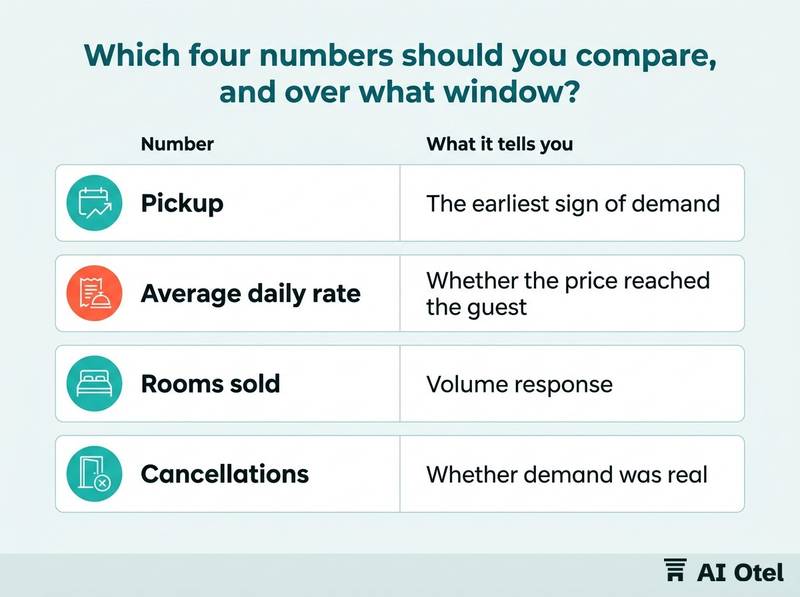
Compare pickup, average daily rate, rooms sold and cancellations, over two windows of equal length, each measured at the same number of days before arrival.
Match length and weekdays. A 14-day window against a 14-day window, both starting on the same weekday, keeps the weekend share constant. A 14-day window against a 10-day window measures the calendar, not the price. Measure at the same lead time, not the same calendar date: compare what was on the books 21 days before arrival in both windows, so the booking horizon is held still.
Hold the definition of average daily rate constant: same tax treatment, same breakfast inclusion, same commission basis on both sides. A rate that is net in one window and gross in the other will produce a result you cannot use. Count rooms sold as room-nights, not reservations: one group of 30 rooms for three nights is 90 room-nights and will swamp a transient price effect the change was meant to test.
Keep cancellations in the set. A price rise can move demand from never booked to booked and then cancelled, and a review that ignores cancellations flatters every increase. Treat revenue as a derived check, rooms sold multiplied by average daily rate, not as a fifth independent number, so you notice when the two disagree.
| Number | What it tells you | What it can hide |
|---|---|---|
| Pickup: rooms on the books for a future date at a fixed moment | The earliest sign of demand | Group blocks and releases, bookings made under the old rate |
| Average daily rate: average room revenue per occupied room-night | Whether the price reached the guest | Discounts, channel mix, inclusions |
| Rooms sold: room-nights occupied in the window | Volume response | One large group, long stays, house use |
| Cancellations: rooms released before arrival | Whether demand was real | Late cancellations that arrive after the review date |
Write the four numbers into one small table before you look at them, so the shape of the result is visible at a glance instead of assembled from memory.
Why do holidays, events and competitor rates break the comparison?
Because they move the same four numbers your price change moves, and once the window has passed the data cannot separate them.
Religious and public holidays move against the calendar. A bayram that fell inside one window last year falls outside the other this year, so the two windows are not selling the same product. School breaks and long weekends shift the booking curve weeks earlier, so pickup changes before the stay dates do; a window that looks flat may simply be a window whose guests have not started booking.
Local events fill or empty a window: a fair, a match, a festival, a congress. Note them in the record on the day. Reconstructing them from memory three weeks later is where most reviews go wrong.
Competitor rate moves matter because a market-wide rise and your own rise look identical in your own numbers. A weekly rate check gives you a market line to compare against; a weekly rate-shopping routine for competitor prices is enough to build one. Restriction and channel changes made in the same week belong in the same record, because a new minimum stay or a closed channel changes volume without any price effect at all.
Watch outConfounders cannot be removed afterward
A price change made in the same week as a holiday, a local event or a competitor's campaign cannot be separated from them afterward. Write the confounders down on the day, and note which ones the window still contains.
Handle a confounder one of three ways: split the window at the confounder, widen the window until a clean comparison exists on both sides, or accept that this window cannot answer and wait for the next one. Then say which confounders you removed and which you could not. A reader of your own review, including your future self, needs that sentence more than it needs a verdict.
What does an honest worked example look like?
It shows four numbers that disagree, and it ends with "we cannot tell yet" rather than a verdict.
For example, a 40-room hotel raises its flexible rate for two weeks. The comparison windows are the 14 days before and the 14 days after, and both are measured 21 days before arrival.
The four numbers come out mixed: average daily rate is up, rooms sold is up slightly, pickup is down, and cancellations are up. No single direction, and no obvious story.
The arithmetic shows why. Most of the extra cancellations came from the same segment that booked at the higher rate, and the rooms sold figure is carried by one group block that would have booked at any price. Remove the group and the remaining movement is smaller than the normal week-to-week swing in the same hotel's own numbers from the previous months.
The write-up says exactly that: the change is consistent with a small rate gain and no volume loss, but the window contains a group and a holiday, and the two cannot be separated. The decision is to keep the rate, extend the review by two clean weeks, and record group business separately from transient business from now on.
The point of the example is the shape of the reasoning, not the numbers. The same four steps work at any size of hotel.
When can two weeks of data not answer the question?
When the movement you are trying to detect is smaller than the normal swing in your own numbers, or when the window contains something you cannot remove.
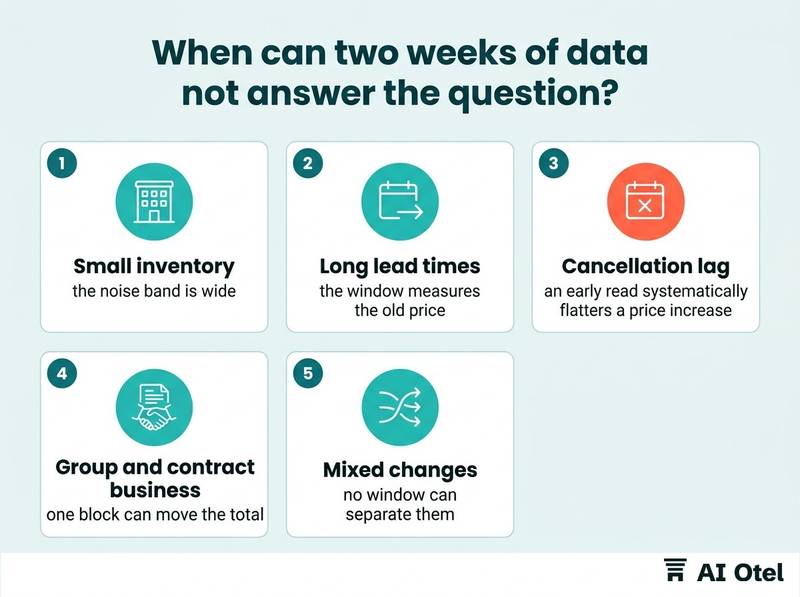
Small inventory is the first reason. In a hotel of 30 to 40 rooms, a handful of bookings is a large share of the total, so the noise band is wide and a real effect can hide inside it. Long lead times are the second: if most guests book months ahead, the two weeks after the change contain almost no bookings made under the new rate, so the window measures the old price.
Cancellation lag is the third. Cancellations arrive late, so an early read systematically flatters a price increase and makes a decrease look worse than it was. Group and contract business is the fourth: one block or one corporate allotment can move the total more than the price change did, in either direction. Mixed changes are the fifth: if the rate, the restriction and the channel mix all moved together, no window can separate them, and the honest conclusion is that the test was not designed.
The test itself is simple. Compute the week-to-week swing in rooms sold over the previous few months. If the post-change movement sits inside that band, the answer is "cannot tell yet", and the correct next step is a longer or cleaner window, not a guess. The same discipline applies when you judge your own forecasts; measuring forecast accuracy with your own numbers uses the same noise band.
Treat "cannot tell yet" as a result. It tells you the test was too small, which is information about your measurement, and it protects you from reverting a good rate on noise.
How do you write the decision and the review date?
Before the change, write one page that states what you expect, how you will measure it, and what you will do with each possible result.
State the change exactly: which rate, which room types, which channels, from which date, and what stayed the same. State the hypothesis in one sentence, in numbers you control: for example, rate up, rooms sold flat or slightly down, revenue up. Fix the four numbers and the two windows, and write the measurement date as a date in the calendar, not as "after two weeks".
Set the threshold from your own recent week-to-week swing, so "an answer" means a movement larger than your normal noise. List the confounders you already know about: holidays, local events, a planned campaign, a group on the books. Write the decision rule in advance, keep, revert or extend, and name the person who decides. If the change is a seasonal rise rather than a mid-season test, put the cost side on the same page, as in setting next season's price rise against lira costs and euro contracts, so the rate decision and the cost decision are read together.
ChecklistOne-page record before the change
- The change: rate, room types, channels, start date, what stayed the same
- The hypothesis in one sentence
- The four numbers: pickup, average daily rate, rooms sold, cancellations
- The two windows and the measurement date
- The threshold taken from the hotel's own week-to-week swing
- The known confounders
- The decision rule: keep, revert or extend
- The owner of the review
- The review date in the calendar
What to do next
Write the one-page record before your next rate change and put the review date in the calendar. The method is small: four numbers, two equal windows measured at the same lead time, a written list of confounders, and a threshold taken from your own noise. When the result falls inside that noise, the answer is "we cannot tell yet", and the next step is a cleaner window rather than a confident story about a rate that may not have done anything.
If you want the four numbers to come out of one system instead of three spreadsheets, a hotel operating system that keeps reservations, rates and cancellations in one record, built and working, ahead of launch, makes the windows easier to build, and a hotel growth consultancy can help set the thresholds before the change rather than after.
Frequently asked questions
How long after a price change should I wait before judging it?
There is no fixed number of days; the window is set by lead time and by noise. Wait until the post-change window contains bookings made under the new rate at the same lead time as the comparison window, which for a short-lead city hotel can be a few weeks and for a resort selling months ahead can be a season. Then check whether the movement is larger than the hotel's own week-to-week swing before drawing any conclusion.
Should I compare with the weeks before the change or with the same weeks last year?
Both are proxies with different biases. The weeks before share the current market, the current competitor set and the current cost base, but they sit in a different part of the season. The same weeks last year share the season but carry a different calendar, a different price level and different events. Choose the proxy that shares the most conditions with the test window, state which one you used, and do not switch proxies after seeing the result.
Rooms sold went up but the average rate went down. Did the change work?
It depends on what you predicted. Revenue is the derived check: if rooms sold rose by less than the rate fell, revenue fell, and the change did not work on its own terms. Before concluding, check whether the volume came from transient guests or from one group block, and whether cancellations rose in the same window.
Do cancellations belong in a price change review?
Yes. A price increase can turn a lost booking into a booking that is made and then cancelled, which looks like success in a pickup report and like nothing in the final numbers. Count cancellations and no-shows in the same window as the bookings, net them against rooms sold, and note when each cancellation arrived relative to the review date.
Can I measure a price change on a single room type?
In principle yes, and it is the cleanest comparison when the change touched only that room type. In practice the volume gets small quickly, and a single room type in a small hotel often produces too few bookings for a movement to rise above normal noise. Measure at the level where the volume exists, then check whether the room mix shifted in a way that explains the result.