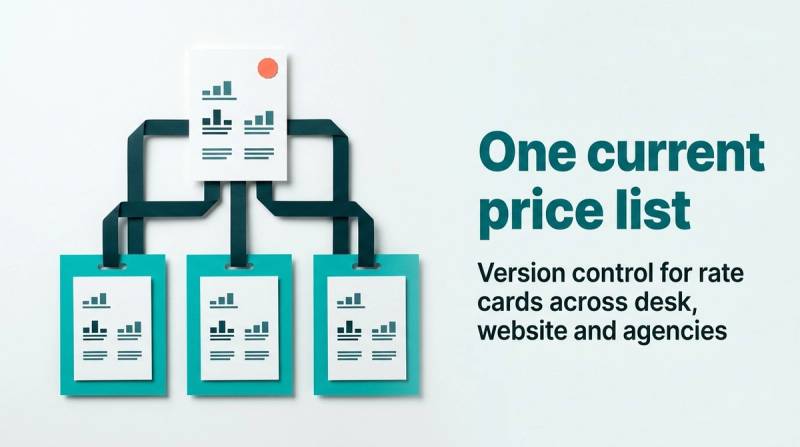
One current price list: version control for rate cards across desk, website and agencies
A stale price on one channel creates two truths and no accountability. This guide explains how to maintain one master rate card, track every copy, and update all channels the same day.
AI draft · awaiting editorial review
Contents
Key takeaways
- A price is not a number: it is a number, a date range, a room type, a board basis and a set of conditions, and a copy that carries only the number will drift.
- The master list needs one named owner, a version number and an effective date; every other copy is generated from it, never edited locally.
- A rate change is finished when every copy shows it, not when the decision is made: the desk, the website, the channel manager and the agency sheets move the same day.
- The change log is append-only: a reversal is a new line, so the record of the wrong price survives and answers the question months later.
- A weekly spot check reads the price as a guest would, including supplements and season boundaries, and leaves a written trace.
Hotel rate card version control means one master price list, owned by one person, carrying a version number and an effective date, from which every other copy is generated. Every change is logged and pushed to the desk, the website and agencies the same day, so no channel can quote a price the hotel no longer sells.
A guest at the desk is quoted last season's price from a laminated card while the website shows the new one. Nobody typed anything wrong: one copy simply stopped being current, and the hotel now has two prices and no way to say which one is real. This article gives you the four pieces that prevent it: a master rate card, a list of every copy, a same-day update routine, and a change log with a weekly check behind it.
Why do old prices keep circulating?
Old prices circulate because a rate leaves the hotel in many copies, each with its own owner and its own update path, and the slowest copy sets the price the guest actually meets.
A rate is never one number. It is a number plus a date range, a room type, an occupancy basis, a board basis, a currency and conditions such as minimum stay or cancellation terms. A copy that carries only the number is already incomplete, because the reader has to fill in the rest from memory, and memory drifts.
The same price gets copied into the front desk folder or the PMS rate screen, the website booking engine, the channel manager that feeds the OTAs, the contracted sheets sent to travel agencies, quotes written by email, corporate contracts, metasearch listings and printed collateral. Each copy has its own life and its own pace.
Separate the two failures. A wrong price, such as a typo or a missing supplement, is a validation problem. A stale price, correct once and never retired, is a version problem. They need different fixes, and treating both as "someone made a mistake" fixes neither.
The desk is the highest-risk copy because it can say yes out loud. A spoken price is a commitment the hotel has to answer for, and it is hard to take back once the guest has heard it. An old sheet whose season boundary has already passed is a standing offer: anyone still holding it can reasonably argue the hotel published it.
The cost is not only the money on one booking. Two guests in the same week can pay different prices for the same room, and the hotel cannot explain the difference to either of them.
Key pointThe core rule
A price is a number plus an effective date plus a version. A copy missing either the date or the version is not a price, it is a rumor.
What belongs in the master rate card?
The master card holds everything a person needs to quote a price without asking anyone, and it carries a version number and an effective date on every page.
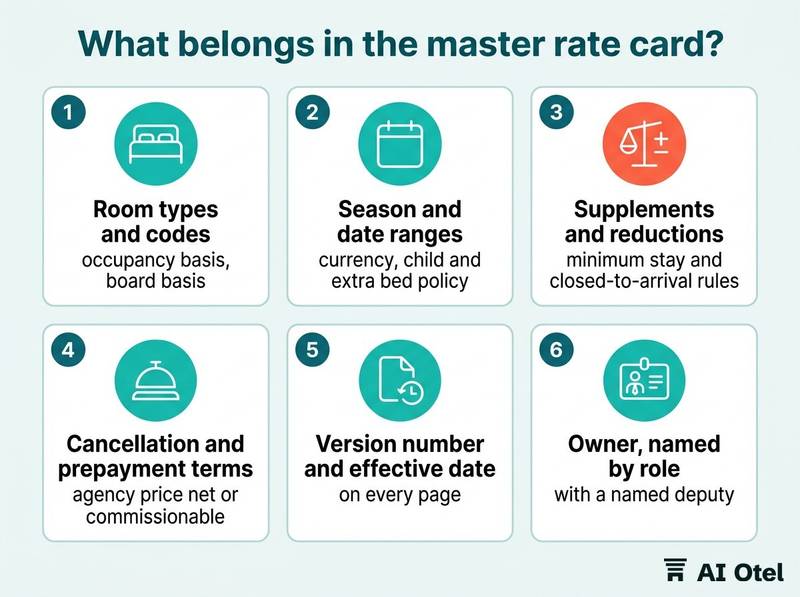
One owner, named by role, with a named deputy. A committee owns nothing, and an unowned document is edited by whoever is closest to the problem. When the revenue manager is on leave, the deputy decides, and the log records it.
Keep two dates, labelled differently. The effective date is when the price starts to apply; the issue date is when the version was published. Confusing them is how a correct change looks wrong a month later, because someone checks the wrong column and "corrects" a price that was never wrong.
The card must state room types and codes, occupancy basis, board basis, season and date ranges, currency, child and extra bed policy, supplements and reductions, minimum stay and closed-to-arrival rules, cancellation and prepayment terms, and whether an agency price is net or commissionable. Every other copy is a view of the master, never a fork: if an agency needs a different layout, the layout is generated, not retyped.
Put the version and the effective date into the file name and the footer of every page, so a screenshot or a printed page dates itself. And keep the master in one place with one link that the desk, sales and reservations all use, not in three inboxes and a shared drive nobody can find.
ChecklistMaster rate card contents
- Room types and codes
- Occupancy basis (single, double, extra bed)
- Board basis
- Season date ranges with first and last day
- Currency and any conversion rule
- Child policy
- Supplements such as parking, pets and late checkout
- Reductions
- Minimum stay and closed-to-arrival
- Cancellation and prepayment terms
- Agency net or commissionable
- Tax line
- Version number, effective date, issue date
- Owner and deputy
For the table itself, the seasonal structure is covered in a hotel rate sheet with prices, supplements and reductions in one table.
Where does a rate card get copied, and who updates each copy?
Every channel that can quote a price holds a copy, and each copy needs a named owner and a defined update path; the copies without an owner are the ones that go stale.
List the copies before fixing anything. You cannot control a copy you have not written down, and most hotels find copies they had forgotten, from a two-year-old brochure to a rate plan in the channel manager that nobody maps to a current season.
The channel manager is a copy too. A rate loaded there but not in the PMS, or the reverse, produces two truths inside the same hotel, and the guest meets whichever one the channel in front of them reads. Agency sheets and corporate contracts are copies with a counterparty: they need a version, a date and a confirmation back, otherwise the agency can reasonably work from the version it holds. Text that states a price in words, on website pages, brochures, in-room material or pre-arrival messages, is the copy teams forget, because it does not look like a rate.
| Where the copy lives | Who owns it | How it is updated | What goes wrong when it lags |
|---|---|---|---|
| Front desk folder or PMS rate screen | Front office manager | Replaced on every version change | Guest quoted an old price out loud |
| Hotel website booking engine | Reservations or web owner | Pushed same day from master | Direct guests see stale prices |
| OTAs through the channel manager | Revenue or distribution | Pushed same day from master | Parity gaps, mispriced bookings |
| Agency sheets and allotments | Sales contact per agency | Regenerated, sent, confirmed | Agency sells prices the hotel retired |
| Corporate clients and email quotes | Sales | New version attached, confirmed in writing | Contracts dispute at settlement |
| Metasearch listings | Distribution | Refreshed from same inventory | Wrong price shown before the site |
| Printed collateral and in-room material | Marketing | Next reprint, old stock withdrawn | Old price keeps circulating |
Give each copy a maximum lag: the desk and the booking engine the same day, agency sheets the same day with confirmation, printed material at the next reprint with the old stock withdrawn. One person should be able to answer where the hotel's price is published from a single list, without asking three colleagues. A consistent naming convention helps here, as described in one rate plan naming convention for the PMS, the channel manager and the website.
How do you update every channel the same day?
Treat the change as unfinished until every copy shows it: write the log line first, update the master, push to the systems, then read each copy back as a guest would.
Step one is the log line, written before anything is touched. It fixes what is being changed and why, and it stops a second person making a different change at the same time. Step two is the master: bump the version, set the effective date, then push to the systems that carry the price, the PMS, the channel manager and the booking engine, in that order, because the master is the source and the systems are copies.
Step three is the human copies. Regenerate the agency sheets, send them with the new effective date and ask for confirmation, replace the desk copy, and brief the desk at the shift handover rather than by email. A handover briefing reaches the person who will actually quote the price; an email reaches whoever opens it.
Step four is read-back. Open the website and one OTA as a guest, check the desk copy and the agency sheet, and compare the total including supplements, not just the room rate. Two channels can show the same room rate and still produce different totals because one carries a supplement the other dropped.
For an urgent error, stop the sale first and correct second. Close the wrong price on every channel, then fix it, because a correction takes time and a booking takes seconds. When a channel cannot be updated the same day, the master carries a note saying which copy is behind and until when, so nobody assumes it is current. Who is allowed to make the change in the first place is its own question, covered in discount limits and override rules for hotel staff.
What should a rate change log record?
One line per change, never edited afterwards, holding who changed what, from which value to which, why, and which copies were updated and confirmed.
The fields that earn their place: date and time, person, room type and date range affected, old value, new value, reason in one line, copies updated with times, and who confirmed on the agency or OTA side. Keep the log next to the master, not in a chat thread: a log in a messaging app is a conversation, not a record. A plain spreadsheet with fixed columns beats a system nobody fills in; the discipline matters more than the tool.
The log is append-only. A reversal is a new line that restores the old value, not a deletion, because the record of the wrong price is the most useful part of the log. It answers the question that arrives months later: why is this guest paying this price, and who agreed to it.
Review the log weekly for repeats. The same room type changed three times in a month is a pricing process problem, not a typing problem, and the log is where that becomes visible.
TipThe two fields people skip
The reason in one line, and the confirmation that the agency or OTA side actually applied the change. Both are the ones a dispute or an audit needs, and both are the ones left blank on a busy afternoon.
How do you spot an outdated price before a guest does?
Run a short weekly check that reads the price the way a guest would, on a handful of dates, and write down what you found.
Pick dates at random across the coming season plus the first and last day of each season, because boundaries are where copies disagree. Read four copies for each date: the website booking engine, one OTA, the desk copy and the agency sheet, comparing the total with supplements, not the room rate alone. Check the date stamp on every copy you touch: a copy with no visible version or effective date is a finding on its own, whatever the number says.
Separate the two questions. Parity asks whether channels agree with each other now; version control asks whether they agree with the master today. A hotel can pass a parity check and still be quoting last month's price everywhere, as the routine in a weekly rate parity check for direct and OTA prices shows. Give every mismatch an owner and a date on the same day, and record the check itself, because a check that leaves no trace cannot be audited or improved. Rotate who runs it, so the desk learns where prices live and the person who made the last change is not the only one testing it.
ChecklistWeekly spot check
- Choose three future dates and one past date
- Read the website booking engine
- Read one OTA
- Read the desk copy
- Read the current agency sheet
- Compare totals including supplements
- Check version and effective date on each copy
- Check the season boundary dates
- Log the result and give any mismatch an owner and a date
What to do next
Today, list every place the current price is published and put a name next to each one. Then put a version number and an effective date on the master. Version control is not a document but the routine that keeps the document true: the master, the copies, the log and the weekly check only work as one loop.
Frequently asked questions
How often should a hotel update its rate card?
On every change, not on a calendar. The card carries an effective date and a version, so a scheduled review only confirms that nothing has drifted. A fixed review date is still useful, because it catches the copies nobody remembered to update.
Should the front desk keep a printed price list?
Yes, if it carries the version and the effective date and is replaced whenever the master changes. A printout without a date is the riskiest copy in the building, because staff quote it out loud and a spoken price is hard to take back.
Is a channel manager enough to keep prices consistent?
No. It carries what it is given and does not decide what is current, and a rate loaded in one system but not the other creates two truths. It also does not touch agency sheets, printed copies or quotes already sent by email.
What do we do when a guest produces an old price list?
Check the version and the effective date on the copy, check the change log, and record the decision and who made it. Whether the hotel is bound by a price it no longer sells is a question for its legal adviser. Operationally, the job is then to find and retire the copy that is still circulating.
What is the difference between a rate sheet and a rate change log?
The sheet is the current state and answers what the price is today. The log is the history and answers why it changed, when, and who confirmed it on each channel. A hotel needs both, because a dispute is always about the past, not the present.