Missed charges: finding services delivered but never posted to the guest folio
A missed charge is a service delivered but never posted to the guest folio. This guide shows how to find them with a weekly sample, classify the errors, and fix the underlying process.
AI draft · awaiting editorial review
Contents
Key takeaways
- A missed charge is a delivery with no folio line, so the check has to start from the delivery record, not from the bill.
- Ten departures a week, matched line by line against minibar sheets, outlet checks, spa logs and parking records, is enough to show which department misses and why.
- Classify every miss as no record, wrong room, unposted record or undocumented complimentary: each class has a different owner and a different fix.
- A slip posted to the wrong room matters more than an unposted one, because it overcharges one guest while it undercharges another.
- The monthly summary should give counts and recovered value by department and by class, plus the one process change made, not an estimate of lost revenue.
A missed charge is a service the hotel delivered but never posted to the guest folio: a minibar item, a spa treatment, an extra bed, parking. You find missed charges on the hotel folio by taking ten departures a week, pulling every delivery record for those rooms, and matching each record to a folio line.
A guest checks out at 11:00 and the folio shows the room and breakfast. The minibar sheet for that room lists items taken, the spa log has a treatment booked to the same room, and the parking barrier logged the car for three nights. None of it is on the bill, and nobody notices until someone compares the two sides. This article gives you the comparison method: a fixed weekly sample, a classification sheet, and the process changes that follow from what the sample shows.
What counts as a missed charge, and where do charges slip?
A missed charge is a service the hotel delivered and did not post to the guest folio before it closed. It is not a rate error, a discount or a deliberate write-off, and separating those four is the first step.
Draw the boundary before you count anything. Delivered and not posted is a miss. A charge that was never due, such as an agreed complimentary or a corrected rate, is not a miss and must not be counted as one, because it inflates the number and hides the real pattern. Timing is a third thing: a charge posted late but posted is a discipline problem, not missing revenue, and it belongs in a different column of the sheet.
The reason the folio cannot diagnose itself is simple: it only shows what was posted. Every check has to run from the delivery side toward the bill, never the other way. And because a full audit of every departure is not affordable, the method is a fixed weekly sample that shows the pattern rather than the total.
The delivery record each department leaves
| Department | Record that proves delivery | Usual failure point |
|---|---|---|
| Minibar | Count sheet by housekeeping | Counted at end of shift, never keyed |
| Restaurant and bar | Guest check with room number and cover count | Check closed after night audit |
| Spa | Treatment log or appointment book | Room number taken verbally, never verified |
| Laundry | List and tag number | Guest charged at collection, nothing written |
| Parking | Barrier or ticket log | No link to the room at all |
| Extra bed, day room | Front desk or housekeeping note | Noted at departure, not at the request |
| Transfer or tour | Driver sheet or voucher | Billed to the agency, never to the room |
The same logic governs minibar stock as a whole: minibar stock, charges and late postings are controlled from the count sheet, which is why the count sheet is where the sample starts.
Four places a charge slips
Every miss you will find sits in one of four structural places. First, no record was created at delivery: the item or service was handed over and nothing was written anywhere. Second, a record was created on paper and never keyed into the system. Third, a record was keyed to the wrong room, which means it sits on another guest's folio. Fourth, a record was keyed after the business day closed, so it arrives too late or not at all.
How do you run a weekly sample of ten departures?
Take ten departures from the past week, pull every delivery record attached to those rooms, and match each record to a folio line. One person can finish it in an afternoon if the pack is fixed in advance.
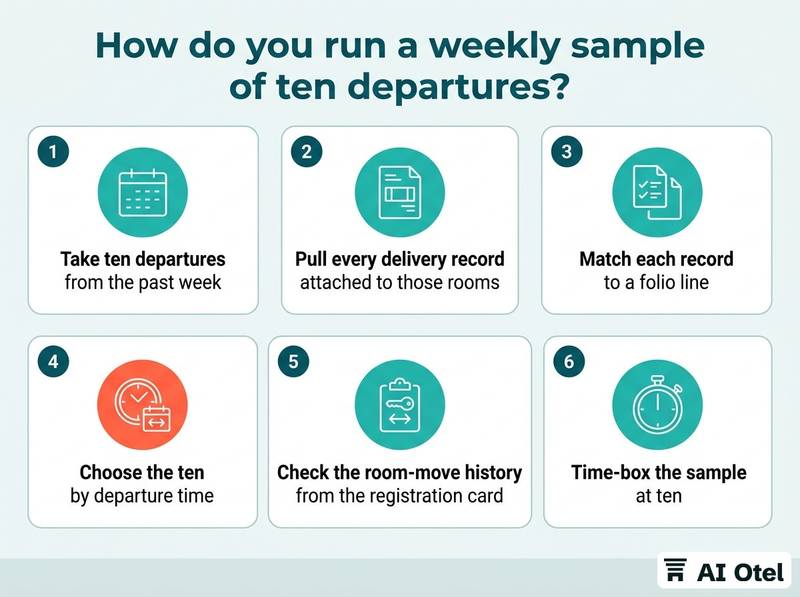
Choose the ten from the night audit departure list by departure time, not by who is on shift. Spread them across days and segments, and include at least one group or agency account and one cash-settled account, because those two settle differently and fail differently. Keep the size and the weekday identical every week, so month-on-month counts compare like with like.
Before matching, check the room-move history from the registration card. A move breaks the room number as a key and produces false misses on both folios, and one week of false misses is enough to make staff distrust the whole exercise.
Checklist
- Departure list from the night audit
- Folio printout with every posting line
- Minibar count sheet for the room
- Restaurant and bar checks carrying that room number
- Spa treatment log for the stay dates
- Laundry list and tag numbers
- Parking or barrier log
- Extra-bed and day-room notes
- Registration card and room-move history
- Blank classification sheet with the four classes and a value column
What a match means
Use room number, date and a time window as the matching key, and define a match strictly: same amount, same date, same room. A near match goes into the classification, never into the clean pile. Record one line per delivery record with four fields: record found, folio line found, class, value. Nothing else, so the sheet stays readable after twenty weeks.
Time-box the sample at ten even when the tenth departure opens a bigger question. Note it and take it to the manager as a separate matter; the sample is a measurement, not an investigation.
How do you classify a miss: forgot, wrong room or no slip?
Four classes cover almost every case: no record at all, a record on the wrong room, a record that was never posted, and a complimentary nobody wrote down. Each class points to a different fix and a different owner.
| Class | What you see in the sample | What it usually means | Who owns the fix |
|---|---|---|---|
| No record | Delivery proven by a log, no slip anywhere | The handover step has no control | Outlet supervisor |
| Wrong room | Record exists on another folio | Room number taken verbally or keyed from memory | Front desk and outlet together |
| Unposted record | Slip in a drawer or a failed posting | Closing routine ends before posting is confirmed | Outlet supervisor and night audit |
| Undocumented comp | No charge and no note | An authority decision with no trace | Department manager with the general manager |
The overcharge hiding inside the miss
A wrong-room posting is two errors at once: an overcharge and an undercharge. The overcharge is the urgent one, because it reaches the guest as a complaint, a refund and possibly a review, all from the same class of error that quietly undercharges someone else. When you rank what to fix first, rank by guest exposure, not by value.
Why undocumented comps belong in the same sheet
An undocumented complimentary is not a loss until you cannot tell it apart from a miss. The fix is a written authorization carrying a name: who decided, on what basis, when. Flag timing separately throughout: a charge posted after the folio closed is a policy question about late charges, not a classification, and the hotel needs its own written rule for it. The class matters more than the total, because the total says there is a problem while the class says who owns it and what to change.
How do you fix the process instead of the person?
Move the control to the moment the service is handed over, and make the end of the shift the second check rather than the only one.
Require the slip at delivery. The person who hands over the item, the treatment or the parking ticket writes or scans the room number at that moment, because a slip written at the end of the shift is a memory test. Verify the room number against the in-house list at the point of entry, which is also the cheapest control against the wrong-room class.
Close every outlet with a count of checks issued against checks posted, and require the difference to be explained before the business day closes. Count the minibar at a fixed time and post it in the same shift, with housekeeping and front desk agreeing in writing who posts. Note extra beds, day rooms and late departures in the room file at the moment of the request, not at departure.
The closing routine as a second check
The night audit exception list is the daily net: it catches what the shift missed. It cannot catch what was never recorded at all, which is why the delivery-side control comes first and the closing routine second. The exception lists sit alongside card reconciliation at night audit and the other night audit reports as the daily layer of control; the weekly sample is the layer that checks the daily layer.
TipOne rule for the notice board
No service leaves the counter without a room number, and no exception leaves the shift without a name. Allow the exception, require the note.
Is a missed charge the same as theft?
No. Most misses come from the shape of the process, and treating them as theft removes the reporting you need in order to find them.
Keep the collection step blame-free. Staff who expect an accusation stop writing the notes that make the sample possible, and the sheet goes quiet without the problem going away. Distinguish a miss from a deliberate act by shape, not by feeling: a miss is spread across people and shifts and leaves a record somewhere or nowhere at all, while a deliberate act concentrates on one person, one shift or one payment type.
Handle a concentration separately. Take the records to the manager as its own matter, outside the weekly sample, and take the records rather than a conclusion. Write the report in the language of classes and records, never of people, so the monthly summary can be read in a management meeting without becoming a disciplinary file. And treat the overcharged guest as the larger exposure throughout: a wrong-room posting produces a refund, a complaint and a review from the same class of error.
Watch outA sample run as a hunt
A weekly sample run as a hunt produces clean sheets and unchanged losses. Collect the records first, classify second, and let the pattern, not the mood of the week, decide what happens next.
What goes in the monthly summary for the owner?
Counts by department and by class, the value found and the value recovered, and the one process change made that month with a named owner.
Fix the columns: department, records checked, misses by class, value found, value recovered, open items, owner of the fix. Lead with counts, not money. A count of misses is a fact the owner can act on, while an estimate of lost revenue is a guess that will be quoted back as if it were measured. Separate recovered from absorbed: say which charges were re-posted with the guest's agreement, which were written off, and on whose authority.
| Department | Records checked | Misses by class | Value found | Value recovered | Owner and date |
|---|---|---|---|---|---|
| Spa (for example) | 22 | 3 (two class 1, one class 3) | Illustrative | Illustrative | Spa supervisor, 15 March |
The example row above is illustrative only. Show the trend on the same basis every month, since the sample size and weekday never change. State what the sample cannot see: departments that leave no delivery record at all, and charges that were never due in the first place. The same counts-before-money logic runs through the weekly count that keeps a petty cash float honest: the count is the fact, the estimate is not.
One change per month
Make one change per month with a name and a date, because two changes at once leave you unable to tell which one worked. Send late-charge and correction questions to the accountant: the fiscal document may already have been issued, and the treatment of a correction is an accounting decision, not a front desk one. If you are weighing software support for this routine, a hotel operating system that keeps financial records append-only, built and working, ahead of launch, and the wider ecosystem around it, are both worth understanding before you choose.
What to do next
Start with one week and ten departures: pull the pack, match every record to a folio line, classify what you find, and change one thing at the point of delivery. The sample is not an audit of last week; it is the measurement that tells you next month whether the change worked, and the monthly summary is how the owner sees it without reading the sheets.
Frequently asked questions
Can you post a charge to a folio after the guest has checked out?
The folio is closed by the night audit, and financial records are corrected by voiding and re-posting, never by deleting a line. Whether a late charge is acceptable is the hotel's own written policy, and in practice it needs the guest's agreement, recorded in writing. Because the fiscal document may already have been issued, the accounting treatment of the correction is a question for the hotel's accountant.
How many departures should we sample each week?
Ten is a starting size chosen so that one person can finish the pack in an afternoon. What matters is not the number but the constancy: the same size, the same weekday and the same pack every week, with every department covered over the course of a month.
What is the difference between a missed charge and revenue leakage?
Revenue leakage is the wider term, covering rate errors, unposted no-shows, complimentary upgrades and charges that were never due. A missed charge on the hotel folio is one specific kind: a service that was delivered and never reached the folio. Keeping the two apart stops the sample from being blamed for losses it was never designed to find.
Does a minibar count sheet prove a charge was due?
It proves that stock moved, which is a signal and not a bill. Before posting, the count needs a second signal: a fixed counting time, a housekeeping record tied to the room, or the guest's own confirmation. Without that second signal you cannot tell consumption from a stock error, and the guest will say so.
Who should own the weekly sample?
The front office manager should run it, with the accountant reviewing the classification and the value column. It should not be owned by the department being sampled, because the person who closes the outlet is the person least able to see the pattern across outlets.