Naming rate plans: one convention for the PMS, the channel manager and the website
A fixed rate plan naming convention prevents mapping errors and guest confusion. Learn the four-part pattern, the two-name rule, and the safe order for renaming plans across systems.
AI draft · awaiting editorial review
Contents
Key takeaways
- A rate plan name is data, not decoration: the front desk, the channel manager and the guest must all read it the same way.
- Fix the order of the parts once (room type, board, flexibility, audience) and keep that order even when you change the words.
- Keep two names for one plan: a short code for staff and systems, a plain name for guests, joined in a single register.
- Rename in one order (PMS, then the channel mapping, then the website), test on each channel, and retire plans instead of deleting them.
A hotel rate plan naming convention is a fixed pattern, usually room type, board, flexibility and audience in that order, plus a short code for staff and a plain name for guests. The same plan then reads the same in the PMS, the channel manager and the website, and every rename is mapped before it is made.
Ask the front desk for the rate with breakfast and you may get four answers: SPO2, SPO2 NEW, SPO2 NEW BB, and one plan nobody has opened since the season it was built for. If your plan list grew by addition rather than by design, you have an accumulation, not a convention. This article gives you a pattern for new names, a rule for keeping staff and guest names apart, a safe order for renaming, and a register so the list does not drift back.
Why do rate plan names drift, and what does it cost at the desk?
Names drift because a plan is created in a hurry, in one system, for one season or one contract, and nobody owns the list afterward. The cost appears later at the desk, in the mapping and in the reports.
Each system asks for a name at a different moment. The PMS asks when a rate is built, the channel manager asks when a plan is mapped, and the website asks when a label is typed into the booking engine. Three moments, three names, and no moment where anyone compares them.
The drift mechanisms are always the same. Someone copies last season's plan and edits the name. Someone adds a suffix for a campaign. Someone names a plan after the person or the channel that needed it. Someone leaves the year in the name and the year ends.
The costs follow a pattern too. At the desk, two plans that differ only by a suffix get quoted interchangeably, so a guest is told breakfast is included when the booked plan is room only, or the reverse. In the mapping, a plan mapped to the wrong code sells a non-refundable rate with free cancellation, or sells a board basis the hotel did not price. Mapping is only as reliable as the names it joins, as we cover in detail in channel manager mapping: room types, rate plans and testing.
In reporting, revenue by plan becomes unreadable, so the hotel cannot tell which plan actually sells and which one only exists. In inventory, a retired plan left open in one system keeps selling after the contract behind it ended.
The decision rule is simple: if two trained people can read one plan name two ways, the name is wrong, however convenient it was on the day it was typed.
ChecklistSigns the plan list has drifted
- Two plans differ only by a suffix or a year.
- A plan's name does not state its board basis.
- A plan is named after a person, a channel or a campaign.
- A plan exists in the channel manager but not in the PMS, or the reverse.
- Nobody can explain a plan without opening it and reading its terms.
- A plan is still open for sale although the contract behind it ended.
What should a rate plan name contain?
Four parts, always in the same order: room type, board, flexibility, audience. The words you choose matter less than the order never changing.
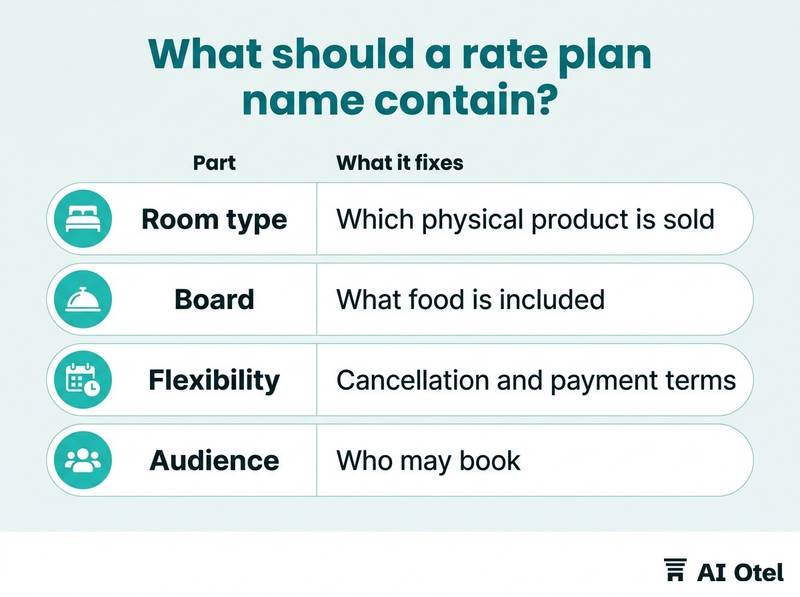
Room type comes first, and it should use exactly the room type names the PMS already uses, spelled the same way. A plan that renames the room type splits one room into two in every report.
Board comes second: room only, breakfast, half board, full board, all inclusive. Staff may use short tokens; guests must see the words.
Flexibility comes third: refundable or non-refundable, and when payment is taken. This is the part guests compare most and the part a wrong mapping damages most.
Audience comes fourth: public, member, corporate, travel agency, group. It records who is allowed to book the plan, which is a restriction, not a marketing label.
Fixed order beats clever wording. Any consistent order is workable, but a convention that changes order between seasons is not a convention. Size the pattern for the narrowest field it must survive, not the widest: a name that fits the PMS and gets cut on a channel is a name that lies on that channel.
For example, a double room, breakfast included, refundable, sold publicly could read DBL BB FLEX PUBLIC, with the plain guest version kept beside it.
| Part | What it fixes | Example token | Why it must not move |
|---|---|---|---|
| Room type | Which physical product is sold | DBL | A renamed room type splits reporting |
| Board | What food is included | BB | Board is the first thing a guest checks |
| Flexibility | Cancellation and payment terms | FLEX or NR | A mapping error here costs money |
| Audience | Who may book | PUBLIC or CORP | It is a restriction, not a label |
Should staff and guests see the same name?
No. Keep a short code for staff and systems and a plain name for guests, and join the two in one register so neither depends on memory.
The code is built for machines and speed: fixed length, uppercase, no spaces, no punctuation that breaks in an export, a URL or a spreadsheet column. The guest name is a short phrase a traveler understands without training: room, board, and the cancellation or payment term that decides the purchase.
The link between them is a field in the register, not a habit. If the code and the guest name live in two documents, they will disagree within a season. Put the decisive words first in the guest name, because a truncated name that begins with a campaign word tells the guest nothing.
Never put a price, a season or a year in either name. Price and dates belong to the rate; a name that carries them goes stale the first time either changes.
The test: read the guest name aloud to someone who does not work at the hotel. If they cannot say what they are buying, rewrite it.
| Where it appears | What it must do | Example |
|---|---|---|
| PMS and channel manager | Survive exports and mapping, stay short and stable | DBL BB FLEX |
| Website and channel listing | Tell a traveler what they buy, lead with room and board | Double room, breakfast included, free cancellation up to 2 days before arrival |
| Rate sheet and register | Hold both, side by side, with the owner's name | DBL BB FLEX · Double room, breakfast, free cancellation |
Which rate plan names need an explanation?
Any name that only makes sense to the person who invented it. BAR, rack and SPO each carry a real meaning, so write that meaning down once and put it in the register.
BAR is the best available rate: the public reference price the hotel publishes for a date. It is a role in the rate structure, not a product, so it should not be the only name a plan has. Rack rate is the published full price before discounts. It is useful as a reference and dangerous as a selling plan if it is never meant to be booked. SPO and similar tokens usually mark a negotiated or special rate for a segment. The token says nothing about board or cancellation, so it needs the full pattern behind it.
Derived plans, built from another plan by a rule such as adding breakfast at a supplement, should show that origin in the code so a change upstream is traceable. Restrictions such as minimum stay or closed-to-arrival dates are not part of the name, but they change what the plan sells, so the register should point to where they are set. For more on building the structure itself, see best available rate and building a rate structure with derived rates.
The rule: if a name needs a meeting to explain, it is not a name, it is a note. Move the note to the register and give the plan a name.
Key pointThree definitions to keep beside the plan list
BAR: the public reference price for a date, a role in the structure rather than a product. Rack rate: the published full price before discounts, a reference point. SPO and similar tokens: segment or negotiated markers that say nothing about board or cancellation and must never stand alone.
How do you rename or retire a plan without breaking a booking?
Map first, change in a fixed order, test on each channel, then retire instead of deleting. A plan with history is never removed.
Step one: write the old name and the new name side by side in the register before touching any system. A rename that exists only in someone's head will be applied halfway.
Step two: change in one order. The PMS first, because it is the source of the plan; then the channel manager mapping; then the website and the booking engine. A plan renamed only in the channel manager will disagree with the PMS at the next rate push, and the disagreement will surface as a wrong price at the desk.
Step three: test with a real search on each channel. The plan must appear with the right board, the right cancellation and payment terms, and the right price for a known date. The same-day check across systems is the habit that makes season loads safe, as described in loading a new season's rates and checking PMS, channel manager and website the same day.
Step four: keep the old code as an alias until every open reservation carrying it has departed. Guests hold confirmations that quote the old name.
Step five: retire, do not delete. Close the plan to new bookings and leave its history readable, so past revenue and past guest bills still make sense.
A rename mid-season is a change to what the guest bought. If the board, the cancellation terms or the payment timing change as well, create a new plan and retire the old one.
ChecklistRename sequence
- Write old and new names side by side in the register.
- Change the PMS.
- Change the channel manager mapping.
- Change the website and booking engine labels.
- Run a live search on each channel and check board, terms and price.
- Keep the old code as an alias until the last booking on it has departed.
- Close the old plan to new bookings and keep its history.
Who owns the rate plan register?
One named person owns the register and one approver signs new plans. Everyone else proposes changes to them, and no plan is created without a row.
The register is one row per plan, holding the code, the guest name, the room type, the board, the terms, the audience, the systems the plan exists in, the owner and its status. Revenue usually owns the register, reservations keeps it accurate day to day, and the front desk reads it. Ownership without maintenance produces a register that is wrong in a month.
A change log matters more than it sounds. When a wrong sale happens, the question is which name was live on which date, and only a log answers it. Review at every season load and after every contract change, because that is when plans are copied, edited and abandoned. Create the row before the plan: a plan that exists in a system without a register row is already unmanaged.
The register and the rate sheet must not become two lists. One holds what the plan is, the other what it costs; if they disagree, the guest is quoted the disagreement. Keep the pricing side honest with the hotel rate sheet: seasonal prices, supplements and reductions in one table.
The register is also the handover document: it is what a new reservations manager reads in their first week instead of asking the desk.
| Register field | What it holds | Why it matters |
|---|---|---|
| Code | The short staff name | Keeps systems joined |
| Guest name | The plain phrase | Keeps the guest-facing side honest |
| Room type and board | What is actually sold | Prevents a wrong quote |
| Terms | Cancellation and payment timing | The part a mapping error damages |
| Audience | Who may book | A restriction, not a label |
| Systems and channel identifiers | Where the plan exists, any channel pointer | Makes retirement safe |
| Owner and status | Who answers for it, active or retired | Keeps the list current |
What to do next
Open the plan list in the PMS today and give every plan one row: code, guest name, room type, board, terms, audience, the systems it lives in, and an owner. That register is the whole article in one action. The pattern keeps new names readable, the two-name rule keeps staff and guests served, the rename order keeps changes safe, and the owner keeps the list from drifting back to where it started.
Frequently asked questions
Should a rate plan name include the price or the season?
No. Price and dates belong to the rate, not to the plan. A name carrying a number goes stale the first time the price changes, and a stale name is still sellable, so the hotel ends up quoting a plan whose name contradicts its price.
Can we rename a rate plan in the middle of the season?
Only when the terms stay the same. If board, cancellation or payment timing change too, create a new plan, map it, and retire the old one, so guests holding confirmations with the old name still match a readable record.
How many rate plans should a hotel keep?
Set the number by what the team can keep mapped and explained, not by a target. Every plan must be explainable in one sentence and present in every system it sells through. If two plans sell the same thing to the same audience, one of them is a mapping error waiting to happen.
Do the website and the OTAs need the same plan names?
The guest-facing name should read the same wherever a traveler compares, because a different wording on each channel looks like a different product. The internal code stays the hotel's own, and where a channel holds its own identifier for the plan, store that identifier in the register next to the code.
Who should approve a new rate plan?
One owner, usually revenue, with one approver for the terms. The register row is created before the plan is built, so the code, the guest name and the audience are agreed while the plan is still an idea rather than after it is already selling.