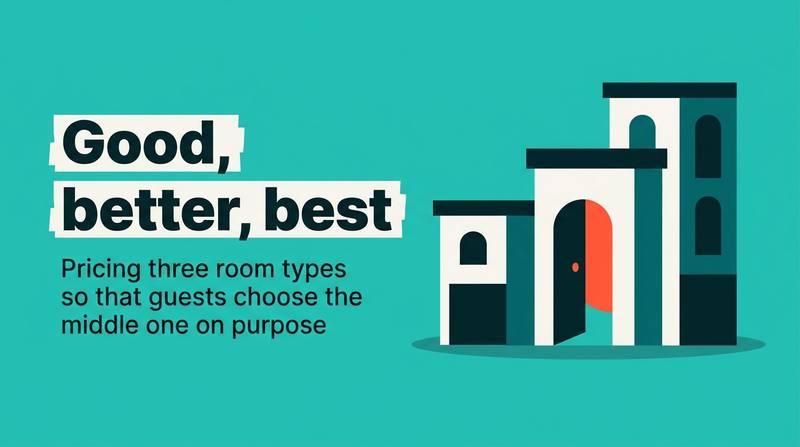
Good, better, best: pricing three room types so that guests choose the middle one on purpose
Price three room types so guests choose the middle one on purpose. Set gaps as percentage steps, test one change for four weeks, and ensure each tier is worth its price.
AI draft · awaiting editorial review
Contents
Key takeaways
- Anchoring is a reading effect: guests judge the middle price against the top and bottom prices on the same page, not against a fair price they carried in.
- Every step up the ladder must be checkable in the room within seconds, or the middle tier reads as a trap rather than a choice.
- Set the gaps as percentage steps between tiers, then check the money: too small a step removes the choice, too large a step sends guests back to the entry room.
- Change one thing at a time and hold rate plans, restrictions, photos, terms and channels fixed, or the month tells you nothing about the ladder.
- Two room types is a legitimate ladder; three tiers only work when the building can deliver three genuinely different rooms in the volume the page will ask for.
Room type price anchoring on a hotel booking page works like this: the top room sets the reference point, the entry room sets the floor, and the middle tier is priced and described so the step up is visible and worth taking. It is a test, not a guarantee.
A guest opens your booking page, sees three room types and three prices, and picks one in under a minute. Most of that decision is made by the gaps between the numbers, before the photos load. The question is whether you set those gaps on purpose or left them to whoever last edited the rate sheet. This article gives you the pieces: what each tier must offer, how far apart to price them, a worked comparison of three ladder shapes, and a one-month test you can run and read.
What is price anchoring on a hotel booking page?
Anchoring is the habit of judging a number against the numbers printed beside it. On a booking page, the top room type sets the reference point, the entry room sets the floor, and the middle price is read as a position between the two rather than on its own.
A guest does not arrive with a fair price for your building in their head. They build one from the page in front of them, in the order the page presents it. The three-tier shape gives the reader a reference, a floor and a comparison. Remove any one of the three and the middle price has nothing to be read against.
Anchoring is not discounting. A discount lowers the level of the ladder; anchoring changes the shape of it. They are decided in different meetings and should stay that way, because a discount applied mid-test will make the ladder unreadable.
The effect describes how people read a page; it does not guarantee an outcome. Guest mix, season, channel and the room itself all move the result, so any change is a test with a start date and an end date. The middle tier is the one the ladder is built to make easy to choose. Easy is the goal, forced is the failure: a guest who books the middle and finds the room the page promised comes back, a guest who feels steered writes it down.
Anchoring runs through the rest of the booking flow too. Rate plan names, cancellation terms and extras sit next to the room price and are read the same way. If you want to go deeper on naming, room type names explained: standard, superior, deluxe and junior suite covers what each label should promise.
Key pointAn anchor is a reference point, not a promise
The top price frames the middle one, and the middle room still has to be worth what it costs.
What must each of the three tiers actually offer?
Each tier must be describable in one concrete sentence a guest can check at the door. If two tiers differ only in name, the ladder collapses and the guest picks on price alone.
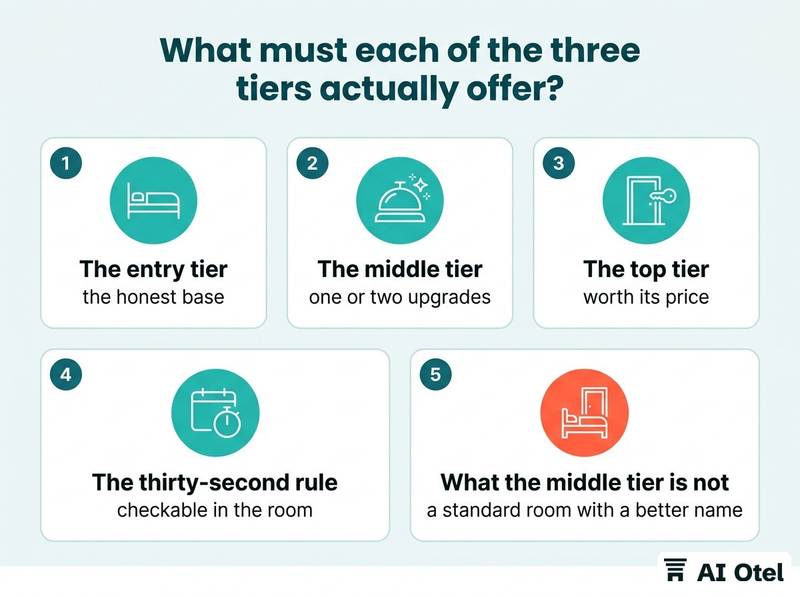
The entry tier is the honest base. Name the bed, the floor area, the window, the view or its absence, the side of the building and the noise. It has to be a room you are willing to sell, not one you hope nobody books. The middle tier carries one or two upgrades a guest can feel within seconds of walking in: floor area, a view, a balcony, a quieter side, a separate bath, lounge access. Two real differences beat six adjectives.
The top tier must be worth its price on its own terms. If the top room is only the most expensive room, the ladder loses credibility and the middle starts to look like the trap.
The thirty-second rule
Every step up must be checkable in the room, not only in the description. A step that exists only on the page becomes a complaint at check-in. This is also an inventory question: the ladder only works if you can deliver the middle tier in volume. Four middle rooms against forty entry rooms produces free upgrades at the desk, and a free upgrade is a price you set by accident.
What the middle tier is not
The middle tier is not a standard room with a better name. Use tier names a guest can compare across hotels, and keep the same names in the rate sheet, the channel listings and the room itself. Write what is there: a grand name on a standard room with a kettle costs more in trust than it earns in rate.
ChecklistThe three-tier check
- Each tier has one sentence a guest can verify at the door.
- The middle tier carries one or two felt upgrades, not a list of adjectives.
- The top tier is worth its price without the ladder.
- The middle tier exists in enough rooms to sell.
- The same tier names appear in the rate sheet, the channels and the room.
- No tier is described with a word the room does not earn.
How far apart should the three room types be priced?
Far enough that the step up is visible in money, close enough that the middle stays inside the guest's budget. Set the gaps as percentage steps between tiers, then check what each step means in cash.
Work in percentages, not amounts. The same cash step means one thing on a low base price and another on a high one, and the guest reads the proportion even when the page shows the amount. There are two steps and two jobs. The first step, entry to middle, decides whether the middle is reachable. The second, middle to top, decides whether the top frames the page or empties it.
Too small a first step and the middle does not exist as a choice, so the guest picks on availability. Too large a first step and the guest stays at the entry room and never considers the middle. Too small a second step and the top absorbs the middle. Too large a second step and the top stops framing anything, because no guest believes it is a real option.
The top step is usually the largest in cash and must be the largest in product. A big price jump over a small product jump is the fastest way to make a whole page look invented. The same percentage also reads differently by segment and by season: a midweek corporate guest and a school-holiday family compare the same ladder against different budgets, so where you can, run the ladder per segment.
Fix the room, not the number. If a tier will not sell at any gap you can defend, the problem is the room or the description. For a fuller treatment of gap sizing, see how big the gap between room types should be.
TipPercentages before amounts
Write the three prices as percentage steps before you write them as amounts: entry to middle, middle to top. If you cannot say in one sentence what each step buys, the gap is doing work the product should be doing.
What does a three-tier ladder look like with real numbers?
Here are three shapes built from the same three invented rooms and the same invented base price, to show how the gaps change what the page invites.
For example, take a fictional 60-room city hotel, one date, one occupancy, one cancellation policy, prices per night in Turkish lira. Change any of those and the comparison stops being a comparison.
| Ladder | Entry / Middle / Top | Step 1 | Step 2 | What the shape invites |
|---|---|---|---|---|
| A | 4.000 / 4.400 / 5.600 | +10% | +27% | The middle looks like the safe step |
| B | 4.000 / 5.200 / 5.600 | +30% | +8% | The top looks like the obvious value |
| C | 4.000 / 4.200 / 4.400 | +5% | +5% | Guests choose on availability, not value |
Invented prices for a fictional hotel, per night, same date, same occupancy and same terms.
Ladder A has a small first step and a large second step. The middle reads as the safe, obvious step up, and the top reads as a different purchase altogether. Ladder B has a large first step and a small second step: the top reads as the obvious value, because the last step costs little more than the middle. Ladder C has two small steps, and the guest stops comparing value and starts comparing availability, which is the same as saying the ladder is not doing anything.
Read each shape against your own building: which of the three can your rooms actually deliver, in the volume the page will ask for? Do the arithmetic on the mix, not on a single booking. A ladder that sells more middles at a lower average rate is not automatically better than one that sells fewer at a higher one, so decide which outcome you are testing for before you start. If the middle tier is really an upgrade offer in disguise, pricing room upgrades and extras covers the move from rate difference to offer price.
How do you test a three-tier ladder in one month?
Change one thing, hold everything else, and measure the room-type mix against a target you wrote down before the test rather than against your hopes.
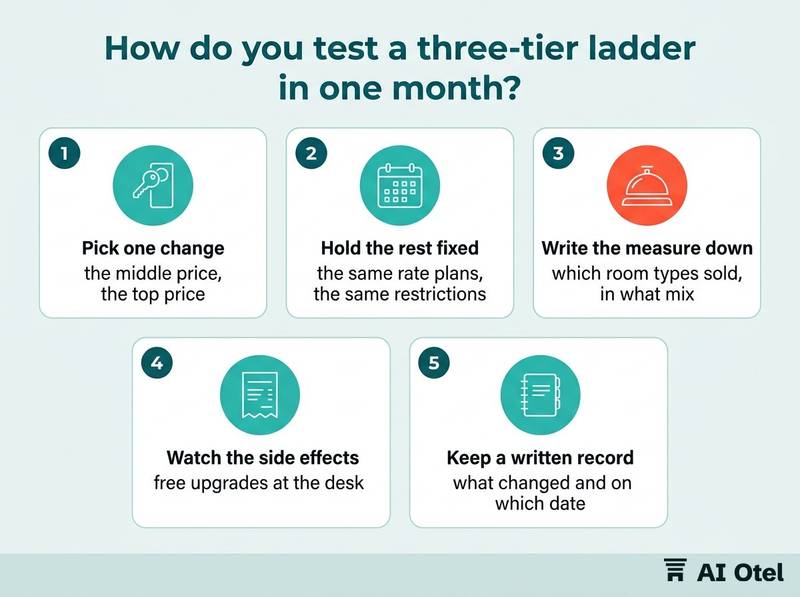
Pick one change: the middle price, the top price, or one description. Not all three in the same month, or you will not know which one moved the result. Hold the rest fixed: the same rate plans, the same restrictions such as minimum stay and closed-to-arrival, the same photos, the same cancellation terms, the same channels. Restrictions in particular can quietly reshape a page; hotel rate restrictions explained lists the ones to check.
Write the measure down before you start: which room types sold, in what mix, at what average rate, and how many guests moved up after booking rather than on the page. Four weeks is a short window. Note the events, the holidays and the day-of-week mix inside it, and do not read a single week as a result.
Watch the side effects: free upgrades at the desk, oversells of the middle tier, and complaints that the room did not match the page. Each of those is a signal about the ladder, not about the guest. Keep a written record of what changed and on which date, so the next test starts from a known state rather than from memory. Treat an unclear result as a result: it usually means the change was too small, the window too short, or two things changed at once.
ChecklistOne-month test setup
- One change, written down with its date.
- Rate plans, restrictions, photos, terms and channels unchanged.
- The measure chosen in advance: room-type mix, average rate, post-booking moves.
- The events and holidays inside the window noted.
- The side effects logged: free upgrades, oversells, complaints.
- A written close-out saying what you will keep and what you will reverse.
If you run this test inside software, the reporting side matters: a hotel operating system that reports room-type mix and average rate in one place makes the before-and-after readable without assembling it by hand. AI Otel's hotel operating system is built and working, ahead of launch, and is built so that room-type mix and average rate can be reported in one place.
When should a hotel not use three tiers?
When the building cannot deliver three genuinely different rooms, or when the middle tier is too thin to sell. Two tiers is a legitimate ladder.
Two room types work: entry and top, with the single gap doing the work. The page is simpler and the guest still gets a comparison. Small properties should take this seriously: three suites and forty standard rooms will produce a page that asks for demand the building cannot serve.
If the middle tier differs only by floor or by the age of the furniture, do not give it a name. A name invites a comparison the room will lose. Contracted room types need care too: if agencies and corporate clients book against contracted categories, the page ladder and the contract ladder must say the same thing, or the guest arrives expecting a room the contract does not name.
Pensions, apart units and hostels compare differently. The ladder is built around a room product, and a unit with a kitchen is not a step up from a room, it is a different purchase. And if the top tier is not worth its price, take it off the page rather than pricing it high for effect. A top tier nobody believes makes the middle look like the only real option, which is the opposite of a choice.
Watch outA tier that exists only to frame
A tier that exists only to make the middle look reasonable is a trap. The guest sees the room at check-in, and the review is written about the room, not about the page.
What to do next
Write your three current prices down as percentage steps, pick the one step you are least sure about, and change only that for four weeks with the dates recorded. The ladder is a shape you set and then test, not a trick you install once, and the honest description of each room is what keeps the middle tier a choice rather than a trap.
Frequently asked questions
Does the middle room type always sell best?
No. The middle is the tier the ladder is built to make easy to choose, but whether it does depends on the gaps, the guest mix, the descriptions and how many middle rooms you actually have. Treat the shape as a test with a start date and a measure, and read the room-type mix rather than a single booking.
Is a decoy room type dishonest?
A top tier that few guests book is legitimate when it is a real room at a real price that a guest can book and enjoy. A tier that is deliberately bad, never available or misdescribed is a trap: the guest sees the room at check-in and the complaint costs more than the rate earned. The test is whether you would be comfortable if the guest booked it.
Should the most expensive room be listed first?
Order changes what the guest reads first. Listing top-down frames the middle against the top price; listing entry-first builds the case upward. Test the order as a single change, and never hide the entry room, because a guest who cannot find the affordable option leaves the page instead of moving up.
Does this work with only two room types?
Yes. The shape becomes entry and top, and the single gap carries the whole job, so the gap has to be set more carefully than in a three-tier page. The rules about verifiable differences and honest descriptions apply exactly the same way.
How do I price a room type that differs only by view?
A view is a real, checkable difference when it is described plainly: what the guest sees, from which floor, in which direction, and what happens when the view is blocked. Price it as a step on the ladder, not as a new category, and do not use it to invent a middle tier that is otherwise the same room.