Room type names explained: standard, superior, deluxe, junior suite and what a listing should say
Room type names vary by hotel, so guests often misunderstand what they book. This guide explains how to write listings that state size, bed, view, floor and layout to prevent disputes.
AI draft · awaiting editorial review
Contents
Key takeaways
- Room type names are set by each hotel, so the same word can describe two different rooms in two hotels on the same street.
- Guests read standard, superior and deluxe as a ranking inside one hotel, and assume each step up means more space, a better view or a higher floor.
- The door is the test for a suite: if a door separates the sleeping area from the sitting area, say so; if not, write open-plan.
- Size, bed, view, floor and layout settle more doubts than any adjective, and they survive translation.
- The confirmation voucher is the document the guest brings to the desk, so the name on it must match the name on the channel.
A room type name is a hotel's own label for a category of room, not a classification with a shared definition. Standard, superior and deluxe describe a hotel's internal ladder; junior suite usually means one room with a sitting area. A listing should state size, bed, view, floor and layout instead of relying on the name.
A guest books a deluxe room, arrives, and finds a room the hotel next door would call standard. Nobody lied, and nobody wrote down what the word meant. That gap is a naming problem before it is a service problem. This article explains how hotel room types actually work, what guests assume each name means, and how to write a listing that answers questions before the guest asks them at the desk.
Why do room type names not mean the same thing from hotel to hotel?
Because no shared rule defines them. Each hotel writes its own names, and the same word can describe two different rooms in two hotels on the same street.
A star rating classifies the facility and its services, not the individual room. The entry room of a large resort and the best room of a small hotel can carry similar names for very different products. Names are set by the hotel's own marketing and reservations team, and they change when a hotel renovates a block, re-floors rooms or re-prices a category.
The mismatch starts in the search result. Guests compare names across hotels in a list where usually only the name, the price and a photo appear. Without a stated size or layout, the guest treats the name as the product. The name is a headline; the description and the confirmation voucher are what the guest can hold the hotel to at the desk. Treat the name as a sorting device inside your own inventory, and the description as the promise you are making.
Standard, superior and deluxe: how do guests read the ladder?
As a ranking inside one hotel, from the entry room upward. Guests rarely read these words as absolute sizes, and they assume each step up means more space, a better view or a higher floor.
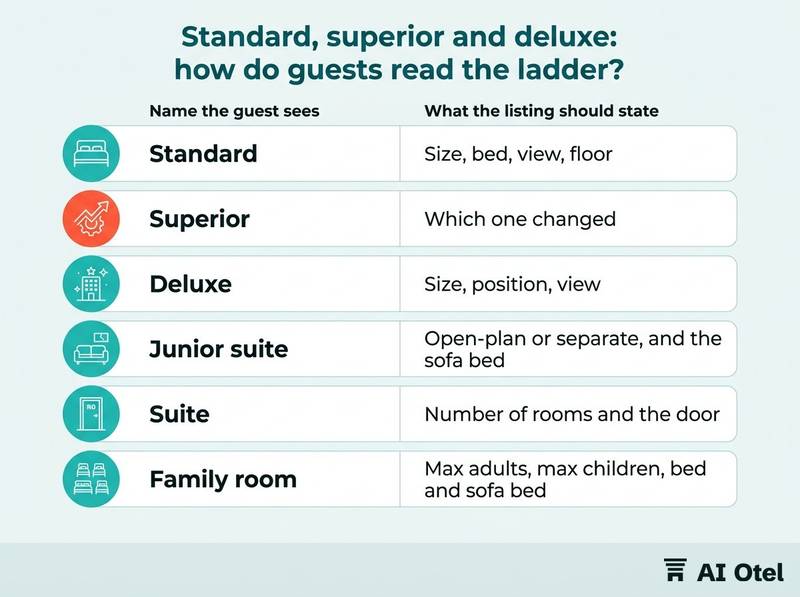
Standard, sometimes written classic or comfort, is normally the room the hotel sells most of and the base of its price ladder. Superior usually signals something better than the base: more floor area, a renovated block, a balcony, a view or a quieter side. Which one it is must be written down. Deluxe usually sits at the top of the non-suite range; in some hotels it is a size step, in others a location step such as a corner, a top floor or a direct sea facing.
The ladder is relative. A deluxe in a small hotel can be smaller than a standard in a large resort, and guests who travel between hotels notice. If two steps differ only in furniture or in floor, say so plainly; otherwise the guest will look for the difference and not find it. Never carry two names for the same physical room across seasons, channels or languages.
| Name the guest sees | What guests usually assume | What the listing should state |
|---|---|---|
| Standard | Smallest, most basic room | Size, bed, view, floor |
| Superior | Bigger or better than standard | Which one changed |
| Deluxe | Top of the non-suite range | Size, position, view |
| Junior suite | A separate sitting room | Open-plan or separate, and the sofa bed |
| Suite | A door and two spaces | Number of rooms and the door |
| Family room | Space for children | Max adults, max children, bed and sofa bed sizes |
What is a junior suite, and when is a suite not a suite?
A junior suite is usually one room with a sitting area inside it; a suite usually has a separate living space behind a door. The door is the test guests apply.
If a door separates the sleeping area from the sitting area, write separate bedroom. If it does not, write open-plan or sitting corner, and show it in a photo. A sofa that converts is a bed only for the people it is sized for; state the sofa bed's width and how many people it suits. Family room describes capacity, not quality: it says how many people sleep there, not how good the room is.
Connecting rooms and adjacent rooms are different products that guests confuse constantly, and the error surfaces at check-in. Connecting rooms have a door between two rooms and are usually sold as a pair; adjacent rooms are simply next to each other. Suite names carry a price premium and a promise, and a suite without a door produces complaints and refund requests that cost more than the naming exercise. Check the actual layout on the floor plan before writing the description, not the brochure from the last renovation. How you assign these rooms before arrival is its own discipline, covered in assigning rooms before arrival: blocking, upgrades and special requests.
Which facts settle the doubt in a listing?
Size, bed, view, floor and layout. A guest who reads those five does not need to interpret the name.
Give the size in square meters, measured the same way for every room type in the hotel, with a line saying whether the balcony is included in the figure. State the bed type and width, for example 160 x 200 cm, plus what the extra bed is and who it suits. Name what is visible from the window and say whether the view is guaranteed or on request; side sea view and sea view are different products and should be different names.
Floor and access matter more than hotels expect: which floors the type occupies, lift access, stairs, and distance from the bar, the lift shaft or the road. State occupancy, maximum adults and maximum children, and whether the room takes a crib. Say whether the bathroom has a shower or a bathtub, and whether it is private or shared. Finally, state what is not included: balcony, minibar, kettle, safe. A guest who is told what is missing does not ask for it at the desk.
ChecklistBefore you publish a room type, confirm
- Measured size in square meters, and whether the balcony counts
- Bed type and width, plus the extra bed or sofa bed
- What the guest actually sees from the window, and whether that view is guaranteed
- Which floors the type sits on and how the guest reaches them
- Maximum adults, maximum children, crib yes or no
- Shower or bathtub
- The three things the room does not have that a guest might expect
How do you keep room type names consistent across channels?
By giving each physical room type one internal code and one master description, then mapping that code to whatever name each channel uses.
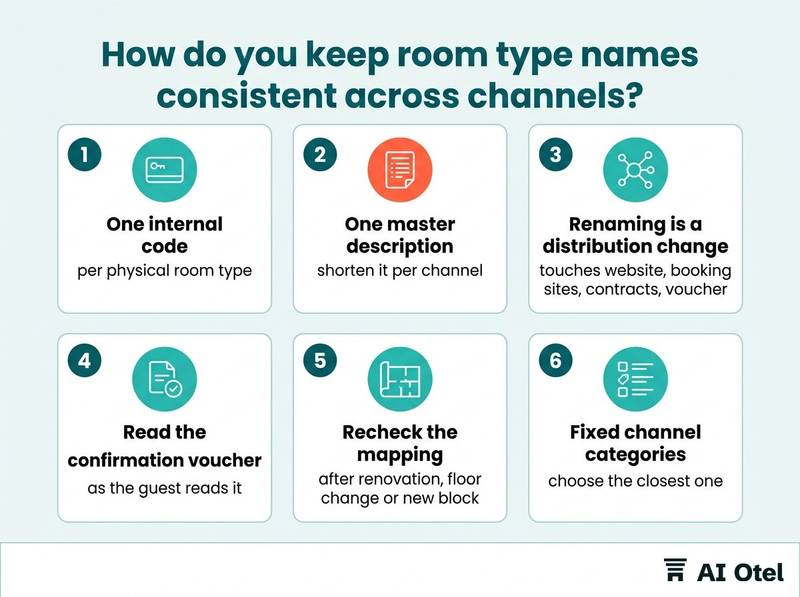
A channel manager maps codes, not names. If the name changes in the hotel system and not in the mapping, the guest sees the old name at the moment of booking. Keep one master description per code and shorten it per channel; never write a second, different description for one channel. The mechanics of this are covered in channel manager mapping for room types and rate plans, and the wider vocabulary of contracts and channels in hotel distribution terms: contracts, rates and channels.
Renaming a room type is a distribution change: it touches the hotel website, the booking sites, agency contracts and the confirmation voucher. Read the confirmation voucher as the guest reads it, because that is the document they bring to the desk, and the name on it is the name they will defend. Recheck the mapping after every renovation, floor change or new block, and after any change of channel manager. Where a channel offers fixed categories of its own, choose the closest one and let the description carry the difference; do not stretch a category to fit a better-sounding word.
What should a room description say? A template
Name the room, state the five facts, then say what is not included. Four lines are enough, and they work in any language.
TipA four-line template, with an illustrative example
For example: "Deluxe, sea facing. 28 m2, balcony included. One 180 x 200 cm double bed. Maximum 2 adults, 1 child on a 90 cm sofa bed. Direct sea view, 4th floor, lift. Bathroom with shower. No minibar; a kettle can be added before arrival." Line one: the name and one sentence on what makes this room different from the one below it. Line two: size, bed, maximum adults and children. Line three: view, floor and layout, including whether a door separates the sitting area. Line four: what is not included, and what can be added before arrival.
Leave out: luxury, spacious, modern, cozy, dream, best room, renovated without a year, quiet without a reason, sea view without a qualifier, and suite without a door. Write the guest-facing text in the guest's language and keep the internal code in your own system, so translation never becomes the source of a new name. A hotel operating system that keeps one master record per room type and feeds every channel from it removes the drift by design; the same idea sits behind a distribution platform and a property management system built so one inventory serves every channel.
What to do next
Take your three most-sold room types this week, write the five facts for each on one page, and compare that page with what your booking sites and your confirmation voucher currently show. Where they differ, the name has drifted. The parts fit together in that order: the name is the headline, the facts are the promise, and the mapping is how the promise reaches the guest.
Frequently asked questions
Is a superior room always bigger than a standard room?
No. Superior can mean a larger room, but it can also mean a renovated block, a balcony, a better view or a quieter floor. The only way a guest can know is if the listing states the size and the specific difference. If the hotel cannot name the difference, the step up is a price step, not a product step.
Does a junior suite have a separate bedroom?
Usually not. Junior suite normally means one room with a sitting area inside it, while a suite normally has a living space behind a door. The test is the door, and the listing should say which one applies and describe the sofa bed if there is one.
Can we rename our room types freely?
The names are the hotel's own decision, so there is no approval to seek for the wording. What needs care is consistency: a rename touches the website, the booking sites, the channel mapping, agency contracts that name categories, and the confirmation voucher. Change the name in the master record first, then everywhere it is mapped.
How many room types should a small hotel publish?
As few as genuinely differ in size, bed, view or layout, and no more. Every published type must be a physical group of rooms a receptionist can assign without guessing. A type that exists only to make the price list look longer creates assignment errors and upgrade requests at check-in.
Should we translate room type names for foreign guests?
Describe the room in the guest's language, but keep one internal code and one master description behind every translation. Translated names drift fastest, because two translators will choose two words for the same room. The facts, size, bed, view, floor and layout, survive translation unchanged.