Net revenue per channel: comparing direct, agency and booking-site sales on your own numbers
Compare channels on net revenue per sold room night, not on the rate sold. Build a quarterly table from your own records to see what direct, agency and booking-site sales actually leave behind.
AI draft · awaiting editorial review

Contents
Key takeaways
- Compare channels on net revenue per sold room night, not on the rate sold: the rate is a price before the hotel pays anything for the sale.
- Four cost lines separate channels: the fee or net-rate discount written in the contract, payment and currency cost, nights that never paid, and staff minutes per booking.
- A cancelled night costs the room you could not resell, so count nights held and released next to nights paid.
- A high net on few nights and a low net on many nights are different tools, and the table has to show both columns.
- Repeat the same table each quarter with the same definitions, and change one thing at a time.
Net revenue per channel is what a hotel keeps from one sold room night after the fees, payment costs, unpaid cancellations and staff time that channel causes. Compare channels on that figure, not on the rate sold: a lower rate with no fee and no follow-up can beat a higher rate that carries both.
Two channels sell the same room type at the same rate. One leaves most of the money with the hotel and no paperwork; the other leaves less, arrives three weeks later, and costs two emails and a phone call. The rate on the confirmation is identical. After reading this you will be able to build one table, from your own numbers, that shows what each channel actually leaves behind.
Why does the gross rate mislead when you compare channels?
Because the rate sold is the price before the hotel pays anything for that sale, and each channel charges in a different currency of cost: fees, payment cost, unpaid nights and staff minutes.
The rate on a confirmation is a gross figure. The hotel's revenue is what remains after the deductions that particular sale caused. Channels deduct in different places: a fee taken off the top, a net rate agreed in the contract, a payment processor's cut, a currency conversion, a cancellation that never pays. Two channels with the same gross rate can end up far apart once those lines are counted, and two channels with different gross rates can end up level.
ADR and RevPAR answer "what did we sell the room for". They do not answer "what did we keep", which is the question a channel decision turns on. Fix three things before comparing anything: the unit (one sold room night), the currency, and the period. A window with a different mix of weekdays and weekends is not comparable.
For example, a room sold at 100 through a channel that charges a fee and pays out late, against a room sold at 92 direct with a card cost: the two can land within a few lira of each other, and only the net column shows it. This is the core of net revenue per channel hotel analysis, and it needs no market benchmark, only your own records.
Keep the rate comparison too. Price is what the guest sees and what rate parity is about; net is what the owner spends. If you do not already run a regular price check, a weekly rate parity check for direct and booking-site prices is the companion routine to the table this article builds.
Key pointThe number to compare
Net per sold room night: the rate sold minus every cost that sale caused, in one currency, over one fixed period.
Which cost lines belong in a channel comparison?
Every line the hotel pays because that booking exists: the fee or net-rate discount in the contract, payment and currency costs, nights that never paid, and the staff minutes the channel consumes.
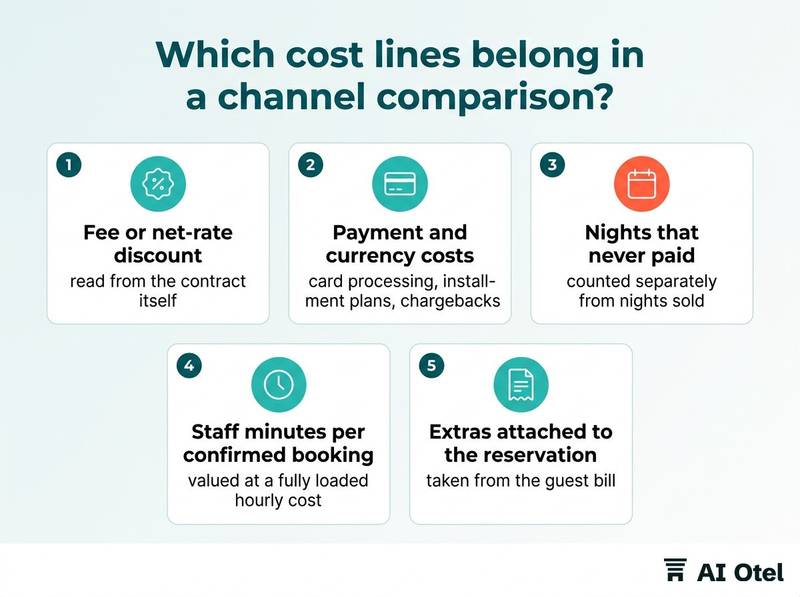
Read the agreement, not the monthly summary. If the channel works on a net rate, the fee is already inside the number you receive, so do not subtract it a second time. Payment cost covers card processing, installment plans, chargebacks, and the gap between the guest paying and the hotel receiving. A channel that pays by transfer after departure carries a different cost from one that pays by card at booking.
Currency needs one rule. A rate sold in euro and a cost paid in lira cannot sit in the same column unconverted. Choose one reporting currency, convert at the central bank's daily indicative rate for the day you book the revenue, and write the rate and its date in the file.
Nights that never paid, cancellations and no-shows, are counted separately from nights sold. Staff minutes per confirmed booking are valued at a fully loaded hourly cost, wage plus employer costs. Extras attached to the reservation are taken from the guest bill rather than assumed from the channel's own summary.
Leave out costs that do not move with the channel, such as rent or the fixed salary of the front desk. A channel comparison is a marginal calculation, and fixed costs blur it.
ChecklistCollect these before you build the table
- the fee or net-rate discount written in each contract, read from the contract itself
- payment processing, installment and chargeback cost, and how long the money takes to arrive
- currency conversion and the exchange rate used, with its date
- nights held and released without payment, per channel
- staff minutes per confirmed booking, per channel
- extras attached to the reservation, counted from the bill
- the costs that do not change with the channel, listed separately and left out
If your channels still draw on separate inventories, start by reading how one room inventory feeding every channel changes the arithmetic: one inventory is what makes the per-channel numbers comparable at all.
How do cancellations and no-shows change the picture by channel?
A night that is held and then released is not revenue, and its real cost is the room you could not resell because the release came too late.
Count two things per channel: nights held, and nights that ended as a paid stay. The difference is the channel's leak, and it belongs in the table as a count, not as a feeling. A free-cancellation window that closes close to arrival leaves little time to resell. The same cancellation made early costs almost nothing. The date of the cancellation matters as much as the fact of it.
Contracted rooms work on an allotment with a release period. Rooms released at the release period return to inventory; rooms released late in the season often go empty. Write the release period into the table so the reader sees it.
A no-show on a non-refundable rate keeps the money and may still let you resell the room. A no-show on a flexible rate may keep nothing. The two are different events and should not be added together. Measure the resale: for each released night, did the room sell again, at what net, and through which channel. That answer tells you whether the leak was real.
Watch displacement. A low-net booking taken months ahead can block a better one later, and the cost is the difference between the two, not the fee on the first. And reconcile before you count: agency lists and your reservations have to match first, or unmatched lines will distort the channel's numbers in both directions. The method is described in agency booking reconciliation against your reservations.
Watch outCount a night once
A cancelled booking that was resold through another channel belongs to the channel that finally paid, and the released night stays in the first channel's held-and-released count.
How much staff time does each channel really take?
Measure it in minutes per confirmed booking, not in impressions of effort: two weeks of logging is enough to show the difference between channels.
Direct sales carry phone and email enquiries, quotes and payment follow-up. No agency to chase, but a share of enquiries never converts, and that time still counts. Travel agency sales carry contract work, allotment updates, list reconciliation, invoicing, collection follow-up and credit terms. The follow-up is the part hotels forget to count. Booking sites carry extranet rate and availability work, guest messaging before arrival, and dispute and chargeback handling after departure.
The method is a simple sheet with channel, date, minutes and booking reference, kept for two weeks including a weekend. Divide total minutes by the bookings confirmed in the same window. Value the minute at one fully loaded hourly cost for the whole hotel, and write that assumption in the file so next quarter uses the same figure.
Record the time of the person who actually does the work, not a department average, or the number will not survive a question from the owner. A channel that takes twenty more minutes per booking is not automatically worse. The question is whether the net difference covers those minutes, and the table answers it.
TipTwo weeks, one assumption
Log two weeks, including a weekend, then divide total minutes by the bookings confirmed in the same window. One assumption, written down, used every quarter.
How do you build the net-per-sold-night table?
One row per channel, one column per cost line, one fixed period, and a final column that divides what the hotel kept by the nights that actually paid.
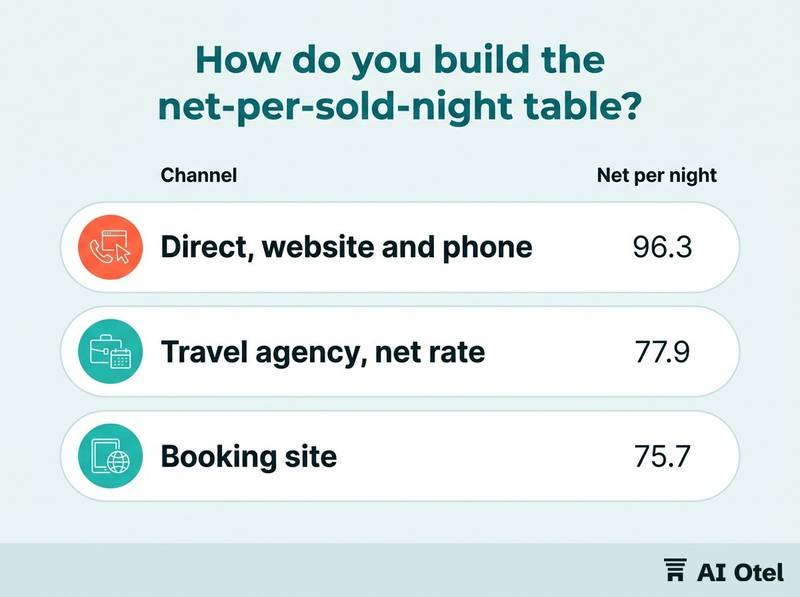
Fix the window and write it at the top: for example the last closed quarter. Fix the currency and the definition of a sold night, meaning a night paid for and stayed, or paid for and not refunded. Start from the gross room revenue the channel produced, taken from the reservation system's own export rather than a summary.
Subtract each cost line as a total for the period, then divide by paid nights. Do not average percentages across channels; totals divided by nights is the honest arithmetic. Keep a separate column for nights held and released, so the reader sees the volume behind the net figure and not only the ratio. Add a net-per-available-night column only if you need it: net per sold night and net per available night answer different questions, and mixing them in one column confuses both.
Date the table and put the builder's name on it. It is an internal working document, and next quarter's version will be compared against it.
For example: one quarter, one currency, all figures hypothetical.
| Channel | Paid nights | Gross revenue | Fee | Payment and currency | Released nights | Staff cost | Net | Net per night |
|---|---|---|---|---|---|---|---|---|
| Direct, website and phone | 300 | 30,000 | 0 | 620 | 12 | 480 | 28,900 | 96.3 |
| Travel agency, net rate | 400 | 32,000 | inside net rate | 0 | 30 | 850 | 31,150 | 77.9 |
| Booking site | 500 | 45,000 | 5,830 | 900 | 45 | 400 | 37,870 | 75.7 |
The fee amounts here are invented and varied on purpose: no single figure in this table is typical, standard or a market norm. Yours come from your contracts.
How do you read the table, and how do you repeat it each quarter?
Read the net column against the volume column, decide per channel whether to push, hold or restrict, then rebuild the same table next quarter with the same definitions.
Compare net per sold night and check how many nights each channel actually delivers. A high net on a small volume is not a strategy, and a low net on a large volume is not automatically a problem. Think at the margin: the last rooms a channel sells can be worth taking at a low net when the alternative is an empty room. That argument covers the marginal room only, never the rooms sold early at the same low net.
Push where net sits close to direct and the channel fills nights you would not otherwise sell. Restrict where net sits far below and the channel displaces better business. Change one thing at a time: allotment, rate, release period or minimum stay. Record what you changed, the date, and the number you expect it to move. If the mix itself looks wrong, the wider question is covered in when a hotel's channel mix needs rebalancing.
Do not benchmark your table against another hotel's or against a published market figure. The costs in it are yours, and so is the decision it supports.
ChecklistThe quarterly routine
- fix the window at the last closed 90 days
- reuse last quarter's cost lines and staff-cost assumption
- rebuild from the reservation system's export, not from a summary
- write one sentence per channel: push, hold or restrict, and why
- record the change made, its date and the number it should move
- keep the file, because next quarter is read against it
What to do next
Build the table for your last closed quarter before you change any channel: one page, one owner, one currency, and one written decision per channel with its date. The parts fit in that order: rate first, then the cost lines, then the released nights, then the minutes, and the table turns them into a single number you can defend to an owner and revisit next quarter.
The table is only as good as the records under it. The reservation and billing records that feed it are described on the hotel operating system page. On the agency side, AI Otel's distribution hub is built, with seed data: hotels publish contracted rates to travel agencies on their own terms, and every quote shows its working, the hotel's net, each pricing rule that fired and the final price. No agency is connected yet; you can read how it is designed on the distribution platform page. If you want to see where this is heading, request a briefing.
Frequently asked questions
Should I compare channels on ADR or on net revenue?
ADR is a rate measure and ignores what the sale cost, so use it to set and defend prices. Use net per sold room night to decide where to push inventory. Two measures, two different decisions, and neither replaces the other.
How do I count a night that was cancelled and then resold through another channel?
Count the paid night once, in the channel that finally paid. Keep a separate count of nights held and released so the first channel's leak stays visible in its own row.
What staff cost figure should go into the table?
One fully loaded hourly cost for the whole hotel, wage plus employer costs, written into the file so every quarter uses the same number. Measure minutes for two weeks including a weekend, then divide by the bookings confirmed in the same window.
Is the channel with the lowest net always the one to restrict?
No. Check volume, displacement and what the guest spends beyond the room. The last rooms a channel sells can still be worth taking at a low net when the alternative is an empty room, but that argument does not cover rooms sold early at the same net.
How often should the comparison be rebuilt?
Quarterly on a fixed window, and again after any contract change. Keep the earlier files, so a movement in net can be traced back to a decision rather than to a change in method.