How wrong was your forecast? Measuring hotel forecast accuracy by hand with your own numbers
Measure hotel forecast accuracy by saving snapshots before the stay date. Calculate error in rooms and percent to identify bias, then run a ten-minute monthly review to make one written change.
AI draft · awaiting editorial review
Contents
Key takeaways
- A forecast you never saved cannot be checked: the number you remember is the number hindsight rewrote.
- Measure error in rooms and in percent, and keep the sign: rooms give the size of the miss, the sign tells you whether you are consistently high or consistently low.
- Percentage error misleads on quiet nights, because a handful of rooms against a small actual produces a large percentage; judge those nights on rooms.
- One change per month, written down, is the simplest way to know whether the monthly review is doing anything.
Hotel forecast accuracy is the gap between a forecast you saved before the stay date and the rooms that actually sold. Measure it two ways: error in rooms (actual minus forecast) and error in percent (that gap divided by actual). Save snapshots at 90, 60, 30 and 7 days before arrival, then review monthly.
The forecast sits in the spreadsheet, the month closes, and nobody puts the two side by side. The hotel has an opinion about how good its forecasts are, and no evidence either way. After reading this, you will be able to save a forecast snapshot at fixed horizons, calculate the error in rooms and in percent, and run a ten-minute monthly review that produces one written change.
What does hotel forecast accuracy actually mean?
Forecast accuracy is the distance between a forecast you wrote down before the fact and the number that actually happened. Without the saved forecast there is nothing to measure, only a memory that quietly adjusts itself.
Define the target first. Rooms sold per stay date is the cleanest primary measure, because occupancy divides by a room count that changes when rooms go out of order. A night can lose three rooms to maintenance and show a different occupancy with the same demand. Rooms sold does not have that problem.
Keep two ideas straight. Accuracy is how close you were; error is how far off you were. They are the same number read in opposite directions, so pick one word for your reports and stay with it. Confusion between the two is common and wastes meeting time.
Insist on the timestamp. A forecast is only a forecast if it was saved before the stay date and cannot be edited afterward. A number in a live spreadsheet that someone updates on Thursday is not a forecast of Friday; it is a record of Thursday.
Separate two numbers that often get mixed. The forecast judgment is what you expected to sell. The on-the-books figure is what the market had already given you at that moment. The second is a fact, the first is a belief, and the gap between them over time is where you learn the most. If you are building the expectation itself, see estimating the next 90 days from what is on the books.
Decide the unit of review now: per night for diagnosis, per week or per month for the trend. Both are legitimate, but they answer different questions, and a review that drifts between them answers neither.
Key pointThe one habit everything depends on
A forecast is only measurable if it was saved before the stay date and never overwritten. Everything else in this article depends on that one habit.
What should you save in a forecast snapshot, and when?
Save the same fields at fixed horizons, 90, 60, 30 and 7 days before each stay date, and store each one so it cannot be edited. Fixed horizons are what make nights comparable across the year.
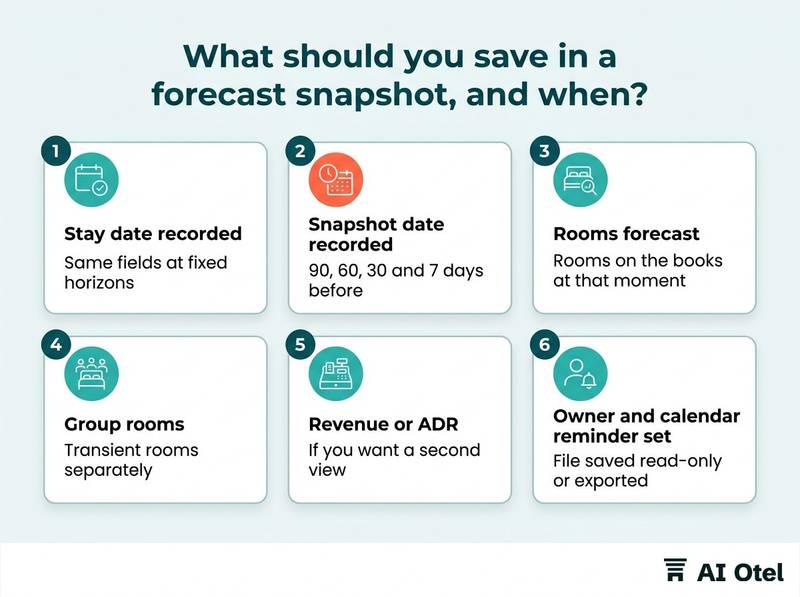
Fixed horizons, not convenient ones. A snapshot taken whenever someone remembers cannot be compared with last month's, because the information available at the two moments differs. Ninety days before arrival means ninety days, every time.
Each row carries the same fields: stay date, snapshot date, days before arrival, rooms forecast, rooms on the books at that moment, group rooms and transient rooms separately, and revenue or average daily rate if you want a second view. The group and transient split matters later, when you try to name the cause of a miss.
Immutability beats format. A dated PDF, a read-only export, or an emailed copy to a shared mailbox all work. A tab that anyone can overwrite does not. Put the job on a calendar with a named owner; four dates a month per stay month is a small task that dies the moment it depends on memory.
Snapshot the on-the-books figure at the same moment as the forecast. That pair is what later lets you separate a pace problem from a judgment problem, the same distinction you use when reading booking pace day by day in the pickup report.
Start with the stay dates you can still capture. A perfect archive that begins next year teaches nothing this quarter.
ChecklistSnapshot checklist
- Stay date recorded
- Snapshot date recorded
- Days before arrival recorded
- Rooms forecast
- Rooms on the books
- Group rooms
- Transient rooms
- Revenue or ADR (optional)
- File saved read-only or exported
- Owner and calendar reminder set
How do you calculate forecast error in rooms and in percent?
Error in rooms is actual minus forecast. Error in percent is that difference divided by actual. Two columns, one subtraction and one division, and the whole measurement is in place.
Keep the sign in the rooms column. Plus means the hotel sold more than forecast; minus means it sold less. A run of the same sign is bias, and bias is fixable in a way that random noise is not.
Add an absolute-error column for the size of the miss regardless of direction, so a month of plus and minus errors does not cancel out to a flattering zero. If you want a single summary number, mean absolute percentage error averages each night's absolute error divided by that night's actual, with the sign removed. Read it next to the room totals, never on its own: a summary built from small denominators can look worse than the month was. Say the definition once in plain language, then use the short form.
Do not average the percentages of individual nights and treat the result as the hotel's error. Nights with small actuals dominate that average. Compute on totals, or weight by rooms, instead.
Choose one level for the headline number, night or week, and keep it for the year. Changing the level between reviews makes every comparison worthless.
Note the undefined case: when a night sold zero rooms, percentage error has no meaning. Leave the cell blank and read that night in rooms.
| Stay date | Days before | Forecast | Actual | Error (rooms) | Error (%) |
|---|---|---|---|---|---|
| 14 Mar | 30 | 101 | 104 | +3 | 3% |
The example row shows the arithmetic: 104 minus 101 is plus 3 rooms; 3 divided by 104 is about 3 percent.
A worked example with invented numbers
For example, take a 120-room hotel and two stay dates, a busy Friday and a quiet Tuesday, each forecast at four horizons. The arithmetic shows why the percentage alone points you at the wrong night.
These numbers are invented for illustration. Your own four rows will look nothing like them.
| Stay date | Days before | Forecast | Actual | Error (rooms) | Error (%) |
|---|---|---|---|---|---|
| Friday | 90 | 88 | 104 | +16 | 15% |
| Friday | 60 | 95 | 104 | +9 | 9% |
| Friday | 30 | 101 | 104 | +3 | 3% |
| Friday | 7 | 103 | 104 | +1 | 1% |
| Tuesday | 90 | 22 | 28 | +6 | 21% |
| Tuesday | 60 | 24 | 28 | +4 | 14% |
| Tuesday | 30 | 26 | 28 | +2 | 7% |
| Tuesday | 7 | 27 | 28 | +1 | 4% |
The Friday forecast improved steadily as arrival approached, from plus 16 rooms at 90 days to plus 1 at 7 days. That is normal and not a failure: at 90 days most of the week's demand has not booked yet.
Now compare the two 90-day rows. Sixteen rooms wrong on Friday reads as 15 percent. Six rooms wrong on Tuesday reads as 21 percent. The percentage ranks the quieter night as the worse forecast, while the money sits on Friday.
Read the horizon column as a story, not a score. A 90-day miss that closes by 30 days is a pace question: demand arrived later than the forecast assumed. A 7-day miss is a judgment question about the last week, and that is the one worth a conversation.
Why does percentage error mislead on quiet days?
Because the denominator is small. Six rooms against an actual of 28 is a fifth of the night; the same six rooms against 104 is a rounding error. The percentage rewards busy nights and punishes quiet ones.
Set the rule before the review, not during it: report both measures every month, and judge low-demand nights on rooms. A rule agreed in the moment bends to whatever number looks alarming that day.
There is a second denominator for quiet nights if you want one: error in rooms divided by total room count, which measures the miss against the hotel rather than against the demand that showed up. Six rooms against 120 rooms is 5 percent of the property, on a Tuesday or a Friday alike.
Watch the reverse trap. An alarming percentage on a Tuesday can pull attention away from a 16-room miss on a Friday that costs far more. Keep the percentage for the trend on comparable nights, and use rooms for the decision about tonight. Never compare percentage errors across hotels, seasons or departments; the denominator differs, so the number is not the same quantity.
Watch outLook at the rooms column first
A large percentage on a quiet night is usually a small number of rooms. Before you react, look at the rooms column.
What patterns should you look for in the error?
Look for bias first, then for structure: the same sign, the same day of the week, the same segment, the same kind of date. A pattern you can name is a pattern you can correct.
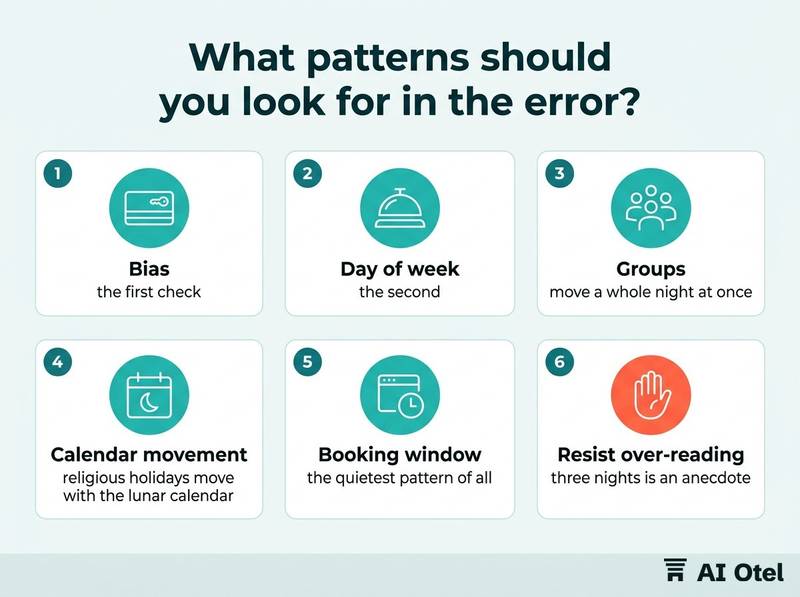
Bias is the first check. If the sign repeats across most nights at one horizon, the forecast is systematically high or low, and a single adjustment to the method is worth more than a hundred small fixes. Day of week is the second: weekend and midweek nights often miss in opposite directions, which a monthly total hides by cancelling out.
Groups move a whole night at once, through a cancellation or a block that picks up differently than assumed. Tag group nights so they do not distort the read on transient demand.
Calendar movement matters more than it looks. Religious holidays move with the lunar calendar, and bridge days around fixed public holidays move the shape of the week, so the same date last year is not the same night. Compare like with like, or set the comparison aside.
Booking window is the quietest pattern of all. If long horizons are always off in one direction and short horizons are close, the issue is how far ahead your segment books, not the forecast itself. That question has its own method in booking window analysis by segment.
Resist over-reading. Three nights is an anecdote. Wait for a month of stay dates at the same horizon before you change anything.
TipThe worst-five exercise
Sort the error column by size, look at the worst five nights, and write one cause next to each. If the same cause appears three times, that is your next change.
What does a ten-minute monthly review look like?
One page, one decision. Read the totals, name the worst nights, agree one change, and write it down so next month can judge it.
Run the agenda in a fixed order: total error in rooms, signed bias, the three worst nights with a cause each, one change, owner and date. Change one thing at a time. Two changes in the same month leave you unable to say which one moved the number.
Record the change in the same file as the snapshots, so the next review reads the decision next to the evidence that produced it. Keep the snapshot habit through bad months; the months you would rather not measure are the ones that carry the information.
Bring the person who writes the forecast and the person who owns the budget. The variance conversation and the forecast conversation are the same conversation held at different times, and both feed reading the monthly variance between budget and actual and building next year's budget month by month.
Ten minutes is the target, not the ambition. A review that needs an hour will be skipped by the second month.
ChecklistMonthly review checklist
- Total error in rooms read
- Signed bias read
- Three worst nights named with a cause
- One change agreed
- Owner and date set
- Change written into the snapshot file
- Next review date confirmed
What to do next
Take this week's forecast, save it with today's date and the days before arrival, and put a recurring ten-minute review in the calendar. The rest follows in order: the snapshot makes the measurement possible, the two measures make the miss readable, the pattern tells you what to change, and one written change per month is what turns a forecast into something the hotel can actually improve.
Frequently asked questions
What is a good forecast accuracy for a hotel?
There is no published benchmark this article can point to, and any figure quoted as a target would be invented. The only useful comparison is the hotel against its own history at the same horizon and the same kind of night. Set the baseline from your first three months of snapshots and judge every later month against that.
Should I measure occupancy error or rooms error?
Start with rooms, because occupancy divides by a room count that changes when rooms go out of order and quietly moves the number. Once rooms are measured and understood, occupancy error can be added as a second view. Keep the same primary measure for at least a year.
How many nights do I need before the numbers mean something?
More than a handful. A full month of stay dates at one horizon is the minimum before drawing a conclusion, and a holiday week should be read on its own rather than folded into the month. Three bad nights are an anecdote, not a pattern.
My forecast lives in the system and I cannot export it. What then?
The point is immutability, not format. A dated screenshot, a printed page or an emailed copy to a shared mailbox all preserve what you believed on that day. What breaks the measurement is a number that can be edited after the stay date.
Does forecast accuracy improve if I use software?
Software can store snapshots and do the arithmetic, which removes the excuse for skipping the review. It cannot supply the discipline of saving a forecast before the fact or the judgment about which change to make. This article makes no claim about any tool improving the forecast itself.