Banquet and event terms for hotel sales teams: BEO, guarantee, set-up and the words on the contract
This glossary defines essential banquet terms for hotel sales teams, clarifying the roles of BEOs, guarantees, set-ups, and attrition. It helps prevent billing disputes by linking each term to its governing document.
AI draft · awaiting editorial review
Contents
Key takeaways
- Every banquet term belongs to a document: the contract fixes money and liability, the BEO fixes the room and the menu, the run of show fixes the clock, and the invoice fixes what was delivered.
- The guarantee is what the hotel cooks and bills for; the final count is the client's last stated number, and the contract decides which of the two the invoice follows.
- One room has a different capacity for each set-up style, so capacity is agreed per style and per extra, never as a single number for the room.
- Attrition prices a shortfall against a committed block; cancellation ends the booking. They are different clauses and must never be used as synonyms.
- An unsigned BEO is a proposal. Only the signed version authorizes the kitchen and the floor.
A BEO (banquet event order) is the operational instruction sheet for one event. The guarantee is the number of covers the hotel cooks and bills for. The set-up is the room layout, and each layout gives the same room a different capacity. Every term belongs to a named document, and mixing them is where banquet disputes start.
A client agrees a number on the phone, sales writes it on the function sheet, the kitchen orders against it, and on the night fewer people arrive. Nobody lied, and somebody still pays for the difference. The missing word is guarantee. This banquet terms glossary gives each word a definition, a Turkish equivalent and a home document, so that sales, kitchen, floor and client all act on the same meaning. If you also sell meetings and conferences, start with our piece on MICE terms for hotels.
Why does one wrong banquet word cost money?
Because the same word is read by three parties who each act on it separately: sales writes the contract, the kitchen orders food, and the banquet team sets the room.
One number travels through three documents. Sales puts it in the contract, the kitchen orders against the BEO, and the invoice is issued from a clause. A loose word at any step becomes money at the last one. The cost shows up as food bought for a count that did not arrive, staff scheduled for a set-up that changed, and a disputed line on the final invoice.
Several word pairs look interchangeable and are not: guarantee against final count, option against confirmed booking, attrition against cancellation, hall hire against minimum spend. The test for any term is simple: which document holds it, and who is allowed to change it. If two people in the hotel answer differently, there is a dispute waiting.
Sales teams inherit these words from clients, not the other way round. The client says "BEO" or "overset" because a previous hotel used it, and the hotel answers as if everyone meant the same thing. The fix is cheap: one bilingual term sheet per hotel, one term per concept, attached to the contract as an annex and used identically by sales, kitchen and front office.
Watch outThe expensive sentence
"We will confirm the numbers closer to the date." It names no deadline, no person and no consequence, so the hotel carries the food cost and the client carries nothing. Replace it with a date, an hour and the name of the clause.
What do option, release date, deposit and attrition mean in a hall booking?
An option holds the space without committing the client, the release date is when that hold ends, the deposit turns the hold into a booking, and attrition prices a shortfall against what the client committed to.
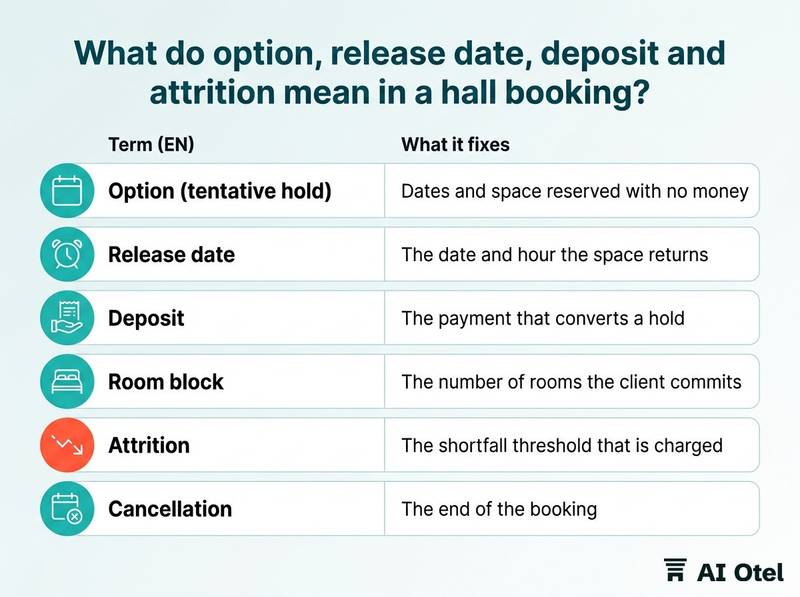
An option, also called a tentative hold, reserves dates and space with no money attached. It must carry an expiry, or the sales calendar slowly fills with holds that will never convert. Two options on the same room for the same date is a double booking in waiting, so the calendar has to show holds as holds, visibly different from confirmed business.
The release date is the moment the space returns to sale if the client has not confirmed. Write the hour, not just the day, and write it in the contract. The deposit then converts the hold into a booking: the contract states the amount, the payment schedule, whether it is refundable, and which charges it is applied against.
Attrition and cancellation are different clauses. Attrition is the shortfall against a committed room block or cover count, a priced clause with a threshold, not a penalty invented on the day. Cancellation ends the event; attrition lets it go ahead at a smaller size. Contracts need both, and the sales team needs to know which one it is invoking. Before signing, check that the sales calendar, the contract and the deposit invoice show the same dates, the same space and the same release date. For the room side of a group deal, see how to quote a hotel group.
| Term (EN) | Turkish | What it fixes | Document that holds it |
|---|---|---|---|
| Option (tentative hold) | Seçenek | Dates and space reserved with no money and a fixed expiry | Sales calendar and contract |
| Release date | Serbest bırakma tarihi | The date and hour the space returns to sale | Contract |
| Deposit | Kapora (ön ödeme) | The payment that converts a hold into a booking, and what it is applied against | Contract and deposit invoice |
| Room block | Kontenjan (oda bloğu) | The number of rooms the client commits to fill | Contract |
| Attrition | Eksik gerçekleşme | The shortfall threshold that is charged if the block or count is not reached | Contract |
| Cancellation | İptal | The end of the booking and what is owed when it happens | Contract |
What is the guarantee number, and how is it different from the final count?
The guarantee is the number of covers the hotel contracts to serve and bill, given by the deadline the contract sets; the final count is the client's last stated number, and the contract decides which of the two the invoice follows.
The guarantee is a commitment with a deadline. Once it passes, the kitchen orders to it and the floor staffs to it, whether or not the guests appear. The final count arrives later and can move up or down. If it moves up, the hotel serves if it can and bills what it served; if it moves down, the guarantee usually stands. The contract says so, not the sales team's memory.
Overset is a small buffer of chairs and covers set beyond the guarantee so a late arrival is not turned away. It is a service cushion, not a billed number, unless those covers are actually consumed. The contract should say who pays for the overset crew. A minimum number or minimum spend is a different mechanism: it protects the room's value rather than the kitchen's order. Below it, either the per-person price changes or the hall hire applies.
Per person, hall hire and minimum spend are three pricing bases. An invoice can carry all three, but only one can be the primary basis for a given event, and the contract must name it. For example, a contract that bills the higher of guarantee and actual: a guarantee of 180 with a final count of 200 and 190 guests arriving is invoiced at 190 covers; the same contract with 150 guests arriving is invoiced at 180. The person who takes the final count writes it on the BEO with the date and hour, and signs it. A count that lives only in a phone call has not been given.
| Term (EN) | Turkish | What it decides |
|---|---|---|
| Guarantee | Garanti sayı | The covers the kitchen produces and the invoice bills, fixed at the contract's deadline |
| Final count | Kesin sayı | The client's last stated number, used when it is higher than the guarantee and the contract allows it |
| Overset | Yedek kuver | Extra chairs and covers set beyond the guarantee as a buffer |
| Minimum number | Minimum sayı | The floor below which the agreed per-person price or room terms change |
| Minimum spend | Minimum harcama | The revenue the event must reach for the hall to be released on the agreed terms |
| Hall hire | Salon kirası | A fixed charge for the space, separate from food and beverage |
| Per person | Kişi başı | A price multiplied by a count, which is why the count basis matters |
Which set-up style fits the room: theater, classroom, U-shape or banquet?
The session decides the style, and the style decides the capacity: the same room holds a different number of people in each layout, so capacity is agreed per style, never as one number for the room.
Theater puts rows of chairs with no tables and gives the highest capacity; it suits a keynote and fails as soon as people need to write or eat. Classroom adds narrow tables in rows, seats fewer than theater, and supports the laptops and note-taking that most corporate meetings actually need. U-shape and boardroom place seats around a hollow center: the lowest capacity per square meter and the best discussion, so they belong to small decision-making groups.
Banquet uses round tables for a served meal. It is the layout a wedding dinner needs, and it competes for floor space with the dance floor, the buffet and the stage. Cocktail is standing with high tables: it moves the most people through a room and promises a seat to nobody, which the client must understand before the invitation goes out. Cabaret, half-round tables facing a stage, is the compromise for a gala dinner with a program; it should be drawn, not described.
Extras eat capacity: stage, dance floor, buffet, registration desk, AV position and emergency exits. The floor plan must show the style with the extras, not the empty room. Changing layout costs crew and hours, so a theater-to-banquet changeover is a scheduled operation with a start time, and the contract should name the window and who pays for the labor.
| Set-up | Turkish | What it is | Best for | Effect on capacity |
|---|---|---|---|---|
| Theater | Tiyatro | Rows of chairs, no tables | Keynotes, general sessions | Highest |
| Classroom | Sınıf | Rows of narrow tables with chairs on one side | Training, exams, laptop work | High, below theater |
| U-shape | U düzeni | Tables joined in a U around a hollow center | Board meetings, negotiation | Low |
| Banquet rounds | Banket (yuvarlak masa) | Round tables with seats on all sides | Weddings, gala dinners | Medium, reduced by dance floor and stage |
| Cocktail | Kokteyl | Standing with high tables | Receptions, networking | Highest flow, no seat for everyone |
| Cabaret | Kabare | Half-round tables facing a stage | Dinners with a program | Medium to low |
What do coffee break, buffet, plated and open bar actually commit the hotel to?
Each is a service format with its own cost driver: a coffee break is priced per person per break, a buffet per person with a minimum to open, a plated menu per person plus a service crew, and a bar either per consumption or as a package with a cap.
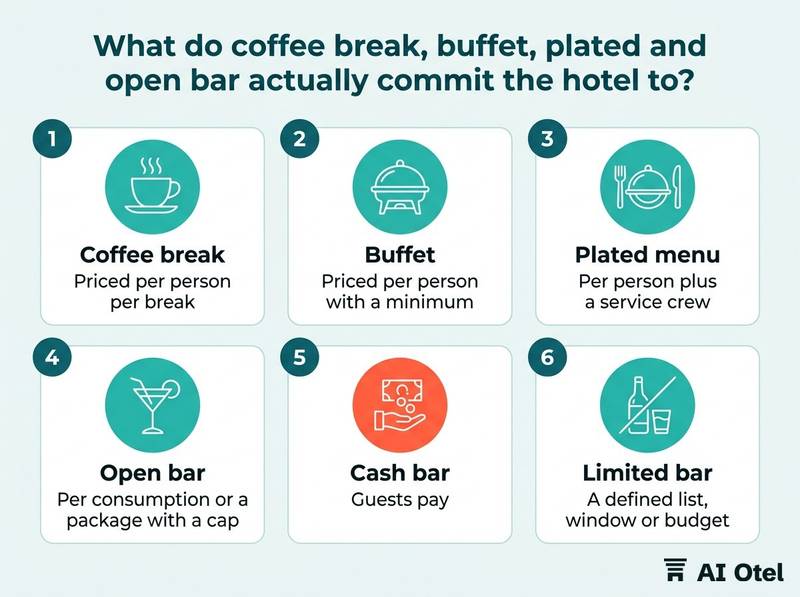
A coffee break is a set menu served in a set window, priced per person per break. The number of breaks and their times belong on the BEO, because each one is production and labor. A plated menu fixes the dishes, the crew size and the time between courses; menu changes after the kitchen's print and order deadline cost money, and the contract should say who pays. A buffet is priced per person and needs a minimum number to open at all, which is why the guarantee deadline matters most for buffet events.
Open bar, cash bar and limited bar are three different contracts. Open bar means the host pays for what is consumed, often inside a time window and often with a cap; it does not mean unlimited. Cash bar means guests pay. Limited bar means a defined list, a defined window or a defined budget. Consumption billing and package billing cannot be compared without the same assumptions: one rewards a sober room, the other a full one, and the client should be told which one they are signing.
Lines that surprise clients on the invoice include service charge, corkage, extra crew hours, late-night surcharge and special dietary meals. Name them at quotation, not at settlement. For the kitchen-side vocabulary, see our food and beverage control glossary.
ChecklistFix these in writing before the BEO is signed
- The service format for every food and drink item, not just the menu
- The count basis for each line: guarantee, final count or actual consumption
- The service window for each break, meal and bar period, with start and end times
- For a bar, the drinks included, the hours, and whether a cap applies and who watches it
- Dietary requirements, their count and the deadline for reporting them
- Service charge, corkage, extra crew hours and any late-night surcharge
- The name of the person authorized to approve a change on the day, and where that change is written
Which document holds which word: contract, BEO, run of show or invoice?
The contract holds money and liability, the BEO holds the operational instruction for one event, the run of show holds the timeline, and the invoice holds what was delivered and billed.
The contract carries the parties, the dates, the space, the rates, the deposit, the guarantee deadline, attrition, cancellation, liability and which language governs if the two versions disagree. The BEO, also called the function sheet, is the instruction to the kitchen and the floor: room, set-up, menu, counts, times, contacts and billing instructions. It is not a place to negotiate. The run of show is the minute-by-minute timeline, written with the client and used by the floor.
The final invoice bills against the contract's rule and the BEO's counts. If those two disagree, the contract wins, which is why the BEO must never quietly contradict it. Version control is the quiet hero: number every version, keep the signed one, and mark superseded copies clearly. The floor follows the signed BEO and nothing else.
Most banquet disputes come from two habits: a change agreed by phone and never written on the BEO, and a BEO signed by someone who had no authority to approve it. The BEO itself deserves a full read: the one document that runs a hotel meeting or wedding.
| Document | Turkish | What it holds | Who may change it |
|---|---|---|---|
| Contract | Sözleşme | Parties, dates, space, rates, deposit, guarantee deadline, attrition, cancellation, liability, governing language | A signed amendment by both parties |
| BEO / function sheet | Banket iş emri (fonksiyon sayfası) | Room, set-up, menu, counts, times, contacts, billing instructions for one event | Sales, with a version number, until the client signs |
| Run of show | Akış programı | The minute-by-minute timeline of the event | Event manager and client together |
| Final invoice | Nihai fatura | What was delivered and billed, against the contract's rule | Finance, by credit note only |
What to do next
Build a one-page bilingual term sheet for your hotel, define each term once, and attach it to the contract as an annex. Then use the same word in the contract, the BEO, the run of show and the invoice, because the glossary only pays off when all four documents agree. Start with the ten words in this article's tables; they cover most of the money.
Frequently asked questions
Is a BEO the same as a contract?
No. The contract is the commercial and legal agreement: money, dates, liability, cancellation. The BEO is the operational instruction for one event, telling the kitchen and the floor what to prepare. A signed BEO can authorize charges for changes, so it should never be treated as a casual internal note.
What happens if fewer guests arrive than the guarantee?
The hotel has already bought and staffed to the guarantee, so the invoice normally follows the guarantee rather than the room count. Some contracts allow the client to reduce the guarantee before the deadline. The clause, not the arrival count, decides, which is why the deadline and the reduction rule must be read before signing.
Does open bar mean unlimited drinks?
It means the host pays for drinks consumed, not that there is no limit. Contracts usually define the drinks included, the hours and sometimes a cap or a per-person package. Cash bar means guests pay, and a limited bar means a defined list, window or budget. Ask which of the three is on the contract.
Who pays for the extra chairs in an overset?
The overset exists so a late arrival is not turned away, and it is normally a service buffer rather than a billed cover. Whether the client pays for the extra set-up labor depends on the contract. Write it down, along with the number of overset covers, before the event.
Should the contract use the Turkish or the English term?
Use both, with one definition per term, and state in the contract which language governs if the two versions ever disagree. The risk is not translation, it is two words for one concept drifting apart between sales, kitchen and client.