Sold out too early: a look-back on whether the rate was too low
A sold-out date does not prove the rate was right. This guide shows how to run a five-question look-back on one date to find where money may have been left.
AI draft · awaiting editorial review
Contents
Key takeaways
- A sold-out date proves the rooms were committed, not that the rate was right.
- The look-back compares one sold-out date with its closest comparable date, not with the whole month.
- Turnaways are the only direct record of demand you refused; without them the review rests on inference.
- A sold-out date cannot prove what a higher rate would have earned; it can only show where the rate did not move while demand was still arriving.
- The output is one written rule for the next season, tested on comparable dates, not a new rate for every date.
A sold-out date is not proof the rate was too low. Run a five-question hotel sold out too early pricing review on one date: when the last rooms sold, how the rate moved, which requests you turned away, which channels took the rooms, and what the closest comparable date did. It shows where money may have been left, not what a higher rate would have earned.
The date sold out early and the team celebrated. A look-back, a review of one date after it sells out, asks a less comfortable question: did the last rooms go at a rate the market would have paid later? After reading this you will be able to pull the right data for one sold-out date, read it honestly, and turn it into one written rule for next season.
Why is a sold-out date not proof of good pricing?
A sold-out date means every sellable room was committed; it does not mean the last room went at the highest rate the market would bear. The distinction matters because a sell-out can be the right result or a missed price, and the same record supports both readings.
Define the terms before judging the date. A sellable room is one the hotel can actually sell after out-of-order rooms, house use and any overbooking buffer. A committed room is one held by a reservation, including one that may still cancel. A sold-out date is a statement about inventory committed for that date, nothing more.
A sell-out can be the right result: a group that fills a midweek night, a date with a known event, a deliberate decision to protect cash flow, or a rate that matched demand at the time. It can also hide a missed price, when the last rooms went at the same rate as the first and requests kept arriving after the date was closed.
Keep occupancy and sold-out status separate. Occupancy is rooms occupied divided by rooms available, one of the three core measures alongside RevPAR and ADR. Sold-out is a binary fact about committed inventory. The review is not a verdict on the team; it is a test of the rules that set the rate, the channel mix and the minimum stay. Do not use one date to judge a season. Use it to find one rule worth testing on comparable dates.
NoteDefinitions used in this article
Sellable room: a room the hotel can sell after out-of-order, house use and buffer. Committed room: a room held by a reservation, cancellable or not. Sold-out date: all sellable rooms committed. Look-back: the after-the-fact review of one date. Turnaway: a refused request. Pickup: the pace at which rooms are taken. Comparable date: a past date with matching day of week, season and booking conditions.
What are the five questions for a sold-out date look-back?
Ask five questions in order: lead time, rate steps, turnaways, channel mix, and the closest comparable date. The order matters because lead time and rate steps explain the pace, while turnaways and channel mix explain who was refused.
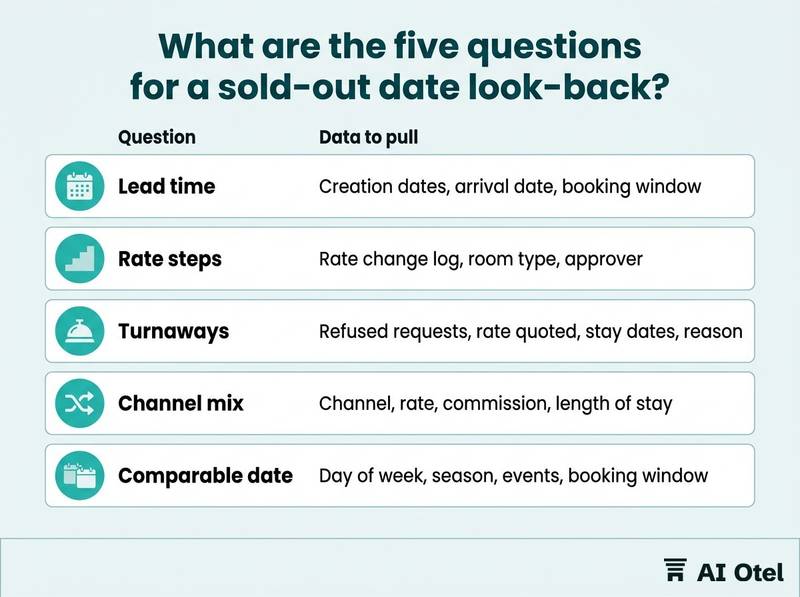
Lead time: when did the last sellable room sell, relative to arrival? Pull the booking creation date, not the arrival date, and note the booking window, the time between booking and arrival. Rate steps: list every rate change for the date, the day it took effect, the room type and who approved it, and note whether the rate rose as inventory fell or stayed flat. Turnaways: count refused requests by request date, stay dates, room type, length of stay, rate quoted and reason, including phone, email, walk-in and waitlist contacts. Channel mix: which channels took the last rooms, at what rate, commission, length of stay and cancellation terms. Comparable date: choose a date with the same day of week, similar season, no major event and a similar booking window. If no fair comparable exists, say so and do not force one.
Write the five answers on one page before drawing a conclusion.
| Question | Data to pull | A signal looks like | It cannot prove |
|---|---|---|---|
| Lead time | Creation dates, arrival date, booking window | Last rooms sold early while requests continued | Those guests would have paid more |
| Rate steps | Rate change log, room type, approver | A flat rate while inventory fell | The market would accept a higher rate |
| Turnaways | Refused requests, rate quoted, stay dates, reason | Repeated requests after closure | Every caller was a real booking |
| Channel mix | Channel, rate, commission, length of stay | Last rooms taken by one low-rate channel | Another channel would have filled them |
| Comparable date | Day of week, season, events, booking window | A different pace at a similar date | The two dates faced the same demand |
How do you read the last 20 percent of sales by date?
Sort bookings by the date they were made, then compare the rate and length of stay of the last fifth of rooms with the first four fifths. This is where a flat rate during falling inventory becomes visible.
Use booking creation date, not arrival date. A reservation made in January for August belongs in January when you read pickup, the pace at which rooms are taken. Split sellable inventory into the first 80 percent and the last 20 percent by creation date, and calculate average daily rate (ADR) and average length of stay for each group.
If the last 20 percent sold at the same or a lower rate while requests continued, the rate did not respond to scarcity. That is the signal to investigate. If the last 20 percent sold at a higher rate, the sell-out may be healthy; check whether the higher rate held or was discounted late.
Watch cancellations and no-shows, because a sold-out date can reopen. Review after the stay date and after the final pickup has settled. Check group blocks and allotments too: a block that fills early can make the date look sold out while individual demand is refused. Do not read the last 20 percent alone; pair it with turnaways and the comparable date before you change a rule.
ChecklistData to pull for the last 20 percent
- Booking creation date
- Arrival date
- Room type
- Rate
- Length of stay
- Channel
- Cancellation date
- Group code
- Rate change date
What do turnaways and denied requests tell you?
They are the only direct record of demand you refused, and they turn a guess about missed revenue into a dated list of requests. Without them, the review rests on inference.
Record every refused request at the moment it happens: date of request, stay dates, room type, length of stay, rate quoted, channel and reason. The reason matters most. Separate no room from no room at that rate and from channel closed; each points to a different fix, and mixing them hides the pricing signal. The practice of recording turnaways and lost requests is what makes this section of the look-back possible at all.
Use a waitlist for sold-out dates and call back when a cancellation reopens inventory; a hotel waiting list for sold-out dates is also a demand record. Count repeat requests from the same guest or company; a pattern matters more than one call, but one call still belongs in the log. Review what the OTA and website availability displays showed, because a closed channel can create turnaways you never see. Keep the log after the date passes; it is the evidence you will need when you test a new rule next season.
Watch outAn inquiry is not demand at a price
A turnaway log without the rate quoted and the stay dates cannot support a pricing decision; it records an inquiry, not demand at a price.
What can the look-back not tell you?
It cannot prove what a higher rate would have earned, and it cannot recover demand that never appeared in your records. The counterfactual is missing: you do not know which turned-away guests would have paid a higher rate, or how many would have walked away.
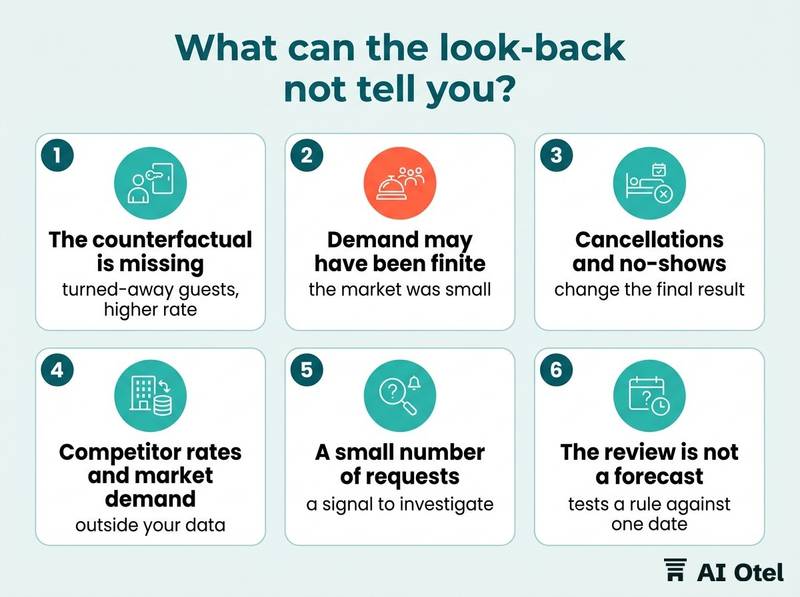
Demand may have been finite. A date can sell out because the market was small, not because the rate was low. Events, holidays, weather and travel restrictions can explain pace; the look-back does not isolate price from them. Cancellations and no-shows change the final result, and a date that looked sold out may have ended with empty rooms.
Competitor rates and market demand are outside your data unless you collected them at the time. A small number of requests is a signal to investigate, not a reliable conclusion about the whole market. The review is not a forecast; it tests a rule against one date and gives you a reason to watch the next comparable date.
Key pointUse the look-back to test a rule, not to relitigate a date
The output is a written rule and a date to watch, not a reconstruction of what should have happened.
How do you change the rule for the next season?
Write one pricing rule that ties a rate step to pickup and time to arrival, then test it on comparable dates next season. One rule, written on one page, beats a new decision for every date.
State the trigger in your own numbers: a share of sellable rooms committed and a number of days before arrival, written in plain words. Name the rate step: one step, not a new rate for every date, and protect group and contract rates from the same rule. Set a review cadence: weekly pickup review, and daily inside the final booking window. Assign authority: who can raise or lower the rate, and who must approve an exception.
Add guardrails: minimum stay, a group displacement check, channel parity and cancellation terms. Track turnaways and waitlist calls after the change, and compare the same dates next season, not the whole month. Change one variable at a time so you can learn from the result, and review the rule after the season.
ChecklistOne-page rule
- Trigger
- Rate step
- Owner
- Guardrails
- Review date
- Evidence to keep
What to do next
Pick one sold-out date from last season, pull the five data sets, and write the one-page rule before the next booking cycle opens. The look-back is not a verdict; it is a test you can repeat.
Frequently asked questions
How soon after a sold-out date should we review it?
Wait until after the stay date and after cancellations and no-shows have settled, because a sold-out date can reopen. Review the booking creation dates, rate steps, turnaways and channel mix together. A review before the final pickup is a progress check, not a conclusion.
Should we raise rates as soon as a date sells out?
No automatic increase follows from a sell-out. Check whether the last rooms sold at the same rate while requests continued, whether a comparable date behaved differently, and whether a group or event explains the pace. Change one written rule for comparable dates rather than reacting to one date.
What if we have no turnaway records?
Start the log now and use the records you do have: waitlist calls, emails, phone notes and channel closures. Without turnaways the review is weaker, so treat the result as a prompt to collect better evidence, not as proof of a missed price. Do not invent demand you cannot show.
Is selling out early always a bad sign?
No. Early sell-out can be right for a group, a known event, a cash-flow decision or a date where demand is genuinely limited. The question is whether the last rooms went at a rate that stopped responding while demand was still arriving. The look-back tests that question; it does not condemn every early sell-out.
Which date is a fair comparable?
Use the same day of week, a similar season, no major event and a similar booking window. A date from your own history is better than a general market average. If no fair comparable exists, say so and keep the review to the evidence from the sold-out date itself.