Insurance words for hotel owners: premium, sum insured, excess, exclusion and more
This guide explains key insurance terms for hotel owners, including premium, sum insured, excess and exclusion. Learn what each term means and how to compare quotes effectively.
AI draft · awaiting editorial review
Contents
Key takeaways
- The premium is the price of cover and the sum insured is its ceiling; a lower premium with a lower ceiling is a different purchase, not a better one.
- Excess and deductible are usually two names for the same mechanism, the first slice of each loss the hotel funds itself, so confirm in the definitions clause before comparing two quotes.
- An exclusion removes a loss from cover, while a condition sets something the hotel must do or keep true; both can affect a claim and both are read in different parts of the document.
- The schedule and its endorsements describe what the hotel actually bought, so read them before the printed wording.
- Read a renewal as a diff against last year's schedule, and treat every changed number as a question for the broker.
An insurance policy is read through five words. The premium is what the hotel pays for cover. The sum insured is the most the policy can pay. The excess is the first part of each loss the hotel carries. An exclusion is what the policy does not cover. A sub-limit caps one type of loss inside the total. This hotel insurance terms glossary explains each one in plain language.
The renewal arrives as a two-page summary: the premium has moved, the sum insured has moved, and one line near the bottom says the excess is now different. Signing it takes a minute. Knowing what changed takes an afternoon, and that afternoon is the whole difference between a policy and a guess. After reading this article you will know what each word means, where it sits in the document, and the question to put to the broker about every one of them.
What do premium and sum insured mean?
The premium is the amount the hotel pays for the cover period. The sum insured is the maximum the policy can pay for the insured property or liability, and it is the number that has to track what it would cost to put things back, not what they are worth on paper.
The premium is a cost line in the budget, usually paid in installments, and it says nothing about how much protection the hotel has bought. Two hotels can pay the same premium for very different ceilings. The sum insured is declared by the hotel at proposal and accepted by the insurer, and it should follow rebuild or replacement cost, not book value, not the loan balance, and not last year's figure plus a guess.
If the sum insured sits below the real cost of rebuilding, a partial loss can be settled in proportion rather than in full. Ask the broker whether the policy contains an average (co-insurance) clause and how it would be applied to a partial loss. Ask, too, who produced the figure: the owner, a valuer, or the broker from a formula. Keep the supporting document in the same folder as the policy, because it is the first thing anyone will ask for after a large loss.
Three further questions change the answer. Whether the sum insured is set per building, per location, or as one shared limit across a group: a shared limit means one serious fire at one property reduces what is available for the rest. Whether the limit is reinstated automatically after a partial claim, reinstated for an extra premium, or reduced for the rest of the period. And, in Turkish policies, the words are prim for the premium and sigorta bedeli for the sum insured; when a broker supplies translations, check that both documents carry the same definition.
| Term (English / Turkish) | What it means | For example (hotel) | Ask the broker |
|---|---|---|---|
| Premium / prim | The price of the cover for the period | A figure invoiced in four installments | How does a mid-term change to the property affect it? |
| Sum insured / sigorta bedeli | The ceiling the policy can pay | The declared cost of rebuilding one wing | Which document supports the figure, and when was it last updated? |
| Reinstatement of the sum insured | Whether the ceiling returns after a claim | A fire that uses part of the limit in March | Is the rest of the year still covered in full? |
| Average (co-insurance) clause | A proportional reduction when the sum insured is below the value at risk | A declared figure well under rebuild cost | Does the clause exist, and how is it calculated? |
For the wider vocabulary of ownership and investment, see this glossary for owners.
Excess or deductible: what is the difference?
Usually nothing. Excess and deductible are two names for the same mechanism, the first slice of each loss that the hotel pays itself. A single policy can still use both words for different things, so read the definitions clause before you compare two quotes.
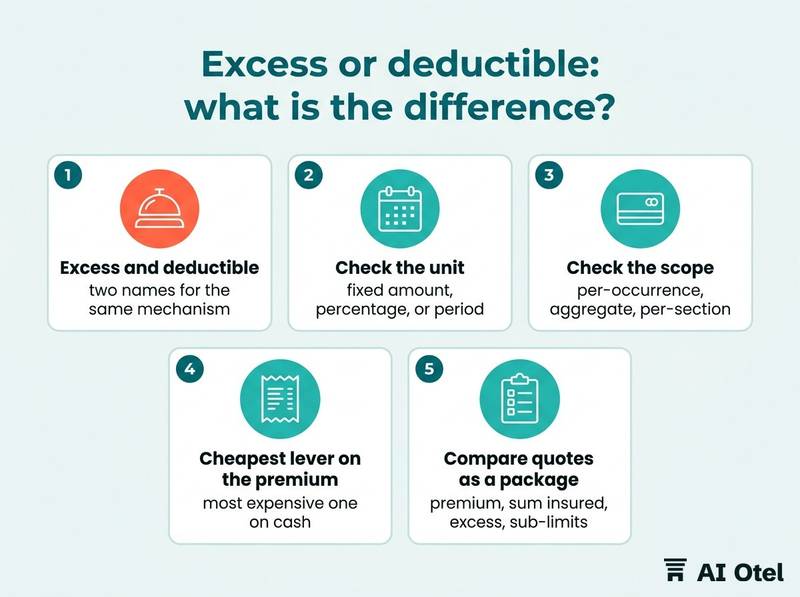
The mechanism is simple: a loss of a given size, minus the excess, is what the insurer pays. The hotel funds the difference from its own cash, and it funds it at the worst possible moment. Check the unit: an excess can be a fixed amount, a percentage of the loss, or a period of time, and a time-based excess is common on business interruption cover, where it works as a waiting period rather than a sum of money.
Check the scope as well. A per-occurrence excess applies to each event, an aggregate excess applies across the year, and a per-section excess applies separately to property, business interruption and liability. The same word can mean three different cash outcomes.
The excess is the cheapest lever on the premium and the most expensive one on cash. Raising it lowers the price of cover, but only if the hotel can genuinely pay that amount on any ordinary Tuesday without touching working capital. Compare quotes as a package: premium, sum insured, excess, sub-limits and exclusions together. A quote with a lower premium and a much higher excess is not cheaper, it is a different distribution of the same risk.
Write the excess into the hotel's own cash rule: a named reserve, a named person who can release it, and a note in the annual budget so the number is not discovered during a claim.
TipCompare the total, not the price
Add three numbers before you choose between two quotes: the premium, the largest excess the hotel could face in a single event, and the gap left by any sub-limit. Two quotes with the same premium are rarely the same purchase.
What does exclusion mean, and how is it different from a condition?
An exclusion is a loss the policy does not cover at all. A condition is something the hotel must do, or keep true, for cover to respond. Both can affect a claim, and they sit in different parts of the document.
Read the document in a fixed order: the schedule first, then the definitions, then the insuring clause, then the exclusions, then the conditions. The definitions decide how every other word is read, so a term that looks obvious may be narrowed there.
An exclusion removes a cause or a type of loss. For example, a policy may exclude loss caused by gradual deterioration, by faulty design, or by work the hotel carries out itself. The wording matters more than the heading, so ask the broker to mark each exclusion that touches a real exposure at your property. A condition is an obligation attached to the cover: for example, a policy may require that a system is maintained and records kept. If the hotel cannot show the record, the conversation after a loss becomes about the record, not about the damage.
An endorsement is a written amendment that adds, removes or changes cover. Endorsements are where renewals really happen, and a summary page rarely lists them all. Ask which document governs when a printed clause and an endorsement disagree, and put the answer in your file, in writing, before anything happens. Finally, keep a one-page list of the exclusions and conditions that apply to your property, in your own words, checked by the broker. A list you can read in two minutes is worth more than a policy you never open.
Watch outThe schedule is what you bought
The printed wording is the same for thousands of policyholders; the schedule and its endorsements are yours alone. Read them first, and ask the broker to confirm in writing which document governs if the two ever disagree.
From loss to claim: what do the words mean after an incident?
After the incident the vocabulary changes. A loss is the event and its financial effect, notice is telling the insurer, a claim is the formal request for payment, and indemnity is what the policy puts back.
Notice is the step that starts everything. The policy sets what notice means and when it is expected, so the hotel needs its own written rule: who calls the broker, in what order, and where the first record is kept. A rule written before the event is worth more than a good intention during it.
Proximate cause is the effective cause the insurer tests, not simply the last thing that happened. This is why the sequence of events should be written once, early, by one person, while the details are still accurate. Indemnity means putting the hotel back in the position it was in before the loss; replacing an old item with a new one can leave a gap the hotel funds itself, and that gap is a budget question, not an argument.
Salvage is what remains of damaged property, and subrogation is the insurer's right to recover from a third party who caused the loss. Both affect how the file is handled, so ask before anything damaged leaves the property. Business interruption is a separate section with its own sum insured, its own excess and its own proof, and the numbers come from the hotel's own records, which is why clean monthly figures matter long before a claim exists. The hotel's evidence is what balances the adjuster's report: photographs, maintenance logs, purchase invoices and a dated incident note are collected in the first days or not at all. A practical guide to that folder is the evidence folder for an insurance claim, built on day one.
Who is who: broker, insurer, underwriter and loss adjuster
The insurer carries the risk, the underwriter sets the terms, the broker places the policy for the hotel, and the loss adjuster examines the claim. Four roles, four different loyalties, and the hotel should know which one it is talking to.
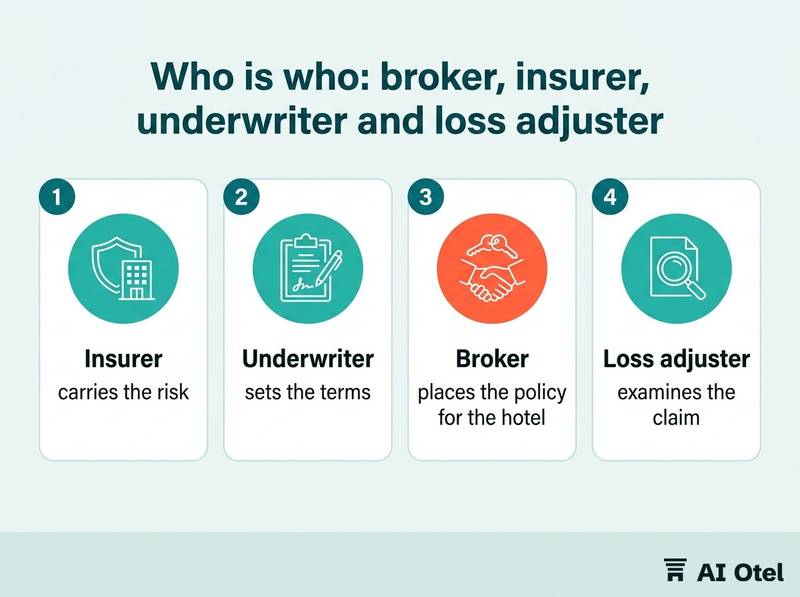
Ask the person in front of you whom they represent and how they are paid. A broker places cover for the hotel; an agent may act for one insurer. The distinction changes the advice you get, so ask directly and write the answer down. The underwriter is the person or team at the insurer who decides whether to accept the risk and on what terms; the information the hotel supplies at proposal becomes the basis of the contract, so accuracy at that stage is a form of protection.
The loss adjuster is appointed in connection with a claim and examines the damage, the cause and the numbers. Ask who appointed them and who pays them, and record the answer in the claim file. For a large or complex loss, the hotel may need its own expert, for example a valuer or a quantity surveyor, working alongside the adjuster, and that is a decision to take early, not after the first report. Ask two practical questions of every policy: who does the hotel call outside office hours, and who at the insurer has authority to agree a settlement. A name and a number in the folder beat a switchboard at midnight.
How do I read a renewal before I sign it?
Read the renewal as a diff, not as a document. Put this year's schedule next to last year's, compare them line by line, and treat every changed number as a question for the broker.
Ask for the full schedule and every endorsement, not only the summary page. The summary is written to be signed; the schedule is written to be read. Compare the sum insured per building and per location, and check the valuation behind it: a sum insured that did not move while construction costs did is a decision, whether or not anyone made it deliberately.
Compare the excess on each section, note whether any of them is now aggregate, and check which sub-limits changed. A sub-limit is a ceiling inside the ceiling, and it is where large sums insured quietly stop applying. List the exclusions added and removed, and every new condition: a renewal that adds one condition and removes one exclusion can be better or worse than last year, and only the wording says which. Check the dates, diarize the notice period, and keep one folder per policy year, because next year's diff is only possible if this year's file exists.
ChecklistRenewal checklist
- Last year's schedule beside this year's
- Sum insured per building and per location, with the valuation that supports it
- Excess per section, and whether any is aggregate
- Sub-limits that changed
- Exclusions added or removed
- Every new endorsement and condition
- Inception, expiry and the notice period diarized
- One folder per policy year: schedule, endorsements, valuation, correspondence, claims history
Put the premium in the budget and the excess in the cash plan. The premium is a cost line; the excess is money the hotel may have to produce in a week. For the budget side of that rule, see hotel budget terms explained: zero-based, rolling, flexed, variance and reforecast. If you want the same clarity in the systems that hold the hotel's financial records, a hotel operating system, built and working ahead of launch, keeps billing, reports and compliance in one place, and a revenue and consultancy arm for hotels works with hotels on their numbers.
What to do next
Take this year's schedule, mark the five words this article defined, and send the broker one written list of questions before you sign: what the sum insured is based on, what the excess is per section, which exclusions and endorsements are in force, and who to call after a loss. The glossary only becomes useful at that moment, when the words turn into numbers the hotel has to live with.
Frequently asked questions
Is excess the same as deductible?
In most wordings they are two names for the same mechanism: the first slice of a loss that the insured party pays. A single policy can still use both words for different things, such as one per event and one per year, so the definitions clause settles it. Have the broker confirm in writing which applies to each section.
What is a sub-limit and why does it matter?
A sub-limit is a cap on one type of loss inside the overall sum insured. A large total can hide a small sub-limit, so a claim that looks covered by the headline figure may be settled at the lower number. Ask for the list of sub-limits and check each one against a real exposure at the property.
Does a higher excess really lower the premium?
It is one of the levers an insurer uses, and how much it moves depends on the risk and the insurer's own terms. The useful test is to ask the broker to price the same cover at two excess levels and compare the total: premium plus the cash the hotel would have to find after a loss. The decision is a liquidity decision as much as a price one.
Who pays the loss adjuster?
Ask who appointed the adjuster and who pays them, and record the answer in the claim file. The adjuster examines the cause and the numbers on the insurer's behalf, which is why the hotel keeps its own evidence from the first day. For a large loss, the hotel may decide to bring its own expert alongside.
What should I keep after a renewal?
One folder per policy year: the full schedule, every endorsement, the valuation behind the sum insured, the correspondence with the broker, the claims history and the broker's written answers. Next year's comparison is only possible if this year's file exists, and the same folder is the first thing needed after a loss.