LED lighting retrofit: a payback sum a hotel can do with its own meter readings
A single payback figure for the whole hotel hides the truth. Learn to calculate payback for each area using your own meter readings and switch schedules to order the work by speed of return.
AI draft · awaiting editorial review
Contents
Key takeaways
- Payback is price divided by yearly saving, and the yearly saving is watts saved times hours lit times your own tariff.
- Hours lit decides the answer: an area burning all night repays far faster than a room lit for a few evening hours.
- Count lamps area by area and record the fitting type, because a mixed area hides both the cheap swaps and the expensive ones.
- Order the work by payback, not by visibility: the lobby is the most photographed area and often among the slowest to repay.
- A lamp that changes the color of light in a guest room can cost more in complaints than it saves on the bill.
Payback is the installed price of the new lighting divided by the yearly saving on the electricity bill. For each area, count the lamps, note the watts before and after, multiply the difference by the hours that area is lit and by your own tariff, then divide the price by that yearly figure.
A supplier quotes a whole-hotel LED package with a single payback figure. Your corridors burn all night and your guest rooms burn for a few hours, so the two areas cannot share that number. The decision belongs to the areas, not to the package. After reading this article you will be able to build a one-row-per-area table, measure the hours yourself, run the sum on your own bill, and hand a general manager a rollout order that can be approved in one meeting.
Why does one payback figure for the whole hotel mislead?
Because a single figure blends areas that are lit for wildly different numbers of hours, and the blend hides both the areas that repay in months and the areas that never repay at all.
The saving in an area is driven by hours lit, not by the number of lamps. A hundred corridor lamps on all night can outweigh a thousand room lamps used for a few evening hours. A blended average is arithmetically correct and practically useless, because you cannot act on it: it tells you to do everything or nothing.
The tariff you apply matters too. Use the all-in price per kilowatt-hour from your own bill, including taxes, and treat any demand charge separately, as the sum below does. The supplier's figure usually assumes one hours number for the whole property, and that number is rarely the one your building actually runs.
The fix is a table with one row per area, and a decision rule: any area whose payback is shorter than the life you expect from the fitting goes to the front of the list. Keep guest-facing and back-of-house areas in separate rows even when they share a corridor, because the acceptable light quality and the acceptable disruption differ.
Hours lit, area by area, for example
The table below is an illustrative example, not a benchmark. Your building's switch schedule is the real source.
| Area | What turns lights on | Hours per day | Effect on payback |
|---|---|---|---|
| Guest corridor | Night switch or permanent | 24 | Fastest |
| Lobby | Time clock or staff switch | 16 | Fast |
| Back-of-house corridor, store | Staff switch or sensor | 8 | Medium |
| Car park, garden | Photocell | 11 | Medium to fast |
| Restaurant | Service hours | 6 | Slow |
| Guest room bedroom | The guest | 4 to 6 | Slow |
| Guest room bathroom | The guest | 1 to 2 | Slowest per lamp |
The last two rows explain why a whole-hotel figure misleads: guest rooms hold the most lamps and the fewest hours.
How do you count the lamps in each area?
Walk the area with a floor plan and a tally sheet, one line per fitting type, and record what is in the fitting now rather than what should be in it.
Count fittings first, then lamps per fitting: a five-lamp downlight group is one line, not five. Record the lamp type and cap from the label, because the same-looking fitting can hold a screw lamp, a pin-base lamp or an integrated unit that is replaced whole.
Note the control gear: a magnetic or electronic ballast in a fluorescent fitting, or a driver in an integrated unit, decides whether a tube swap is a lamp change or a fitting change. Note the condition and the age of the fitting too. A corroded or yellowed fitting will be replaced soon anyway, and paying labour twice is the most common waste in a retrofit.
Mark the fittings you cannot reach without a lift or a ladder, and count them separately, because access is a real cost line. Photograph the label of each type and keep the photographs with the tally sheet, so the purchase order can be checked against the building. Keep the sheet as an asset record afterwards, with the same discipline you would use for turning a device list into a five-year plan.
What to record on each line of the tally sheet
Checklist
- Area and floor
- Fitting type and mounting (recessed, surface, track, pendant)
- Lamp type and cap
- Lamp wattage read from the label
- Control gear present and its type
- Number of fittings
- Lamps per fitting
- Dimmable or switched only
- Condition (sound, yellowed, corroded)
- Who operates the switch
- Access needs (ladder, scaffold, lift)
- Whether the fitting is on an emergency circuit
What is the payback sum, step by step?
Yearly saving for an area equals the watts saved, times the hours lit, times the days, divided by a thousand to get kilowatt-hours, times your tariff. Payback is the installed price divided by that yearly saving.
Work in total watts for the area, not watts per lamp: lamps per fitting multiplied by fittings multiplied by lamp watts, with the control gear loss added to the old figure. Use the new figure from the supplier datasheet, including the driver, because a lamp quoted at a lower wattage with a separate driver can end up close to the old consumption.
Convert to kilowatt-hours by dividing by a thousand, then multiply by days: use 365 for an all-year area and your own season length for a seasonal one. Apply your all-in tariff from the bill, and treat any demand charge separately rather than guessing it into the rate.
The installed price includes lamps, drivers, labour, access equipment, disposal of the old lamps and any making good of the ceiling. Keep the maintenance saving on its own line and label it as an estimate, because it depends on how long the new lamps actually last in your fittings. Do not add a comfort, marketing or sustainability value to the sum: it cannot be checked, and it turns a decision into a preference.
The sum, line by line
| Line | What goes in | Where the number comes from |
|---|---|---|
| Fittings in the area | Count | Tally sheet |
| Lamps per fitting | Count | The fitting |
| Watts before | Lamp label plus gear | Tally sheet |
| Watts after | Datasheet, with driver | Supplier |
| Hours lit per day | Measured or scheduled | Switch schedule or one-week count |
| Days per year | Your calendar | Your calendar |
| kWh saved per year | Arithmetic | The lines above |
| Tariff per kWh | All-in | Your bill |
| Yearly saving | Arithmetic | kWh times tariff |
| Installed price | Quotes | Quotes |
| Payback in years | Arithmetic | Price divided by saving |
The hours line is the one that decides the result, and it is the one nobody records. The next section fixes that, and daily meter readings a hotel can act on give you the consumption side of the same check.
Where do the hours lit come from if nobody records them?
Measure one week per area rather than guess, using the switch schedule, the sensor log or a simple count at fixed times, and then check the result against a meter reading.
For a permanently lit corridor, the hours are 24 and the only question is whether the circuit really is permanent. For a lobby on a time clock, read the clock settings rather than asking staff what they think happens. For guest rooms, separate the bedroom from the bathroom: the bathroom is lit for a short part of each stay, but it often holds the most lamps per square meter.
For outdoor lighting, the photocell setting gives you the hours, and the seasonal swing is large enough to matter. For back-of-house areas on occupancy sensors, the hours are the sensor's on-time, not the shift length.
Then check the whole area: multiply the calculated kilowatt-hours by the tariff and compare with a sub-meter reading over the same week. If they disagree by a wide margin, the hours are wrong, not the meter. Where a sub-meter does not exist, compare the whole building's consumption in the week before and after a single area is changed, at similar occupancy. Before spending on anything larger, it is worth reviewing the room controls to check before investing in energy management.
Watch outDo not use occupancy as lighting hours
Do not use the room occupancy rate as the hours a room is lit. Occupancy tells you how many rooms were sold; it says nothing about how long a guest kept the bathroom light on. Using it as a proxy usually overstates the saving in guest rooms and understates it in corridors.
Which areas should you do first?
Sort the areas by payback, shortest first, and let the saving from the first areas fund the next ones.
Corridors, back-of-house and car parks usually come first, because they combine long hours with low light-quality risk. The lobby and the façade come later: they are visible, they are often on dimmers, and the light quality requirement is the hardest to meet cheaply. Guest rooms are the largest count and the slowest payback, so they are the last area, not the first, unless the fittings are already failing.
Respect the season in the order: back-of-house and plant areas in high season when contractors can work out of sight, guest rooms in low season when floors can be taken out of service. Buy in batches per area rather than per hotel, so that one corridor gets lamps from one production batch and the color matches. Keep a small stock of spares from the same batch, and write the batch and the fitting type into the asset record. Re-run the sum after each area is finished, because the measured saving updates the hours for the next area.
TipWrite the order as a document, not a discussion
A rollout order written as a list of areas with a payback figure and a season next to each one is a document a general manager can approve in one meeting, and a contractor can price without visiting twice.
What can go wrong with light quality and guest comfort?
A cheaper lamp that changes the color of light, flickers or dims badly costs more in complaints and rework than it saves, so light quality is a purchase condition, not a detail.
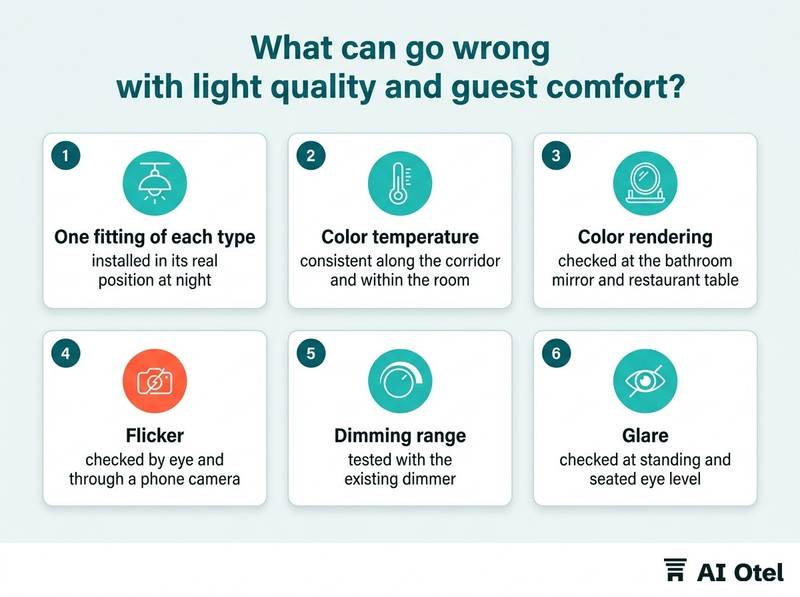
Color temperature has to match along a corridor and inside a room: two shades of white on one ceiling read as a fault, not as a choice. Color rendering matters most where a guest looks at themselves or at food, which means bathroom mirrors and restaurant tables. Flicker shows up on phone cameras before most people notice it by eye, and guests film hotel rooms.
Dimmers and existing control gear decide the dimming range: a lamp that will not dim below a certain level turns a dimmable lobby into an on-off lobby. Glare depends on the beam angle and the fitting, not on the lamp alone, so a brighter lamp in the same fitting can make the lobby worse. Test one fitting of each type in place, at night, before the order is placed, and look at it from where a guest stands. Get the warranty in writing, with who honors it locally and what replaces a failed unit in the first year.
Checks before the purchase order
Checklist
- One fitting of each type installed in its real position and viewed at night
- Color temperature consistent along the corridor and within the room
- Color rendering checked at the bathroom mirror and over a restaurant table
- Flicker checked by eye and through a phone camera
- Dimming range tested with the existing dimmer
- Glare checked at standing and seated eye level
- Beam angle confirmed against the fitting
- Batch number recorded on the order
- Warranty terms and the local party who honors them written down
How do you check the saving afterwards?
Read the meter on the same basis before and after, at similar occupancy, and compare the result with the figure you predicted for that area.
Take a baseline week immediately before the work, at the same season and a similar occupancy, and write down the occupancy with the reading. Read again in the first full week after the work, then again a month later, because the first week can be distorted by testing and adjustment.
Watch for rebound: once a corridor is brighter, staff and guests may leave more lights on, and the saving will be smaller than the arithmetic. Separate the lighting saving from weather and occupancy effects by comparing the same area, not the whole building, wherever a sub-meter exists. Update the area table with the measured figure, so the next area's prediction starts from a real number rather than a supplier's. File the table with the asset record and the warranty documents, so the next person to touch the lighting starts from the building's own history.
NoteThe sum is arithmetic, not a forecast
The sum in this article is arithmetic on your own numbers, not a forecast. If the measured saving comes in below the prediction, the usual cause is hours lit, not the lamps.
What to do next
Take one area, count it, measure its hours for a week and run the sum before anything is signed. Then let the measured saving from that area pay for the next one, and keep the table as the record that makes the second decision easier than the first.
If you want the tally sheet, the meter readings and the after-measurements to live in one place your whole team can see, a hotel operating system can hold them as records rather than spreadsheets: see what a hotel operating system covers, built and working, ahead of launch, and how the approach to data handling and trust is documented.
Frequently asked questions
How long does an LED retrofit take to pay back in a hotel?
There is no single figure, and any supplier who gives one for the whole building is blending areas with very different hours. The hotel LED lighting retrofit payback is price divided by yearly saving, so a corridor lit all night repays far faster than a guest room lit for a few hours. Do the sum per area and the answer becomes a list, not a number.
Should we replace the fluorescent tube or the whole fitting?
It depends on the control gear and the condition of the fitting. A tube swap in a fitting with an old ballast means paying labour again when the ballast fails, and some tube replacements need the ballast bypassed. If the fitting is yellowed, corroded or near the end of its life, price the whole fitting and compare the two installed prices, not the two lamp prices.
Do LED lamps last as long as the packaging claims?
The claimed life assumes a certain driver temperature and a certain number of switches, and a closed fitting in a hot corridor is not that condition. Cheap drivers fail before the lamp does. Treat the maintenance saving as the least certain line in the sum, buy with a written warranty, and keep spares from the same batch.
Can we do one floor first and decide about the rest later?
Yes, and it is the safer sequence. One area gives you a measured saving, a tested light quality and a real installed price, and those three numbers make the rest of the rollout a calculation rather than an argument. Choose the first area for its short payback, not for how visible it is.
What about the dimmers and controls we already have?
They decide the result as much as the lamp does. Test one new fitting on the existing dimmer and check the range, the lowest level and any flicker or buzz. Where the dimmer is old or the load is now far lower than it was designed for, price a dimmer change into the area, or the retrofit will be judged on a fault it did not cause.