A software subscription audit: what the hotel pays for and nobody uses
A hotel software subscription audit lists every recurring payment with an owner, seat count and last-use date. It ends in one decision per line: keep, merge or cancel.
AI draft · awaiting editorial review
Contents
Key takeaways
- Build the list from card and bank statements: memory misses annual renewals and the tools a single department bought.
- A line without a named owner, a seat count and a last-use date cannot be judged, so it cannot be kept.
- Two tools that write the same record cost more than their fees: they split the data and double the work.
- The date that decides the year is the notice deadline, which sits weeks before the renewal date.
- Keep what has an owner and real use, merge what writes the same record, cancel what has neither.
A hotel software subscription audit is a dated list of every recurring software payment the hotel makes, each line carrying an owner, a seat count, a last-use date, an overlap check and a renewal date, ending in one decision per line: keep, merge or cancel. It is built from card and bank statements, not from memory, and repeated once a year.
The card statement carries more recurring software charges than the hotel can name. One of them renews next week, and nobody in the building knows what it does. This is normal, and it is fixable in one afternoon. After reading this you will be able to build the list from payments rather than memory, judge each line on owner, use and overlap, and time the decisions around the notice deadlines that actually control the calendar.
Why does a hotel end up paying for software nobody uses?
Because subscriptions are bought one at a time by different people, renew on their own, and no single list holds them all.
Purchases start in the department that felt the pain. The front desk buys a guest messaging tool, sales buys a reputation tracker, the restaurant buys a reservation widget. Each is small enough to approve without a committee, so each enters the building through a different door.
Free trials convert silently. A card is entered to start a trial, the trial ends, and the first paid year begins without anyone deciding to buy. Bundled modules hide inside larger contracts: a booking engine or a channel manager can carry a module nobody opens but everybody pays for. Staff turnover erases the reason: the person who knew why the tool was bought leaves, and the tool stays.
Auto-renewal is the default. Renewing costs nothing and cancelling costs an action plus a date, so the balance tips toward renewal every year.
NoteShadow IT, and the audit's ground rule
Shadow IT, in plain words, is software bought and used outside the IT function's knowledge. It is not automatically wrong; unowned and unlisted is the problem. No line in this audit is judged by who bought it or how it was bought, only by owner, use and overlap. The audit is a register, not a disciplinary file.
How do you build the list from payments, not memory?
Pull twelve to twenty-four months of card and bank statements plus the expense ledger, and read every recurring charge, including the ones that look like something else.
Collect from five places: corporate card statements, bank direct debits, the accounting ledger's software and service expense accounts, app store and marketplace billing, and reseller invoices. Read the charge descriptor exactly as it appears. Vendors often bill under a parent company name that does not match the product the hotel calls it by, so a line that reads like a consultancy fee may be a subscription.
Apply the recurrence test: the same or a similar amount in consecutive periods, or a single charge once a year. Annual renewals hide in one month and are easy to miss on a monthly reading. Record the currency of every line. A charge set abroad moves with the exchange rate, so the renewal price is not the price the hotel signed.
Ask each department head one question: which tools do you open that do not appear on a statement? Modules inside other contracts surface this way, not from the ledger. Do not judge anything in this pass. The first pass produces a complete list; the second produces decisions. If you want the list to feed a wider plan, it connects naturally to a hotel IT budget built from devices and licenses.
ChecklistBefore the list is called complete, read
- Corporate card statements for the last twelve months
- Bank direct debits
- The ledger's software and service expense accounts
- App store and marketplace billing
- Reseller and integrator invoices
- One question to each department head about tools not on a statement
What must every line record: owner, users and last use?
Three facts decide a line: a named owner, the number of seats actually used, and the date the tool was last used for real work.
The owner is a person's name and role, not a department. If nobody accepts the line, it defaults to the finance manager until the decision meeting, which is itself a finding. Compare seats issued with seats active: the vendor's admin console shows logins, the contract shows seats paid for, and the gap between the two is the first number the audit produces.
Last use needs a definition per tool. For tools with logins it is the last login; for tools without, such as a payment link or a channel manager, it is the last booking or transaction that passed through it. Ask the people who work with the tool, in one question: when did you last open this, and what for? The desk knows in seconds what the ledger cannot show.
A tool used twice a year can still be worth keeping if those two moments are critical, such as a safety log or a statutory report. Write the reason in the row so next year's audit does not reopen it. Put the renewal date and the notice deadline in the same row as the owner, so the decision and the calendar never separate.
| What the statement says | Owner | Seats issued / active | Last real use | Decision |
|---|---|---|---|---|
| Guest messaging tool (example) | Front office manager | Several issued, one used | Months ago | Merge |
| Reputation and survey tool (example) | Sales manager | Most seats active | This month | Keep |
| Reporting add-on (example) | None | Unknown | Unknown | Cancel |
| Channel manager in a bundle (example) | Reservations | All active | Daily | Keep, renegotiate at renewal |
All four rows are illustrative examples with generic tool categories, not real hotels or products.
Where do hotel tools overlap?
Overlap appears wherever two tools write the same record: the same guest message, the same rate, the same reservation, the same monthly report.
Three overlaps cover most hotel lists. Guest communication: messaging, surveys and reputation tools often write the same guest conversation in three places. Rate and availability: a channel manager, a booking engine and a metasearch feed can each hold a version of the same rate. Reporting: a spreadsheet add-on that rebuilds numbers the property system already produces.
The test is one sentence per tool: which record does it write, and where does that record live? If two tools both claim to be the source, one of them is a copy. The cost of overlap is not the fee. It is two versions of the same number, a person reconciling them every month, and a guest who receives the same message twice.
Merge order matters: start with the pair that shares a data source, and keep the tool the operation actually opens at midnight, not the one with the tidier invoice. A tool that overlaps but is trusted by staff is a training problem before it is a license problem; removing it without training moves the work, not the cost. Read the exit terms before merging: notice period, data export format, and whether the overlapping module is bundled with something the hotel needs. Those clauses are covered in the contract clauses that decide whether you can leave.
| The overlapping pair | The question that settles it |
|---|---|
| Messaging tool vs the property system's own messaging | Which one does the front desk open during a shift? |
| Reputation tracker vs the guest app's built-in survey | Which one does the guest actually answer? |
| Spreadsheet reporting add-on vs built-in reports | Who rebuilds which number every month, and why? |
| Channel manager vs the booking engine's connections | Which one holds the rate the hotel treats as true? |
Why do renewal dates and notice periods decide the calendar?
Because a cancellation decided one day after the notice window buys another full year.
The date that matters is the notice deadline, which usually sits weeks before the renewal date. Diarize the deadline, never the renewal. Auto-renewal is the default in most subscription contracts: silence renews, and the audit's job is to turn silence into a decision.
Many contracts raise the fee at renewal by an index or a fixed percentage. The notice deadline is also the last moment to renegotiate, so put the two in the same appointment. Notice must be given in the form the contract requires: some vendors accept an email, some require a letter to a named address, and a notice in the wrong form is no notice.
Keep proof of every notice sent, with the date and the person who sent it, in the same file as the contract. Put the deadlines in the calendar the hotel already trusts, the one that carries inspections and license renewals, with the owner's name against each entry. A full year of such dates is mapped in the software renewal calendar a hotel should not miss.
Watch outThe invoice date is not the deadline
The renewal date on the invoice is not the deadline. The deadline is the notice date in the contract, it is earlier, and a decision taken after it costs a full term. Check the form of notice as well as the date.
How do you decide keep, merge or cancel?
Keep what has an owner and real use, merge what writes the same record as another tool, and cancel what has neither owner nor use.
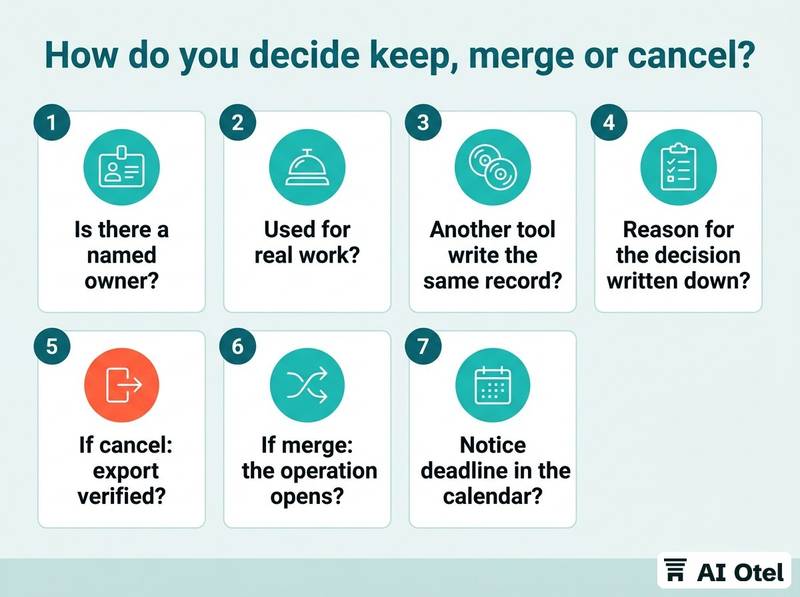
Keep: owner named, use inside the period, and no other tool writing the same record more cheaply. Record the reason in the row, so the decision survives the next audit and the next manager. Merge: choose the surviving tool by which one the operation opens, not by which contract is cheaper to break, then check the exit terms of the one being closed.
Downgrade before cancel. Fewer seats, a lower tier, or an annual term instead of a monthly one often removes most of the cost while keeping the tool that people trust. Cancel in order: export the data, open the export and confirm it is complete, then give notice in the contract's form. A cancellation before a verified export is a data loss, not a saving.
Before cancelling a tool that holds fiscal records or guest personal data, confirm with your accountant or legal adviser what must be kept and for how long, and who holds it afterwards. Never cancel a tool that a legal or operational duty depends on without naming what replaces it in the same decision.
ChecklistThe checklist applied to every line
- Is there a named owner?
- Was the tool used for real work in the period?
- Does another tool write the same record?
- Has the reason for the decision been written down?
- If cancel: is the export verified and the notice in the contract's form?
- If merge: is the surviving tool the one the operation opens?
- Is the notice deadline in the calendar with a name against it?
When a line survives the audit because the property system covers the need, it is worth knowing what a modern system can carry in one place; one hotel operating system is built to hold reservations, front desk, housekeeping, billing and reports together, built and working, ahead of launch, which is one way overlap stops forming in the first place.
How does the audit repeat each year?
Same month, same template: the list carries forward, new charges are added from the year's statements, and last year's decisions are checked against what actually happened.
Fix a month that sits before most of the hotel's renewal dates. The first audit is the slow one; every later one starts from the previous list. Carry the template forward with last year's decisions and reasons, so a keep does not have to be argued again and a cancel is not quietly reversed.
Add every new charge found in the year's statements. A line that appears without a decision behind it is the finding of the year. Check the cancels: did the charge stop? A canceled subscription that still bills is a refund to claim, and it is only visible if the list is compared with the statements.
Report one page to the owner: lines kept, merged and canceled, plus the notice deadlines for the coming year with the owner's name against each. Keep the list next to the hotel's device and license inventory, so a new purchase starts as a line with an owner rather than as a surprise on next year's statement. That inventory is described in the IT inventory and network map that save the night of an outage.
What to do next
Pick a date this month, pull twelve months of card and bank statements, and have the list finished before the earliest notice deadline it contains. The audit is not a cost-cutting exercise: it is the register that makes every later decision, a renewal, a merge or a new purchase, start from a recorded fact instead of a memory. If you want a sense of what a full technology stack should look like when it is designed rather than accumulated, the platform overview and the trust page on how data and decisions are handled are useful reference points.
Frequently asked questions
Should the audit include software that came bundled with the property management system?
Yes, list it, with a note that the fee sits inside another contract. The decision on a bundled module is about use and overlap, not about stopping a separate payment, and it is usually settled at renewal when the whole contract is renegotiated. A hotel software subscription audit that ignores bundled modules misses the quietest costs of all.
Who should own the subscription list?
Finance holds the list because finance sees the payments, each line carries a named owner in the department that uses it, and the systems manager supplies the technical facts such as seats and logins. The general manager signs the decisions, so the list has one authority behind it. Without that signature, decisions drift back to whoever argues loudest.
What if a department insists on keeping a tool the audit shows is barely used?
Ask for one thing: a description of the work the tool does that nothing else covers. If that description exists, the line is kept with the reason written down. If it does not, the line is merged or canceled, with the data exported first and a trial period agreed so the department can prove the gap.
Can a hotel cancel a subscription in the middle of its term?
That depends entirely on the contract: notice period, termination clause, any exit fee, and the vendor's obligation to return the data. Read those clauses before the decision meeting, not after, and give notice in the form the contract requires. A mid-term exit that ignores the notice form can cost the remainder of the term anyway.
How long does the first audit take?
The list is one afternoon of reading statements, and the decisions are a second session with the owners in the room. The first year is the slow one because nothing is written down yet; later years start from the previous list and take far less time. Treat the first audit as building the register, not just cutting the costs.