The software contract renewal calendar: twelve months of dates a hotel should not miss
A hotel software contract renewal calendar tracks every paid system, its notice deadline and its owner. This guide shows how to build the register, find forgotten contracts and place reviews ninety days ahead of each deadline so the hotel decides instead of renewing by silence.
AI draft · awaiting editorial review
Contents
Key takeaways
- Two dates matter for every system, not one: the renewal date, and the notice deadline, which is the renewal date minus the notice period.
- A review placed ninety days before the notice deadline leaves time to write requirements, compare offers and plan a change without touching high season.
- A register line is only finished when it carries a named owner, an annual cost in its own currency and the place where the signed copy is kept.
- The renewals that hurt are the ones nobody remembers signing: door locks, Wi-Fi controllers, key card systems and the e-invoice integrator.
- Negotiating and replacing are different projects: negotiating costs a meeting, replacing costs a migration, retraining and a parallel run.
A hotel software contract renewal calendar is one list of every paid system, its renewal date, its notice period and its owner, turned into dated review points. Because notice deadlines fall weeks before renewal dates, the calendar puts a review ninety days ahead of each one, so the hotel decides instead of renewing by silence.
The renewal notice arrives in March for a contract signed in another manager's time, for a system whose name nobody in the building recognizes. By then the notice window has usually closed, and the hotel has renewed for another year without deciding anything. After reading this article you will be able to build the register, find the contracts nobody remembers, place the reviews on a calendar and ask the questions that turn a payment into a decision.
What is a hotel software contract renewal calendar?
It is one dated list, built from the contracts themselves, that shows for every paid system the renewal date, the notice deadline, the owner and the cost, and puts a review in the calendar ninety days before each notice deadline.
Every system carries two dates. The renewal date is when the new term starts and the invoice arrives. The notice deadline is the renewal date minus the notice period, and it is the only one with a consequence: miss it, and the term renews whether or not anyone wanted it to.
Most software contracts renew themselves unless the hotel acts. This article does not interpret any contract: read your own notice and term clauses once, at the start, with your legal adviser, and record the answer in the register. The register is a table; the calendar is the same information sorted by date and handed to a person. Both are needed, and neither replaces the other.
Ninety days is a working rule, not a legal one. It is roughly the time to write requirements, ask two or three vendors, compare offers and, if the answer is to change, plan a migration outside the peak season. Anchor each review to a month rather than a single day, so a slipped week does not push the decision past the notice deadline. Add an earlier marker at 120 days for the two or three systems the hotel would genuinely consider replacing, because those need the longest runway.
Key pointThe rule, in four lines
Write down the renewal date; write down the notice period; subtract the notice period to get the notice deadline; subtract ninety days to get the review date. If the review date has already passed, this cycle's decision is already made.
Which systems belong in the register?
Every system the hotel pays for by subscription, license, maintenance or support contract, including the ones bought by a department rather than by IT.
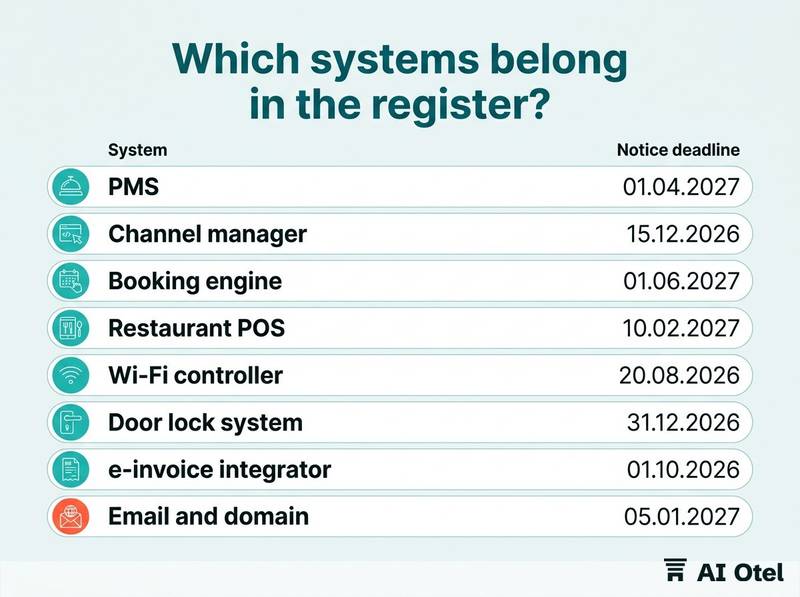
The obvious lines: PMS (the property management system, the hotel's operating software), channel manager, booking engine, website hosting, payment gateway, restaurant and bar point of sale, spa and activity booking. The lines that get forgotten: door lock and key card system, Wi-Fi controller and guest Wi-Fi portal, telephone exchange and call billing, minibar or shop point of sale, accounting interface, e-invoice integrator, review and reputation tool, guest survey tool, revenue reporting, email hosting, domain and DNS records.
Each line needs: system name, what it does in one sentence, vendor and local reseller, contract owner, renewal date, notice period, notice deadline, annual cost and currency, payment method, and where the signed copy is kept. Currency is part of the cost: a contract priced in another currency moves with the exchange rate even when the vendor never raises the price. Record any clause that raises the price each year, so the renewal figure is not a surprise in the month it lands. Keep license, subscription and the costs around them in separate columns, so a cheap subscription with expensive interfaces is visible as such; how hotel software is priced covers those layers in detail. If the PMS is the system under review, the platform page on hotel operating systems describes what such a system now covers, which makes the fit question easier to frame.
| System | Contract owner | Renewal date | Notice deadline | Annual cost | Signed copy |
|---|---|---|---|---|---|
| PMS | IT manager | 01.07.2027 | 01.04.2027 | EUR 9,600 | Contracts / PMS |
| Channel manager | IT manager | 15.03.2027 | 15.12.2026 | USD 2,400 | Contracts / channels |
| Booking engine | IT manager | 01.09.2027 | 01.06.2027 | USD 1,800 | Contracts / channels |
| Restaurant POS | F&B manager | 10.05.2027 | 10.02.2027 | EUR 1,200 | Contracts / F&B |
| Wi-Fi controller | IT manager | 20.11.2026 | 20.08.2026 | EUR 900 | Contracts / IT |
| Door lock system | Chief engineer | 30.06.2027 | 31.12.2026 | USD 700 | Contracts / technical |
| e-invoice integrator | Financial controller | 01.01.2027 | 01.10.2026 | TRY 18,000 | Contracts / finance |
| Email and domain | IT manager | 05.02.2027 | 05.01.2027 | USD 300 | Contracts / IT |
The rows above are an illustration, not a template of real dates: the point is that every cell can be filled, and that the notice deadline column, not the renewal date, drives the calendar.
How do you find the contracts nobody remembers?
Work backwards from the money, not from the filing cabinet: every recurring payment on the bank and card statements is a contract, whether or not anyone can still find the paper.
Export twelve months of bank and card statements and mark every recurring payment. Each one becomes a line in the register, named or unnamed. Search the accounting mailbox for the vendor names that appear on those payments, rather than asking managers to remember what they signed.
Interview by area, not by title: housekeeping, food and beverage, spa, front office, sales, and whoever handles the website. Check the vendors' own account portals: many subscriptions can be listed by the account email, which shows the renewal date even when the contract is lost. Ask the reseller as well as the vendor; in Türkiye a system is often sold and supported through a local partner, and the partner holds the renewal terms.
Write "unknown" in the register rather than a guess, and attach a task to it. A guessed date is worse than a blank one because it looks settled. Where no signed copy exists, ask the vendor in writing for the current terms and keep the reply in the same folder as the register line.
TipRun the search on a fixed month every year
Keep last year's statement export next to the register. A payment that appears this year and not last year is a new contract; one that stopped is a system the hotel may still be running without support.
How do you turn the register into a twelve-month calendar?
Sort the register by notice deadline, subtract ninety days from each, and place the result on the month grid the management team already reads.
Put each review in the shared calendar as an event with the owner as an attendee, not as a note inside a document nobody opens. Add a second, short reminder ten days before each notice deadline, in case the review was moved and the decision slipped.
Cap the load: if four systems fall in the same month, pull the earlier reviews forward rather than stacking four decisions into one week. Keep the calendar in one place that survives staff changes, and print a one-page version at the start of each quarter for the management meeting. Record the outcome on the review date in writing: renew, renegotiate, replace or postpone, with the reason and the date any notice was sent.
Respect the season. A hotel does not change its PMS in August, so a system whose notice deadline falls in spring needs its review in winter.
ChecklistCalendar build, in order
- Sort the register by notice deadline
- Subtract ninety days from each deadline to get the review date
- Assign one owner per line
- Add a ten-day warning before each notice deadline
- Check that no month holds more than two reviews
- Move any review that lands in the hotel's peak month
- Print the coming quarter
What should you ask before you renew?
Six questions, asked in the same order every time, turn a renewal from a payment into a decision: use, fit, support, price, exit and data return.
Use: which named people logged in last month, and what would stop tomorrow if the system were switched off. A system nobody uses is a cancellation, not a negotiation. Fit: what the hotel now does that the system does not cover, and whether that gap is a feature request, an interface or a reason to change.
Support: response times written in the contract against response times actually experienced, and who answers at two in the morning in high season. Price: this year's renewal figure against last year's, the index clause behind it, and what the price includes, such as interfaces, training, extra users and storage.
Exit: the notice period, the accepted method (email to a named address, registered letter, vendor portal), early termination, and what happens to the data at the end. Data return: format, completeness, cost and deadline for receiving an export, and whether the hotel may test that export before signing anything.
Write the answers down in the same template for every vendor, so offers can be compared side by side instead of remembered; a requirements document that makes vendor offers comparable gives you the template.
| Question | A good answer looks like | Warning sign |
|---|---|---|
| Use | "Four named staff log in daily" | "Someone uses it, we think" |
| Fit | "The gap is covered by an interface we can price" | "That is on the roadmap" |
| Support | "Written response times, with an escalation contact" | No named contact for high season |
| Price | "Same figure as last year, or the index clause shown" | New figure, no reason given |
| Exit | "Notice by email to a named address" | "Notice only by registered letter to head office" |
| Data return | "A full export in a standard format within thirty days of a written request" | "The data stays with us until the final balance is settled" |
The entries above are illustrative, but the pattern is real: the data return row is where most contracts fail the test.
Should you negotiate or replace?
Negotiate by default and replace only when the gap is structural, because replacing costs a migration, retraining and a parallel run that a price difference rarely covers in the first year.
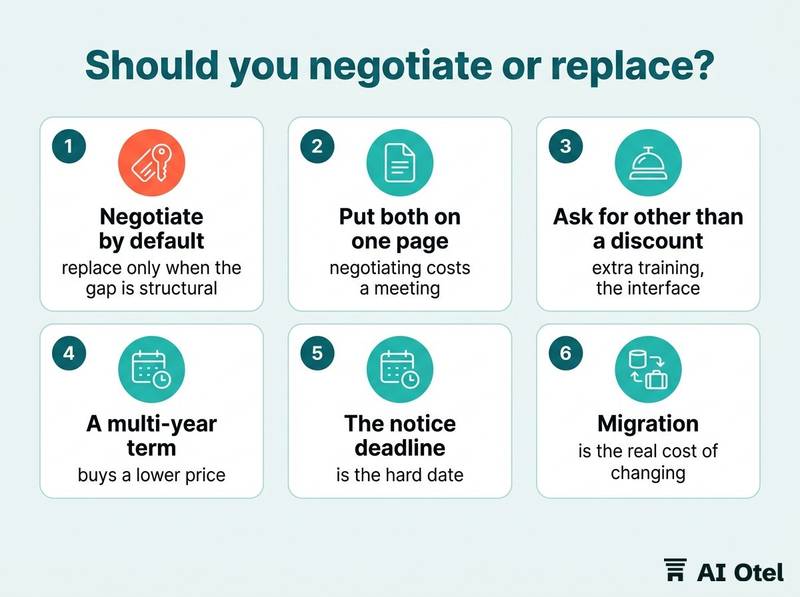
Put both on one page: negotiating costs a meeting and a written request, replacing costs a project with a start, a cutover and a risk of its own. Ask for things other than a discount: extra training, the interface the hotel actually needs, more named users, a shorter notice period, a price cap for the next term, and a written commitment on data export.
A multi-year term buys a lower price, and it also keeps you in the contract for the whole term. Accept it only when the exit and data return terms are already acceptable for that full period. If the answer is to replace, the notice deadline is the hard date: send notice in the form the contract requires, confirm receipt in writing, and plan the cutover outside the peak season.
Migration is the real cost of changing, and deciding what to move, check and leave behind is what tells you whether the project fits the window. Choosing a new system is a separate exercise with its own questions and its own timetable; how to choose a hotel PMS in Türkiye covers those questions. Do not run it inside a renewal negotiation that already has a deadline.
Who signs, and where does the copy live?
One named person signs, one named person keeps the copy, and the register records both, because the most common cause of a missed renewal is a contract that left with the manager who signed it.
Decide who may sign: usually the general manager up to a stated annual value, above which the owner signs. Write the limit down and keep it with the register. Keep one folder per vendor holding the signed contract, the order form, the price annex, the personal data terms and every amendment, and record its location in the register.
Treat email amendments as contracts. A supplier's written note that the price changes from January changes the renewal figure, so it belongs in the folder. On a change of IT manager or financial controller, the register is part of the handover, not a personal file. The hotel's duties as data controller do not end when the software does, so the personal data terms stay with the contract after termination. Check a vendor's security claims against the contract rather than the brochure; the trust page shows how one company describes what it has and has not built, which is the standard to hold any vendor to.
Watch outSilence is still a renewal
A renewal confirmed by email, by a card payment or by simply not answering is still a renewal. If the hotel wants different terms, it has to act before the notice deadline and in the form the contract requires.
What to do next
This week, export twelve months of bank and card statements and mark every recurring payment. That list is the register, and everything else follows from it: the notice deadlines, the calendar, the reviews and the decisions. The parts fit in one order, register then calendar then review then decision, and the only step that cannot be recovered is the notice deadline.
Frequently asked questions
How far in advance should a hotel start a software renewal review?
Work back from the notice deadline, not the renewal date, because the deadline is what closes the options. Ninety days is a workable default for a system the hotel intends to keep; add time for requirements and offers if it might be replaced. The notice period itself comes from the contract, so read that first.
What happens if the hotel misses a notice deadline?
The contract governs what happens next, and many software contracts renew for a further term when nobody acts. The first step is to read the notice and term clauses and to ask the vendor in writing what options exist before the new term starts. Do not assume a late email cancels anything.
Who should own the renewal calendar?
One named person, usually the IT manager or the financial controller, with the general manager reviewing the coming quarter once. Ownership means the reminders land in that person's calendar and the decision is recorded in writing, not that the person does all the work.
Do small subscriptions need a calendar entry too?
Yes. Small subscriptions are the ones nobody remembers, and they carry notice periods like any other contract. A Wi-Fi controller, a review tool or a survey subscription can renew silently for years while the hotel pays for something it no longer uses.
Should a hotel accept a multi-year software contract?
Only when the price, the exit terms and the data return terms are acceptable for the whole term. A discount on a contract the hotel cannot leave is a cost, not a saving. If the exit terms are unclear, keep the term short and revisit it at the next renewal.