Noise between hotel rooms: tracing the sound path before spending on soundproofing
Sound usually enters a room through one dominant path. Learn how to locate it with a simple two-person test, apply cheap fixes first, and record results to prevent repeat complaints.
AI draft · awaiting editorial review
Contents
Key takeaways
- Sound almost always has one dominant entry point in a room; fixing the other surfaces first wastes the budget.
- The door is the cheapest path to test and usually the cheapest to fix: perimeter seal, drop seal and a closer that latches without slamming.
- A two-person test with a clap, normal speech and a television at realistic volume locates the path in under an hour, room by room.
- Shared services such as ducts, risers, ice machines and fan coil units carry noise along a route, so the fix sits at the source or in the duct, not on the bedroom wall.
- A room with a structural path that needs a contractor should come out of sale and be recorded as such, not sold again and refunded.
A sound path is the route noise takes into a room: the door, the party wall, the floor or ceiling, the window, or a shared duct. Find the loudest path with a two-person listening test before buying anything, because sealing the wrong surface costs money and changes nothing. Hotel room soundproofing starts with diagnosis, not materials.
The same room generates the same complaint every few weeks: a guest heard the neighbors, or the corridor, or something running behind the wall. Before anyone orders panels, someone has to stand in that room and find where the sound actually enters. This article gives you a repeatable routine: the five paths, a two-person test, the cheap fixes to try first, and how to record the result so the complaint does not return with the next guest.
What are the paths sound takes into a hotel room?
Sound reaches a guest through five routes: the door, the party wall, the floor or ceiling, the window, and shared services such as ducts and risers. Each route has its own fix, and each behaves differently.
The door is the weakest point in most rooms. Gaps at the bottom, around the frame and at the lock keep a door from sealing, and a door that does not latch is an open channel regardless of its thickness. A heavy, expensive door with a 10 millimeter gap underneath performs worse than a light door that seals.
The party wall is rarely the problem along its whole surface. Sockets, switches, wall-mounted televisions, headboards fixed through the plasterboard, and connecting doors between rooms all interrupt the wall, and each interruption is a leak. Sound concentrates at these points, which is why a guest says the noise comes "from behind the bed".
The floor and ceiling carry impact noise. Footsteps, dragged chairs and dropped objects travel through the structure and are heard as thuds rather than speech. The window lets in street and courtyard noise through frame gaps, worn gaskets and vents, and this noise peaks at different hours than interior noise.
Shared services are the hidden route. A duct, a riser or a service shaft is a continuous tube between floors, so noise enters a room far from where it started. Guests describe it as coming from inside the wall because, from where they sit, it does.
Finally, separate airborne noise from impact noise. Speech and television travel through air and are blocked by sealing gaps; footsteps and furniture travel through structure and are not. A guest complaint usually names the effect, not the type, so the walk-through has to make the distinction.
| Path | What the guest hears | Cheap check | Fix order |
|---|---|---|---|
| Door | Speech and corridor noise, loudest at the gap | Hand at the gap, then the towel test | Seal and closer first |
| Party wall | Neighbor's television or conversation, loudest near sockets, headboard and connecting door | Listen along the wall | Socket gaskets and connecting-door seals before building work |
| Floor or ceiling | Footsteps, dragged chairs, thuds | Listen while a helper walks above | Felt pads and carpet before structural work |
| Window | Street, courtyard, ventilation hum | Listen with the window closed, then the vent covered | Gasket and frame adjustment before glazing |
| Shared duct or riser | Fan noise, voices from another floor, often constant | Listen at the vent and in the bathroom | Source or duct treatment, not bedroom wall |
How do you find the sound path with a helper?
Put one person in the room and one outside it, run three fixed tests at the same positions every time, and write down where the sound is loudest. The loudest point is the path to fix first.
Start with the clap test. A sharp clap outside the door and along the corridor wall shows where the seal fails, because a clap is short and directional, so the gap is easy to locate by ear. One person claps at fixed points, the listener inside marks the spot where the sound jumps.
Follow with the speech test. The helper speaks at normal conversational level, then at the level of a guest on a phone call, first at the door, then at the connecting door, then at the headboard wall. Then run the television test: set a television in the neighboring room, or play one on a phone, at a realistic listening volume. Television speech is a common complaint and a useful signal.
The towel test is the decisive one for the door. Block the gap under the door with a folded towel and repeat the speech test. If the room gets noticeably quieter, the door is the dominant path and the fix is cheap.
Walk the perimeter rather than testing from the middle of the room: move along each wall, then the ceiling and the window, and mark the loudest spot. Test at the hours guests complain about, because a corridor that is quiet at 11:00 can be loud at 23:00 when housekeeping carts, lifts and late arrivals are running. Record the result in words and a photo of the spot, not in decibel readings from a phone app; the team needs a repeatable comparison, not a number nobody can reproduce. If the complaint is part of a wider pattern of guests sleeping badly, a room check for noise, light, temperature and pillows covers the other causes in the same visit.
ChecklistChecklist for the two-person test
- Two people and one phone with a stopwatch
- Room number and date written down
- Door gap checked by hand and by towel
- Clap test at door, connecting door and two points on each wall
- Speech test at normal and raised level
- Television or phone playback in the adjacent room
- Window closed, then vent covered
- Corridor walked at the complaint hour
- Loudest point photographed and named
- Result written into the room file before anyone orders material
Which fixes are cheap enough to try first?
Start with the door, then the interruptions in the wall surface, then soft furnishings. These are reversible, can be done in a maintenance window, and are the fixes most likely to remove the complaint.
The door perimeter seal and drop seal give the highest return per lira spent, because the gap under and around a door is the largest opening in most rooms. The door closer comes next: a closer set too fast slams and a closer set too weak leaves the door unlatched, and both create noise. A door that does not latch is also a security fault, so this adjustment pays twice.
On the wall side, fit socket and switch gaskets on the party wall, because a back box is a hole in the wall and sealing it is a small, quick job. Seal around pipes and conduits where they pass through a wall, and around the bathroom extract grille; these routes are invisible until tested. Add bumpers and felt pads on the frame and on furniture legs, which remove impact noise at the source instead of absorbing it later.
Soft measures such as a rug, heavier curtains and a padded headboard reduce echo inside the room. They help the guest's perception but do not stop sound entering, so treat them as comfort work, not as soundproofing. After each fix, run the same three tests again and write the result down. If the room did not change, stop spending on that path and look at the next one.
TipThe towel test is the cheapest diagnostic in the building
Fold a bath towel, press it against the gap under the door, and repeat the speech test from the corridor. If the room drops in noise, the door is the path and a seal is the fix. If nothing changes, the sound is coming through the wall, the ceiling, the window or a duct, and door work will not help.
What do shared services add to room noise?
Ducts, risers, ice machines, lift machinery and fan coil units carry noise along a route, so the room that complains is often not the room where the noise starts. The fix belongs at the source or in the route.
A service shaft or duct is continuous between floors: a fan, a flush or a conversation on another floor arrives in a room with no obvious source, which is why guests describe it as coming from inside the wall. Fan coil units and split units generate their own noise as well. Loose panels, worn bearings, unbalanced fans and clogged filters all raise the level, and a service visit often removes the complaint without any building work.
Ice machines and vending equipment mounted on a corridor wall transmit vibration into the rooms behind them. Isolating the machine from the wall, or moving it, is cheaper than treating the room. Lift machinery rooms and shaft walls adjacent to guest rooms produce a low, intermittent noise that guests notice at night; the maintenance contract, not the bedroom, is where to start.
Plumbing noise travels through the wall behind the headboard: water hammer, fast-closing valves and uninsulated drain pipes are service faults with service fixes. Bathroom extract fans running continuously or rattling are frequently reported as a hum the guest cannot locate, so check the fan before opening any wall.
Watch outDo not treat the bedroom wall for a noise that arrives through a duct or a machine
Adding mass to the wall leaves the route open, the complaint continues, and the budget is gone. Confirm the route with the listening test before any wall or ceiling work is ordered.
When should a room come out of sale until it is fixed?
Take the room out of sale when the path is structural, when the fix needs a contractor and a closed room, or when the same complaint has come from two different guests. Sell it again only after the same test shows the change.
Use a simple judgment rule. If the dominant path is the door, a seal or a closer, the room stays in sale and the job is done in a maintenance window. If the dominant path is the party wall, the floor structure, the window assembly or a duct, the room is out of order until the work is finished and retested. Repeated complaints from the same room, or a complaint from both sides of one wall, are the signal that a seal will not be enough.
Record the status change in the hotel management system so the room is not resold by the front desk or by a channel that still shows it available. Tell housekeeping and the front desk why the room is out, and for how long, so the decision is not reversed by the next shift. If a guest is already in a noisy room and no quiet room is free, handle the move as hotel practice: apologize, offer what the hotel can offer, and log the case so the pattern is visible. For the guest-facing side of the same problem, see answering the night noise call and preventing the next one.
Key pointDoor and surface fixes stay in sale; structural paths come out of sale
The test that found the path is the test that clears the room, run by the same person at the same positions.
How do you record the fix so it stays fixed?
Write the path, the test, the fix and the retest result into one work order per room, then add the check to the preventive round. Without that record, the next complaint starts the investigation from zero.
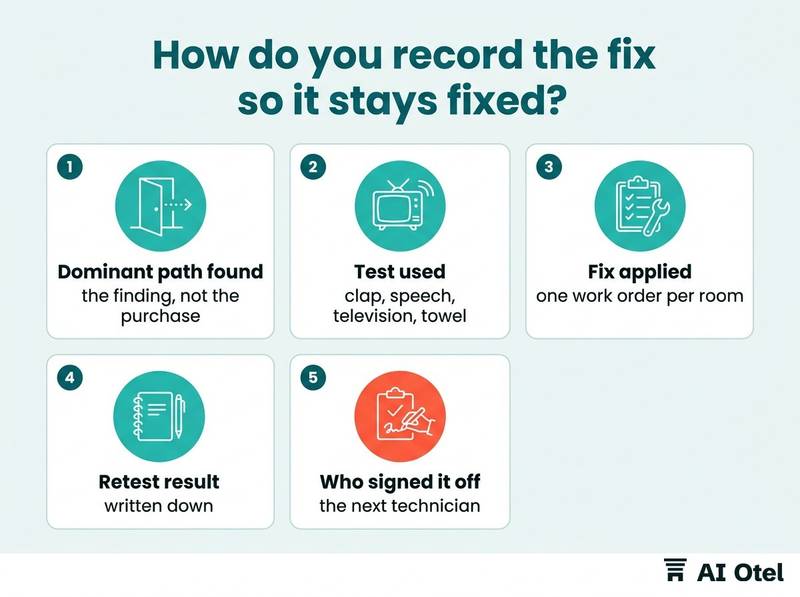
Open one work order per room per investigation, not one per material: the value is in the finding, not in the purchase. The fields that matter are room number, date, complaint wording, dominant path found, test used, fix applied, retest result, and who signed it off. Attach the photograph of the loudest point, because it shows the next technician where to start.
Add the room to the preventive round so seals, closers, bumpers and fan coil units are checked on a schedule rather than after a complaint. Recheck seasonally: door seals compress, doors warp with humidity, and a closer that was correct in spring may not latch in winter. Close the work order only when the retest is written down; a job marked done without a retest is an assumption. If your team does not yet have a fixed routine for this, a hotel maintenance work order flow from complaint to closed job and a room-by-room preventive maintenance round give you the structure.
ChecklistWork order fields
- Room number
- Date and time of the test
- Complaint as the guest worded it
- Dominant path
- Test used (clap, speech, television, towel)
- Fix applied and materials
- Retest result in words
- Photograph reference
- Technician and approver
- Date the room returned to sale
- Next scheduled check
When should you call an acoustic consultant?
Call a consultant when the cheap fixes have been tested and failed, when the path is structural, or when a renovation is being planned. Before the walls close is the cheapest moment to involve one.
The trigger points are concrete. First, after the door, surface and service fixes have been tried and retested, and the complaint continues. Second, when the same complaint pattern appears across several rooms on one wall, one floor or one stack, which points to a building-wide route rather than a room fault. Third, when the fix needs opening a wall, a ceiling or a floor, because the consultant's measurement is cheaper than a second attempt at the wrong surface.
A renovation is the best moment of all: the consultant can specify the assembly before it is built, which is far cheaper than correcting it afterward. If a renovation is on the table, plan it around renovating while the hotel stays open, so noisy-work windows and room moves are scheduled before the first wall is opened.
When you call, hand over room numbers, the test notes, the complaint history, the work orders and the building drawings. What the consultant adds is measurement of the actual path and specification of a build-up that will work, which is exactly what the listening test cannot give you.
What to do next
Pick the three rooms with the most noise complaints this year, run the two-person test in each one this week, and write the dominant path into a work order before anyone approves a purchase. The order in this article is deliberate: find the path, fix the cheap paths first, take structural rooms out of sale, record the retest, and only then bring in a consultant.
Frequently asked questions
Does soundproofing a hotel room actually work?
It works when it treats the dominant path. Sealing a door gap removes corridor and neighbor speech, but it does nothing for footsteps through the floor. The order matters more than the material: test, fix the loudest path, retest, then move to the next one.
How can I tell if my hotel room door is the problem?
Use the towel test. Have a helper speak in the corridor at normal and raised level, listen inside, then press a folded towel against the gap under the door and repeat. A clear drop in noise means the door is the path, and a perimeter seal plus a drop seal is the first fix.
Can a noisy room be fixed without taking it out of sale?
Yes for door seals, closer adjustment, bumpers, socket gaskets and fan coil servicing, which fit in a maintenance window. No for party wall, floor, window or duct work, which needs the room closed. Selling it in the meantime produces the same complaint and a refund.
Should we buy acoustic panels for the bedroom wall?
Only after the test shows the wall is the dominant path, and after the interruptions in it, such as sockets, the headboard and the connecting door, have been sealed. Panels on a wall that is not the path change nothing, and soft furnishings mainly reduce echo inside the room rather than stopping sound entering it.
What should be written in the maintenance record after a noise fix?
The complaint as the guest worded it, the dominant path found, the test used, the fix applied, the retest result in words, a photograph of the loudest point, and the date the room returned to sale. The retest line is what makes the record useful to the next technician.