One-to-one meetings with department heads: a thirty-minute format that works in a hotel
A thirty-minute one-to-one meeting with department heads solves what group meetings cannot. This guide details the four-block format, preparation steps, and seasonal adjustments.
AI draft · awaiting editorial review
Contents
Key takeaways
- The daily heads' meeting coordinates departments; a one-to-one decides the three things a group meeting cannot carry: a decision about a person, a decision about money or a rule, and the head's own workload.
- The thirty-minute format runs in a fixed order: scorecard, one problem the head owns, one support the head needs, one person-related topic.
- The head brings one prepared page; the manager brings last month's decisions and their dates, and nothing else.
- Every meeting ends with three lines per item: the decision, the owner and the date, read back before the head leaves the room.
- In peak season shorten the meeting rather than cancel it; in low season lengthen it and walk the department.
A one-to-one meeting with department heads in a hotel is a private, recurring thirty-minute conversation between a manager and a single department head. The format has four blocks: the head's scorecard, one problem the head owns, one support the head needs, and one person-related topic. It ends with one decision, one owner and one date written down.
The daily heads' meeting ends, everyone leaves with the same five action points, and the one thing the front office manager needed to say stays unsaid. It concerns a rota, a person and a budget line, and it does not belong in front of eight peers. This article gives you a format for that conversation: what belongs in it, what each side brings, what gets written down, and how the schedule bends with the season.
Why can't the daily heads' meeting replace a one-to-one?
Because the two meetings do different jobs. The daily meeting coordinates work between departments; a one-to-one decides the things that only make sense in private. If you run the hotel's daily operations meeting well, you already know what it is good at: arrivals, departures, VIPs, staffing gaps for the day, and who does what before the next shift. Its subject is the day.
A one-to-one carries the three subjects a group meeting cannot: a decision about a person, a decision about money or a rule, and the head's own workload and development. A head who says in front of peers that the rota is short, that a supervisor is struggling, or that a project is behind is exposing themselves. The subject is dropped, not solved.
The group meeting also rewards the fastest speaker. The one-to-one gives the quiet head the same time as the loud one, which matters more than most managers expect. A manager who meets heads only in a group sees the version of the department that performs in public: the numbers that are ready and the problems that are already solved.
The two meetings feed each other. The daily meeting produces the items that go to the one-to-one, and the one-to-one produces the decisions the daily meeting then carries out.
What is the thirty-minute format?
Four blocks in a fixed order, each with its own question and its own output, so the meeting does not drift into a report reading.
Block one, the scorecard, takes about five minutes: the head reads the five numbers they report every month and explains only the misses. The manager does not read the numbers aloud again. Block two, one problem the head owns, takes about ten minutes: one problem, not a list. The manager asks what has been tried and what a fix would need. Block three, one support the head needs, takes about five minutes: a decision, a signature, a person, a budget line or cover from another department. This is where the manager commits. Block four, one person-related topic, takes about ten minutes: one named person, one development question or one difficulty, handled as a private management matter.
| Block | Minutes | The question that opens it | What the manager leaves with |
|---|---|---|---|
| 1 Scorecard | 5 | "Which of your five numbers moved, and why?" | The head's own explanation of each miss |
| 2 One problem the head owns | 10 | "What have you tried, and what would a fix need?" | A decision or a named next step |
| 3 One support the head needs | 5 | "What do you need from me this month?" | A commitment with a date |
| 4 One person-related topic | 10 | "How is this person doing, and what do they need next?" | A private action, kept out of the group meeting |
Keep the order. If the problem block runs long, take the minutes from the support block, never from the person block. Thirty minutes is a ceiling, not a target. A meeting that ends in twenty minutes with a decision made is finished.
The scorecard works best when it is the same five numbers every month, on the department head scorecard. The fixed set is what makes a miss visible.
What should the head bring, and what should the manager bring?
The head brings one prepared page about their own department. The manager brings the open items from last month and nothing else.
The head's page holds the five scorecard numbers with one line on each miss, the one problem with what has been tried, the one support request, and the one person topic. One page, prepared before the meeting. A head who arrives without it has not had the meeting yet.
The manager's page holds last month's three-line notes with each decision and date, so the first question is what happened to them. The manager also brings the hotel-level numbers that touch that department: the occupancy expected for the coming month, a group booking that changes housekeeping load, a maintenance window that closes rooms.
The manager does not bring a list of complaints collected during the week. Complaints belong to the problem block, one at a time, and the head chooses which one to bring. Both pages stay with their owner. The manager does not collect the head's page; the point is that the head prepares it.
ChecklistBefore the meeting, the head ticks five items
- The five scorecard numbers are filled in
- Each miss has one line of explanation
- One problem is chosen, not three
- The support request is written as a specific ask with a date
- One person topic is chosen, and it is not a performance verdict
How do you raise a problem without blaming the head?
Ask about the mechanism, not the person: what happens between two steps, what has already been tried, and what a fix would need.
Open with the process. Ask the head to walk through what happens between the reservation arriving and the room being ready. The head describes a sequence, and the gap usually appears inside the sequence. Ask what has already been tried before offering anything: a head who has tried three things and is handed a fourth learns that the meeting does not listen.
Ask what would have to be true for the problem to disappear: a person, a rule, a piece of equipment, a budget line. The answer names the support block. Use the scorecard as the shared object. A conversation about a number is easier than a conversation about character, and the number is the same for both of you. When the head says the department is fine and the number says otherwise, ask what the number is missing. Sometimes the answer is a real explanation; sometimes it is the problem.
Keep the person topic in its own block. A process problem and a conversation about a person are two different conversations, and mixing them makes the head defend the person instead of examining the process. The person topic is also not the annual review. The monthly conversation collects what the review will need; the review itself follows the hotel's staff performance review form and its own process.
What do you write down after the meeting?
Three lines per item: the decision, the owner and the date. Not minutes, and not a summary of the conversation.
Write it in the last two minutes, in front of the head, and read it back. Agreement on the note is part of the meeting. Every line carries a name and a date. "Housekeeping to review the turndown sequence" is not a line; "the executive housekeeper tests the new turndown sequence on the fourth floor by 12 March" is.
The same list opens the next meeting. The first question is what happened to each line, not how the month went. A decision that changes a rule, a budget or a system goes into the hotel's own written record as well, so the next person who asks finds it.
What stays out: opinions about people, health or personal circumstances, and anything said in confidence. A person topic gets its own note, kept separately, or no note at all. The note belongs to both of you. A manager who keeps the only copy has turned the head into a recipient of their own decisions.
Key pointThe three-line rule
One line per item, each with a decision, a name and a date. The list is read back before the meeting ends and opens the next one.
How should the schedule change with the season?
Shorten the meeting in peak season and lengthen it in low season, but keep the slot in the calendar all year.
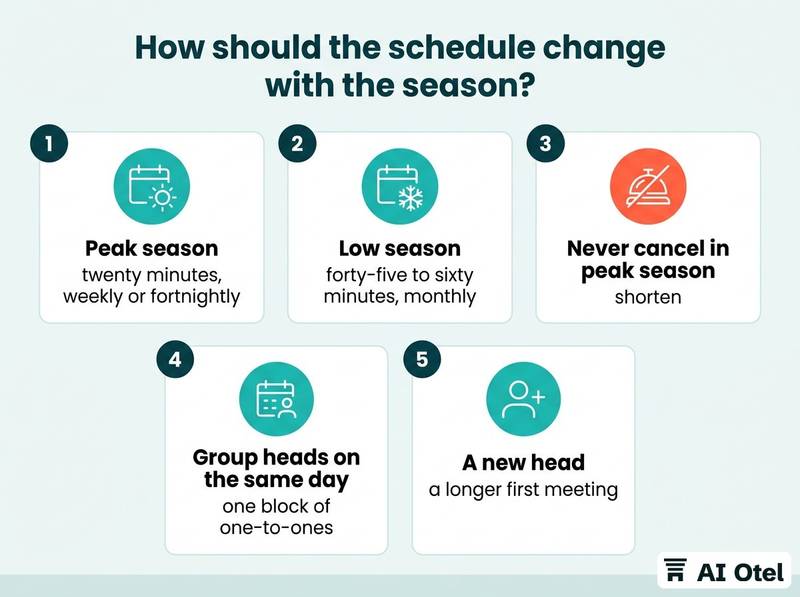
In peak season, run twenty minutes, weekly or fortnightly, on a fixed day and time, placed before the service peak rather than after it. In low season, run forty-five to sixty minutes, monthly, with time to walk the department or read a report together. Never cancel in peak season; shorten. A cancelled slot teaches both sides that the meeting is optional.
Group heads on the same shift pattern on the same day, so the manager's calendar holds one block of one-to-ones instead of seven scattered appointments. The first low-season meeting sets the department's two or three priorities for the year, and the peak meetings track them. A new head gets a longer first meeting and a shorter interval at the start. The format stays the same.
What turns a one-to-one into a report reading?
The manager talking, the head reading numbers aloud, and no decision at the end.
The head reads the scorecard line by line and the manager listens. The numbers were sent before; the meeting exists for the explanation. The manager fills the silence with their own list, and the head leaves with the manager's priorities instead of their own problem.
Watch for the slow failures. No line is written, so the next meeting starts from memory and the same problem returns under a different name. The slot is moved for an operational fire and not rescheduled; once is normal, three times is a decision. The person block is dropped whenever time runs short, and it is the block that develops people. The manager collects complaints during the week and delivers them as a list: that is an inspection, not a conversation. And if the meeting happens only when something is wrong, a head learns that an invitation means trouble.
Watch outThe format can fail quietly
If the manager does most of the talking, or the meeting ends without a written line, the format has failed even though the calendar says the meeting happened.
What to do next
Put the slots in the calendar before the next daily meeting ends: one thirty-minute block per head for the coming month, on a fixed day, with last month's three-line note as the only document the manager carries in. The daily meeting keeps the departments coordinated, the one-to-one decides what cannot be decided in public, and the written line carries that decision into the next month.
If you want the scorecard numbers and the decision notes to live in one place, a hotel operating system can hold both, so the five numbers arrive already collected and the notes from each meeting sit next to them. To see how the pieces connect across a property, the platform overview sets them out.
Frequently asked questions
How often should a general manager meet each department head one to one?
Monthly at minimum in low season, weekly or fortnightly in peak season, twenty to thirty minutes each time. The fixed slot matters more than the frequency, because it removes the question of whether the meeting happens. A new head, or a head in difficulty, gets a shorter interval at the start.
Who sets the agenda for a one-to-one?
The head brings the page: the scorecard, one problem, one support request, one person topic. The manager brings last month's decisions and their dates. If the manager has a topic of their own, it enters the problem or support block rather than replacing the head's agenda.
Should one-to-one meetings be minuted?
No minutes. Three lines per item, each with a decision, a name and a date, read back before the meeting ends and used to open the next one. Anything about a person's health, circumstances or a confidence is kept separately or not written at all.
What should a manager do if a department head keeps postponing the meeting?
Hold the slot and shorten the meeting rather than cancel it. Check first whether the time sits where the head can actually attend, for example before the service peak rather than after a double shift. A second postponement is itself a topic for the next meeting.
Can two department heads share a one-to-one?
No. Two heads in the room is a small group meeting, and the private subjects disappear. If two departments share one problem, that problem gets its own short meeting with both heads, and each head keeps their own thirty-minute slot.