Team chat groups at a hotel: rules for staff WhatsApp groups that keep work in the record
A hotel staff WhatsApp group works when the hotel writes a short house rule. Learn how to define owners, ban guest data, and turn chat messages into logged tasks.
AI draft · awaiting editorial review
Contents
Key takeaways
- A staff chat is a coordination tool, not a record: anything the hotel may need to prove later belongs in a log, not in a group.
- One group per purpose, each with a named owner, removes most of the noise a hotel chat produces.
- A request posted in a chat is not a task until it has an owner, a time and a line in the log.
- Guest identity documents, payment card data and passwords stay out of every group, whatever the urgency.
- Out-of-hours messages need a written answer rule, not a manager who happens to be awake.
A hotel staff WhatsApp group works when the hotel writes a short house rule, meaning the team's own written agreement on how the group is used: one group per purpose with a named owner, a ban on guest documents, card numbers and passwords, a fixed request format that turns a message into a logged task, and a written rule for who answers outside working hours. The chat coordinates; the log records.
At 23:40 the night receptionist posts a request in the hotel's main staff group. By 07:00 it sits under forty messages, a photo of a birthday cake and two forwarded videos, and nobody can say whether the airport transfer was booked. If your team already runs on one group, the question is not whether to use it but how to use it without losing work. After reading this article you will be able to write a one-page rule for your hotel staff WhatsApp group rules: which groups exist, who owns them, what never goes in, how a message becomes a logged task, and who answers at night.
What goes wrong when a hotel runs on one big group?
One group for everything turns into a channel where every message looks equally urgent and nothing has a named owner.
The first problem is mixing. A maintenance fault, a guest complaint, a shift swap and a birthday wish share one thread, so the reader cannot rank them and answers the loudest instead of the most important. The second is search: the answer usually exists somewhere in the scrollback, but chat search returns fragments without the decision, so the same question is asked again next week.
The third is accountability. "Someone will see it" is not an owner. A request with no name attached is a request nobody holds, and it dies quietly between two shifts. The fourth is evidence. A promise made in chat, a late checkout, an airport pickup, a rate agreed at the desk, leaves no record the hotel can check at handover or a month later when the guest disputes it.
Handover pays the price. The incoming shift rebuilds the whole context by reading backwards, which is the most expensive way to learn what is still open. The real loss, though, is not message volume. It is the moment a team member stops trusting the group to carry a request, and starts keeping a private list instead.
NoteThe two-minute test
Could a colleague who was off shift yesterday list today's open items from the group in two minutes? If not, the group is carrying work it cannot hold.
How many staff groups does a hotel need, and who owns each?
As few as the work needs: usually one operational group per department, one cross-department group for the day, and nothing else.
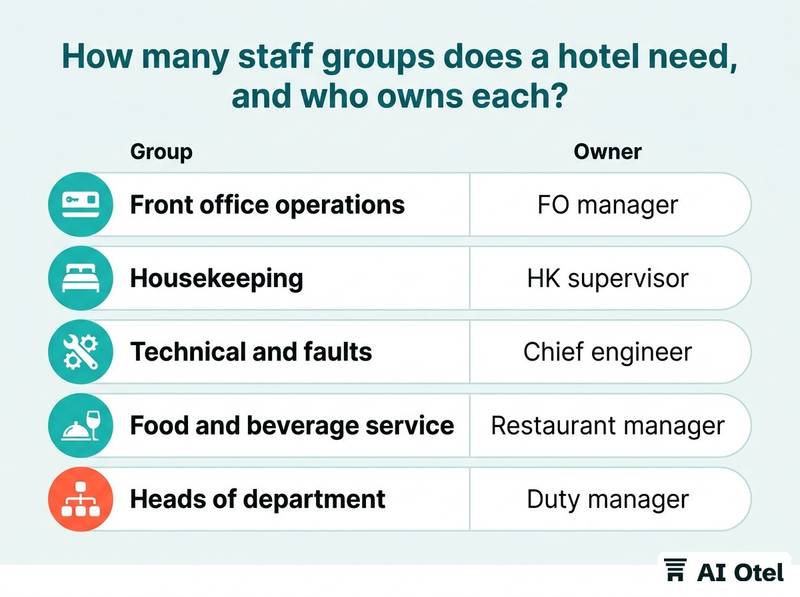
The rule in one line: one group, one purpose, one named owner. Name a person and a deputy, not only a job title, so the group has someone who closes loops rather than someone who is merely senior. Write the purpose in the group description as a single sentence, and add what does not belong there. A purpose nobody can state in one sentence is two groups wearing one name.
Membership follows action, not curiosity. Add the people who must do something with the messages; a general manager in every group becomes a second inbox and a reason for nobody else to decide. Some groups should not exist at all: one per shift, which multiplies the same conversation and splits the record; one per event that never gets archived; and one with the entire hotel in it.
The owner's job is small and constant: keep the purpose, move off-topic posts out, make sure every request ends with a line saying it is done, and hand the open items to the next shift. Name groups plainly so the purpose and the owner are visible before anyone opens them, for example "Housekeeping · operations · owner: HK supervisor".
| Group | Purpose in one sentence | Owner | Belongs here |
|---|---|---|---|
| Front office operations | Day-to-day reception requests | FO manager | Arrivals, room moves, desk requests |
| Housekeeping | Room status and cleaning requests | HK supervisor | Room readiness, lost and found |
| Technical and faults | Faults and repairs | Chief engineer | Broken items, work orders |
| Food and beverage service | Service coordination | Restaurant manager | Kuver counts, setup changes |
| Heads of department | Cross-department decisions | Duty manager | Anything touching two departments |
Every row above is an example a hotel can adapt, not a template to copy.
What should never be posted in a staff chat?
Guest identity documents, payment card data, passwords and anything a guest told the hotel in confidence stay out of every group, however urgent the moment feels.
Identity first: photographs of passports or ID cards, screens of the guest identity notification (KBS, misafir kimlik bildirimi) and guest lists carrying ID numbers. In Türkiye every stay involves a payment, a fiscal document, a guest identity notification and personal data (KVKK, kişisel verilerin korunması kanunu); a chat group is the wrong place for any of them. Payment is next: card numbers, security codes, photographs of a card terminal slip, and bank transfer receipts showing account details. If a payment must be discussed, discuss the amount and the reservation, not the instrument.
Access data belongs out too: Wi-Fi passwords, extranet logins, safe codes and door codes. These belong in a routine for extranet and Wi-Fi passwords, with an owner and a change log, not in a thread that forwards. Guest confidences, including complaints, health details and a room number tied to a name, also stay out. Post the room and the action instead: "Room 412, extra bed, 18:00" tells the team everything it needs and the guest nothing they would object to.
The practical test before sending: would the hotel be comfortable if this guest read this group? If the answer needs a pause, the message belongs somewhere else. Where a document genuinely has to move, it moves through the system built to hold it, with its own access and its own record, not as an attachment in a chat. Which guest information may be shared with whom, and for how long it may be kept, is a question for the hotel's own written rule and its legal adviser.
ChecklistPaste this list into your rule
- No passport or ID photographs
- No KBS screens
- No card numbers or terminal slips
- No passwords or door codes
- No guest health details
- No complaint threads naming a guest
- No photographs taken inside a guest room
How does a chat message become a logged task?
By giving every request the same five parts inside the message itself, and copying it into one log that survives the shift.
The five parts: what, where, who, when, and how the team will know it is done. Written in that order, the message is already half a task. The format earns its keep because it forces an owner and a deadline at the moment of asking, when the person asking still knows both. A request without them is a wish.
Keep one log per day, where the whole shift can see it: a sheet at the desk, a shared file, or the hotel's own system. Columns: time raised, request, room or area, owner, due, status, closed by. The rule that makes the log real is that a request is closed in the log, not in the chat. The chat gets one line saying it is done, and the log gets the time and the name.
Close the day at handover. Open items move to the next shift's list with their owners intact, which is exactly what the front desk shift handover checklist is for. Do not run two logs: a second list in a second place recreates the problem the log was meant to solve, and the team will follow whichever one the supervisor checks.
| Part | Question it answers | Example |
|---|---|---|
| What (the action) | What exactly must happen | "Extra bed" |
| Where (room or area) | Which place | "Room 412" |
| Who (owner) | One named person | "Ayşe, housekeeping" |
| When (due) | By what time | "By 18:00" |
| Done how (proof) | What closes it | "Reply DONE, logged at 17:40" |
The row values are illustrative.
Who answers messages outside working hours?
The hotel decides in writing which messages must be answered at night, who answers them, and what waits until morning.
Split messages into three kinds: emergency (safety, security, a guest in trouble), operational (a late arrival, a room move, a broken lock), and everything else (schedules, questions about tomorrow, requests for reports). Only the first two have a night owner. The third waits, and saying so in the rule gives the night team permission to leave it.
The night owner is a named position per shift, not "whoever sees it". The group is not an alarm; if something cannot wait, it goes to that person by phone. Give senders a marker for non-urgent messages, for example starting the message with "morning", so the night team can skip it without reading the whole thread to decide.
A manager who answers at 01:00 teaches the team that 01:00 is a working hour. If the hotel expects an answer, it schedules the person; if it does not, it says so in the rule. Whatever arrived overnight goes into the morning handover as an item, not into a second round of chat that the day shift has to reconstruct.
TipThe night rule in one line
If it can wait until 07:00, it waits; if it cannot, it goes to the night manager by phone, and the group gets a single line afterwards so the record exists.
When is a chat not enough, and what replaces it?
A chat stops being enough when the hotel needs to prove what happened, when the same request keeps coming back, or when the answer depends on the hotel's own numbers.
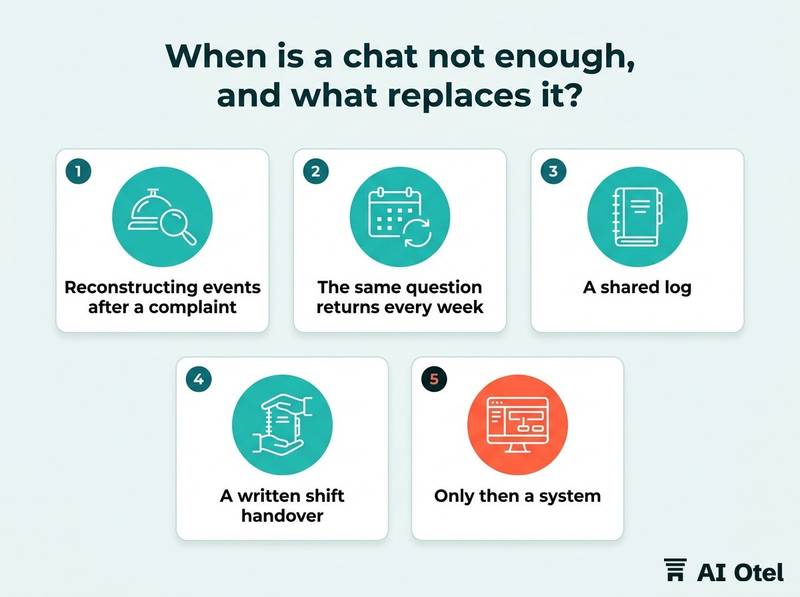
Three signals to watch: the team is reconstructing events after a complaint; the same question returns every week; or someone needs a figure, such as arrivals, an open balance or a room status, that lives in the system rather than in the thread. Replace the chat in order of cost. First a shared log, which costs nothing but discipline. Then a written shift handover that turns talk into an action list. Only then a system.
Separate two problems that look alike: staff coordination and guest messaging. Guest messaging brings its own constraints, including message templates and the 24-hour window, which is a different design from an internal group. The hotel's operating system is where the reservation, the bill and the task can live together, so the record and the work are the same object; the PMS page on ai-otel.com describes what that covers.
AI Otel's PMS assistant is built: it answers questions about a hotel's own property in plain language, carries out routine actions, and a person confirms anything sensitive. It does not replace team chat, and it is not in hotels' hands yet. Keep the group for what it is good at: fast coordination between people who already know each other. Move anything that must survive the shift out of it, into the wider platform or a log the hotel controls.
What should the one-page rule say?
Ten lines the team can read in a minute, pinned in every group and repeated at induction.
State the purpose of each group and its named owner and deputy in one line each. List what never goes in, in the same words every time, so nobody has to interpret it at midnight. Show the five-part request format with one filled example, because a format explained in the abstract is not followed. Say where the log is, who closes items in it, and that a request is closed in the log rather than in the chat.
State the out-of-hours rule: what counts as urgent, who answers, and how a non-urgent message is marked. Say who may add or remove members, and set a review date so the rule can be corrected instead of quietly abandoned. Keep it to one page. A rule nobody can finish reading is a rule nobody applies.
ChecklistThe ten lines, in order
- Purpose of this group
- Owner and deputy
- What never goes in
- The five-part request format, with one example
- Where the log is
- Who closes items
- The out-of-hours rule
- How to mark a non-urgent message
- Who manages membership
- Review date
What to do next
Write the one page this week, pin it in every group, and test it at the next handover: if the incoming shift cannot list the open items from the log in two minutes, the rule needs one more line. The pieces fit in one order: purpose, owner, what stays out, a request format, a log that survives the shift, and a written answer rule for the night. If you want to see how the logged side of hotel work can live in one system, you can request a briefing.
Frequently asked questions
Can a hotel use WhatsApp for staff communication?
Yes, as a coordination tool between people who already work together. The question is not whether it is allowed but what the hotel must be able to show later: anything that may need proving belongs in a log or in the hotel's system. The hotel sets that boundary in writing rather than leaving it to habit.
Should the general manager be in every staff group?
Usually not. Presence in every group turns the manager into a second inbox and gives everyone else a reason to wait for a decision. The manager belongs in the cross-department group and in the escalation path, and should be reachable when the rule says so.
How long should a hotel keep staff chat messages?
The chat is not the archive, so the answer starts with the log: keep the log for as long as the hotel needs to answer a question about a stay, and let the chat expire on its own. How long guest information may be kept is a matter for the hotel's own written rule and its legal adviser.
Do we need a separate group for each shift?
No. Shift groups split the same conversation into three places and leave the handover with no single record. Use one operational group per department and move open items between shifts through the handover note and the log.
What is the first rule a hotel should add to its staff group?
One group, one purpose, one named owner, written in the group description. It is the cheapest change and it removes most of the noise, because off-topic posts now have somewhere else to go and every request has someone who closes it.