The department head scorecard: five numbers each head reports once a month
A department head scorecard is one page with five measures, each with a named owner and agreed limits. Learn how to set these limits, source the data, and run a ten-minute monthly review that ends in a clear decision.
AI draft · awaiting editorial review

Contents
Key takeaways
- Five measures per department, one each for result, quality, cost, people and guest, is a constraint that forces a head to choose what the month was actually about.
- Every line needs a named owner, a named source report and a limit the head proposed and the general manager agreed, or it becomes a number nobody defends.
- Limits come from the hotel's own history, not from an industry average, because a limit borrowed from elsewhere tells the head nothing about this property.
- The monthly review reads only the amber and red lines, and it ends with one written decision per department, with an owner and a date.
- A measure that has stayed green for months and has never changed a decision should be retired and replaced, not kept for the look of the page.
A department head scorecard is one page per department with five measures, each with a named owner, a source report and a green, amber or red limit agreed with the general manager. The head brings it to a monthly one-to-one, and the meeting ends with one decision per department.
The night before the one-to-ones, the general manager opens a folder of department reports: forty pages from housekeeping, a cost sheet from the kitchen, a complaint export from the front desk. Every number is real, and none of them answers the only question that matters in the room, which is what the head intends to do next. This article gives you the page that does answer it: which five measures each department reports, where each number comes from, how to set the limits, and how to run the ten-minute review that ends in a decision.
Why a scorecard instead of the full report pack?
The report pack answers what happened last month. The scorecard answers what the head will do about it, in five lines that fit on one page and can be read aloud in a meeting.
A pack of thirty or forty pages cannot be discussed line by line in a ten-minute review, so it is skimmed, and skimming rewards the numbers that look bad rather than the ones that matter. Five lines force a choice: a head who brings twelve numbers has not decided which of them the month was about. Each line has exactly one owner, so a shared figure cannot quietly become nobody's figure when it turns red.
The pack does not disappear. The monthly profit and loss and its variance is a separate read, done once with the financial controller, not repeated in every department meeting; reading the monthly budget variance in a hotel is its own discipline. Likewise, the hotel's daily operations meeting and its fifteen-minute agenda handles today: arrivals, room status, a broken lift. The scorecard handles the month, and the two should not carry the same agenda.
The page is short enough that the head can defend it from memory, which is the difference between reporting and owning.
Which five measures should each department head report?
One result, one quality, one cost, one people and one guest measure. The five slots stay the same across departments so the pages can be read side by side; the measure inside each slot changes with the department.
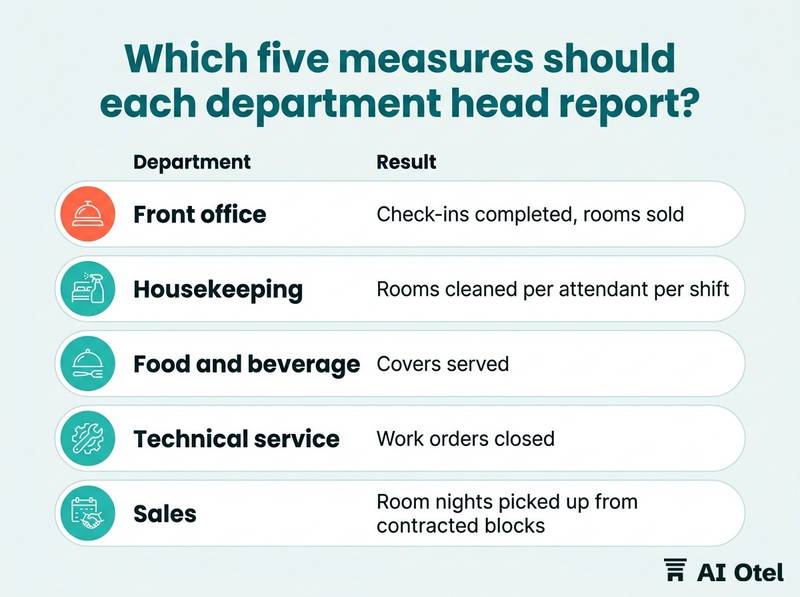
The result measure is what the department produced: rooms cleaned, covers served, work orders closed, room nights picked up from a block, check-ins completed. The quality measure is about rework, because rework is where a department quietly loses its month: registrations corrected after check-in, dishes re-fired, the same fault reported twice on one room, a quote sent late.
The cost measure covers only the spend the head actually controls, such as payroll hours, linen and amenities, spare parts, or sales travel, not the whole hotel's cost line. The people measure is countable, not a mood: unplanned absence hours, overtime hours, scheduled training completed, open vacancies. The guest measure is a count of specific complaints or repeat requests tied to that department, never a score whose source nobody can name.
| Department | Result | Quality | Cost |
|---|---|---|---|
| Front office | Check-ins completed, rooms sold | Registrations corrected after check-in | Front office hours per 100 arrivals |
| Housekeeping | Rooms cleaned per attendant per shift | First-time inspection pass rate | Linen and amenity cost per occupied room |
| Food and beverage | Covers served | Orders re-fired or returned | Food and beverage cost from the cost sheet |
| Technical service | Work orders closed | Repeat faults on the same room within a month | Spare parts and contractor spend |
| Sales | Room nights picked up from contracted blocks | Quotes answered within the hotel's stated time | Sales travel and site-inspection spend |
| Department | People | Guest |
|---|---|---|
| Front office | Unplanned absence hours | Arrival and departure complaints logged |
| Housekeeping | Unplanned absence hours | Cleanliness complaints and repeat requests |
| Food and beverage | Overtime hours, training completed | Complaints about waiting time or temperature |
| Technical service | Preventive tasks done on schedule | Faults reported by guests after a fix |
| Sales | Accounts with a logged contact this month | Complaints or feedback from bookers |
The table is a menu, not a definition sheet: keep every cell to a few words and write the full definition on the measure's own sheet. A measure that cannot be pulled from a system report or a cost sheet is not ready to be a scorecard line, however interesting it is. For the people measures in particular, this page sits next to what a hotel staff performance review should score and who scores it, but the two documents do different jobs.
Where does each number come from, and who types it?
Every line names its source report and the one person who enters it. If a number cannot be produced on the first working day of the month, it is not ready to be a scorecard measure.
Write a one-page definition sheet per measure: what counts, what is excluded, which period it covers and the exact cut-off time. Without it, the same line means something different in March and in September. Name one typist per line, usually the head or a named deputy. Two people entering the same measure produces two numbers and an argument.
Tie the cut-off to the business date closed by the night audit, so the cost line and the guest line describe the same days. Manual measures, such as training hours or logged account contacts, need a fixed day in the calendar for entry, or they arrive late and get estimated. A measure that lives in a spreadsheet must show the sheet name on the page, so a reader can go and check it.
Where the hotel operating system already holds the data, the number should be read from its reports rather than retyped, because a hand-copied figure drifts from the system within a few months. You can see the hotel operating system and the reports it keeps for the kinds of reports a property management system typically maintains, and the platform overview for how reservations, housekeeping and billing data sit in one place. The head signs the page. A number the head did not check is a number the head will not defend.
How do you set the green, amber and red limits?
The head proposes each limit from the department's own recent history, and the general manager agrees it with them. A limit handed down is a target, and a target invites the number to be managed instead of the work.
Base the limit on the department's own last six to twelve months, not on an industry average, because a borrowed figure says nothing about this property, this building or this arrival mix. Use three bands only: green means normal, amber needs a one-line reason in the meeting, red needs a decision. Make amber wide enough that an ordinary month lands in green. A page that goes amber every month is ignored within a quarter.
When a line is red two months running, question the measure, the source and the staffing before questioning the person. Write the limit and the date it was agreed on the page. A limit with no date cannot be reviewed, only argued about. Review the limits once a year, and after any structural change: a renovation, a new outlet, a shift in the mix of arrivals. The head should be able to say what they would do at amber before the month starts, not after it turns red.
Watch outLimits set for, not with
A limit set for the head rather than with the head turns the page into a target sheet. The head then spends the month explaining the number instead of changing the work behind it, and the general manager loses the early signal the page was built to give.
What does a housekeeping page look like?
Five lines, each with a source and a limit, on one page the head can read out in two minutes. The example below is illustrative: the limits are that hotel's own, taken from its recent months, not industry figures.
The result line is rooms cleaned per attendant per shift, read from the housekeeping report rather than counted by hand. The quality line is the first-time inspection pass rate, which catches rework that a room count hides. The cost line is linen and amenity cost per occupied room, taken from the cost sheet at the same cut-off as the room figures. The people line is unplanned absence hours, because absence is what actually moves the other four lines in a housekeeping department. The guest line is a count of cleanliness complaints and repeat requests, not a satisfaction score.
ChecklistFor example, a fictional hotel's housekeeping page
- Rooms cleaned per attendant per shift: limit 14, amber below 12, source the housekeeping productivity report
- First-time inspection pass rate: limit 92 percent, amber below 88 percent, source the inspection log
- Linen and amenity cost per occupied room: limit 3.40, amber above 3.80, source the monthly cost sheet
- Unplanned absence hours: limit under 16 a month, amber above 24, source the time and attendance record
- Cleanliness complaints: limit 0, amber at 2 or more, source the guest request and complaint log
These figures belong to this illustrative hotel only and were set from its own months. Each line carries the name of the person who entered it and the report it came from, so the conversation stays on the work. If you want the wider set of housekeeping numbers, including room-ready time, see housekeeping KPIs such as room-ready time and inspection pass rate.
How do you read the page in ten minutes?
The head speaks first, only the amber and red lines are discussed, and the meeting ends with one written decision for that department.
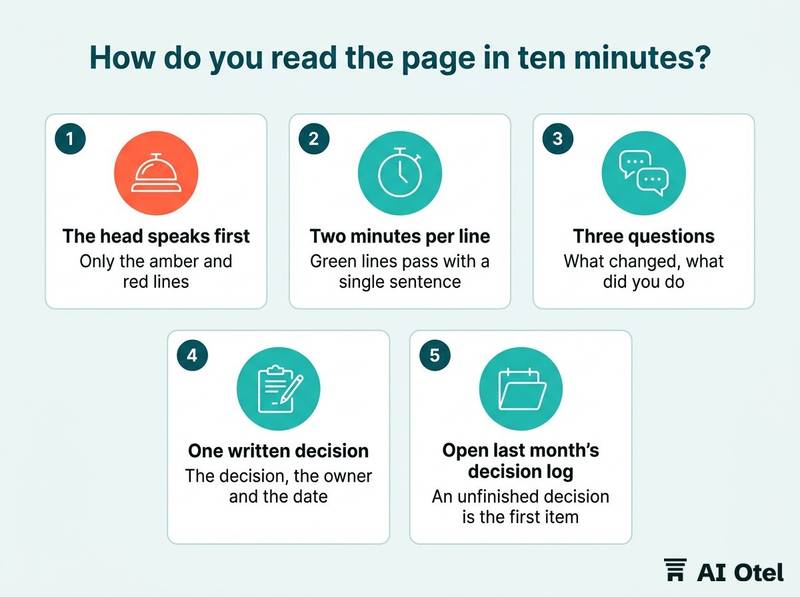
Give each line two minutes at most, and let green lines pass with a single sentence. For every amber or red line the general manager asks three questions: what changed, what did you do, what do you need. The decision is written in one line: the decision, the owner and the date. A decision without a date is a wish.
Open last month's decision log first. An unfinished decision is the first item of this month's meeting, not a footnote. Keep the scorecard conversation and the formal appraisal apart. The monthly page is an operating tool; the appraisal is a separate, slower conversation.
Ten to fifteen minutes per head is the target. If it regularly runs longer, the page has too many lines or the head arrived without a proposal. This monthly one-to-one complements, rather than replaces, a fifteen-minute daily department heads' meeting that gets things done.
When should you retire a measure?
Retire it when it has stayed green for months and nobody can name a decision it changed, or when the head cannot influence it. Keep the five slots and swap the measure inside them.
A measure the head cannot influence belongs on another department's page, where someone can act on it. Two lines that always move together are one line. Retire the duplicate and use the slot for something the page cannot currently see.
If the definition changes mid-year, start a new series and say so on the page. Do not splice two definitions into one line and call it a trend. Announce the retirement and the reason on the page, so whoever reads the file next year knows why the series stops.
Never retire a measure in the month it went red. Retire it at the annual review, on a green or amber month, with the replacement already agreed. The page keeps its shape across departments and across years; only the measures inside the slots move.
What to do next
Pick one department this week and ask its head for five numbers, each with a source report and a proposed limit. Hold the first ten-minute review at month end. The scorecard, the variance read and the daily meeting then do three different jobs: the page decides what the month was about, the variance explains the money, and the daily meeting clears today's obstacles.
Frequently asked questions
Should every department head use the same five measures?
No. The five slots stay the same so pages can be compared and read quickly, but the measure inside each slot is specific to the department. A front office result measure and a housekeeping result measure count different work; forcing one measure across both makes at least one of them meaningless.
How long should a monthly department head scorecard review take?
Ten to fifteen minutes per head is the working target. Only amber and red lines are discussed, green lines get one sentence, and the meeting ends with one decision. If it regularly runs long, the page has too many lines or the head arrived without a proposal.
Can we run the scorecard in a spreadsheet?
Yes at the start, provided every cell names its source report and one named person enters it. The risk is drift: a figure copied by hand stops matching the system within a few months, and the meeting then argues about the number instead of the work.
What if a head cannot produce one of the five numbers?
Replace the measure, not the slot. A number that cannot be produced by the first working day of the month, from a named report, is not ready to be a scorecard line, however useful it might be later.
Is the scorecard the same as the annual performance review?
No. The scorecard is a monthly operating tool that decides what changes next month. The formal appraisal is a slower conversation about the year, and mixing the two makes heads defensive about the page and slower to bring bad news early.