Pool and beach service words: sunbed card, cabana, towel desk, wristband and more
Clarify hotel pool and beach service terms to stop guest confusion. Learn how to define sunbed cards, cabanas, wristbands and towel desk rules clearly.
AI draft · awaiting editorial review
Contents
Key takeaways
- A service word works only when the sign, the desk script and the guest's own language use it for the same object.
- A sunbed card is a claim ticket: it records which bed, which day and from when, and it is neither a payment card nor a room key.
- A cabana is sold as a space and a sunbed is sold as a seat, so mixing the two on one price list creates the argument at the desk.
- Every time word on a pool sign should name who decides and when it ends, not only the state: "reserved until 10:00 by the cabana booking" beats "reserved".
- Write the Turkish and the English version of each rule from the same one-line rule, then check that both name the same object, the same person and the same time.
Among hotel pool and beach service terms, a sunbed card is the ticket a guest shows to claim a particular sunbed. A cabana is a private roofed poolside or beach unit sold as one space. The towel desk issues and takes back towels, and a wristband shows entitlement. Each word must mean one thing on the sign, at the desk and to the guest.
A guest reads "reserved" on a sunbed at nine in the morning and hears "you cannot sit here". The attendant means "this one is held for a cabana booking until ten". Same word, two meanings, one complaint at the desk before lunch. This article sets out the hotel pool and beach service terms one by one: what each object is, what it is not, and the sentence a guest should hear. After reading, you can build a one-page word list that ends the morning argument before it starts.
Why do guests and staff use different words at the pool?
Three vocabularies meet at the water's edge, and the glossary only helps if all three settle on one term per object. The first is the hotel's operational vocabulary, owned by departments: housekeeping owns towels, food and beverage owns the pool bar, the pool or beach team owns sunbeds and cabanas, and guest relations owns the wording the guest actually reads. The second is the shortened vocabulary on signs. The third is the guest's own language.
The failure mode is predictable. A word that is precise inside the team, such as "block", "hold" or "release", becomes vague the moment it is printed alone on a sign. The guest sees "reserved" and builds their own meaning around it.
Pool and beach are harder than the front desk for one reason: there is no receipt and no record. The guest's claim is spoken, the attendant's answer is spoken, and neither can be checked afterwards. The fix is a mechanism, not a dictionary: one page, one column per object, one term per object, signed off by the three departments that touch it.
Resist variety. "Lounger", "sun lounger", "bed" and "sunbed" on four different signs read as four different things to a guest who does not speak English well. Test the page by handing it to a new attendant and asking them to point at the object each word names. If two words point at the same object, delete one.
What is a sunbed card, and what is it not?
A sunbed card is a small card or token issued at the pool entrance or the towel desk that records which sunbed a guest holds, on which day and from what time. It is a claim ticket, nothing more.
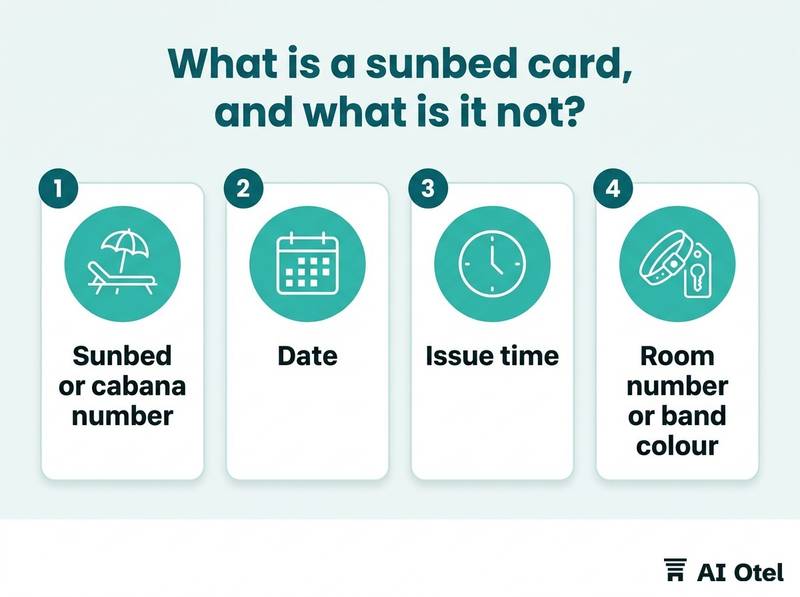
The card carries four things: the sunbed or cabana number, the date, the issue time, and either the room number or the band colour that identifies the party. Without a card, the only record of who holds which seat is the attendant's memory, and the attendant changes at shift handover.
Keep it separate from its three neighbours. The room key card proves the guest is staying in the hotel and opens the door. The towel card records how many towels are out. A payment card settles a bill. The sunbed card proves none of these; it proves the seat.
The desk script can be plain: "This card is for bed 24 until 18:00 today. Bring it back if you move to another bed." Three defects appear again and again: a card with no bed number, a bed number with no time, and two cards issued for one bed at shift change. Each one is prevented by the same two fields, bed and time, written by hand or printed.
The return step closes the loop. The card comes back at the end of the day, the bed is released, and the count at closing tells the hotel how many beds were actually used.
Key pointWhat a sunbed card records
A sunbed card records: which bed, which day, from what time. It does not record: payment, identity or entitlement. The band or the room card carries entitlement; the sunbed card only carries the seat.
What is a cabana, and how is it different from a pavilion?
A cabana is a private roofed unit at the pool or the beach, sold as one space with seating, shade and usually service. A pavilion is normally a larger and more permanent structure, and the two words should never be swapped on a price list.
The physical markers of a cabana are consistent: a roof, side curtains, a sofa or daybed inside, shade for most of the day, and a service point nearby. One caution: in some markets "cabana" means a changing cabin at the beach, so the sign has to say which one the hotel means.
Draw the line between furniture and space. The daybed is the piece of furniture inside the cabana; the cabana is what the guest books. Keep sleeping words out of the pool list entirely: a bungalow is a building a guest sleeps in and must never appear next to a sunbed price.
The listing problem is real. The same word appears on the booking site, on the beach sign and in the guest's confirmation, so the three must match or the guest arrives expecting a different object. For more on how listing words are read by travelers, see words on hotel listings such as cabana and pavilion.
The decision rule for staff is one sentence: if the guest is buying shade and privacy for a group, it is a cabana; if the guest is buying a seat by the water, it is a sunbed.
| Term | What it is | What it is not |
|---|---|---|
| Sunbed | A single seat by the pool or beach | A space |
| Daybed | Padded furniture, often inside a cabana | A booking unit on its own |
| Cabana | A roofed private unit sold as one space | A room or a bungalow |
| Pavilion | A larger, usually permanent roofed structure | A synonym for cabana |
| Gazebo or baldaquin | A shade frame | A service unit |
| Bungalow | A building guests sleep in | A pool seat |
Wristband, card or bracelet: how does a hotel show who is entitled?
The wristband is the visible proof of an entitlement, read at arm's length at the pool bar and the towel desk. The card is the record behind it, and the two do different jobs.
Four objects sit in a guest's hands at a resort, and each proves something different. The room key card opens the room and carries the bill. The wristband shows the meal plan or day pass at a glance. The sunbed card records the seat. The towel card records the towels. Guests assume the band does everything, so a hotel that uses both needs a written line on what each one proves.
Colour coding works as a mechanism when it follows rules: one colour per meal plan or per day, changed on a fixed schedule, so a band from last week is visible at a glance. Reading conditions matter too. A band is checked in sunlight, on a wet arm, in a queue, so the colour must be distinguishable and must not rely on small print.
Day passes and outside guests need their own band or colour, and a written rule on where that band may and may not go. The awkward cases each need one sentence the attendant can say: a lost band, a band kept after check-out, a child's band, a guest who refuses to wear one. Prepare the sentences before the season, not during it.
One privacy point: a band printed with a name or room number is read by everyone in the queue. Keep the band to a colour and a code. And watch the boundary with water sports: if a concession runs the jetty or the slides, its band or ticket is a separate object with separate rules, covered in more detail in water sports run by the hotel or by a concession.
Checklist
- Room key card: opens the room and carries the bill.
- Wristband: shows the meal plan or day pass at a glance.
- Sunbed card: records which bed, which day, from when.
- Towel card: records how many towels are out and when they come back.
What happens at the towel desk, and what does the pool bar sell?
The towel desk issues, records and takes back pool and beach towels, and it is usually the only written record of who used the pool area. The pool bar sells drinks and food against the band or the room bill.
The towel desk words are few: issue, exchange, return, the dirty towel bin, the end-of-day count, and the towel card that tracks the number out. The desk matters beyond towels. It is the point where the hotel learns how many people used the pool and when, which is the same information the sunbed count needs.
The pool bar has its own set: open tab, room charge, band, service to the sunbed, call button, QR menu, last order. The free-or-charged boundary must be explicit. The guest has to hear which one applies before ordering, not at check-out, and the band colour is the fastest way to say it.
Service to the sunbed is a distinct service with its own words: who takes the order, how it reaches the bed, and what happens to a drink that arrives after the guest has left. The snack bar runs on a different rhythm again. It opens and closes on its own clock, and a guest who arrives between the two needs a sentence, not a shrug. For the operational side of these outlets, see the pool bar and beach snack bar: stock, cash and opening hours.
Which time words and sign words cause the most arguments?
The words that describe a state without naming who decided it or when it ends. "Reserved", "opening hours", "adults only" and "last order" all fail the same way: the guest cannot tell what to do next.
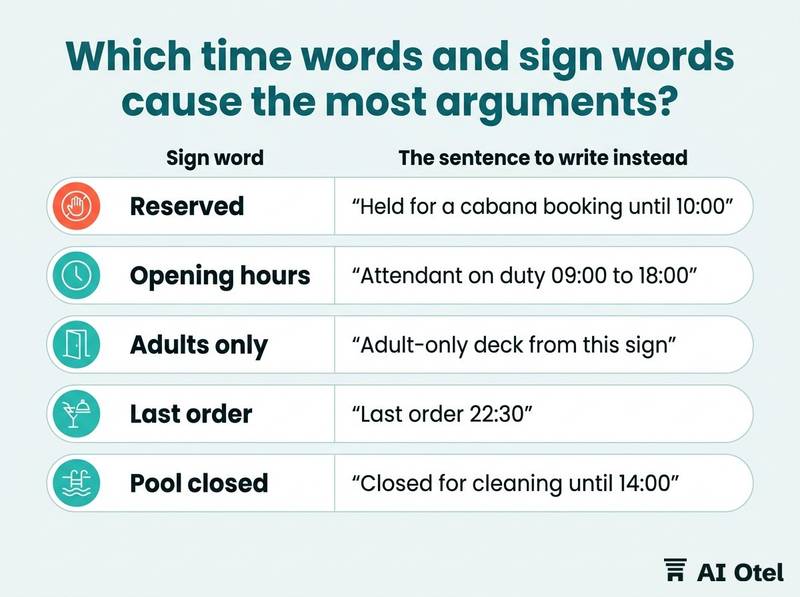
Give "reserved" a three-part test: by whom, until when, and released at what time if nobody comes. A sign with all three ends the argument before it starts. Separate "pool closed" from "pool closed for cleaning" and from "pool closed until 14:00": only the last two tell the guest what to do with the next four hours.
The hotel's own sunbed rule should be a written line stating when a bed may be held, for how long, and what happens to belongings left on it, applied the same way by every attendant. Treat zone words as zones, not people: "adults only" and "quiet hours" name an area and a time, and the sign should show where the area starts. Restriction words work best with the alternative in the same sentence: "no outside food and drink" should be followed by what the guest can do instead.
Distinguish "last order" from "closing". One is when the bar stops taking orders and the other is when the area empties, and guests plan their evening on the difference. Add the seasonal layer: a pool that is open in July may be closed in November, and the sign has to change with it. Telling guests before arrival what is open and what is closed, as covered in a low-season stay, prevents most of these conversations.
| Sign word | What the guest hears | What the hotel means | The sentence to write instead |
|---|---|---|---|
| Reserved | "You may not sit here" | Held for a cabana booking | "Held for a cabana booking until 10:00, then free" |
| Opening hours | "It is open all day" | Staffed between two times | "Attendant on duty 09:00 to 18:00; the pool stays open" |
| Adults only | "Children are banned" | One zone is adult-only | "Adult-only deck from this sign to the sea wall" |
| Last order | "The bar is closing" | Orders stop before closing | "Last order 22:30; the bar closes 23:00" |
| Pool closed | "Something is wrong" | Cleaning in progress | "Closed for cleaning until 14:00" |
How do you write the same pool rule in Turkish and English?
Write both versions from the same one-line rule, then check that each names the same object, the same person and the same time. Translating a finished sign produces two different rules.
Build the list from the objects on the ground, not from a dictionary. Walk the pool area, photograph each object, then name it once in each language. Fix the core pairs and keep them: şezlong for sunbed, havlu masası for towel desk, havlu kartı for towel card, bileklik for wristband, kabana for cabana, günübirlik giriş for day pass.
Avoid the tempting wrong pairs. "Yatak" for sunbed reads as a bed to sleep in, and "havlu bileti" reads as a ticket rather than a card. Keep loanwords guests already use, such as kabana, but gloss them once on the sign so a guest who has never seen the word still knows what is being sold. Ban word-for-word idioms in both directions: say what happens, who does it and when, and drop the metaphor.
Run the two-reader test. Read the Turkish aloud to a housekeeping supervisor and the English aloud to a guest, and check that both point at the same object. Then put the finished list where the guest meets the word: the sign at the entrance, the desk script and the guest app, so the same term appears in all three. A hotel that gives every guest their own guest app in the browser (built, ahead of launch) can carry the same list there, next to the bill and the service requests.
| English | Turkish | The sentence a guest hears |
|---|---|---|
| Sunbed card | Şezlong kartı | "Bu kart 24 numaralı şezlong için, bugün 18.00'e kadar." / "This card is for sunbed 24 until 18:00 today." |
| Towel desk | Havlu masası | "Havlunuzu havlu masasından alabilirsiniz." / "You can collect your towel at the towel desk." |
| Wristband | Bileklik | "Bilekliğiniz her öğünde geçerlidir." / "Your wristband covers every meal." |
| Cabana | Kabana | "Kabana gün boyu sizin için ayrıldı." / "The cabana is held for you for the day." |
| Day pass | Günübirlik giriş | "Günübirlik giriş saat 18.00'de sona erer." / "The day pass ends at 18:00." |
| Reserved | Rezerve | "Bu şezlong saat 10.00'a kadar rezerve." / "This sunbed is reserved until 10:00." |
What to do next
Write the one-page word list this week: one term per object, in English and Turkish, signed off by housekeeping, food and beverage and guest relations, then place it where the guest meets the word, on the entrance sign, at the towel desk and in the guest app. The glossary is not the point; the point is that the sign, the attendant and the guest say the same thing, so the argument at nine in the morning never happens. If you are planning a stay rather than running a hotel, you can browse hotels in Türkiye (opens in a new tab) and see how each one describes its pool and beach services.
Frequently asked questions
What is a cabana at a hotel?
A private roofed unit at the pool or beach, sold as one space with seating, shade and usually service. It is not a room and not a bungalow. The hotel sets what is included and whether it is sold for a day or against a minimum spend, and that should be written on the sign and in the confirmation.
What does a sunbed card actually do?
It records which bed a guest holds, on which day and from what time, so the claim survives a shift change. It is not a payment card, not a room key and not proof of entitlement. The band or the room card carries entitlement; the sunbed card carries the seat.
Is a wristband the same as a room card?
No. The room card opens the door and carries the bill, and the wristband shows the meal plan or the day pass at a glance. A hotel that uses both needs a written line on what each one proves, because guests assume the band does everything.
How do you say towel card and sunbed in Turkish?
Havlu kartı for towel card, havlu masası for towel desk, şezlong for sunbed, bileklik for wristband, kabana for cabana. Keep one term per object across the sign, the desk and the guest app, and avoid "yatak" for sunbed, which reads as a bed to sleep in.
Who decides whether a sunbed can be reserved?
The hotel does, through its own written rule, applied the same way by every attendant. The rule should say who may hold a bed, for how long, and when an unclaimed bed is released, and it should be posted where the guest meets it. A cabana booking that holds a sunbed has to be described in the same rule.