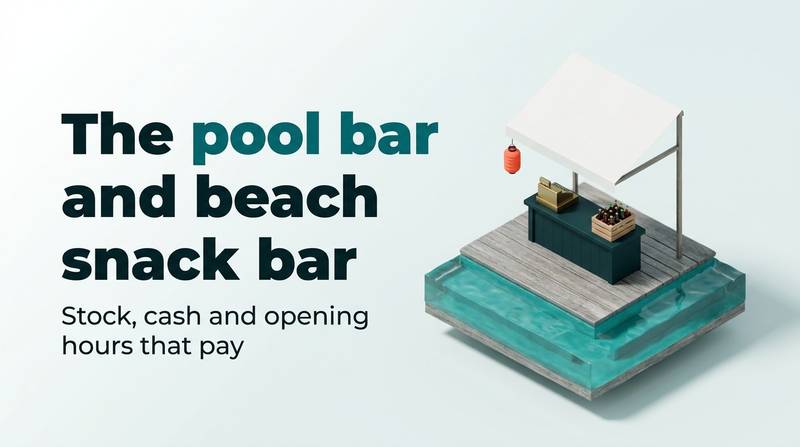
The pool bar and beach snack bar: stock, cash and opening hours that pay
Discover how to optimize hotel pool bar and beach snack bar operations. Learn to set profitable hours, control stock, and manage cash effectively.
AI draft · awaiting editorial review
Contents
Key takeaways
- A pool bar pays when its hours are built from guest movement, not from a fixed sign on the door.
- A short menu is a control: fewer items, clearer par stock, less waste, and faster service.
- Cash and room charges need the same discipline as the main restaurant, even when the outlet is far from the office.
- In all-inclusive hotels, judge the outlet by service, waste, and labor, not by cash sales alone.
- Weather rules should be written before the season, so closing or reducing is not a daily argument.
Hotel pool bar and beach snack bar operations come down to a few daily controls that decide whether a small outlet earns: opening hours built from guest flow, a short menu, shift-level stock counts, cash and room-charge rules, and a review by hours opened rather than daily totals.
A resort opens the pool bar at ten and closes it at five because the sign says so. Guests are on the beach by nine, thirsty, and still want water at six. The bar is slammed for ninety minutes and idle the rest of the day, and at month end the manager sees a weak line on the report. This article gives you the controls that fix that: how to set the outlet's job, its hours, its menu, its stock round, its cash handover, and the review that tells you whether to keep it, change it, or close it.
What is the outlet for: paid sales or all-inclusive service?
The outlet must have a clear job before hours, menu, stock, or cash rules can work. Write the job down in one sentence: paid sales, convenience, all-inclusive service, day-pass support, or event overflow. Everything else follows from that sentence.
In a paid hotel, the pool bar earns when it captures spend that would otherwise leave the property. A guest who wants a cold drink at eleven and finds the bar closed buys nothing, or walks to the shop across the road. The bar also earns when it takes pressure off the main restaurant at lunch: a guest who takes a sandwich at the pool does not occupy a table indoors.
In an all-inclusive hotel the job is different. The outlet earns by reducing queues at the main buffet, shifting demand away from peak hours, improving service, and limiting waste. Cash sales are not the measure; a snack bar that serves two hundred covers between the buffet's lunch seatings can be the most valuable outlet in the hotel while showing almost no revenue of its own.
A day pass changes the job again. If the hotel is selling a day pass for the pool or beach club, the bar must serve outside guests quickly without crowding out in-house guests, and the pricing and capacity rules have to be set before the first pass is sold. If the outlet has no written job, it will be judged by cost and complaint, which is the worst possible scorecard for a small operation.
When should a pool bar or beach snack bar open?
Open when guests are present, staffed, and able to buy or receive service without creating waste. That sounds obvious, but most outlets violate it in one direction or the other: open with no guests, or closed with guests standing at the shutter.
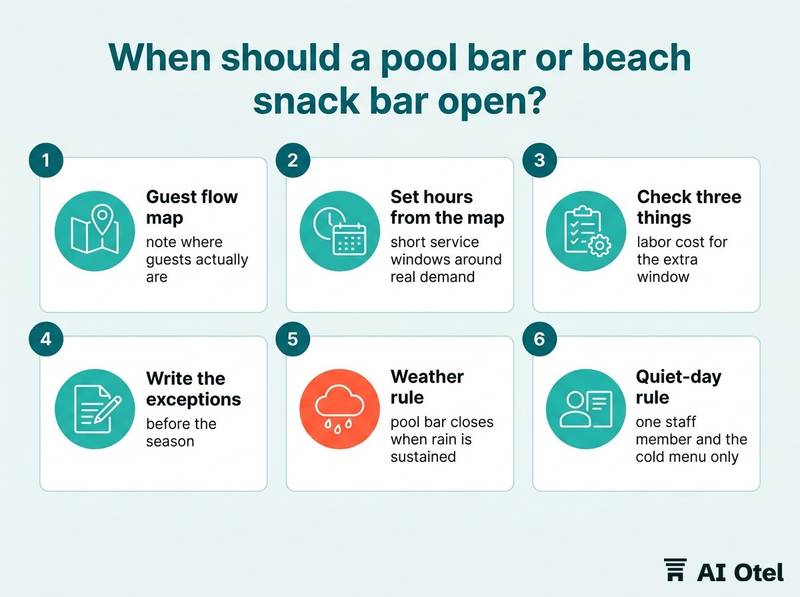
Start with a guest flow map. Walk a typical day and note where guests actually are, hour by hour, and what the outlet's task is at each point.
NoteThe guest flow map
Arrival, breakfast, beach, lunch, pool, afternoon, sunset, dinner. At each point, write one line: where guests are, what they want from the outlet, and whether the outlet should be open, reduced, or closed.
Then set hours from the map. If guests are on the beach from nine, the snack bar opens at nine, not at eleven. If the pool empties at five because families go to rest before dinner, the bar does not need two staff standing there until seven. Short service windows around real demand beat long hours with idle staff, every time.
Before extending any hours, check three things: labor cost for the extra window, perishables that must be prepared and may be thrown away, and cleaning time at close. Extending hours into a period with thin demand adds all three costs for little return.
Write the exceptions before the season. A weather rule ("pool bar closes when the pool area is cleared by lifeguard instruction or rain is sustained") and a quiet-day rule ("on days under X arrivals, one staff member and the cold menu only") remove the daily argument between the outlet supervisor and the duty manager. Day passes, events, and peak weekends can justify extra hours; habit cannot.
What menu fits a small outlet?
A small outlet needs a short menu that can be served fast, counted clearly, and reduced when demand falls. Length is not generosity here; every extra item adds prep time, stock to count, waste risk, and a button for staff to press by mistake.
For drinks, use high-turn items, standard measures, and a small set of bottles or packages. Ten bottles that sell every day count faster and waste less than thirty of which twenty sell once a week. Standard measures matter twice over: they protect the margin and they make the closing count meaningful, because expected consumption can be calculated from sold units.
For food, choose items that hold well, travel well to the beach or poolside, and can be finished in small batches or reduced quickly when demand drops. A sandwich made to order in a five-minute window beats a tray of pre-made sandwiches that sits in the heat and becomes waste at two o'clock.
Before adding any item, check the operational questions: cold chain for anything chilled, hot holding for anything cooked, allergen labeling, and beach safety, meaning glass, skewers, and anything that breaks or cuts on bare feet. Use disposables and packaging that fit the service style and the cleaning routine; a cup that blows across the beach is a service decision, not a purchasing detail.
Change the menu by season, not by daily mood. A written summer menu and a shorter shoulder-season menu, each with its own par stock, keep purchasing and counting stable.
How do you control stock away from the main kitchen?
Control stock with shift-level par stock, signed restocks, waste records, and closing counts. The principle is simple: an outlet two hundred meters from the main kitchen, with no office nearby, gets the same controls as the main bar, just compressed into a form a shift leader can run in ten minutes.
Set par stock for each shift by outlet, not by the whole resort. The pool bar's afternoon par is not the main bar's par divided by some fraction; it is its own number, based on its own sales history. If you want the fuller method for bars generally, see beverage cost control in hotel bars: measures, par stock, and the monthly count.
ChecklistThe daily round has a fixed order
- Set or confirm par stock for the shift
- Count opening stock and record it
- Restock from the main store with a signed transfer
- Record waste, spillage, staff consumption, and sampling as they happen
- Count closing stock
- Compare variance against expected consumption
- Review the variance before the next shift starts
Two details make the round honest. First, record waste, spillage, staff consumption, and sampling separately from sales, at the moment they happen, on a log kept at the outlet. A bottle broken at the bar and a bottle missing at the count are different events, and only the log tells them apart. Second, use a closing count sheet that does not show the expected figure. If the counter can see what the number "should" be, the count will match it. Print the blank, count first, compare after.
Review variance before the next shift, not after the month closes. A variance explained the same evening, with the staff who worked the shift still present, is a conversation. The same variance found on the twenty-eighth of the month is a number nobody can explain, and by then it has repeated twenty times.
How do you control cash and room charges at a pool bar?
Control cash and room charges with outlet codes, fixed floats, approval rules, folio posting, and handover reconciliation. The distance from the office is not an excuse; it is the reason these controls exist, because a far outlet is exactly where unbilled charges and cash gaps hide.
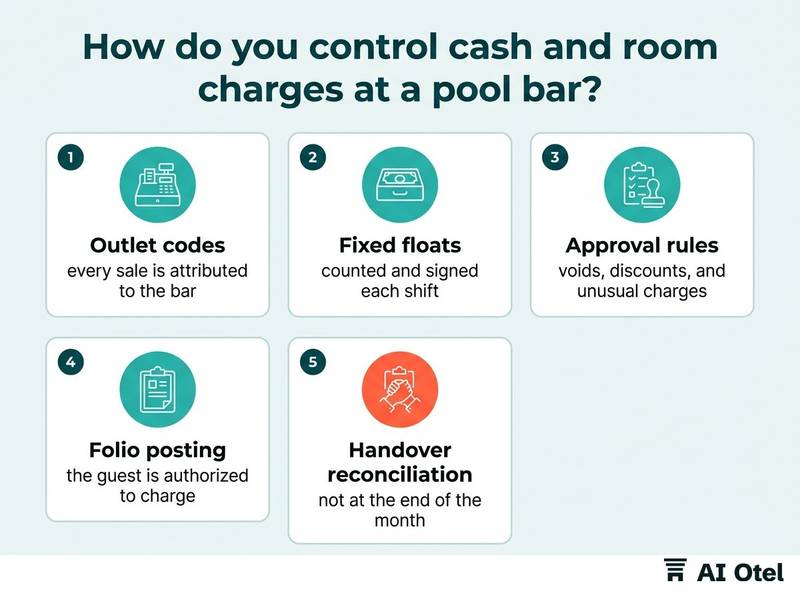
Set up the basics before the season: an outlet code in the point-of-sale system so every sale is attributed to the bar and not to the main restaurant, a clear menu or button set so staff cannot sell items that do not exist in the system, and a fixed opening float counted and signed at the start of each shift.
Require manager approval for voids, discounts, and unusual charges. A void at a beach bar with no approval rule is the simplest theft in the hotel: sell the drink, void the ticket, keep the cash. A four-digit approval code on the handheld removes the temptation.
Post room charges to the guest folio when three things line up: the system supports posting from the outlet, the guest is authorized to charge (room number, name, and where house policy requires it, a signature or key card check), and the posting lands on the audit trail. Set a charge limit per folio and a clear written rule for the two problem cases: a guest with no folio at all, such as a day visitor, and a guest whose folio is already closed at checkout. In those cases the answer is cash, card, or prepaid credit, never "we'll sort it later".
Reconcile cash, card, and room charges at handover, not at the end of the month. The handover record is signed by both the outgoing and incoming staff member and shows: opening float, closing cash counted, card totals, room charges posted, voids with approval, and any unpaid charges with a reason. For the full opening and closing routine, including hygiene, see the hotel bar opening and closing checklist.
Watch outThe far-outlet gap
A distant outlet without outlet codes, folio posting, approval limits, and handover reconciliation produces two quiet losses: charges that never reach a guest's bill, and cash that never reaches the safe. Both look like "weak sales" on the monthly report until someone counts properly.
How do you judge whether the outlet pays?
Judge the outlet by the measure that fits its job: sales per hour opened for paid outlets, service and cost per cover for all-inclusive outlets. The review discipline is the same in both cases; only the measure of success changes.
For a paid outlet, divide net sales by hours opened and compare that figure with labor cost, stock cost, and waste for the same window. A bar showing solid daily totals across fourteen open hours may be earning almost nothing per hour in the middle of the afternoon. Review by hour or service window, not by daily total alone, because the daily total hides exactly the hours you should cut.
For an all-inclusive outlet, compare covers served, cost per cover, labor hours, waste, and service time, and ask one more question: does the outlet reduce pressure elsewhere, or does it create new queues and complaints? A snack bar that shortens the lunch queue at the buffet is doing its job even though its own revenue line is near zero. The same logic applies to waste planning: quantity decisions should come from covers, as covered in measuring buffet food waste in all-inclusive hotels.
| Question | Paid outlet | All-inclusive outlet | Action |
|---|---|---|---|
| Earning | Net sales per hour opened | Covers served, cost per cover | Compare with labor and waste |
| Service | Queue time at peak | Queue time, guest complaints | Add a window or a station |
| Stock | Variance per shift | Waste per cover | Tighten par stock |
| Labor | Staff hours per sales hour | Staff hours per cover | Re-cut the schedule |
| Change decision | Hours, menu, price | Hours, menu, quantities | Keep, change, or close |
Decide from the pattern, not from one bad week. If the eleven-to-one window earns and the three-to-five window does not, change the hours. If one item accounts for most of the waste, cut the item. If variance is clean and service is fast but the outlet still does not justify itself, close it or fold it into a neighboring outlet. Run the rule for a full period, a month is usually enough, then decide.
What to do next
Pick one outlet, the pool bar or the beach snack bar, and write its one-page rule before the season or the next review period: its job in one sentence, its hours from the guest flow map, its short menu, its shift par stock, its cash handover form, and the measure you will judge it by. Run that rule unchanged for a month, then review the numbers by hour and by shift, and change one thing at a time. A hotel operating system built to carry outlet codes, folio posting and shift-level reports in one place can automate these checks, but the discipline must come from management first; the approach is described on the platform overview, and hotels that want help applying these controls to their own property can read about OtelCiro's work.
Frequently asked questions
Should a pool bar open before guests arrive?
Only if guests are already present and ready to buy or be served. Opening early adds labor, prepared perishables, and idle time, and none of that is recovered by the first sale at noon. Use the guest flow map to find the real opening point: the hour guests actually reach the pool or beach.
How do all-inclusive hotels know if a snack bar is worth keeping?
Do not judge it by cash sales, because in an all-inclusive hotel the outlet is a service, not a revenue line. Look at covers served, cost per cover, labor hours, waste, service time, guest complaints, and whether it reduces pressure on the main buffet. If it shortens queues and keeps guests by the pool instead of queueing indoors, it is doing its job.
What is the simplest way to stop stock loss at a beach snack bar?
Use par stock per shift, signed restock transfers, opening and closing counts, and a separate waste log kept at the outlet. Review the variance before the next shift starts, while the staff who worked the shift can still explain it. A variance reviewed a month later is a number; a variance reviewed the same evening is a control.
Can a beach snack bar accept room charges?
Yes, when the outlet code, folio posting, guest authorization, charge limit, and audit trail are all in place. If any of those is missing, the answer is cash, card, or prepaid credit. Posting a charge to a closed folio or an unverified room number is how hotels end up writing off sales they already made.
When should a pool bar close early?
When a written weather or quiet-day rule is met, decided before the season, not at the bar at four in the afternoon. The rule should weigh demand, labor cost, perishables at risk, and safety, and it should be communicated to staff and guests so the decision reads as policy, not as a personal call.