Board upgrades on arrival: offering half board or all-inclusive at the desk
A board upgrade is a kitchen decision before it is a price decision. Learn how to offer half board or all-inclusive at the desk, price it from marginal cost, and track take-up.
AI draft · awaiting editorial review
Contents
Key takeaways
- A board upgrade is a kitchen decision before it is a price decision: offer it only when the extra cover costs less than the supplement and the kitchen has room to serve it.
- Price the difference per person per night from the cost of the extra covers, then check the guest's new total against the board supplement you already publish and the rate floor for that room type.
- Give the desk a written limit and a three-line script, and let the restaurant confirm the cover before anything is posted.
- Post the upgrade as a separate line for each remaining night, so a guest who leaves early is reversed cleanly and the restaurant gets a cover count it can cook to.
- Count offers made as well as offers accepted: take-up is accepted offers divided by offers made, per service and per channel.
A board upgrade is a change of meal plan sold after booking: a room-only or bed-and-breakfast guest adds dinner, or moves to all-inclusive, for the remaining nights. Price it from the cost of the extra covers and the kitchen's spare capacity, set a written limit on who may sell it, and post it to the folio per night.
It is 21:40, a guest with a room-only booking puts a bag down at the desk and asks whether dinner is still possible. The restaurant has a few covers left, the kitchen has already ordered for tomorrow, and the receptionist has no price to quote. This article gives you the pieces that moment needs: what a hotel board upgrade offer at check-in actually changes, how to price it from the kitchen's cost and capacity, who may sell it, how it reaches the folio and the restaurant, and how to review take-up each month.
What is a board upgrade at check-in?
A board upgrade changes the guest's meal plan after the booking is made, usually from room only or bed and breakfast to half board, full board or all-inclusive, for the nights that remain. It changes three things at once: what the kitchen cooks, what housekeeping restocks (the minibar, under all-inclusive), and what the guest is charged.
Half board adds dinner to breakfast, full board adds lunch, and all-inclusive adds drinks, snacks and often bar or pool service. All-inclusive is therefore a different cost decision rather than a larger half board. A board upgrade is also not a room upgrade: the room stays the same, the price moves per person per night, and the child rate usually differs from the adult rate.
The guest is buying certainty for tonight, not a package, and the desk has seconds to say what is included and what is not. The board code on the reservation matters more than the price: the restaurant list, the kitchen order and the folio must all read the same field, or the guest arrives at a restaurant that has no cover for them. Name the change precisely in the posting, so the guest, the restaurant and the accountant describe the same thing. For the background on each plan, see hotel board types explained, from room only to ultra all-inclusive.
| Board change | What the kitchen adds | What else changes | What the guest pays for |
|---|---|---|---|
| Room only to bed and breakfast | Breakfast covers | Breakfast order | Per person per night |
| Bed and breakfast to half board | Dinner covers | Dinner service staffing | Per person per night, remaining nights |
| Half board to full board | Lunch covers | Lunch service and pool-side staffing | Per person per night |
| Any board to all-inclusive | All three meals plus snacks | Minibar restocking, bar hours, beverage stock | Per person per night, with a beverage assumption |
When does a board upgrade make sense for the kitchen?
When the cost of the extra cover is lower than the supplement and the kitchen can serve it at the standard the guest is paying for. Both conditions, not one.
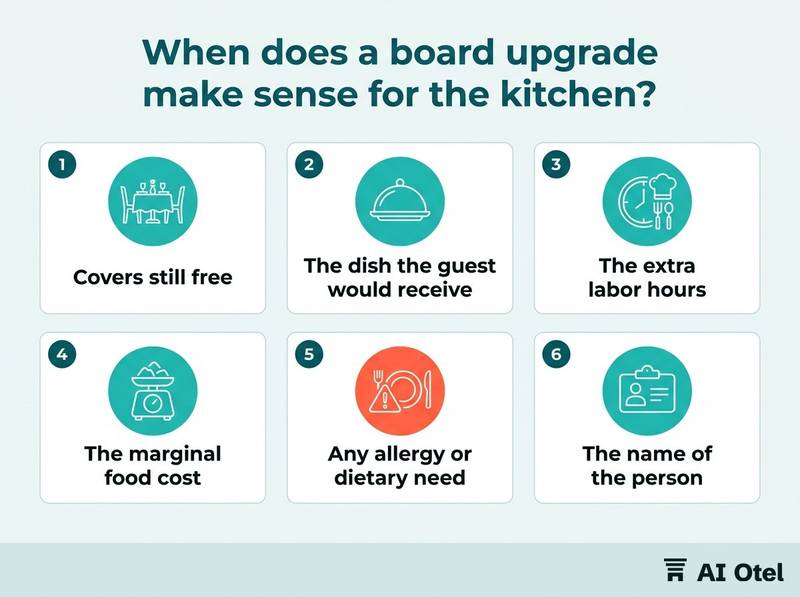
Use marginal cost, not average cost. The average cost per cover carries rent, salaries and equipment the hotel pays whether the guest eats or not, while the decision turns on the food, the extra labor hours and the energy for one more cover. Capacity is covers per service, not seats: for example, a restaurant with 120 seats whose kitchen plates 90 covers in the 19:00 to 21:00 window has 90 covers of capacity, not 120.
Time of day is part of the answer. An offer made at 16:00 can still reach the kitchen's order, while an offer at 21:40 depends on what is already prepped and on the last seating. Perishability cuts both ways: food bought for a buffet that will not be sold tomorrow makes the marginal cost low, and a dish cooked to order for one guest makes it high. Follow the menu already running, so the upgrade lets the guest eat what the kitchen is producing rather than opening a new line for one person. All-inclusive passes a different test, because it promises drinks and snacks across the day, so beverage cost and bar staffing hours enter the calculation.
ChecklistBefore the desk offers dinner tonight, check
- Covers still free at the last seating
- The dish the guest would actually receive
- The extra labor hours and who works them
- The marginal food cost of that cover
- Any allergy or dietary need, and whether the kitchen can meet it
- The name of the person in the kitchen who confirmed it
How do you price the difference between board types?
Start from the cost of the extra covers, add your margin, then check the result against the board supplement you already publish and the rate floor for that room type and date.
Quote per person per night and state the total for the stay in one sentence, including whether the child rate is a share of the adult rate or a fixed figure. Mid-stay means proration: a guest who upgrades on the third of five nights pays for three nights, and the offer must say so before it is accepted.
Treat your published supplement as the reference. A desk price far below it rewards the guest who waits and penalizes the one who booked the board in advance. If the desk price must differ, write down why, for example a buffet already prepared and unsold, and keep the reason inside the limits you set. Run the rate floor check too: compare the guest's new total per night with the floor for that room type, because a supplement can be right for the kitchen and still leave the room under its floor. All-inclusive needs a beverage assumption: the supplement must cover the drinks a guest is likely to take, not the drinks they might. The choice of which board bases to sell in the first place has its own logic, covered in choosing the board basis a hotel sells.
Watch outTwo ways a desk price goes wrong
Undercutting your own published supplement teaches guests to wait until arrival, and quoting a per-night figure without the number of nights means the guest hears a smaller number than the bill will show. How a board supplement is taxed, and whether it can be shown as a separate line or must sit inside a package price, is a question for the hotel's accountant.
Who may sell it, and when should the desk refuse?
A named person with a written limit sells it, and the desk refuses whenever the kitchen cannot serve the cover at the standard the guest is paying for.
Write the limit down: a maximum supplement per stay, or a maximum number of covers the desk may commit per service without calling the kitchen, with the duty manager deciding above it. Keep the script to three lines: the price per person per night, what it includes, and what it does not, for example drinks at dinner. Give the desk a refusal script that offers what does exist tonight, such as a table at the à la carte, breakfast only, or dinner tomorrow, instead of a bare no.
Never sell a board upgrade the restaurant has not confirmed, because a promise made at the desk and broken at the restaurant door costs more than a refusal. Treat allergies and dietary needs as part of the capacity check, not as a detail discovered after the sale. Record who sold what, since the name on the posting is the only way to review the practice later.
TipCopyable desk script
"Half board for the rest of your stay is X per person per night, and it includes breakfast and dinner; drinks at dinner are charged to your room." Refusal line: "Dinner is fully booked tonight; I can offer you a table at the à la carte at 21:30, or half board starting tomorrow."
When should you offer it: before arrival, at the desk or mid-stay?
Offer the whole stay before arrival, the same evening at the desk, and the remaining nights mid-stay, and use a different sentence for each moment.
Before arrival the guest still has choices and the kitchen still has time to order, so the offer can cover every night of the stay. At the desk the offer is about tonight: the guest is tired, the bag is down, and the answer has to arrive in one sentence with a price. Mid-stay the offer must state the nights remaining and the new total, and it should not be repeated every morning to a guest who has already declined. Groups are their own case: a coach arriving at 22:00 needs one decision for the whole party, made before the coach leaves its previous stop.
The channel matters less than the record: whichever way the offer is made, the acceptance must land on the reservation, not in a message thread. Measure the three moments separately, because a message that converts and a desk that does not are two different problems. One way to reach guests before arrival is a hotel's own guest app: AI Otel's guest app is built so that upgrades and extras are offered before arrival and during the stay, and an accepted offer goes straight onto the guest's bill. The broader logic of timing offers is covered in matching each upsell offer to the right moment.
| Moment | What you offer | What you check first | What goes wrong |
|---|---|---|---|
| Before arrival | The whole stay | Kitchen order lead time | Offer arrives after the guest booked dinner elsewhere |
| At the desk | Tonight only | Covers left at the last seating | Price quoted without the total |
| Mid-stay | Remaining nights, prorated | The folio and the restaurant list | Offer repeated to a guest who said no |
How does the upgrade reach the folio and the restaurant?
As a separate posting for each remaining night, and as a cover count the restaurant receives before it orders and plates.
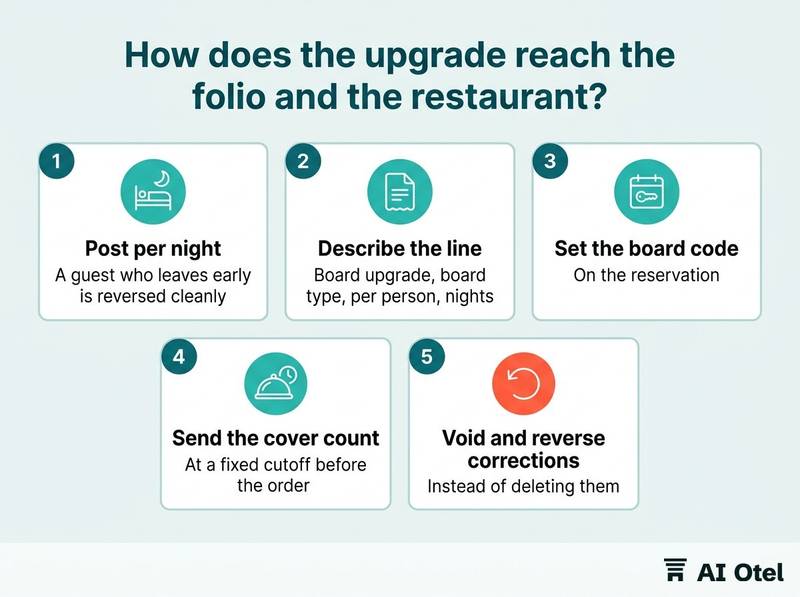
Post per night rather than as one lump sum, so a guest who leaves a day early is reversed cleanly and the night audit sees the right revenue on the right day. Describe the line so the guest and the accountant both understand it: board upgrade, the board type, per person, and the nights covered. Set the board code on the reservation, so the restaurant list, the breakfast and dinner counts and the kitchen order all read the same field.
Send the cover count at a fixed cutoff before the kitchen's order point, because a count that arrives after the order is information rather than a plan. Void and reverse corrections instead of deleting them, so the record of who posted what stays intact. All-inclusive also changes housekeeping: minibar restocking and pool towel rules follow the board code, not a note left at the desk.
ChecklistPost and tell, in order
- Set the board code on the reservation
- Post one line per remaining night, with the guest's name and the seller's name
- Send the cover count to the kitchen at the cutoff
- Confirm the restaurant list shows the guest
- Tell housekeeping if the board is all-inclusive
- Check the next morning that the covers served match the covers posted
How do you review take-up each month?
Count offers made, offers accepted and covers added, per service and per channel, and read the three together.
Offers made is the denominator: accepted offers divided by offers made tells you whether the script works, while accepted offers divided by arrivals tells you almost nothing. Keep the desk, the pre-arrival message and the guest app apart in the count, because each has a different cost and a different failure. Read the cost side next to the revenue side: the marginal cost of the covers actually served against the supplements actually posted.
Look for the guest who declined the upgrade and then ate in the restaurant anyway, which is a script problem rather than a demand problem. Retire the offer that never converts, and re-examine the price that always does, because a supplement accepted every single time is probably too low. Read these counts next to the restaurant's own numbers, so a busy restaurant and a full restaurant are not confused; the underlying measure of in-house guests using the restaurant is covered in what capture rate tells you about your restaurant, bar or spa.
Key pointThe four counters of a monthly board-upgrade review
Offers made per service; offers accepted per service; covers added and their marginal cost; supplements posted, split by channel (desk, message, guest app). One owner reads them, and one decision follows from each.
What to do next
Write the desk limit, the three-line script and the posting rule down this week, then read the first month's four counters before changing the price. The pieces fit together in one order: the kitchen confirms the cover, the desk quotes within its limit, the folio carries one line per night, and the restaurant gets the count before it orders. OtelCiro, the ecosystem's hotel growth and consultancy arm, works with paying hotel clients today on how a hotel sells; you can read more about OtelCiro's consultancy work and about the platform AI Otel is building. To see how these pieces run in one system, request a briefing.
Frequently asked questions
Should the desk charge the same board supplement as the booking engine?
Keeping one published supplement is simpler and fairer, and a lower desk price teaches guests to wait until arrival. If the desk price must differ for a specific reason, write the reason down, keep it inside the written limit, and make sure the receptionist can explain the difference in one sentence. A hotel board upgrade offer at check-in should be priced against the published supplement, not invented at the desk each evening.
Can a guest upgrade to half board for one night only?
Yes, the night is the natural unit. Check the covers free at that specific dinner service, post the upgrade as its own line for that night, and state clearly whether the per-night price is the same for a single night as for a longer stay.
What should reception do when the restaurant is fully booked?
Refuse the board upgrade and offer what does exist, such as a table at the à la carte at a later time, breakfast only, or half board starting the next day. Record the refusal, because a run of refusals is a capacity signal that belongs in the monthly review.
Does an all-inclusive upgrade cost the hotel more than half board?
Usually yes, because it carries drinks, snacks and bar hours as well as meals. The supplement has to be built on a beverage assumption and on the bar staffing the promise requires, not on the food cost of one more dinner cover.
Who should own board upgrades: front office, F&B or revenue?
Revenue sets the price and the rate floor, F&B sets the capacity and confirms each cover, and front office sells inside a written limit. One named person owns the monthly review, so the three counts and the cost side are read together rather than by three departments separately.