The in-house service price list: laundry, extra bed, transfer and late services on one page
A clear service price list prevents billing disputes by fixing units, posting codes and waiver rules. This guide shows how to write each line, where to display it, and how to reconcile posted charges monthly.
AI draft · awaiting editorial review

Contents
Key takeaways
- A service price list is a control document, not a marketing flyer, because it fixes what is sold, how it is posted and who may change it.
- Every line needs a posting code, so the desk cannot create a free-text charge that disappears in month-end reporting.
- Late services should be listed with their unit and cut-off time, because a late charge is usually a time charge, not a vague penalty.
- The list should state the charge currency and the conversion rule in plain words, and unclear contract or display cases go to counsel or an accountant.
- A monthly check of posted charges against the list reveals which lines are not understood by staff or guests.
A hotel in-house service price list is a single written page that shows every paid service a guest can buy during a stay, with price, unit, currency, posting code and waiver authority. It gives guests a clear reference and gives staff one source to quote and post charges.
A guest asks for an extra bed at 23:00. The desk quotes one amount, the night audit posts another, and the laundry bill arrives with a charge no one can trace. A one-page service list prevents that drift. This article shows what belongs on that page, how to write each line, where guests should see it, who may waive a charge, and how to check that what was posted matches what was promised.
What belongs on an in-house service price list?
The list belongs to services the hotel sells during the stay, not the room rate and not free amenities. It should cover only services the hotel can deliver, price, post and explain.
Start with what guests actually ask for at the desk or by phone: laundry, extra bed, transfer and late services. Then separate paid services from complimentary amenities, so staff do not treat a free item as a chargeable line. A separate guest amenities list can hold the complimentary items, and a rate sheet can hold seasonal prices, supplements and package inclusions.
Apply three tests before a service earns a line. First, can the hotel deliver it reliably, at the promised time? Second, can it record and correct the charge if something goes wrong? Third, can someone at the desk explain the price and the unit in one sentence? A service that fails any of these creates a dispute at checkout.
Transfers deserve special care. Include a transfer only if the hotel can state the price, the cancellation rule and who receives the payment. The hotel does not need to own the vehicle; it needs to control the promise.
If a service is free under a condition, for example late check-out for guests staying multiple nights, put that condition in the waiver or complimentary rule, not in the paid price column. Mixing free and paid on the same line is the most common source of desk confusion.
How should each service line be written?
Each line needs a clear name, unit, charge currency, timing, posting code and waiver authority. The line should be short enough for the desk to read aloud and precise enough for night audit to post.
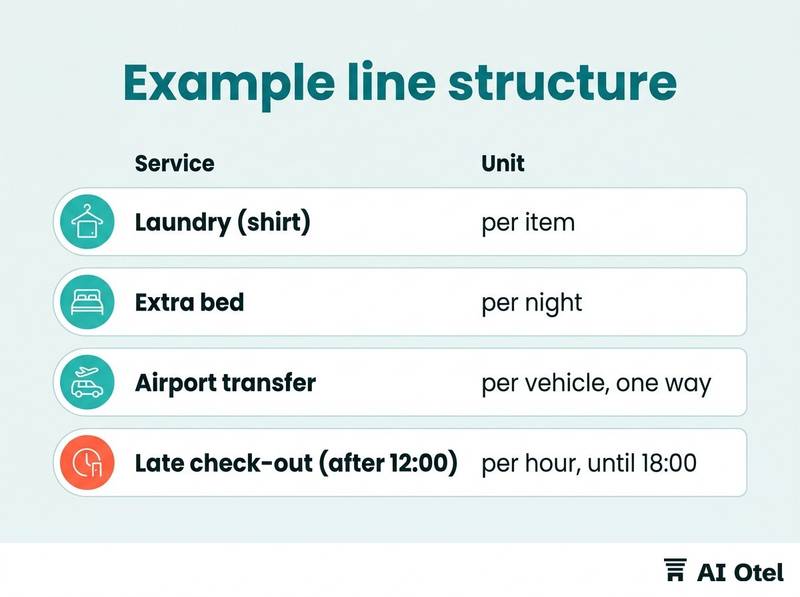
Use one unit per line: per item, per night, per person, per hour or per vehicle, depending on the service. "Extra bed, per night" and "airport transfer, per vehicle, one way" leave no room for interpretation. State the charge currency and any conversion rule in plain words; if the hotel prices contracts or displays in more than one currency, that case goes to counsel or an accountant before the list is published.
Add timing to services that change with the clock: late check-out, late laundry or late breakfast. A late charge is usually a time charge, so the line should carry the unit (per hour, per half day) and the cut-off time, not a vague phrase like "as applicable". Avoid "upon request" in the price column altogether; it invites different answers at different desks.
Give each line a posting code in the property management system, so the charge can be reported by service rather than buried in a room total. Free-text charges are where disputes hide, because no report can group them. This connects directly to how the hotel prices room upgrades and extras: the offer price and the posted price must be the same number.
Example line structure
| Service | Unit | Example price | Posting code | Waiver authority |
|---|---|---|---|---|
| Laundry (shirt) | per item | 5 (example) | LAUN-01 | Duty manager |
| Extra bed | per night | 30 (example) | EXBED-01 | Duty manager |
| Airport transfer | per vehicle, one way | 60 (example) | TRANS-01 | Front office manager |
| Late check-out (after 12:00) | per hour, until 18:00 | 10 (example) | LATE-01 | Duty manager |
All prices in the table are placeholders, marked as examples, not recommended prices. Each hotel sets its own prices against its own costs and market.
Keep the line readable in this order: service name, unit, price, condition, posting code, waiver role. If a line cannot be read aloud in one breath, it is two lines.
Where should guests see the service price list?
Guests should see the same list before they ask, at the desk, in the room and in any digital channel the hotel uses. The printed and digital versions must carry the same version number and effective date.
Place a printed card near the telephone, the laundry bag and the room service menu, because those are the places guests look when they need a service. Keep the list visible on the desk screen as well, so the front office can quote it without leaving the reservation screen. If the hotel uses an app, show the same list there, with the same prices, units and conditions.
TipPut the QR code where the need arises
Put a QR code next to the telephone and the laundry bag, linking to the digital version of the list. That is where the guest is standing when the question forms.
Write the list in plain language, and in the languages the hotel serves where needed, so the guest understands what is being offered before accepting it. One role, usually the front office manager, should own the master version. Without a single owner, updates drift and the room card ends up quoting last year's prices.
Who may waive or discount a service charge?
The list should name the role that may waive or discount each line, the limit and the reason code. A waiver is a controlled exception, not a verbal favor at the desk.
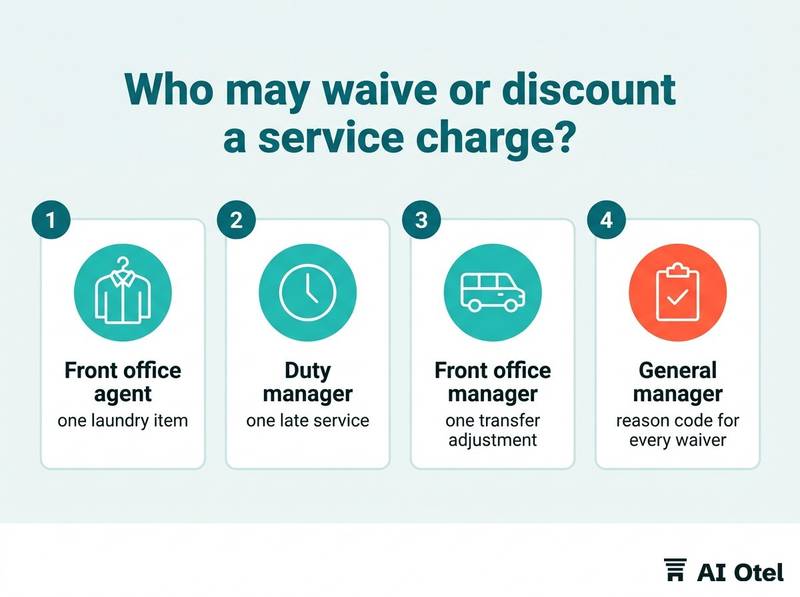
Build a small waiver matrix with four roles: front office agent, duty manager, front office manager, general manager. Give each a clear limit, such as one laundry item, one late service or one transfer adjustment. Require a reason code for every waiver, so month-end reporting can separate service errors from goodwill gestures.
Correct wrong charges through the normal void or reversal process, never by deleting the original charge. Financial records that can be traced are the point of the whole exercise. Tell the guest the same amount the system will post, so the bill does not surprise them at checkout.
Review waiver patterns monthly. Repeated waivers on the same line usually mean the price, unit or condition is wrong, not that the staff are generous. The same logic governs room rates, and the article on discount limits and override rules covers it in more depth.
Watch outA verbal waiver without a reason code
A waiver granted verbally and left uncoded becomes an unexplained discount. It weakens month-end reporting and hides the real cause, which is often a badly written service line.
How do you check that posted charges match the list?
Run a monthly reconciliation of posted charges against the list and its posting codes. The check shows whether staff are quoting correctly, whether codes are being used and whether the list needs a new version.
Pull a charge report by posting code for the month, not only by room number. Compare posted amounts with the list price, unit and effective date. Investigate free-text charges first, because they usually mean a service line is missing or too hard to use.
Reconcile charges that arrive from outside the desk: restaurant and bar postings, telephone, transfer vouchers and external providers. The article on connecting the POS and the property management system explains how those charges reach the guest bill. Check whether supplier prices changed without the hotel updating its own list, which happens often with laundry and transfers.
Review waivers and corrections as a separate group. They reveal where the list is unclear. Whenever a price, unit, condition or posting code changes, update the version number and effective date everywhere at once.
ChecklistThe monthly control checklist
- Version number and effective date on every copy
- Named owner of the master list
- Posting code on every line
- Waiver matrix with limits and reason codes
- Monthly charge report pulled by posting code
- Free-text charges investigated
- Supplier price changes reflected
- Currency and conversion note checked
- Staff briefed on the current version
What to do next
Draft one controlled page for the services guests actually buy. Assign a posting code and a waiver role to each line, publish the same version to the room, the desk and any digital channel, then reconcile posted charges once a month. The list becomes useful when price, unit, posting code, waiver authority and the monthly check are tied together. Hotels that want a system where these postings, codes and reports are defined once can look at how a hotel operating system structures them, or talk to OtelCiro, the ecosystem's revenue and distribution arm.
Frequently asked questions
Should free amenities appear on the paid service list?
No. The paid list should cover only charges that can be posted to a guest bill. Free amenities belong in a separate amenities list, so staff do not confuse a complimentary item with a chargeable one.
Can a hotel sell an airport transfer without owning a vehicle?
Yes, if it can arrange, price, cancel and post the service. The line should show the provider, the price, the unit, the cancellation window and who collects the payment. If any of these cannot be stated, the service is not ready for the list.
What should happen when a guest disputes a service charge?
Staff should check the list version, the posting code, the time of the charge and the waiver authority. If the charge is wrong, correct it through the normal void or reversal process and record the reason. If the charge is right, the list itself is the answer to the dispute.
Is a late check-out always a paid service?
Not always. The list should state which late services are chargeable, with the unit, the cut-off time and any room-status condition. If the hotel offers late check-out free under a condition, that condition belongs in the waiver or complimentary rule, not in the paid price list.