Weekend brunch at a hotel: price, capacity and the effect on the breakfast
Price a hotel weekend brunch by calculating cost per guest and setting capacity limits. Learn to protect in-house breakfast with clear booking rules and a four-weekend trial.
AI draft · awaiting editorial review

Contents
Key takeaways
- A brunch is sold per person for a fixed window, so its economics rest on cost per guest, seats sold and how long each table stays.
- Cost per guest comes from standard recipes and portion costs plus a waste allowance you set from your own kitchen records, not from a market average.
- Capacity is seats multiplied by turns, and turns are set by the length of the sitting, not by how many reservations you accept.
- If brunch replaces the breakfast your rate plan promises, in-house guests keep that breakfast; the brunch is an upgrade with a fee, not a second charge for the same meal.
- Four weekends at one price and one seating plan, recorded the same way each week, settle the question better than a season of guessing.
A hotel weekend brunch is a fixed-window, per-person meal that replaces breakfast and lunch for the guests who book it. Price it from cost per guest plus a waste allowance and direct labor, cap it at seats times turns, and hold seats for in-house guests before outside bookings open.
The first Sunday the room fills with outside guests, the hotel's own guests are waiting for coffee at ten past ten, and the front desk has no rule to apply. A weekend brunch is easy to fill and hard to price, because the seat, the buffet and the breakfast are the same seat, the same buffet and the same morning. After reading this you will be able to work out cost per guest, set a price with a floor and a ceiling, size the seating plan to the room, write a booking rule that protects in-house guests, and run a four-weekend trial that gives you a decision instead of an opinion.
What is a weekend brunch next to breakfast and lunch?
A brunch is one sitting that replaces breakfast and lunch for the guest, sold per person for a fixed window, usually at the weekend. It differs from both meals in how it is priced, how long a table stays and who is paying.
Breakfast is normally included in the room rate and served to a captive audience on a short turn. Brunch is sold to a guest who chose it and can walk out. Lunch is à la carte or a set menu with a short turn; brunch is a buffet with a long turn, so the same seat earns once in the morning instead of twice around midday.
The window defines the product: a start time, a last seating time and a stated hour when the kitchen closes the buffet. The menu is a buffet plus one or two live stations, and the live station is where labor and queueing concentrate. The guest expects to keep the table for a long time, which is why the turn time, not the seat count, sets capacity.
| Meal | Price basis | Who pays | Sitting length | Kitchen load |
|---|---|---|---|---|
| Breakfast | Included in the room rate | The hotel, through the rate | Short turn | Steady line service |
| Brunch | Fixed price per person | The guest or the city | Long turn | Buffet plus live station at peak |
| Lunch | À la carte or set menu | The guest | Short turn | Kitchen cooks to order |
The real decision is whether brunch is a guest amenity inside the stay or a separate revenue line open to the city. The answer changes the price, the booking rule and the accounting, so settle it before the menu is written.
What does a brunch cost per guest?
Cost per guest is what the average guest actually consumes, valued at standard recipe cost, plus a waste allowance and the direct labor of the sitting, divided by covers. It is not the sum of the menu. Adding up every dish on the buffet and dividing by nothing tells you what you laid out, not what a plate cost you.
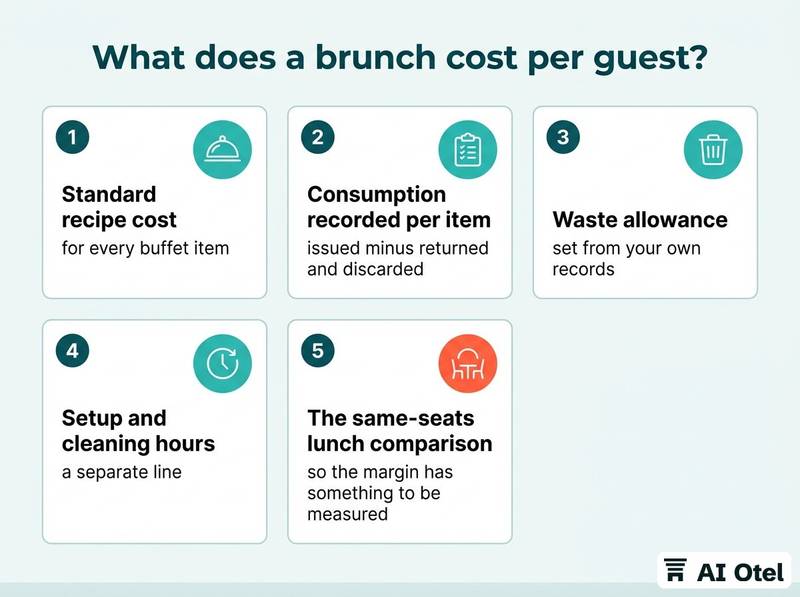
Give every buffet item a standard recipe and a portion cost before the first service, so a portion has a price before a guest takes it. If your kitchen has not done this for the breakfast yet, the same method applies: standard recipes and portion cost for hotel kitchens are the foundation for both meals.
Count consumption, not production. Record what was issued per item and subtract what came back and what was discarded, weekend by weekend. Set the waste allowance as a line you choose from your own trim, overproduction and leftover records; it is an internal number, not a market figure.
Watch the high-volume items first: eggs, bread, fruit, coffee and the live station's protein move the average far more than the desserts do. Add direct labor: kitchen and service hours worked for the sitting, multiplied by the hourly cost, divided by covers. Carry a separate line for setup and cleaning hours, which a brunch needs and a lunch does not. Then put the result next to what the same seats earn at lunch, so the margin has something to be measured against.
ChecklistWhat goes into cost per guest
- Standard recipe cost for every buffet item
- Consumption recorded per item (issued minus returned and discarded)
- A waste allowance set from your own records
- Live station labor hours
- Service labor per cover
- Setup and cleaning hours
- The same-seats lunch comparison
How many seats and turns can a brunch actually sell?
Capacity is seats multiplied by turns, and turns come from the length of the sitting: a two-hour brunch inside a four-hour window sells two turns, not four. This is where most brunch plans go wrong, because the reservation book will happily accept 90 covers for 90 seats and ignore the clock.
Fix the window first, meaning the start, the last seating and the close, then fix the turn time, then multiply. Brunch turns run longer than lunch turns because guests stay; measure the real turn over the first two weekends instead of assuming it. Theoretical covers are a ceiling; apply your own no-show and walk-in record to reach a number you can plan food and staff against.
The last seating time protects the kitchen: a table seated twenty minutes before close will hold the buffet open and stretch the labor. The buffet line, not the seat, can become the constraint; one line serving a full room queues at peak and slows every table. Overbooking seats shows up as a slower buffet, more waste and a worse breakfast for the guests who did not book brunch.
TipWorked example (illustrative)
A room of 90 seats, a four-hour window and a measured 90-minute turn gives two turns and 180 covers at the ceiling. With the hotel's own no-show and walk-in record applied, the plan is set nearer 150 covers, and the food order is built on 150.
How should we price a hotel brunch?
Hotel weekend brunch pricing starts from three inputs: your cost per guest sets the floor, comparable local venues give a ceiling check, and your own four-weekend test tells you what your city will pay. Each input answers a different question, and only the third one answers the question you actually care about.
Choose a target margin and write it down; the price is cost per guest divided by one minus that margin. Use nearby venues only as a ceiling check, because their rent, labor cost and guest mix are not yours and their price carries no information about your cost. The same logic applies to any fixed-window, per-person meal: the approach to pricing an iftar menu, with cost per person and outside guests, transfers almost line for line.
Price the drink package separately: alcohol and specialty coffee change cost per guest more than the food does. Set a children's price from what children actually consume, not as a fixed fraction of the adult price. Protect the seat with a deposit or prepayment on outside bookings, since a no-show costs the food already prepared.
Do not discount in the first weeks; the first price teaches the city what the brunch is worth and is hard to raise afterward. Judge the price by revenue per available seat rather than price per person: a cheaper brunch that fills two turns can beat a dearer one that fills one.
Watch outPricing from a competitor's menu
Copying a nearby hotel's price imports their cost base, their rent and their guest mix, and it answers a question about their business rather than yours.
Should brunch be included for in-house guests or sold as an extra?
If brunch replaces the breakfast your rate plan promises, in-house guests keep that breakfast. The brunch is then an upgrade with a fee, not a second charge for the same meal. This is not a courtesy; it is what the rate plan sold.
Read the rate plan first: what breakfast did the guest pay for, at what time, and in which room. If brunch replaces breakfast on Sunday, either include in-house guests at no charge or keep a breakfast corner running; a paying guest who finds no breakfast has a complaint, not a choice. If you keep a corner running, plan it like any other service: setting buffet quantities from arrivals, not from habit is how the corner stays stocked without over-catering.
Estimate in-house demand from the arrivals already on the books for those dates, not from last month's average. An included brunch is a cost with no revenue line; an upgrade fee is revenue, and it has to be visible at booking, in the confirmation and at check-in. Decide the rule once and put the same sentence on the rate plan, the confirmation and the front desk screen.
Watch the breakfast itself: a brunch that pulls staff and buffet space degrades the breakfast for guests who never booked it. The mechanics of a breakfast buffet that holds up at peak apply doubly when half the kitchen is working the brunch line.
Key pointThe in-house rule
Write the rule in one sentence before the first weekend and apply it every weekend without exception, so the front desk, the restaurant host and the booking team all say the same thing.
How do we protect hotel guests' breakfast when outside guests book brunch?
With a written booking rule that holds seats and a time window for in-house guests before outside bookings open, applied at the door without escalation. The rule is a service instrument, and it only works if it exists before the first busy Sunday.
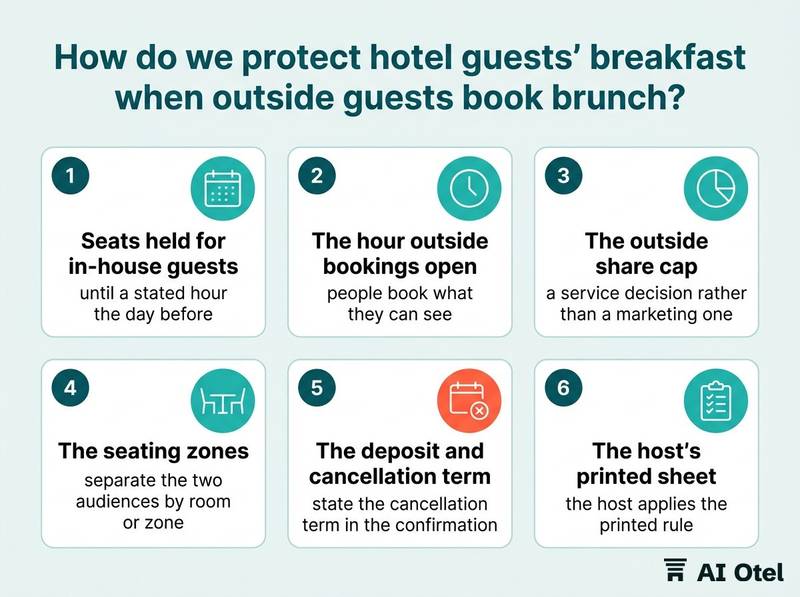
Hold a share of seats for in-house guests until a stated hour the day before, then release what is left to outside bookings. Separate the two audiences by room or by zone, so the buffet queue and the noise do not land on the breakfast tables. Publish the sitting times and the hour when outside bookings open; people book what they can see.
Cap the outside share at a number the kitchen and the buffet line can serve, and treat the cap as a service decision rather than a marketing one. Take a deposit or a card hold on outside bookings and state the cancellation term in the confirmation the guest receives. Market through local listings, neighborhood channels and group bookings such as birthdays and family tables, and record how each booking heard about you so the trial can tell you what worked. Brief the door: the host applies the printed rule and escalates only exceptions.
ChecklistThe booking rule, on one page
- Seats held for in-house guests, and until when
- The hour outside bookings open
- The outside share cap
- The seating zones
- The deposit and cancellation term
- The last seating time
- The host's printed sheet and the named person who decides exceptions
The same seat-allocation question comes up with other outside-guest products, and the reasoning is the same: selling a day pass for the pool without crowding out in-house guests follows the identical hold-then-release structure.
What does a four-weekend trial look like?
Run four weekends at one price and one seating plan, record the same numbers each week, and decide on the Monday after the fourth. Four weekends is long enough for the city to find you and short enough to stop before a bad plan becomes a habit.
Hold the menu, the price and the window fixed for four weekends; changing them mid-trial destroys the comparison and the staff never settle into the service. Record covers split between in-house and outside, no-shows, food issued and consumed per item, labor hours, complaints and the breakfast result for guests who did not book. Keep a note of what the same seats earned at lunch on a comparable day, so the decision has an alternative to be weighed against.
Set the decision rules in advance: continue as is, change the price, change the seating plan, or stop. Price the stop before you need it: setup cost, rostering, and the expectations you created in the city when you advertised. Review the numbers with the chef and the front office together, because each of them holds half the explanation.
| Weekend | In-house covers | Outside covers | No-shows |
|---|---|---|---|
| 1 | |||
| 2 | |||
| 3 | |||
| 4 |
Add the remaining columns on the same sheet: food issued versus consumed per item, labor hours, complaints, the breakfast result for non-brunch guests, and the same-seats lunch comparison. Fill it the same way each time; the comparison only works if the rows mean the same thing.
What to do next
Pick one price, one window and one booking rule, write them down, and run four weekends before changing any of them. Cost per guest sets the floor, seats times turns sets the ceiling, and the in-house rule decides who gets the seat at ten o'clock on Sunday. If you want to read the wider picture of how a hotel's systems hold rate plans, restaurant sales and guest charges together, the pages on a hotel operating system and the ecosystem around hotel growth cover the ground. And if you are reading this as a traveler rather than a hotelier, you can browse hotels for a weekend stay (opens in a new tab) and see which ones offer a Sunday brunch.
Frequently asked questions
How much should a hotel charge for a Sunday brunch?
There is no figure that transfers between hotels. Build cost per guest from standard recipes, consumption records, a waste allowance and direct labor, choose a target margin, and test one price over four weekends before adjusting it. A nearby venue's price is a ceiling check, not an answer.
Can a hotel brunch make money when in-house guests eat for free?
An included brunch is a cost with no revenue line, so it has to earn its place through the rate or through the stay. If it does not, sell it as an upgrade with a fee, keep the promised breakfast running, and make the rule visible at booking and at check-in.
Do we need a deposit for brunch reservations?
A deposit or card hold protects the seat against no-shows and covers food already prepared. Set the rule yourself, state the cancellation term in the confirmation, and apply it to every outside booking. How that term is worded in your own contract is a question for your legal adviser.
What food cost percentage should a brunch target?
Set the target from your own profit and loss account rather than from an outside figure. The useful comparison is the same seats at lunch on a comparable day: if brunch returns less per seat and ties up the room longer, the price or the seating plan has to change.
Should brunch replace breakfast on Sunday?
Only if in-house guests still get the breakfast their rate plan promises. Either include them in the brunch at no charge or keep a breakfast corner running, and separate the two services by room or by time so the brunch queue does not land on the breakfast tables.