Setting check-in and check-out times: working back from the cleaning team's day
Set check-in and check-out times by working back from the cleaning team's day. This guide explains how to calculate the earliest honest hour using your room count, minutes per room, and staff availability.
AI draft · awaiting editorial review
Contents
Key takeaways
- The times on a confirmation are a promise repeated on every channel, so calculate them from the cleaning team's day rather than copying them from another property.
- The peak day, not the annual average, sets the window: count departures, stayover rooms and granted late checkouts on the busiest day of the season.
- The gap between check-out and check-in must cover rooms to turn multiplied by minutes per room, divided by attendants on shift, plus a buffer for inspection.
- Moving either time by one hour is paid for in attendant hours or in guests waiting in the lobby, never for free.
- Publish one time everywhere, and sell early check-in or late checkout only against capacity you have measured.
Set check-in and check-out times by working back from the cleaning team's day: count the rooms to be turned on your peak day, multiply by the minutes one attendant needs per room, divide by the attendants you can field, and let the gap between the two times cover that work plus a buffer.
The confirmation says check-in from 14:00. At 13:40 the lobby is full of suitcases, four rooms on the third floor are still being cleaned, and the desk is apologizing for a number nobody has recalculated in years. After reading this, you will be able to work out how to set hotel check-in and check-out times from your own numbers: rooms, minutes and people, and to change them across every channel without leaving a guest holding a screenshot of the old hour.
Where do hotel check-in and check-out times actually come from?
Mostly from habit. A hotel opens with the times its manager used at the last property, they go onto the website and the confirmation, and after that nobody owns them. The pair of hours usually arrives by copying, then survives because changing it looks like a risk rather than a calculation.
Once printed, the time multiplies. It appears on the website, in every OTA extranet, in the confirmation mail, in the tour-operator contract, on the sign at the desk and in the answer the call center gives. The front office quotes it, housekeeping lives with it, and sales signs contracts that repeat it. Nobody owns the number, so nobody recalculates it.
The time is a commercial promise with a cost. Every guest who arrives before the stated hour is either served, which takes cleaning minutes, or turned away, which costs goodwill. The real constraint is not the clock but the cleaning team's day: how many rooms, how many minutes each one takes, how many people are on shift.
A useful first check: take the last peak week and count how many guests reached the desk before the stated check-in hour. That count is what the current promise actually costs you.
NoteA time on a confirmation is a promise
It is repeated by the website, every OTA, the call center and the contract, so changing it is a distribution task, not a front-desk decision.
How many rooms does your team turn on a peak day?
Count the rooms that must be cleaned on the busiest day of the season, not the annual average. The average hides the day the desk breaks.
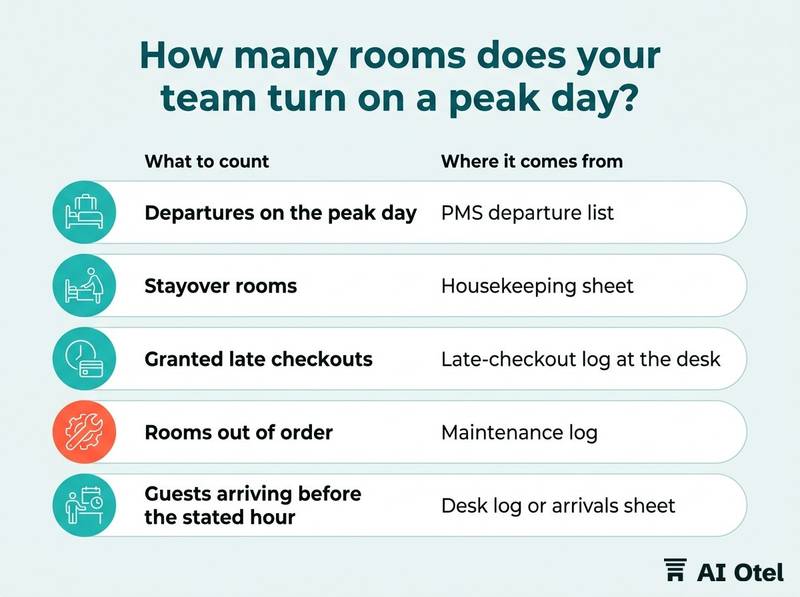
Start with departures on the peak day. A group of thirty leaving at 08:00 is a different problem from thirty individual departures spread to noon, so look at the shape of the morning, not only the total. Add stayover rooms: a stayover still takes minutes for towels, bins and the bed, and those minutes compete with the departure cleans in the same window.
Add granted late checkouts. Each one removes a room from the morning list and pushes it into the afternoon, exactly when the arrivals begin. Add rooms out of order or under deep cleaning, which can take a full day each and quietly remove capacity from the same team. Same-day bookings belong in this count too, because they land on the same team late in the day.
Do not double count. A room that departs and returns the same day as a same-day arrival is turned once. Get the numbers from the property management system's departure list for the peak week, the housekeeping sheet and the late-checkout log at the desk. If same-day bookings are part of your pattern, the cut-off hour that governs them matters here too, as covered in how to set the same-day booking cut-off so the desk is not surprised.
| What to count | Where it comes from | Why it changes the times |
|---|---|---|
| Departures on the peak day | PMS departure list | Sets the bulk of the cleaning load |
| Stayover rooms | Housekeeping sheet | Minutes that compete in the same window |
| Granted late checkouts | Late-checkout log at the desk | Push work into the arrival period |
| Rooms out of order or deep cleaning | Maintenance log | Remove team capacity for a full day |
| Guests arriving before the stated hour | Desk log or arrivals sheet | Measures what the promise costs today |
How do you calculate the earliest honest check-in time?
Divide the total cleaning minutes by the attendants actually on shift, add a buffer, and add the result to your check-out time. That is the earliest hour you can honestly promise.
Measure minutes per room by room type. A suite, a family room and a standard double are not one number, and averaging them hides the slow rooms. Include the parts people forget: the walk to the floor, the linen run, the trolley, the inspection and the re-clean after a failed check.
Count attendants who are genuinely on shift on the peak day, after days off, breaks and the shift handover, not the number on the staffing plan. The buffer is not padding. It covers the room that fails inspection and the attendant pulled away to help on another floor.
Read the result honestly. If the arithmetic puts the earliest honest check-in after your published time, you have three levers: more attendants, an earlier check-out, or a later check-in. Repeat the calculation for a quiet day. The same team will produce a much earlier hour, which is where goodwill can be given away cheaply.
Key pointThe formula, with a worked example
Window = (rooms to turn × minutes per room) ÷ attendants + buffer. For example, a 60-room hotel on a peak day has 40 departures at 22 minutes and 20 stayovers at 8 minutes, which is 1,040 minutes; with 8 attendants that is 130 minutes, plus a 20-minute buffer, so 2 hours 30 minutes. A 12:00 check-out therefore gives an earliest honest check-in of 14:30, and a published 14:00 is half an hour short.
What does moving either time by one hour change?
It moves the same block of work. Check-in and check-out are two ends of one window, so an hour gained at one end is an hour taken from the other.
One hour earlier check-in shrinks the window by an hour, which is either an extra attendant or a queue of guests sitting with their luggage. One hour later check-out means more rooms are still occupied when the team starts, so the same work begins later and finishes later. Moving check-out later also moves the night audit, the breakfast peak and the transfer list for departure day, which are usually planned around the old hour.
Early arrivals do not read the confirmation. Flights land when they land, so the stated hour decides whether the desk serves those guests or turns them away. A change has to reach every channel at once, because a channel that keeps the old time produces a guest holding a screenshot. Give the team the honest version: an hour is bought with attendant hours or with guest waiting, and the hotel should say which one it chose.
| Change | Effect on the cleaning window | What the guest feels | What it costs |
|---|---|---|---|
| Check-in one hour earlier | Window shrinks by an hour | Faster access, or a lobby wait | An extra attendant, or waiting guests |
| Check-in one hour later | Window grows by an hour | Later access to the room | Goodwill, and possibly rate pressure |
| Check-out one hour earlier | Window grows by an hour | A rushed morning | Complaints and late-checkout requests |
| Check-out one hour later | Same work starts and ends later | A relaxed morning | Attendant hours or a later finish |
When dates change rather than hours, the rate and channel questions are covered separately in early departure and stay extension: rate, fee and channel.
Should peak days and quiet days have different times?
They can, if the calendar is published in advance and applied identically on every channel. If the hotel cannot keep two times straight, one published time with an internal target earlier on quiet days is the safer choice.
A two-tier calendar is honest: the guest is told the hour that applies to their date, and the team is not asked to perform the impossible on a Saturday. The risk is a guest who sees 14:00 on one channel and 15:00 on another, so the calendar must live in one place that feeds all channels.
The middle path works well: publish one time, aim internally for an earlier one on quiet days, and let the desk grant early access with slack it already has. Group and corporate contracts may fix the times in writing, and a published calendar cannot override a signed agreement. Review the calendar each season against the room mix, the staffing plan and the arrival pattern, because all three drift.
Watch outOne time, everywhere
The website, every OTA extranet, the confirmation, the call-center script and the contract must carry the same hour. A guest holding a screenshot of a different time wins the argument at the desk.
Quiet days are when goodwill is cheap. An early check-in granted on a Tuesday costs minutes; the same favour on a peak Saturday costs a room. On the departure side, the same logic shapes departure day in a resort: late flights, transfer lists and the day room.
Should you sell early check-in and late checkout?
Yes, but only the hours the operation can genuinely deliver, and only as a paid guarantee with a written rule, not as a hope.
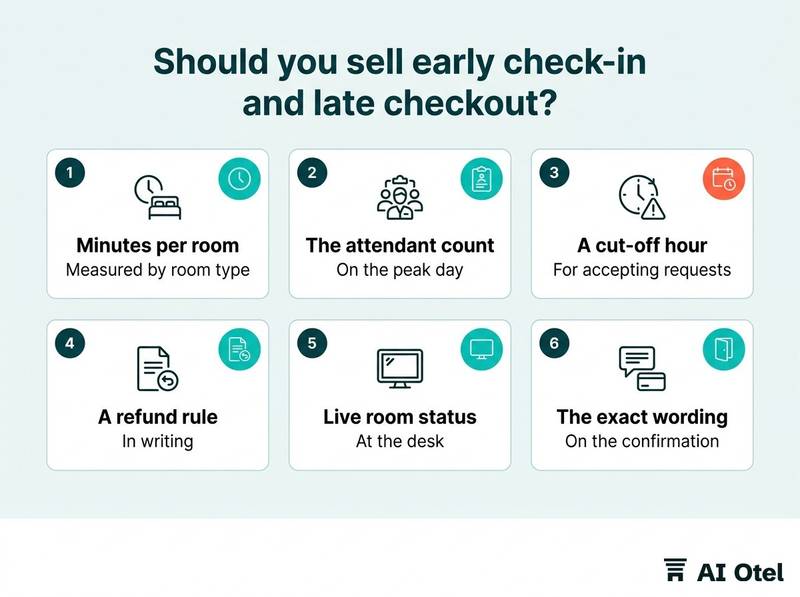
Sell against measured spare capacity: the rooms the team can truly turn before the guest arrives, taken from the same arithmetic as the published time. A paid early check-in is a guarantee, so it needs a refund rule and a cut-off hour after which the request is refused rather than promised. Price it in attendant hours: an extra shift has a cost, and the price of the product should cover the work it creates.
Keep the paid product separate from the free favour. Mixing them teaches guests that asking is enough and the paid option is optional. The desk must see live room status, or the product turns into an apology at the counter. Late checkout has a second cost on departure day: it collides with transfer times and with the day-room demand of guests with late flights. The policy questions are covered in more detail in setting the early check-in and late checkout policy.
ChecklistBefore selling early check-in or late checkout
- Minutes per room measured by room type
- The attendant count on the peak day
- A cut-off hour for accepting requests
- A refund rule in writing
- Live room status at the desk
- The exact wording on the confirmation
- A named owner for the time calendar
How should the times appear on the confirmation?
In one sentence, stating the hour and what happens before it. The guest should never have to ask what to do with a suitcase at 11:00.
State the hour and the alternative in the same breath: luggage storage, use of the facilities, and a message when the room is ready. Ask for the expected arrival time at booking, so the desk plans the morning instead of reacting to it. Give the desk two scripts, one for the guest who arrives early and one for the guest who wants to stay late, so the answer does not depend on who is on shift.
A hotel's own guest app is a good place for the guest to ask and to see the answer, but a request made there still needs a person to confirm it. Put a review date on the calendar: each season, and whenever the room mix, the attendant count or the arrival pattern changes. Check the wording against what the team can actually do on the worst day, not on the day the sentence was written. A wider view of how the pieces of a hotel's operation connect is on the platform overview.
TipSample confirmation wording
"Check-in from 14:00. If you arrive earlier, we will store your luggage and message you as soon as your room is ready. Check-out by 12:00; ask us about a later time before your departure day."
What to do next
Take the departure list from your last peak week and do the arithmetic once: rooms to turn, minutes per room, attendants on shift, plus a buffer. That single number tells you whether your published check-in hour is a promise you keep or a promise the desk absorbs, and which lever to pull: more attendants, an earlier check-out, or a later check-in. Then carry the answer to every channel on the same day, because the times are a calculation, a promise and a distribution task at once.
Frequently asked questions
Is 14:00 check-in and 12:00 check-out a legal requirement?
No, the hours are commercial terms the hotel sets and publishes in its confirmation and contracts, not a fixed hour handed down by regulation. Where a tour operator or corporate contract fixes them, that contract governs. Confirm your own contract terms and any guest-facing wording with your legal adviser.
Can we refuse an early check-in if the room is not ready?
Yes, if the published hour is the promise and the guest was told it before arrival. Refusing well means offering the alternative in the same sentence: luggage storage, use of the facilities, and a message when the room is ready. The desk needs a script so the answer is the same on every shift.
What do we do with a guest who lands at 06:00?
That is a different product, not an early check-in. Either the previous night is sold so the room is held from the morning, or the hotel offers a day-use arrangement. Decide which one before the season, price it, and write it into the confirmation so the desk is not improvising at dawn.
Does a later check-out hour hurt cleaning quality?
It compresses the window, and quality is a function of minutes per room. If the team keeps the same minutes in a shorter window, the work either finishes later or is rushed. The honest options are more attendants, a later check-in, or a paid late checkout limited to the rooms the team can still turn.
How often should we recalculate the times?
Once per season at minimum, and whenever the room mix, the attendant count or the arrival pattern changes. The arithmetic is short and uses data the hotel already has, so the cost of recalculating is far below the cost of a promise the desk cannot keep.