The room-ready message: telling a waiting guest their room is ready, in the right words
A room-ready message must be sent quickly, in the guest's language, and on the channel they used. This guide covers the required fields, channel rules, and scripts for delays to maintain trust.
AI draft · awaiting editorial review
Contents
Key takeaways
- A room is ready when it has been inspected and released, not when housekeeping has finished cleaning it.
- The message carries six things: the guest, the room, where to collect the key, any remaining wait with a clock time, one next action and a named person to ask for.
- Send on the channel the guest already used, and put the same words in writing after saying them face to face.
- When the promised time moves, send the new time before the old one passes; the second message is the one that keeps trust.
- One log line per waiting guest turns the weekly review into a decision about staffing, room blocks and check-in times.
A hotel room ready message is the short notice a hotel sends once housekeeping has released a room and a second person has inspected it. It tells the guest the room is ready, where to collect the key and any remaining wait, and it goes out within minutes, in the guest's language, on the channel the guest already used.
It is 11:40, the guest's flight landed early, the bags are stacked by the lobby sofa, and the desk says someone will let them know. Whether that promise is kept depends on two things: who marks the room ready, and who writes to the guest. This article separates the two jobs, gives you the six fields every room-ready message needs, the channel rules, the scripts for the awkward cases, and a one-line log that turns waiting times into a weekly decision.
What does "room ready" mean at the front desk?
A room is ready when housekeeping has finished it and a second person has inspected and released it in the system. Clean is not the same as released, and the desk should never promise a room on the cleaner's word alone.
Name the two states out loud in the shift brief: cleaned (housekeeping has finished) and released (inspected and marked available). Only released rooms go into a message. The person who cleans should not be the only person who releases: a second pair of eyes catches the missing towel, the unemptied bin, the hair in the bathroom and the television left on a foreign channel.
Before release, match the booking's requests to the room: extra bed, cot, high floor, quiet side, connecting door. A room that is clean but wrong is not ready for that guest. Close every maintenance ticket for the room first, because a dripping tap or a dead lamp means a second visit to the guest, and the second visit costs more than the first. If the inspection fails, the room goes back to cleaning and the guest gets a new clock time, not a hopeful one. Record the release time in the system: without a time, nobody can review the wait later.
ChecklistRelease check before a room is marked ready
- Bed made and bathroom finished
- Towels, amenities and minibar counted
- Safe, air conditioning and lights tested
- Every maintenance ticket for the room closed
- The booking's special requests matched to the room (extra bed, cot, floor, quiet side)
- Status changed to ready by the inspector, with the time recorded
Who sends the room-ready message, and how fast?
One named person per shift owns the message queue, and the message goes out minutes after release, not at the next quiet moment. Housekeeping releases the room; the desk writes to the guest.
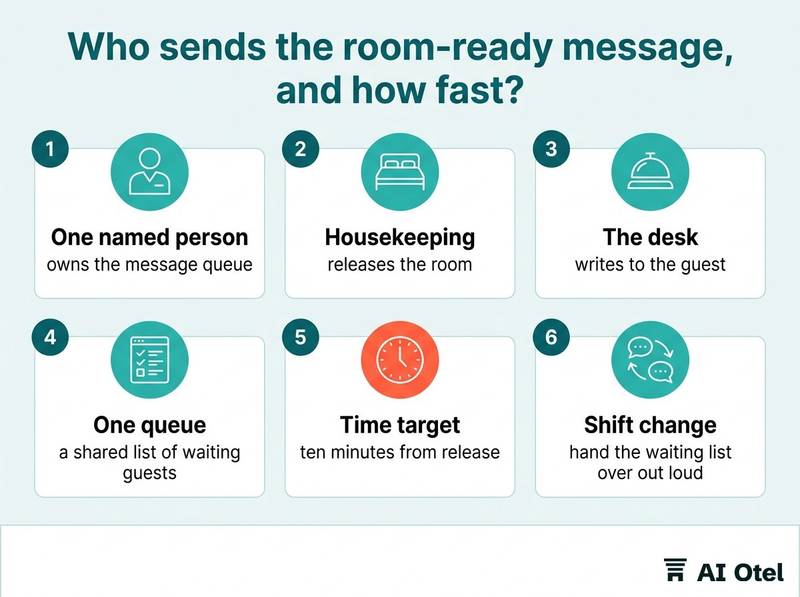
Split the two jobs. Housekeeping owns the room's state, the desk owns the guest's information, and neither guesses the other's. Keep one queue: a shared list of waiting guests with arrival time, room, status and who last wrote to them, so two staff do not message the same guest twice.
Set a time target the hotel chooses itself, for example ten minutes from release to message, and write it into the shift brief so it is a rule and not a mood. Do not send before the key exists: an encoded card in a folder at the desk is the physical half of the message. At shift change, hand the waiting list over out loud, with times and not just names, because a list read in silence is a list nobody owns. When the desk is overwhelmed, the message still goes first; it takes less time to send than the apology takes later.
TipPut the waiting list where both teams can see it
Put the waiting list where both housekeeping and the desk can see it, and write the release time next to the room. The gap between release and message is the number the hotel actually controls.
The wait begins long before the lobby, and the same handover discipline shapes welcoming guests in the first ten minutes from the door to the room.
What must the room-ready message contain?
Six things and nothing else: who it is for, which room, where to collect the key, any remaining wait with a clock time, one next action, and the name of a person to ask for.
The room number is a trade-off, not a rule. Some hotels send it; others send only the room type and give the number at the desk after the identity check. Choose one policy and apply it every time. Any remaining wait must carry a clock time: "your room will be ready at 14:20" can be checked, "in a few minutes" cannot.
Give one next action only, come to the desk or call this extension, because two actions produce a guest who does neither. Name a person: "ask for Elif at the desk" beats "our team will be happy to assist you". Keep offers, surveys and upgrade pitches out of this message; it is a service notice, and mixing it with selling makes it slower to read. Write it in the guest's language, with approved wording kept for each language your guests actually use and checked by a native speaker on the team. A translation that gets the room type wrong is worse than a plain sentence in English.
| Field | What it says | Why it matters |
|---|---|---|
| Greeting and guest name | The guest's name, spelled as in the booking | Confirms the message is for them, not a broadcast |
| The room | Room type, and the number only if policy allows | Sets expectations before the desk |
| Where to collect the key | The desk, or another named point | One destination, no wandering |
| Remaining wait | A clock time, not "soon" | A checkable promise |
| One next action | Come to the desk, or call one extension | Two actions produce no action |
| Who to ask for | A named person | A face, not a department |
| What to leave out | Offers, surveys, upsell, attachments | Keeps the notice short and readable |
Which channel should carry the room-ready message?
Use the channel the guest already used to reach the hotel, and keep a second one ready. A guest standing in the lobby needs a person first and a written copy second.
If the guest is in the lobby, say it face to face, then send the same words in writing so the room and the time sit on their phone. If the guest messaged the hotel on chat, reply in the same thread: the guest already has the conversation open and does not need to learn a new channel. If the guest left only a phone number, send a short text message, one paragraph, no links and no attachment.
A service message about the current stay and a marketing message are different things. Keep consent for each separate, and confirm the rules that apply to your hotel with your adviser. Whatever the channel, the message must be readable without opening anything: no portal login, no QR code, no file to download before the guest can act.
Channel rules differ by platform, and WhatsApp message templates and the 24-hour window decide what a hotel account can send and when. A hotel that gives each property its own guest app, installed from the browser gains one more channel, but the rule stays the same: the guest should not have to learn it on arrival day.
What if the guest has gone out, or the room is not as promised?
Two different problems with two different scripts. A guest who has gone out gets one clear message and a held room; a room that differs from the booking gets an honest sentence before the guest opens the door.
If the guest has gone out, send one message with the room, how to collect the key and the time until which the desk will hold it. Do not call every twenty minutes; a stream of calls reads as panic. Note in the booking that the guest was informed, on which channel and at what time, so if they return at midnight the record answers the question.
If the room is not as promised, say what changed in the first sentence, offer two options, accept the room with a gesture or move to another room, and let the guest choose. Never let the guest discover the difference at the door: the walk to the room is where a small problem turns into a complaint. If the wait grows past the time you gave, send a new time before the old one passes, with the reason in one line. Record what was promised and what was delivered; the gap between the two is exactly what the weekly review is looking for.
Watch outNever contradict the first message quietly
If the time moves, say the new time and the reason in one line, and send it before the old time passes. A second ready message that quietly contradicts the first destroys the trust the first one built.
Whether a room can be promised before the official check-in hour is a policy question, covered in setting an early check-in and late checkout policy.
How do you hand over the key when the guest reaches the desk?
The message ends at the desk, so the handover must take less time than the guest now expects. Key, identity check and luggage belong in one stop.
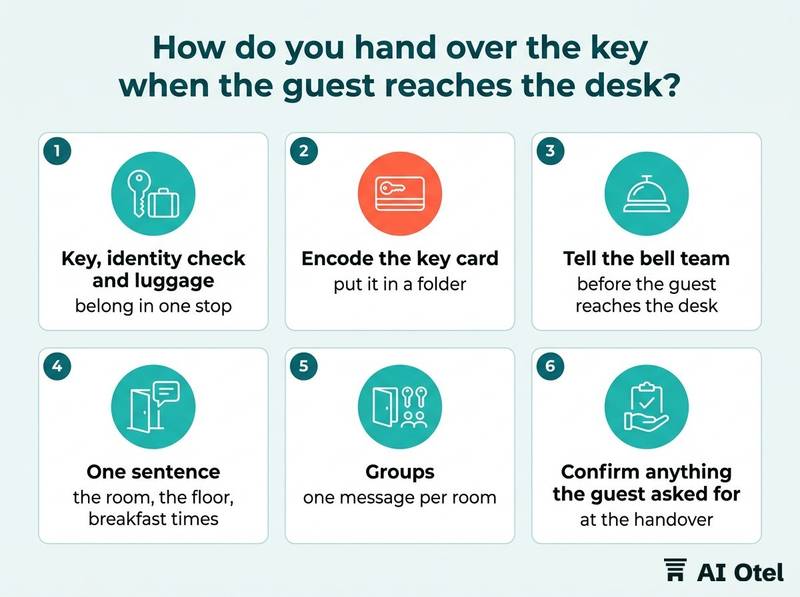
The guest's identity is checked in person at the desk, so the message should bring the guest to the desk, not past it. Encode the key card and put it in a folder before the guest arrives; if the hotel keeps room numbers off messages, write the number on the folder by hand. Tell the bell team before the guest reaches the desk, and keep the luggage tag number on the waiting list so the bags follow the guest without a second question.
At the desk, one sentence: the room, the floor, breakfast times, and the name of the person to call. Then let the guest go. For groups, the rule applies per room: a group waiting in the lobby needs one message per room, not one announcement to the crowd. Confirm anything the guest asked for before arrival, a cot or a quiet room, at the handover rather than leaving it to be discovered.
How do you review waiting times each week?
Keep one log line per waiting guest and read it once a week with housekeeping in the room. The review turns a feeling about busy mornings into a decision about staffing, room blocks and check-in times.
Record four things: the guest's arrival time, the room's release time, the time the message went out, and the time the guest reached the desk. Two gaps matter more than the total: release to message, which is the desk's, and arrival to release, which is housekeeping's and the room block's.
Read the lines with the floor supervisor present, because a number that nobody who can change it has seen changes nothing. Look for patterns by hour and by room type: the same corridor, the same late departures, the same rooms blocked for early arrivals. Change one thing per week and check the log again; two changes at once and you learn nothing about either. The log feeds directly into housekeeping KPIs such as room-ready time and inspection pass rate, and the room block decisions behind it start with assigning rooms before arrival. Hotels that run all of this through a hotel operating system get the log line written for them; on paper, the same four columns work.
What to do next
Write the six fields into one approved message per language this week, name the person who owns the queue on each shift, and start the log line. The message itself is the smallest part of the arrival: the release check, the handover at the desk and the weekly review are what make it true.
Frequently asked questions
Should the room-ready message include the room number?
Either policy can work, but the hotel must pick one and apply it every time. Sending the number is faster for the guest; keeping it out of the message means the number is given at the desk after the identity check. If numbers stay off messages, say in the message where the number will be given.
How often should we update a guest who is still waiting?
Set an interval the hotel can actually keep, for example every thirty minutes, and send an update even when there is no news. A message that says the room is still in cleaning and gives the next check time is better than silence. Never let a promised time pass without a new one.
Can we send the room-ready message on WhatsApp?
It depends on whether the guest has opened a conversation with the hotel's account and on the template rules that apply to that account. Keep the message a plain service notice about the current stay, with no offer inside it. Whether a given message needs prior consent is a question for your messaging provider and your adviser.
What do we write when the room will be late?
Give a new clock time, the reason in one line, and a choice: wait in the lounge with a coffee, or take a different room if one is free. Send it before the old time passes. The guest forgives a delay that is named; they remember one that is discovered.
Does the room-ready message have to be in the guest's language?
That is the hotel's decision, and it should follow the languages your guests actually speak. Keep approved wording for each of those languages, checked by a native speaker on the team. A machine translation that gets the room type or the floor wrong is worse than a clear sentence in English.