The late arrival bag: a small packed supper for guests who reach the hotel after the kitchen closes
A late arrival bag is a pre-packed cold supper for guests who reach the hotel after the kitchen closes. This guide explains how to set cutoff times, store bags safely, label allergens, and post charges consistently.
AI draft · awaiting editorial review

Contents
Key takeaways
- A late arrival bag is a cold, pre-packed supper for guests who arrive after the kitchen closes, not a replacement for room service.
- Decide the bag at booking or before arrival, so the kitchen prepares it once and the desk knows what to hand over.
- Allergen labeling and cold storage are the two controls that make the bag safe.
- A written charging rule prevents surprise bills and keeps the night team consistent.
A late arrival bag is a pre-packed cold supper, water and a short note handed to guests who reach the hotel after the kitchen closes. It works when the hotel plans it before arrival, labels allergens, stores it safely, offers it at check-in and posts any charge under a written rule.
For example, a family lands at 00:40 after a delayed flight, reaches the desk at 01:20, and the restaurant stopped taking orders at 22:30. The child is hungry, the parents are tired, and the nearest open shop is a taxi ride away. A hotel late arrival snack bag, prepared once during the evening shift, turns that moment from an apology into a service. After reading this you will be able to set the cutoff, pack the bag, store and label it, script the handover, post the charge and review the whole routine.
When does a late arrival bag make sense?
It makes sense when the kitchen is closed, the guest cannot easily buy food, and the hotel can prepare a cold bag before the desk handover. It is a small recovery tool, not a standard meal service.
Start by defining the cutoff as the time the kitchen stops taking orders, not the restaurant's closing time, and give that time to reservations and the front desk. Use the arrival time from the booking, or the flight number when the guest shares it, and flag arrivals after the cutoff on the day's arrival list. Common triggers are a delayed flight or transfer, small children, a medical need such as diabetes, and a room-only guest who arrives after nearby food outlets close.
Just as important are the stop signals. Do not offer the bag to a guest who already has a dinner reservation, when the kitchen can still serve a simple hot dish, when the guest declines it, or when the bag would sit unrefrigerated for hours. Choose one simple rule, for example offer the bag to every arrival after the cutoff and decide charging by written policy, so the night team does not improvise. Keep the bag small: it is a bridge to breakfast, not a full dinner.
ChecklistArrival flag checklist
- Arrival time is after the kitchen cutoff
- Flight or transfer delay is noted
- Children or a medical need are recorded
- The guest has no dinner booking
- Dietary restriction is recorded
- Bag is prepared and labeled
- Front desk is briefed
What goes in a late arrival bag, and what stays out?
A good bag holds a simple cold supper that travels well, a drink, a napkin and a note; it leaves out hot food, strong smells, messy sauces and anything that needs last-minute assembly.
Start with a sandwich or wrap with a stable filling such as cheese, cold cuts or grilled vegetables, plus a piece of fruit and a bottle of water. Add a sealed dessert or a packet of crackers if the hotel wants a fuller bag, but keep the portion modest and easy to eat in a room. Offer variants such as vegetarian, no pork or gluten-free where the kitchen can control cross-contact, and record the request before arrival.
Pack in a sealed box or paper bag with a label, and keep the welcome note outside the food box so it stays clean. For children, use a smaller portion, familiar food, and no whole nuts or hard sweets. The same packing logic that works for the lunch box checklist for early departures applies here: one sealed unit, one label, one handover.
| Item | Why it works | Keep out |
|---|---|---|
| Sandwich or wrap | Stable, easy to eat | Loose, wet fillings |
| Fruit | Simple and sealed | Cut fruit held warm |
| Water | Essential after travel | Glass bottles |
| Sealed dessert | Small treat | Ice cream, cream cakes |
| Hot food | Comforting | Unsafe and messy cold |
| Strong-smelling food | Filling | Affects the room |
| Alcohol | A gesture | Licensing and guest safety |
How do you store and label the bags safely?
Store cold bags in a refrigerator at a recorded temperature, label each one with the preparation time and allergens, and discard any bag that has been out of the cold chain or kept past its written shelf life.
Prepare the bag as close to arrival as possible, keep it in a refrigerator rather than on the desk, and record the fridge temperature on the kitchen log. Label each bag with the date and time prepared, the contents, the allergen list, the guest name or room number if known, and the words keep refrigerated. Write a simple shelf-life rule, for example use within four hours if kept cold, mark it on the label, and discard at the end of the shift.
Use a written allergen list for each variant, separate boards and knives, and do not promise allergen-free food unless the kitchen can control the whole process. Keep a separate sealed bag for allergy guests, and make sure the person who packs it reads the allergy note. The deeper routine is in the food allergy routine for hotel restaurants and buffets; the bag inherits its rules. Log bags prepared, given and discarded, because that log feeds the monthly review.
Watch outLabels are a safety control
Allergen labels are not decoration. A bag without a contents and allergen label should not leave the kitchen.
Who offers the bag, and what does the note say?
The front desk offers the bag at check-in, using a short script and a printed note that tells the guest what is inside, what to do if they have an allergy, and when breakfast starts.
Brief the night desk before the shift: which arrivals are flagged, where the bags are kept, and how to hand them over. Use a short script: your room is ready, the kitchen is closed, we packed a small cold supper, and breakfast starts at a stated time. The note should carry a welcome line, the contents list, an allergen warning, the breakfast time, the reception extension, and a request to tell staff about allergies before eating.
Use the hotel's main guest languages and keep the note short and plain. Hand the bag over at the desk, or take it to the room if the hotel offers luggage help, and never leave it outside the door without telling the guest. Mark the bag as given on the arrival list so the kitchen and the bill agree. This moment sits inside the wider arrival experience described in the first ten minutes from the door to the room; the bag is one item in it, not a substitute for the welcome.
TipNote template
Welcome. The kitchen is closed, so we packed a cold supper: contents. Allergens: list. If you have an allergy, please call reception before eating. Breakfast: time. Reception: extension.
Should you charge for the bag, and how do you post it?
Choose one written rule, tell the guest before the bag is handed over, and post the charge or the zero-value item to the guest bill in the same way every night.
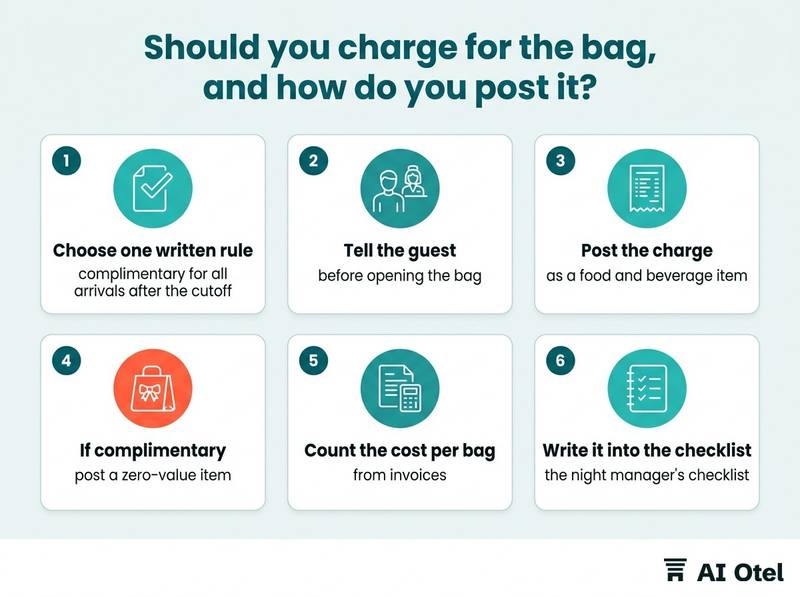
Rule options are complimentary for all arrivals after the cutoff, complimentary for direct bookings or specific rate plans, or charged at a set price shown in the room directory or a small menu. Tell the guest before opening the bag whether it is complimentary or charged, so no surprise line appears on the bill. If charged, post it as a food and beverage item to the guest folio; if complimentary, post a zero-value item or an internal cost record so the kitchen sees the cost.
Count the cost per bag from invoices and keep the bag simple to protect the margin. How the charge is documented depends on the hotel's own accounting, so confirm the treatment with the accountant. Make the night team, the kitchen and the billing team use the same rule, and write it into the night manager's checklist. A hotel operating system that puts billing, restaurant sales and front desk in one place, such as the one described on the platform overview, makes the same-line posting easier to enforce; a guest app that shows the bill, like the one on the guest app page, lets the guest see the item before checkout.
Key pointOne rule, one line
If the bag is chargeable, it appears on the bill as a food and beverage item; if it is complimentary, it appears as a zero-value item or an internal cost record.
How do you review the bag after a month?
Count what was prepared, what was handed over and what was thrown away, then change the cutoff, the contents or the charging rule based on those three numbers.
Keep a simple log with date, number prepared, number given, number discarded, reason for discard and any guest comment. Compare bags given with late arrivals flagged; if many flagged arrivals refuse, the offer or the script is wrong. Compare discarded bags with the preparation count; if waste is high, prepare only to confirmed arrivals or use a shelf-stable bag.
Read guest comments and night staff notes, and look for repeated complaints about choice, temperature or timing. Check cost per bag against the charge or the complimentary budget, and adjust portion or contents rather than safety. Review after one month, then quarterly, and write every change into the checklist.
ChecklistMonthly bag review
- Count prepared
- Count given
- Count discarded
- List discard reasons
- Read guest comments
- Check cost per bag
- Update cutoff or contents
- Brief the night team
What to do next
Write the cutoff time, the bag contents, the allergen label and the charging rule on one page, then give it to the night manager for the next late arrival. The bag is small, but it joins arrival planning, kitchen storage, front desk language and billing into one routine the guest can feel. If you are a traveler rather than a hotelier reading this page, you can look for a hotel in Türkiye (opens in a new tab) for your next trip.
Frequently asked questions
Can we give a late arrival bag to a guest who booked room-only?
Yes, if the hotel's written rule says so. Tell the guest at booking or at check-in whether the bag is complimentary or charged, and post it consistently. The bag is a service decision, not a rate-plan accident.
What should we do if a guest has a food allergy?
Record the allergy before arrival, prepare a separate sealed bag, label the contents and allergens, and ask the guest to call reception before eating. Do not promise allergen-free food unless the kitchen controls the whole process.
Do hotel late arrival snack bags need to be refrigerated?
If the bag contains cold meat, cheese, cut fruit or dairy, keep it in a refrigerator and label the preparation time. If the hotel cannot hold it cold, use shelf-stable items and say so on the note.
Who should hand out the bag at night?
A trained front desk agent or night porter who has been briefed on the arrival list, the script, the allergen labels and the charging rule. Record the handover so the kitchen and the bill agree.
How do we stop wasting bags?
Prepare to flagged arrivals, confirm with the guest when possible, keep a shelf-stable fallback, and review the discard log every month. Change the cutoff or the contents before adding more bags.