Shampoo dispensers or mini bottles: cost, waste and what guests make of each
Compare dispensers and mini bottles per occupied room, counting product, packaging, refill labor and waste. Learn to build a cost model, write a refill routine, and trial the change on one floor.
AI draft · awaiting editorial review
Contents
Key takeaways
- Compare dispensers and mini bottles per occupied room, counting product, packaging, refill labor, half-used waste and loss, never the shelf price of one bottle.
- A dispenser only pays back if the refill round is written down, assigned to a named person and checked on a sample of rooms every day.
- Half-used mini bottles are the quiet line item: a bottle opened for one night is paid for in full and thrown away partly full.
- Guest expectations follow your facility class and your own brand standard, so read your own reviews and comment cards before you switch anything.
- Run the change as a trial on one floor against a control floor, with the measures and the reversal rule fixed before the first room is converted.
A dispenser is a fixed, refillable unit that housekeeping tops up in the room; a mini bottle is a sealed single-use unit replaced at every departure. The two differ in where the cost sits: dispensers trade packaging for refill labor, mini bottles trade labor for packaging and half-used waste. Compare them per occupied room, not per unit.
A housekeeping supervisor empties a room bin: three mini bottles, two of them half full. On the purchasing manager's desk sits a quote for wall-mounted dispensers, priced per unit. Neither number answers the question the hotel is actually asking. After reading this article you will be able to build a cost per occupied room for both models, write the refill routine dispensers demand, count your own waste, and trial the change on one floor before you commit the building.
Dispensers or mini bottles: what is actually being compared?
Two operating models, not two products. One keeps a housing in the room and sends a person to fill it; the other sends a sealed unit to the room and takes the remainder away with the guest.
A dispenser is a fixed housing at the shower or basin holding bulk product or a sealed cartridge, refilled or swapped by housekeeping, and left in the room between stays. A mini bottle is a sealed single-use unit, placed before arrival and replaced at departure or on request, which leaves the building in the guest's bag or in the bin. The comparison axes that matter are cost per occupied room, housekeeping minutes per room, waste volume, loss and damage, guest perception, brand standard, and the storage and par stock each model demands.
Where each model puts the work
Dispensers add a refill step inside the room plus stock control inside housekeeping: the room attendant carries product, tops up, checks the pump and records it. Mini bottles move the work to the back of house: receiving cases, shelf space in the store, trolley space and a daily par count. Neither model removes labor; each relocates it. A hotel with a tight store and generous cleaning minutes leans one way; a hotel with the opposite profile leans the other.
One decision per item, not per bathroom
Shampoo, shower gel and conditioner suit dispensers: they are used in the shower, guests rarely expect to carry them home, and the volumes are large. Soap at the basin, the vanity kit, the shower cap and slippers may stay single-use, because guests expect to take them or discard them, and a wall-mounted equivalent would look odd. Give the decision one owner, usually the rooms division manager with the general manager, taking written input from purchasing and housekeeping. A decision made by purchasing alone optimizes the invoice; a decision made by housekeeping alone optimizes the round.
How do you calculate the cost per occupied room for toiletries?
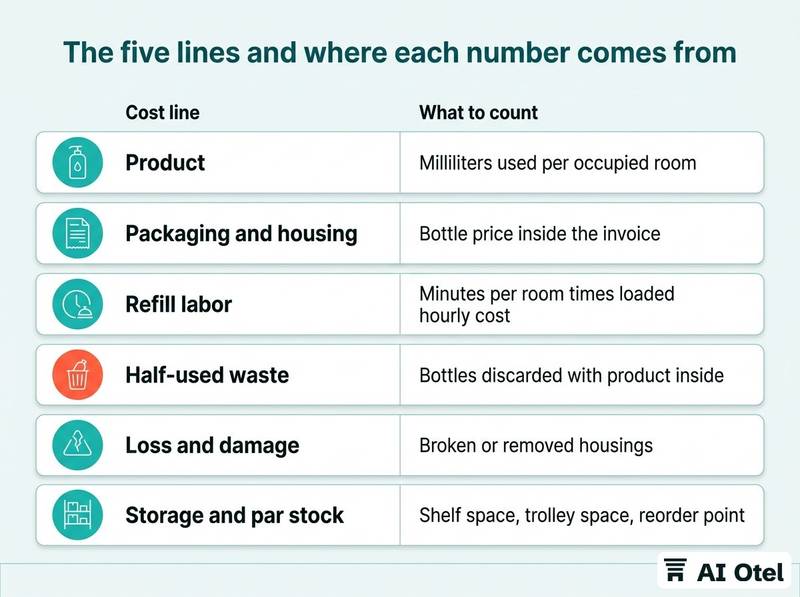
Add five lines over a period and divide by the occupied rooms in that same period. Occupied rooms means rooms with a guest in them, not rooms available and not units of stock issued. This is the same discipline as the wider cost per occupied room, line by line, applied to one basket of items.
The five lines and where each number comes from
| Cost line | What to count | Where the number comes from |
|---|---|---|
| Product | Milliliters used per occupied room | Supplier invoice and a measured fill volume |
| Packaging and housing | Bottle price inside the invoice; dispenser price spread over its life plus annual loss | Purchase invoices, replacement log |
| Refill labor | Minutes per room times loaded hourly cost | Stopwatch timing on ten rooms, payroll |
| Half-used waste | Bottles discarded with product inside, converted to milliliters and money | One floor counted for one week |
| Loss and damage | Broken or removed housings, taken bottles, spills, over-dilution | Maintenance log, stock count variance |
| Storage and par stock | Shelf space, trolley space, reorder point | Store room count |
For product, divide the invoice price by units per case and by milliliters per unit to get cost per milliliter, then multiply by the milliliters actually used per occupied room, measured rather than assumed. A dispenser housing is a capital item: spread its price over its expected life and add the share you lose to damage each year. For refill labor, time the round with a stopwatch on ten rooms, then multiply minutes by the loaded hourly cost of housekeeping, which includes wages, benefits and the supervisor's share.
For waste, count the bottles removed with product still inside for one floor over one week, convert the remainder to milliliters and to money, and add it as its own line. For example, a hotel with 100 occupied rooms a night records product, packaging, refill minutes, discards and replacements for one month, then divides the total by 3,000 occupied rooms to get one comparable figure per model. Keep the two models on the same basis: same period, same room types, same occupancy mix, otherwise the comparison flatters whichever floor was busier.
What does a refill routine look like, and who owns it?
A written round with a named owner, a marked fill level, a seal and pump check, and a line on the housekeeping sheet. Without the written part, the dispensers are empty by the second week.
Put the refill inside the room cleaning step, done by the room attendant, and add a supervisor check on a sample of rooms every day rather than all rooms. Set a fill level: top up to a marked line and never blend a different product into a partly used cartridge, because the guest will notice the smell before the manager notices the stock. Check the pump and the housing at every refill: a blocked pump reads to the guest as an empty dispenser, and a loose housing reads as neglect. Record date, room, product and person on the housekeeping sheet, so a complaint can be traced to a round rather than to a person's memory.
Escalate the same day: a broken dispenser goes to maintenance and the room is not sold with a fixture that does not work. Hold a par level on the trolley and in the store, count weekly, and set a reorder point before the shelf is empty. The refill round sits inside the same discipline as choosing, storing and training on housekeeping chemicals: labeled containers, dated stock and a person who knows why dilution ratios matter.
The refill round, step by step
Checklist
- Housing fixed, clean and undamaged.
- Pump works and delivers product.
- Fill to the marked line, correct product, no mixing.
- Cartridge or container labeled and dated.
- Seal closed and locked where the housing allows.
- Any fault written on the sheet and sent to maintenance the same day.
- Trolley par level restored before the next round.
- Supervisor sample check signed.
Bulk decanting versus sealed cartridges
Prefer sealed cartridges where the budget allows: they remove in-room decanting, which is where labeling, dating and contamination problems start. If you decant from bulk, do it away from the guest room, in a labeled and dated container, with a clean funnel, and treat it as a chemical handling task with training behind it. The cartridge costs more per milliliter and buys a class of problem off your books.
Where do waste, theft and spills actually come from?
Most of the loss is not theft. It is product opened and discarded, product over-diluted to stretch it, and fittings that leak or break.
Half-used bottles are the largest quiet line: a one-night guest opens a bottle, uses a fraction, and a replace-at-every-departure policy multiplies that remainder across the year. Some guests take mini bottles on purpose; that is a cost line and also part of what some hotels sell, so count it rather than argue with it. Locked housings and wall fixing reduce dispenser removal, so keep spare housings, keys and fixings in the maintenance store.
Over-dilution and over-filling damage the guest experience and can breach what the supplier expects of its concentrate. A leaking dispenser marks the wall and the shelf, and turns a small fitting fault into a complaint and a repair. Measure your own waste: weigh or count one floor's discards for a week, and report that figure rather than a supplier's claim.
Counting waste without a consultant
One floor, one week, one bin per room. Count the bottles, estimate the fraction left in each, convert to milliliters with the bottle's stated volume, and multiply by your cost per milliliter. Report the number monthly next to the stock issue figure. Do not print a saving you have not measured in your own building, and do not put an environmental percentage on a room card. If you also run a reuse program, the same honesty rule applies, as with a green-choice program that guests accept.
What do guests expect at your hotel class?
Expectations follow the facility's class, its brand standard and what the property has already taught its guests, not a general rule about dispensers. A guest who paid for a five-star room reads a cheap fixed dispenser as a downgrade; the same guest reads a well-made locked housing with a named product as a deliberate standard. What belongs in the room in the first place follows class too, as in the guest amenities list by hotel class and its restocking cost.
Resorts and all-inclusive facilities run high turnover and high volume, so dispensers cut restock load, and pool and beach showers belong in the same decision. Boutique and small properties can make a local product in a dispenser part of the identity, where a generic mini bottle says nothing. Pensions, apart facilities and simple operations are dominated by cost per occupied room, so a clean, plain housing and a reliable round matter more than the label. Long-stay and apart guests need larger formats and a refill on request, because a small bottle does not cover a week.
Reading your own reviews instead of a survey
Your own evidence is the only guest evidence you have: reviews, comment cards, complaints at the desk, and the state of the bin on departure. Search your reviews for "shampoo", "amenities" and "dispenser" before you change anything. Never tell guests that most guests prefer something, and never quote a preference figure you have not measured in your own property.
Watch out
Do not print an environmental saving, a waste-reduction percentage or a guest-preference claim on a bathroom card or a website page unless your own hotel measured it. A claim you cannot show becomes a complaint you cannot answer.
How do you trial dispensers on one floor?
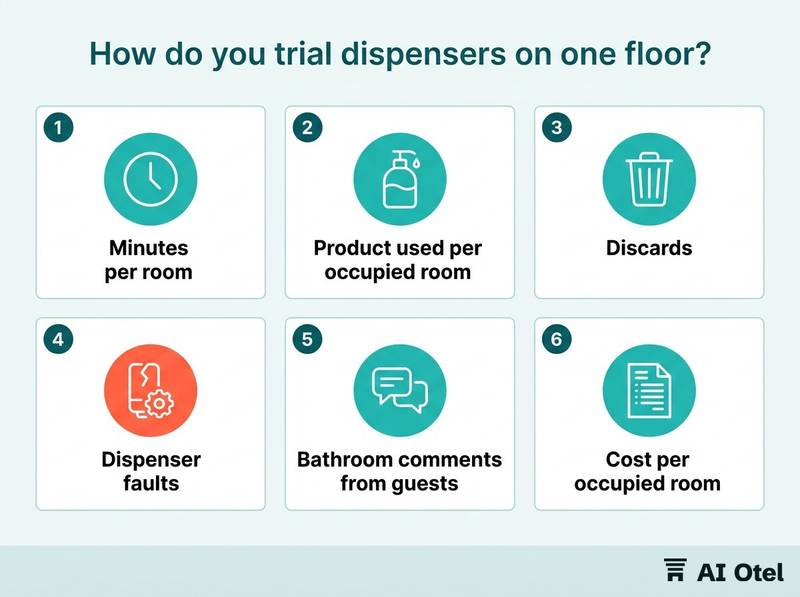
Convert a block of similar rooms, keep a comparable control block untouched, fix the measures and the reversal rule before you start, and put an end date on the wall.
Choose rooms of the same type and a similar guest mix, and avoid the floor with the newest rooms or the loudest complainers, because neither gives you a fair reading. Run long enough to cover a full refill cycle and at least one weekend, and state the start and end dates in the trial note. Brief the room attendants before the first room is converted; they will find the flaw in the routine within a week, and they will carry the change afterwards. Keep guest communication neutral during the trial: a leading survey question produces a leading answer.
Measures to fix before day one
Write down, before converting anything: minutes per room, product used per occupied room, discards, dispenser faults, bathroom comments from guests, and cost per occupied room. Write the decision rule first too: the result that keeps the dispensers, the result that reverts the floor, and who signs. Cost the rollback: housings, patching the wall fixings, and unused stock you cannot return.
Tip
Time the refill with a stopwatch on ten rooms and write the number down. A refill routine estimated from memory is always shorter than the one the room attendant actually performs at 09:00 on a Saturday.
What should the decision and the review date look like?
One written standard, one owner, one review date, and a stated condition that would reverse the decision.
Write the standard: which items are dispensers, which stay single-use, the fill level, the refill frequency, who checks, and what happens when a fitting fails. Put the cost per occupied room into the monthly rooms report, so the decision is reviewed against numbers rather than against memory. Set the review date, for example six months after rollout, and name the triggers that reopen the decision: fault rate, a repeated complaint theme, or a movement in cost per occupied room.
Tell the supplier what you will measure and ask for fill volumes in milliliters, spare housings and spare pumps in the contract. Give the guest one plain sentence about the refill program in the room or in the hotel's own guest information, with no claim you cannot support. Hand the standard to housekeeping training and to the purchasing reorder point, or the two will drift apart within a quarter.
If you want the standard to live somewhere more durable than a binder, a hotel operating system can hold housekeeping routines, par levels and reports in one place, and a guest app can carry that one plain sentence to the guest without a printed card.
What to do next
Before you sign either quote, measure one floor for a week: count the bottles thrown away half full, time a refill with a stopwatch, and divide by the occupied rooms. That single figure turns the rest of this article into a decision: the cost lines tell you what to count, the refill routine tells you what the model demands, the waste section tells you where the money leaks, the guest section tells you what your own property will tolerate, and the trial and the written standard keep the answer in place after the trial ends.
If you are a traveler rather than a hotel manager, you can find a hotel in Türkiye (opens in a new tab) and see the difference for yourself.
Frequently asked questions
Are refillable dispensers allowed in hotel bathrooms in Türkiye?
The choice between dispensers and single-use bottles is an operating decision the property makes, so treat it as your own written standard rather than a permission. Check it against your facility's class requirements and any chain or brand standard you operate under, and confirm your own case with a legal adviser before you change a guest-facing fixture.
Can housekeeping refill a dispenser between two guests, or must the unit be replaced?
Both are workable if the routine is written. Sealed cartridges are swapped, so nothing is decanted in the room. Bulk housings are topped up to a marked line with a labeled, dated container, and the pump and seal are checked at the same time. Whichever you choose, the fill, the check and the fault escalation go on the housekeeping sheet, and a supervisor checks a sample of rooms daily.
How much cheaper is a dispenser than a mini bottle?
No general figure applies, because the answer sits in your own invoices and your own minutes. Build it as five lines: product, packaging and housing, refill labor, half-used waste and loss. Divide the total by occupied rooms over the same period for both models. A dispenser that saves on packaging but adds four minutes a room can lose on the total.
Do guests take dispensers or damage them?
Locked, wall-fixed housings reduce removal to a small replacement cost, so keep spare housings, keys and fixings in the maintenance store. Mini bottles do leave the building, sometimes deliberately, and that belongs in the cost line rather than in a dispute with the guest. Count replacements monthly and compare them with the housing stock.
Should we tell guests about the switch?
Yes, in one plain sentence, in the room or in the hotel's own guest information. Say what the program is: refillable units, checked daily by housekeeping. Do not attach a waste or emissions percentage unless your own hotel measured it, because an unmeasured claim becomes a complaint you cannot answer.