The contracting season: a month-by-month timeline for next year's agency and tour operator rates
This guide builds a month-by-month hotel contracting timeline for tour operators and agencies. It covers cost reviews, price floors, sheet versions, and freeze dates to keep rates profitable.
AI draft · awaiting editorial review
Contents
Key takeaways
- The calendar runs backwards from the opening date, not forwards from the day the first agency request arrives.
- No rate leaves the hotel before the cost review and the price floor are written down, dated and owned by a named person.
- Every sheet you send carries a version and a date, and that version is what you discuss in meetings.
- A freeze date named at the start is what stops a late signature from landing on costs nobody has closed.
- Allotment size and release period decide how much capacity is left for direct and online sales, so they are set with the floor, not after the meetings.
The contracting season is the run of months in which a hotel sets, sends and freezes next season's agency and tour operator rates. Work backwards from your opening date: close costs, set a floor, prepare the sheet, send it, meet, then freeze on a date you chose in advance.
An agency writes in the middle of the season asking for next summer's rates, and the hotel has not yet closed this year's costs. The sheet goes out anyway, and the price ends up set by the calendar rather than by the numbers. This guide builds the hotel contracting timeline for tour operators and agencies month by month, so that by the end you can put six dates on one page: cost review, floor, package, send wave, meetings and freeze.
What is the contracting season for a hotel?
It is the window in which a hotel turns next season's costs into published agency and tour operator rates. It starts when the hotel decides to start and ends at a freeze date the hotel names in advance. The season does not open when the first agency email arrives; it opens when the hotel's own calendar says so.
Working backwards from the opening date
Build the calendar backwards from the opening date, meaning the first arrival of the season. Opening date, then freeze date, then the meeting window, then the send date, then the sheet ready, then the floor set, then the cost review closed. Each date is a deadline for the step before it, and the order matters: a floor cannot be signed before costs are closed, and a sheet cannot be sent before the floor exists.
The request from an agency arrives on the agency's own cycle, often earlier than the hotel expects. The hotel's answer date is its own decision, and naming that date in the reply is the control the hotel actually holds. "We will send our 2027 rates by 15 October" is an answer; a price pulled from last year's sheet is not.
Without a calendar, three failures repeat. Prices get built from last year's sheet plus a guess. A sheet goes out before costs are closed. And two versions of the same sheet circulate at once, so nobody can say which document a given agency is holding.
The table below is an illustrative default. Shift it to your own season: a summer hotel opening in April runs the same logic as a winter hotel opening in December.
| Window (months before opening) | Job | Output that must exist at the end |
|---|---|---|
| 9 to 8 | Cost review | A dated cost sheet per room type |
| 7 to 6 | Price floor and capacity decision | A signed floor per room type, board type and period |
| 5 to 4 | Sheet, fact sheet and release terms | A send-ready package with a version number |
| 4 to 3 | Send and meetings | A follow-up log with a next step and owner per agency |
| 2 | Freeze | One frozen version and a list of everyone holding it |
| Opening | Season start | The frozen sheet as the reference for the year |
A hotel with a year-round season runs the same calendar twice, once per season, rather than one long cycle that never quite closes. A city hotel with a stable mix may shorten the windows, but the order of the steps stays the same.
Who owns which step
Split ownership before the work starts. The revenue manager owns the floor and the capacity decision. The sales director owns the sheet, the meetings and the follow-up log. The general manager owns the sign-off and the freeze. When one person holds all of it, the steps blur, and the sheet tends to leave the building before the floor is signed.
Agree the vocabulary before the first meeting: contract rate, allotment, release period, free sale, stop sale and on request. These are working terms between the hotel and the agency, and the contract is where the hotel writes what each one means for this file. The same word can mean different things to different agencies, so the hotel's own definitions are part of the package it sends.
What has to be closed before you can quote a rate?
Costs first, then a floor: the lowest price the hotel can accept for a given room type, board type and period without losing money, written down and dated before any sheet is prepared. The floor is the boundary of the negotiation, and it exists on paper or it does not exist at all.
The floor is not one number
Close the room cost per night first: housekeeping, laundry, utilities and the breakfast covers that come with the room, per room type. A suite and a standard room do not cost the same to service, and a single blended cost hides the difference. Close the board-type cost separately, per cover, since an all-inclusive cover and a bed-and-breakfast cover are different products with different costs.
Add the agency-linked cost to the same sheet: the margin the hotel gives up on an agency booking, the payment terms, and the exposure the hotel carries if the booking cancels late. These are real costs of the channel, not footnotes.
Set the floor per room type, per board type and per period. One number for the whole season hides the periods where the hotel should not be discounting at all, usually the weeks it will sell out on its own. Give the floor a date and an owner. A floor that lives in someone's head moves during the meeting, usually downwards.
If a request arrives before the floor exists, reply with the date the hotel will answer, not with a price. This is the single discipline that separates a planned season from a reactive one. For the currency question that sits underneath the floor, see setting next season's price rise with lira costs and euro contracts.
ChecklistBefore you prepare any sheet, check that every line below is closed
- Room cost per night by room type
- Board-type cost per cover
- Laundry and housekeeping cost per occupied room
- Utility cost per occupied room
- Agency-linked cost: margin given up, payment terms, late-cancellation exposure
- The currency assumption and the rate the hotel will use for the season
- The floor per room type, board type and period
- The name and date on the signed floor
Currency sits next to the floor
Write the currency assumption next to the floor. Costs sit in lira and many agency contracts sit in euro, and the gap between the two is a decision the hotel takes deliberately, not a rounding at the end. Decide the exchange rate the floor is built on, write it on the cost sheet, and treat any movement beyond it as a reason to revisit the floor, not as noise.
What goes on the sheet before it is sent?
A send-ready package is four documents: the rate sheet, the fact sheet, the release and allotment terms, and a cover note that names the version and the reply date. Anything less and the agency fills the gaps with its own questions, on its own schedule.
The sheet states the season dates, room types, board types, whether the price is per room or per person, the currency, and what the price includes. Ambiguity here becomes a dispute later, so state the obvious: whether city tax is included, whether the price covers two adults, what happens with a child in the room.
The fact sheet answers the questions the agency will ask anyway: room mix and capacity, distances and transfers, season length, and what changed at the property since last season. A one-page fact sheet shortens every meeting; see the one-page hotel fact sheet agencies expect. The release and allotment terms are written as the hotel's own rule: how many rooms are held, how many days before arrival unbooked rooms come back, which dates are free sale and which are on request.
Put a version number and a date on every page of every document. The version is what the meeting discusses and what the agency quotes back. For the full contents and versioning routine, see what goes on a contract rate sheet and how to version it.
What stays off the sheet
Keep three things off the sheet: the internal floor, the cost assumptions behind the price, and the terms given to another agency. The floor is an internal document; the moment it travels, it becomes the other side's opening position. The terms given to another agency, if they leak, become the benchmark every agency negotiates against.
The cover note is short and does three jobs: it names the version, it gives the reply date, and it names the person who owns the file. One paragraph is enough.
Watch outName the version you sent
Never send a sheet whose version number you cannot repeat in a meeting, because the version you cannot name is the version that gets signed.
How do you run the sending and the meetings?
Send in one wave with one reply date, then work a list: each agency gets a meeting, a written note and a next step with an owner and a date. The wave structure is what keeps one version in the market instead of five.
One wave, one version, one reply date. A request that arrives late gets the same version, not a private one, because two versions in the market become two prices in the market. If a late request needs different terms, that becomes a new version with its own number, not an edit of the old one.
Set the meeting agenda in advance: the sheet version, the agency's own volume pattern from last season, the release terms, and the points the hotel will not move on. Walking into a meeting without the agency's pickup history from last season means negotiating against your own memory.
Price or structure: which request is which
Separate a request for a different price from a request for a different structure. Allotment size, release period and payment terms are usually cheaper to give than a lower rate. For example, a small reduction per room night across a season costs more than a longer release period the hotel wanted anyway. Listen for the structure behind the price request, and answer with the structure when you can.
Keep the follow-up log in one place: agency, contact, date, version discussed, what they asked for, what was agreed, next step and owner. A meeting without a written note is a meeting that will be re-run next month. The one-page version of this is the agency visit report and what the office does with it.
TipMinimum fields of the follow-up log
Agency name, contact, meeting date, sheet version discussed, what the agency asked for, what the hotel offered, what was agreed, next step, owner, next contact date. Ten fields, one row per meeting, and the season becomes readable from a single file.
Nothing agreed in a meeting is final until it appears on a new version of the sheet with a date on it. Verbal agreements drift, and both sides remember them differently by the time the contract is signed. Close the wave with a short written summary to each agency: the version, the reply date and the next contact date.
How much capacity should stay out of the contract?
Enough that direct and online channels still have rooms to sell at the price the hotel wants in the periods it expects to be strong. Capacity is not a technical appendix to the rate discussion; it is half of the season's earning power.
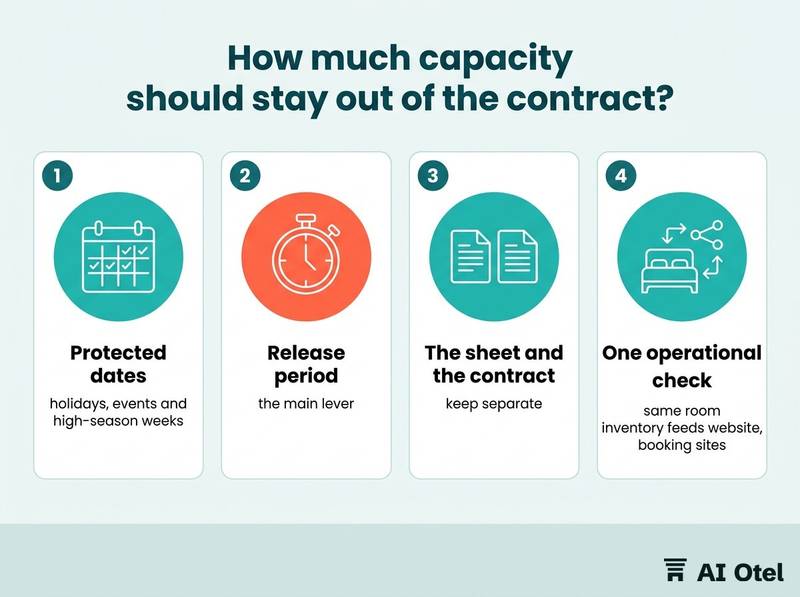
Decide capacity with the floor, in the same meeting, because the two together set what the season can earn. A low floor with a large allotment is a double concession, and hotels that make them separately rarely notice they have made both.
Protected dates
Name the protected dates first: the holidays, events and high-season weeks the hotel expects to sell itself. Those dates get a small allotment or on request only. A room sold to an agency in a week the hotel would have filled on its own is the most expensive sale of the year.
Use the release period as the main lever. A longer release period brings unsold rooms back to the hotel earlier, at the cost of making the offer less attractive to the agency. Weigh the trade-off honestly: a large allotment buys a volume conversation but removes the hotel's freedom to sell that room elsewhere at a better price.
Keep the sheet and the contract separate. The sheet is a price document; the contract is where allotment, release, payment and cancellation terms become binding. A hotel that mixes the two ends up renegotiating prices because a term was ambiguous.
NoteThe four availability modes, in plain words
Allotment: rooms held for the agency until the release period runs out. Free sale: rooms the agency may sell without a hold. Stop sale: dates closed to that channel. On request: the agency asks and the hotel answers each time. These are working terms between hotel and agency, and the contract is where the hotel writes what each term means for this file.
One operational check belongs here. Make sure the same room inventory feeds the hotel's own website, the booking sites and the agencies, so a room sold to an agency cannot be sold again online. A hotel operating system that holds reservations and channel availability in one place is built for exactly this; the alternative is a weekly reconciliation between systems that disagree.
When do you freeze, and what happens to changes after that?
You freeze on the date you named at the start, and after that every change becomes a new version with a reason, an owner and a date, sent to every agency holding the old one. The freeze is not a mood; it is a date on the calendar with a checklist behind it.
Freeze means the sheet stops changing without a written reason, and the floor is checked once more against the latest cost figures before anything is signed. The check is quick if the floor was built properly, and it is the last chance to catch a cost that moved between the floor date and the freeze date.
What counts as a reason
Changes that justify a new version: a cost movement beyond the assumption in the floor, a currency shift, a capacity decision, or an error the hotel has to correct. Changes that do not justify a new version: one agency asking for a better number in a meeting after the freeze. The freeze date exists precisely so that this second kind of request has a written answer.
Payment, cancellation and renegotiation terms belong in the hotel's own contract, drafted once with a legal adviser, so that the answer to a mid-season request is already written down. Confirm the terms of your own contract, and your own case, with a legal adviser before the season starts.
Telling everyone holding the old version
Tell every agency holding the old version, in writing. A version that circulates quietly becomes the version someone signs. Once signed, the frozen sheet becomes the reference for the season, and the next contracting cycle starts from it rather than from a blank page.
ChecklistBefore you declare the freeze, run this list
- The freeze date is the one named at the start
- The floor has been re-checked against the latest costs
- The version number and date are on every page
- The list of agencies holding the previous version is complete
- Each holder has been told in writing
- The contract terms have been reviewed with a legal adviser
- The frozen sheet is filed where the sales team can find it next season
What to do next
Pick your opening date this week and write the freeze date backwards from it, then book the cost review that has to happen before any sheet leaves the hotel. The rest of the calendar follows from those two dates: costs closed, floor signed, package versioned, one send wave, meetings logged, capacity protected, and a freeze that everyone holding the sheet has been told about. If you want the wider picture of where the agency channel sits in a yearly sales plan, the B2B sales plan for agencies, tour operators and corporate accounts covers the full year, and the distribution hub for contracted rates is built with seed data: hotels publish contracted rates to agencies on their own terms and every quote shows its working, and no agency is connected yet.
Frequently asked questions
When should a hotel send next season's rates to agencies?
On a date the hotel chooses, after the cost review is closed and the floor is signed, and early enough that the meetings and the freeze fit before the opening date. If a request arrives before that, reply with the date the hotel will answer rather than a price. The hotel contracting timeline for tour operators and agencies is the hotel's own calendar, not the agency's.
What is a release period in a hotel contract?
It is the number of days before arrival at which rooms still unsold inside an agency's allotment come back to the hotel. It is a working term between the two parties, so the hotel states its own rule and writes it into the contract. A longer release period returns rooms earlier but makes the offer less attractive to the agency.
Can we change a rate after the agency has signed?
What the contract says governs, so the answer is written before the season starts, not invented mid-season. Inside the hotel's own process, a change is a new version with a reason, an owner and a date, and every agency holding the old version is told in writing. Confirm your own case with a legal adviser before signing.
Do we need a different rate sheet for each agency?
Keep one master sheet and create variants only where the structure genuinely differs, for example currency, board type or allotment size. Each variant carries its own version number and date, so the hotel can always say which document a given agency is holding. Variants without version numbers are how two prices end up in the market under one name.