The department budget request: a one-page form and the review calendar behind it
Standardize hotel department budget requests with a one-page form and fixed drivers. Use the September to January calendar to compare, review and decide on every department's request.
AI draft · awaiting editorial review

Contents
Key takeaways
- One form for every department is what makes requests comparable; a strong argument in the wrong shape cannot be weighed against a weak one in the right shape.
- Drivers are issued once by the general manager and the controller before any department fills the form, so two departments cannot budget the same season on different occupancy.
- Recurring operating lines and purchase requests belong on separate parts of the page, because one is judged against the year's activity and the other against the asset it creates.
- A published return date with a written default for late submissions ends the annual negotiation about deadlines.
- A refusal is only useful when it says what would change the answer.
A hotel department budget request is a single page in a fixed form: last year's actual figures, the drivers agreed with the controller, recurring operating lines, separate purchase requests and the reason for each change. It is issued, returned and reviewed on a published calendar, so every department's request can be compared and cut on the same terms.
By the middle of September the owner's inbox holds a spreadsheet from the front office, a three-page letter from the kitchen and a spoken request from housekeeping, and no two of them can be placed side by side. The numbers are rarely the problem. The shape they arrive in is. This guide gives you the one-page form, the driver list that must be agreed first, the calendar from September to January, and the four decisions a review meeting is allowed to make.
Why do department budget requests arrive in different shapes?
Because each department head writes for the person who will read it, not for the person who has to compare it. When no form exists, every head invents one.
A head who was refused last year writes longer. A head who was never refused sends a number in an email and expects it to be accepted. Each request is built on its own department's logic, covers in the kitchen, rooms at the front desk, staff hours in housekeeping, and the owner is left with no shared unit of comparison.
Without a fixed shape, the earliest or loudest request wins rather than the strongest one, and the review meeting turns into a reading session. The usual result is deferral: decisions slip to "after we see how the season goes", which is the same as budgeting on last year's numbers by accident.
The fix is procedural, not personal. One page, one calendar, one set of drivers, issued together, so the argument happens about the numbers and not about the format. Departments keep their detail. The page is the request; the spreadsheet behind it is the evidence, attached and not read aloud.
NoteThe one-page test
Hand two completed requests to someone who was not in the review meeting. If that person cannot say which department asks for more money and why, the form has failed and should be changed before the next round.
What goes on a one-page hotel department budget request form?
Six blocks in a fixed order: who and which period, last year's actual, the agreed drivers, the recurring operating lines, the purchase requests, and the reason for every line that moves.
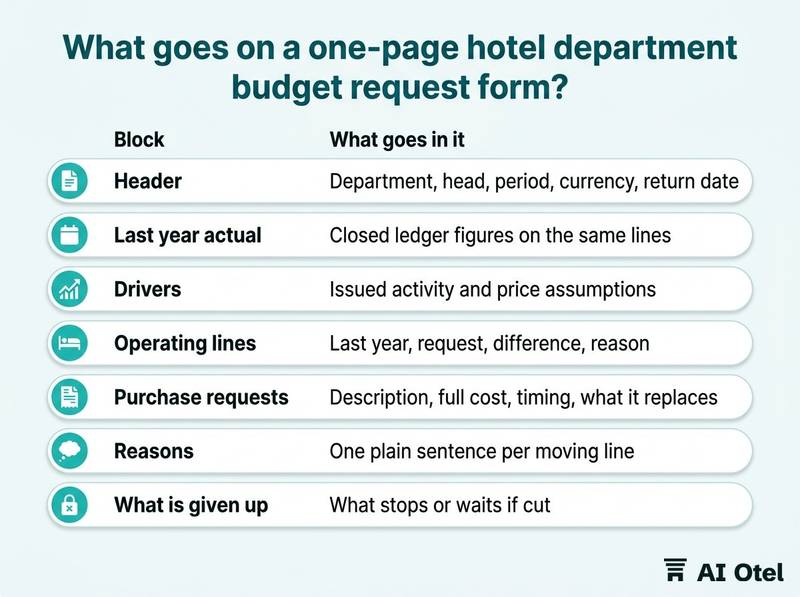
The six blocks
The header carries the department, the head's name, the budget period, the currency and the date the page was returned. One currency per page, with the conversion assumption written on it. Last year's actual comes from the closed ledger, on the same lines and the same period, never from memory or from a department's own tracking sheet.
The drivers are the activity and price assumptions issued by the controller, printed on the page so the reader can see what the department was asked to plan against. Operating lines each show last year, this year's request, the difference in money and in percent, and one sentence of reason where the line moves beyond the threshold the controller set. Purchase requests are kept apart, each with a description, a total cost including installation and training, the month it is needed and what it replaces or adds.
"Prices went up" is not a reason; "the laundry contract renews in March at the new tariff" is. One sentence per moving line, written so a reader outside the department understands it. The last block is the most useful sentence on the page during a review: a short line naming what the department would stop doing or delay if the request is cut.
| Block | What goes in it | What must not appear |
|---|---|---|
| Header | Department, head, period, currency, return date | A second currency or a verbal side agreement |
| Last year actual | Closed ledger figures on the same lines | Estimates, department tracking sheets |
| Drivers | Issued activity and price assumptions | The department's own occupancy guess |
| Operating lines | Last year, request, difference, reason | Purchases hidden inside a recurring line |
| Purchase requests | Description, full cost, timing, what it replaces | Three small items bundled to look cheap |
| Reasons | One plain sentence per moving line | "Market conditions", "prices went up" |
| What is given up | What stops or waits if cut | A threat about service levels |
The one-page test
If the request cannot be expressed in these six blocks on one page, it is not ready to be reviewed. The detail still matters when a line is queried, but it never replaces the summary.
Which drivers have to be agreed before anyone fills the form?
The short list the controller issues in the same week as the form: the activity levels and prices that every department's costs are measured against. Departments plan against them; they do not set them.
A department that assumes a different occupancy from the one in the driver list is budgeting a different hotel, and the two pages can no longer be compared. Issue drivers by month, not by year. A seasonal hotel's costs do not spread evenly, and an annual average hides the two months that decide the result.
Keep the list short. Every extra driver is a second budget, and departments stop reading the page when it grows past what they can check. Where one driver is genuinely uncertain, issue a low case and a high case and ask for the cost of each, rather than an average that describes neither.
A department that disagrees with a driver writes the disagreement in the reasons block. It does not change the number, because a changed number breaks comparability for everyone. The revenue assumptions inside the driver list are the part most often argued about; that is the side where hotel growth and consultancy work can help, and where getting the assumption wrong costs the most.
ChecklistDrivers to issue with the form
- Rooms occupied or room nights, by month
- Arrivals at the front desk
- Covers in each food and beverage outlet, by month
- Banquet or event count
- Staff headcount and the wage assumption
- Utility tariff assumption
- Exchange rate assumption for imported items
- The low and high case for the one driver that is genuinely uncertain
What is the difference between an operating line and a purchase request?
An operating line is consumed inside the year and moves with activity; a purchase creates or replaces something that lasts beyond it. The two are judged against different things, so they belong on different parts of the page.
Two tests settle most cases: does the item still exist next year, and does it change capacity, the cost base or the hotel's compliance position. A yes to either makes it a purchase request. The owner sets a money threshold above which any item is a purchase request, whatever the department calls it. For example, a hotel might set the line at the price of a mid-range piece of kitchen equipment and treat everything above it as a purchase.
A purchase request needs the full cost, not the sticker price: delivery, installation, training, the service contract and the month the money leaves the account. It also needs the alternatives that were considered, repair against replace, lease against buy, and doing nothing for another year with its cost. Bundling is the common evasion. Three small items that together cross the threshold are one request, not three, and the form should say so.
A purchase that saves operating money must show both lines, the purchase and the operating line it reduces. Without the second line the saving disappears in the consolidation. Purchases also belong on the hotel's asset list once they arrive, so the request and the register use the same description; the hotel fixed asset list by room, lobby and kitchen is the natural place to keep that vocabulary consistent.
| Question | Operating line | Purchase request |
|---|---|---|
| Does it last beyond the year? | No | Yes |
| Judged against | The year's activity and the driver | The asset it creates and the years it serves |
| The request must show | Last year, request, difference, one reason | Description, full cost, timing, alternatives |
| Who approves | Head within the envelope, controller checks | Owner, above the threshold, in the owner meeting |
| What deferral means | The cost returns next year | The item goes on a dated list; the asset keeps aging |
What does the annual budget calendar look like from September to January?
Five fixed dates: the pack goes out in early September, pages come back by a stated day in early October, review meetings run through late October and early November, the owner decides the envelope in November, and the final budget is issued in writing in December.
In early September the controller sends the form, the driver list, the purchase threshold and the calendar in one message, so no department can say it did not have the assumptions. Through September, questions go to the controller in writing and the answers go to every department, so all of them plan on the same reading of the same rule.
In October the controller consolidates, checks arithmetic and consistency across departments, and sends queries back with a short deadline. This is where duplicate requests for the same laundry or maintenance contract are merged. Review meetings then run department by department, each ending with a recorded decision rather than an impression. In November the owner meeting decides the total, the purchase list and the cuts: the owner sets the envelope, and the general manager and controller fit the departments inside it.
In December the final budget is issued in writing, dated and frozen. Departments sign the page they will be measured against, which ends later disputes about what was agreed. In January the first month is compared against the budget using a method agreed before the month closes, so the first variance report does not become an argument about definitions. For a hotel whose cash swings hard between seasons, the budget also feeds cash flow planning for the months between seasons.
| Month | Stage | Who | What must be true to move on |
|---|---|---|---|
| Early September | Pack issued | Controller | Form, drivers, threshold and calendar sent together |
| Sept to early Oct | Pages returned | Department heads | Every page complete on one page, detail attached |
| October | Consolidation and queries | Controller | Duplicates merged, arithmetic checked, queries answered |
| Late Oct to early Nov | Review meetings | GM, controller, each head | One of four decisions recorded per department |
| November | Owner meeting | Owner, GM, controller | Envelope and purchase list decided |
| December | Final issue | Controller | Budget dated, frozen, signed by each head |
| January | First comparison | Controller | Comparison method agreed before the month closes |
The late default deserves its own sentence. A department that misses the return date has last year's figures stand as its request and loses the right to ask for increases that year. Published in advance, this removes the deadline negotiation entirely.
How should the budget review meeting be run?
Short, in a published order, with each head presenting their own page and leaving with one of four decisions written down.
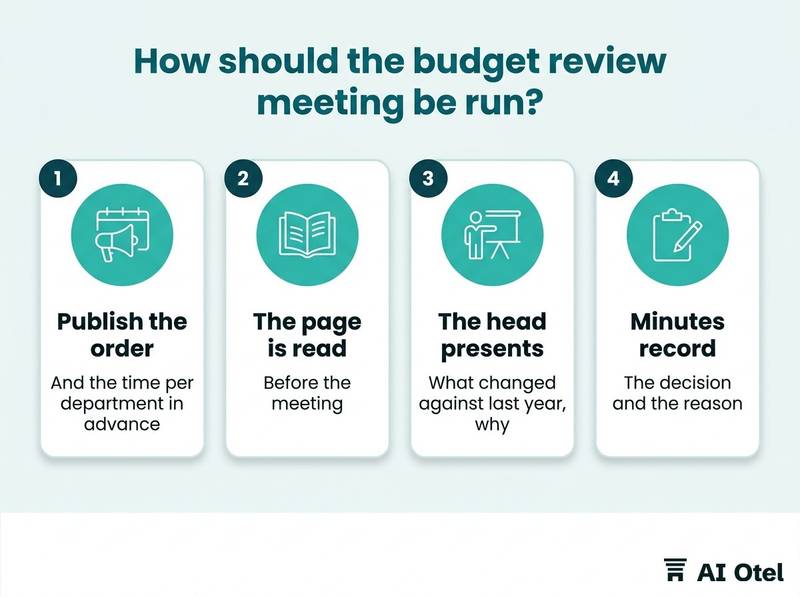
Publish the order and the time per department in advance. A common order is by size of controllable cost, or rooms-facing departments first because their drivers set the rest. The page is read before the meeting. The meeting is for questions, not for reading, which is why the one-page rule matters more on meeting day than on any other.
The head presents three things: what changed against last year, why, and what the department would give up. The controller speaks to comparability across departments; the general manager speaks to the total; the owner speaks to the envelope. Cross-department items, laundry, information technology, maintenance contracts, are decided once in a single slot, not argued again in each department's turn.
Minutes record the decision and the reason, not the discussion. A decision without a reason cannot be applied consistently to the next department that asks the same thing. The departmental profit and loss statement is the natural place to check that the agreed lines will be visible once the year starts, so the budget and the monthly report use the same line names. A hotel operating system built so that the budget page and the monthly report can carry the same line names keeps the comparison honest.
TipThe four decisions, and nothing else
Approved: the line stands as requested. Approved with a condition: the line stands if a named condition is met by a named date. Deferred: decided at a named later meeting, with what must be known by then. Declined: with the three-line reason note. "We will see" is not a decision and is not recorded.
How do you decline a request, and what happens when something changes mid-year?
Decline in writing in three lines, and treat a mid-year change as a new one-page request that also says what it displaces.
The three lines: what was asked, why not now, and what would change the answer, such as a driver moving, a price falling or a date arriving. Decline the line, not the department, and use the same vocabulary as the form so the note can be read next to the page it answers.
A declined purchase goes on a dated list rather than disappearing. The list is reviewed once a year, which stops the same item being argued from scratch every month. A mid-year change request uses the same page plus three additions: what changed since approval, the cost for the remainder of the year, and what the department gives up to stay inside the envelope. A change that only re-phases spending between months needs the controller's written note, not a new approval round, or the calendar collapses under small corrections.
Watch outWrite the emergency rule while the year is calm
A budget with no emergency rule is replaced by an improvised one in the first week something breaks. Write the rule before the year starts: the named roles who may commit money without approval, the ceiling for each, and the report that must reach the controller within a set number of days.
What to do next
Pick the return date first, then build the page backwards from it: the drivers you must issue, the threshold that separates operating lines from purchases, and the four decisions the review meeting is allowed to make. Issue the form, the drivers, the threshold and the calendar in one message this September, and the pile of emails becomes a set of pages you can actually compare.
Frequently asked questions
Who approves a hotel department budget?
The department head owns and signs the page and is accountable for its lines. The controller checks arithmetic, comparability and duplicates across departments. The general manager consolidates and fits departments inside the envelope. The owner approves the total and the purchase requests above the threshold, normally in a single meeting in November.
How detailed should a department budget request be?
One page, with the detail attached as evidence rather than argued in the meeting. If the request cannot be expressed in the six blocks on one page, it is not ready to be reviewed. The detail still matters when a line is queried, but it never replaces the summary.
What should happen if a department misses the budget deadline?
The calendar should state the default in advance: last year's figures stand as that department's request and it loses the right to ask for increases that year. A published default is fairer than an argument about who was late and why, and it protects the departments that returned on time.
How do you budget a department whose costs follow covers rather than rooms?
The controller issues covers per outlet by month as the driver, alongside the room-based drivers used elsewhere. The department plans its lines against those covers and shows cost per cover as a derived check on its own page, not as a comparison against other hotels. Any cross-hotel comparison would need a verified benchmark, which this article does not provide.