The housekeeping cart: what goes on it, how much, and the end-of-shift restock
A hotel housekeeping cart setup has four zones: clean linen, guest amenities, chemicals and waste. Learn how to set par levels, load the cart in a fixed order, and run the end-of-shift restock so the next shift starts full.
AI draft · awaiting editorial review
Contents
Key takeaways
- The cart is the room attendant's whole shift in one frame: every item missing from it becomes a walk out of a half-cleaned room.
- A par level is the quantity a cart carries to cover one shift's rooms plus a margin, set from the hotel's own room count and consumption, not from a supplier's pack size.
- Clean linen, guest amenities, chemicals and waste each need their own zone, and the chemical zone never shares a shelf with anything a guest touches.
- The cart is restocked at the end of the shift against the par card and signed off, so the next shift starts full instead of starting with a search.
- When stock runs out mid-floor, a written rule finishes the room, records the shortage and keeps the attendant on the floor.
A hotel housekeeping cart setup has four zones: clean linen, guest amenities, cleaning chemicals in a closed caddy, and waste with soiled linen. How much it carries is a par the hotel sets from its own room count and per-room consumption. It is loaded in a fixed order at the start of the shift and restocked and signed off at the end.
A room attendant is halfway through a check-out: bed stripped, bathroom started, bin liner in hand. The liner is not on the cart. What follows is a walk to the pantry, a cart left standing in a corridor, and a room that stays unfinished for however long that takes. None of it shows on any report. This article gives you the working standard: which shelf holds what, how much of it, in what order it is loaded, and how the shift ends with a signed, full cart.
Why does a badly loaded cart slow down every room?
Because a missing item does not cost one item, it breaks the sequence of the room. The attendant leaves a half-cleaned room, secures the cart, walks to the store and starts again from where they stopped.
The cart is loaded once in the morning and used for every room of the shift, so a single wrong decision about quantity repeats in every room. The real cost is the interruption, not the walk: a stripped bed or a wet bathroom cannot be left safely, so the attendant either finishes with a substitute or abandons the sequence.
A cart loaded for the average room is wrong twice. It is too much for a quick check-out of a single guest and too little for a family room that needs extra towels, extra amenities and a second waste bag. An overloaded cart has its own cost: it is harder to push and steer in a narrow corridor, it damages door frames and skirting, and it tires the attendant before the floor is finished.
The practical test of a load is simple: can the attendant finish a room without leaving it, and can they push the cart safely down the corridor? Loading is a supervisor's decision written down as a standard, not each attendant's personal habit. Otherwise no cart can be handed over to another person.
What goes on a housekeeping cart, zone by zone?
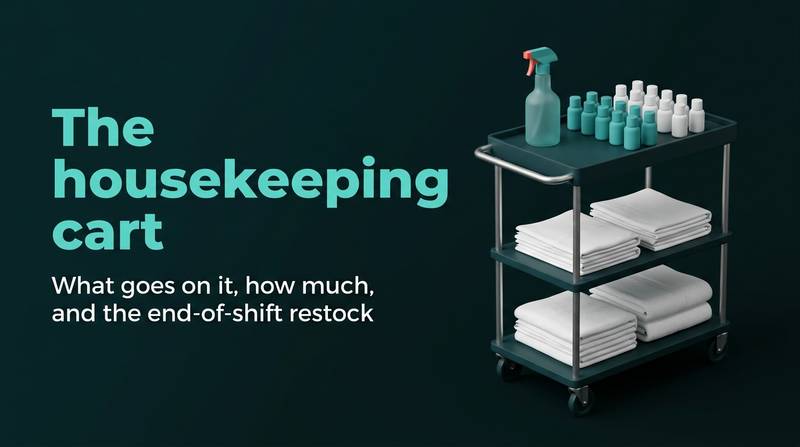
Four zones, kept apart on purpose: clean linen, guest amenities and supplies, cleaning chemicals and tools, and waste with soiled linen. The separation is what makes the cart safe and fast at the same time.
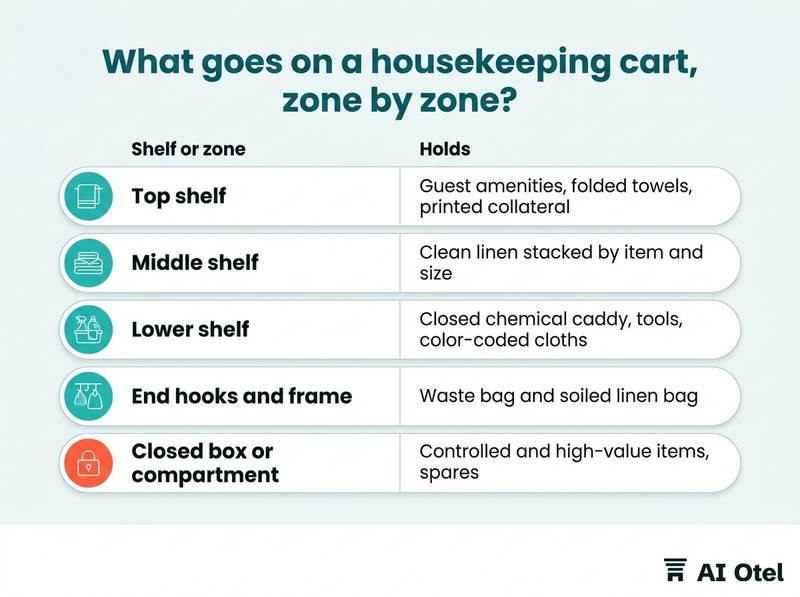
Clean linen goes on its own shelf, stacked by item and size so the attendant's hand goes to the same place every time: sheets, pillowcases, bath towels, hand towels, bath mats. Guest amenities go on a shelf above the linen, so nothing heavy or liquid sits over clean fabric: soap, shampoo, dental kits, slippers, tea and coffee, stationery, laundry bags.
Chemicals and tools go on the lowest shelf in a closed caddy, with cloths sorted by color so a bathroom cloth never reaches a glass or a surface in the room. Waste and soiled linen travel at the end of the cart or in hanging bags, never on a shelf, and the two bags are separate and identifiable from a distance. A closed box or small locked compartment holds controlled or high-value items such as minibar stock, batteries and spares, so a shortage is visible rather than assumed.
The room's own consumables, the ones that go on the bill, stay in the system and on the room's record. The cart carries the working stock, not the inventory of record.
| Shelf or zone | Holds | Never on this shelf |
|---|---|---|
| Top shelf | Guest amenities, folded towels, printed collateral | Chemicals, waste, anything that can leak |
| Middle shelf | Clean linen stacked by item and size | Soiled linen, chemicals, guest waste |
| Lower shelf | Closed chemical caddy, tools, color-coded cloths | Food and drink, amenities, linen |
| End hooks and frame | Waste bag and soiled linen bag, separate and labeled | Clean linen, amenities, guest belongings |
| Closed box or compartment | Controlled and high-value items, spares | Loose items with no record of issue |
How much should a cart carry? Setting par from your own rooms
A par level is the quantity a cart carries to cover one shift's rooms plus a margin. The hotel sets it by counting what its own rooms actually consume, then adding a buffer for the rooms that run over.
Start from the room count the cart will actually serve on a shift, not the floor's total: rooms out of order, occupied departures and stayovers consume different amounts. Count consumption per room type and per occupancy band, because a double room uses more towels and more amenities than a single, and a family room more than both. Set linen par per bed and per room type, and amenity par per guest, then convert both into a number the cart can physically carry.
Treat the cart as working stock and the floor pantry as the reserve: the cart carries what one shift needs, the pantry carries the replacement for the next one. Too high a par adds weight, hides shortages and lets stock walk. Too low a par turns every room into a trip. The right number is the lowest one that finishes the shift without a walk.
Write the par on a card fixed to the cart, so the number is checked against the cart rather than remembered, and revise it when the room mix or the amenity set changes. For example, and only as an illustration: a floor of 40 rooms with 30 to service on a shift, two bath towels per occupied room and a buffer for four extra rooms gives a linen par the supervisor can count in under a minute. A fuller picture of what the floor needs starts with the housekeeping equipment list for a new hotel.
In what order should a cart be loaded, and who loads it?
Heaviest and cleanest first, chemicals and waste last, and one named person signs the cart off before it leaves the pantry. The order matters because it decides what can spill on what.
Linen goes on first and low, so the weight sits over the wheels and nothing is stacked on top of it later. Amenities follow on the upper shelf, counted against the par card rather than by eye. Chemicals go in last, in the closed caddy, so nothing is placed on top of them and nothing is carried over them. Waste and soiled linen bags go on empty and folded, so the first room of the shift does not start with a bag that is already half full.
Whether the attendant loads their own cart or the floor supervisor loads a bank of carts depends on the hotel's model. What cannot vary is that one named person checks the cart against the par card before it leaves the pantry. Where carts are shared between shifts, a short handover note travels with the cart: what is short, what was substituted, what the next shift must collect.
ChecklistThe loading order, in sequence
- Cart cleaned, wheels checked, brakes working
- Waste and soiled linen bags empty, folded and hung
- Clean linen counted against the par card and stacked low by item and size
- Amenities and guest supplies counted and placed on the upper shelf
- Tools and color-coded cloths in place
- Chemicals in the closed caddy on the lowest shelf, labels facing out
- Par card checked and signed by the named loader
- Cart leaves the pantry only after the signature
How should cleaning chemicals be carried on a cart?
In closed, labeled containers, on the lowest shelf, in their own caddy, and never out of the attendant's sight in a corridor or an occupied room. The cart is a moving chemical store, and it is treated as one.
Nothing is decanted into an unlabeled bottle: a container keeps its original label or gets a proper secondary label with the product name and its hazard. The caddy is closed when the cart moves and when the attendant is inside a room, so a spill stays inside the caddy instead of running down the shelves. Chemicals never share a shelf with linen, amenities, food and drink or guest belongings, and the chemical side of the cart is parked facing the wall.
The cart is never left unattended in a corridor where a guest, and especially a child, can reach the lower shelf. Personal protective equipment travels with the chemicals, not in the pantry, or it will not be worn. Safety information for each product stays in the pantry where it can be read in full, and the attendant is trained on what to do with a spill on a carpet or in a lift. More on product choice, storage and training is in housekeeping cleaning supplies and chemicals.
Watch outThe cart is an unattended chemical store for most of the shift
Keep products in closed, labeled containers on the lowest shelf, never decant into an unlabeled bottle, never park the chemical side toward the corridor, and never leave the cart outside an occupied room where a guest can reach it.
How do you run the end-of-shift restock and sign-off?
Restock at the end of the shift, not the start of the next one, count against the par card, and have the attendant and the supervisor both sign. The next shift should begin with a full cart and no search.
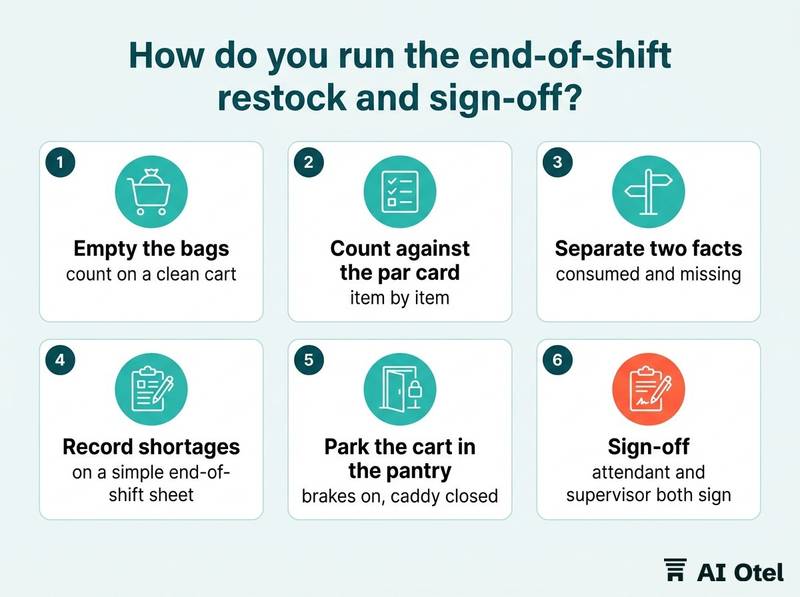
Empty the waste and soiled linen bags first, so the count is done on a clean cart and nothing is left standing overnight. Count against the par card item by item; counting by eye is how a cart leaves the pantry short and nobody notices until the fourth room. Separate two different facts on the sheet: what was consumed and needs replacing, and what is missing and needs explaining.
Record shortages on a simple end-of-shift sheet, so a repeated shortage becomes a par problem or a store problem rather than a personal one. Park the cart in the pantry, not in the corridor, brakes on, chemical caddy closed, bags empty. The sign-off is what makes the standard real: an unsigned cart is an unchecked cart, and the check is the only thing that keeps the par card honest. How these numbers feed the floor's weekly measures is covered in housekeeping KPIs explained.
ChecklistThe two-minute end-of-shift check
- Waste bag emptied and replaced
- Soiled linen bag emptied and counted
- Clean linen counted against the par card
- Amenities counted against the par card
- Chemical caddy closed, containers labeled and complete
- Cloths bagged for laundry, none left on the shelves
- Shortages written on the sheet with the item and the quantity
- Cart parked in the pantry, brakes on
- Attendant signs
- Supervisor signs
What do you do when stock runs out mid-floor?
Follow a written rule that finishes the room, records the gap and keeps the attendant on the floor. The one thing the rule must never allow is an unattended cart in a corridor.
Finish the room with what the cart carries, and note the missing item on the room's record so the room is not released as ready with a gap nobody knows about. The supervisor brings the item, or the room waits for the next round; what does not happen is the attendant abandoning the cart to fetch it. Borrowing from another cart is allowed only with that attendant's knowledge, or the second cart becomes short without a record.
Every mid-floor shortage goes on the end-of-shift sheet, because one shortage is an incident and the same shortage every day is a par that is set too low. The rule is written, posted in the pantry and trained, so a new attendant does not have to invent an answer in a corridor. The routine this sits inside is described in executive housekeeper duties.
NoteThe hotel writes this rule itself
It names who brings the missing item, how the room is recorded until it arrives, and who may authorize borrowing from another cart. A rule that exists only in the supervisor's head disappears on the supervisor's day off.
What to do next
Write the par card for one floor this week. Count what that floor's rooms actually consume on a shift, add a buffer for the rooms that run over, and fix the number to the cart. Everything else in this article follows from that card: the loading order has something to load against, the chemical caddy has a fixed place, the end-of-shift check has something to check, and a mid-floor shortage becomes a number on a sheet instead of a walk down the corridor.
If the hotel runs housekeeping inside a wider system, the hotel operating system and the platform overview describe how room status, housekeeping tasks and reports sit together.
Frequently asked questions
Should a housekeeping cart be loaded at the start or the end of the shift?
Both, for different reasons. It is loaded in a fixed order at the start so the shift begins full, and restocked and signed off at the end so the next shift does not begin with a search. The end-of-shift restock is the one that fails first when the floor is busy, so it needs a named person and a signature.
What is a par level on a housekeeping cart?
The quantity a cart carries to cover one shift's rooms plus a margin. The hotel sets it from its own room count, room types and per-room consumption, writes it on a card fixed to the cart, and revises it when the room mix or the amenity set changes. It is the backbone of any hotel housekeeping cart setup.
Can a housekeeping cart be left in the corridor?
The hotel sets its own rule, and the rule should cover escape routes, guest access to the chemical shelf and the length of time a cart may stand outside a room. What the rule must never allow is an unattended cart with an open chemical container within a guest's reach.
How do you stop linen disappearing from the cart?
Count it twice: out of the pantry against the par card and back at the end of the shift, with soiled linen counted as it is bagged. A shortage that repeats for the same item is a par or a store problem, and it belongs on the end-of-shift sheet rather than in a conversation.