The table setting standard: cover, glassware and napkins for breakfast, lunch and dinner
A written table setting standard fixes what sits on every cover, from cutlery order to glassware. Learn to define the cover for each meal period and run a quick pre-opening check.
AI draft · awaiting editorial review

Contents
Key takeaways
- A cover is one guest's place at the table; everything in the middle, from the bread basket to the salt, is shared and sits outside anyone's cover.
- Lay cutlery in the order the courses arrive, working from the outside in, and decide once whether later courses are laid at the start or brought with the plate.
- One water glass belongs on every cover; a wine glass is added only where wine is served, and a juice glass belongs to breakfast.
- The check that matters is done by a second person, the captain, walking the room in a fixed order before the doors open.
- A table card carries the table number, the meal period and the notices that apply, in two languages chosen from the guest mix rather than from habit.
A hotel table setting standard fixes, for each meal period, exactly what sits on every cover, meaning one guest's place at the table: cutlery in course order, one glass per drink served, a folded napkin, salt and pepper, and the card or menu. Write it once, photograph it, and check every table before doors open.
Three shifts lay the same table three different ways, and the guest notices the difference before the food arrives. The fix is not a stricter captain; it is one page per meal period with a photograph on it. After reading this, you will be able to write that page, define the cover for breakfast, lunch and dinner, and run a ninety-second check that catches every fault before a guest does.
Why does one written table setting standard beat every captain's good taste?
A written standard is the only way three shifts, two outlets and a new hire lay the same table. It fixes what sits on the table, not how the guest is served.
The failure it prevents is easy to picture: the same table laid three ways in one day, morning, evening and night, and a guest who reads that as carelessness before the first plate arrives. A written page ends the argument. It contains one photograph of a correct cover per meal period, a list of items with counts, a placement rule for each item, and a version date.
Ownership matters as much as content. The restaurant manager drafts it, the executive chef agrees on anything the kitchen touches, and the general manager signs it. State at the top of the page that it is a house standard, not a rule of etiquette; that sentence protects the team from arguing about what is "correct" in Europe.
Draw the boundary with the restaurant pre-service briefing: the card fixes what the table looks like, the briefing covers sequence, timing and the day's exceptions. If you want to know who signs off on what, see who decides what in a hotel kitchen. Test the standard honestly: a new commis should be able to lay a passing table from the card alone, with nobody standing beside them.
NoteWhat the card does not cover
How a plate is carried, which side a dish is served from, when a course is cleared, and how a complaint is handed to a supervisor. Those belong to the pre-service briefing.
What is a cover, and what belongs on one?
A cover, kuver in Turkish hotel kitchens, is one guest's place at the table: the cutlery, glass and napkin in front of one chair. Everything else on the table is shared.
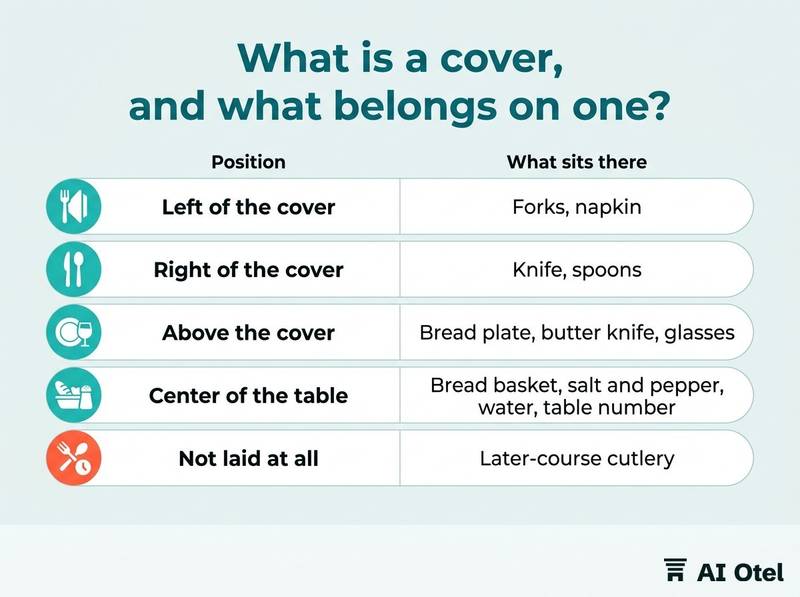
Separate the two zones in writing. The cover belongs to one guest; the bread basket, salt and pepper, oil and vinegar, water bottle and table number belong to the table. Choose a spacing and write it down, for example about 60 cm of table edge per cover, then check it against your widest plate and your chair width.
Left of the cover go the forks, and the napkin either left of the forks or on the plate for a set menu; pick one and never mix the two in the same room. Right of the cover go the knife with its blade toward the plate, spoons to its right, and the glasses above the knife tip. Above the cover go the bread plate with its knife, and the glasses; nothing else, or the guest starts moving things before sitting down.
Never on a cover: a chipped item, a smudged glass, an ashtray that has been used, a menu lying flat where the plate goes, or cutlery for a later course folded into the napkin.
| Position | What sits there | House rule to write down |
|---|---|---|
| Left of the cover | Forks, napkin | Napkin left of the forks, or on the plate for set menus; one rule per outlet |
| Right of the cover | Knife, spoons | Blade toward the plate, spoons right of the knife |
| Above the cover | Bread plate, butter knife, glasses | Glasses above the knife tip; nothing else |
| Center of the table | Bread basket, salt and pepper, water, table number | Shared items, spaced for service access |
| Not laid at all | Later-course cutlery | Omitted if you lay progressively; brought with the plate |
What goes on a breakfast table before the first guest arrives?
Breakfast carries the lightest cover of the day: a cup and saucer, a teaspoon, a napkin, salt and pepper, and nothing the buffet already provides.
Treat the breakfast table as a landing place, not a full setting. Every extra item is another thing to polish, replace and lose between seatings. Choose cup and saucer or mug once per outlet, and state the saucer rule; a cup set straight on a bare table leaves a ring the next guest will see.
The juice glass goes on the table or at the buffet station, not both. If it is on the table, it is removed and replaced, never refilled at the guest's place. Sugar, sweetener and stirrers live in a clean holder on the table, or at the buffet; doubling up wastes stock and clutters the cover. Egg cup, side plate and butter knife appear only if the menu calls for them, and the card says so, otherwise they migrate onto every table by habit.
Write the peak reset rhythm into the same page: what a server carries on one tray so a vacated table is ready in a single trip. State what is cleared the moment a guest leaves and what stays, so the room does not drift between full and half set as the morning goes on. For the other half of the breakfast room, see setting up a hotel breakfast buffet that holds at peak.
ChecklistBreakfast cover, before doors open
- Cup and saucer clean and matched
- Teaspoon polished, bowl up
- Napkin folded to the house shape
- Salt and pepper filled and wiped
- Juice glass placed or station checked
- Table number visible and facing the guest
- Chairs squared
- Condiment holder clean
- No item chipped or clouded
Lunch and dinner: which cutlery goes out, and what stays on the table?
Lay cutlery in the order the courses arrive, working from the outside in, and decide once whether later courses are laid at the start or brought with the plate.
There are two schools, and you make one choice. Full lay puts everything on the table before seating and suits set menus and small tables. Progressive lay brings each course's cutlery with the plate and keeps an à la carte table clear. What stays through the whole meal: the bread plate and its knife, the water glass, salt and pepper, the table number, and the napkin once unfolded. What arrives with a course and leaves with it: soup spoon, fish knife and fork, steak knife, dessert cutlery, side salad fork.
Dessert cutlery goes above the cover, or arrives on the plate; choose one, because a room that does both is the thing guests notice. Write the clearing rule down too, so one server does not lift a plate while another guest at the table is still eating. The menu has a place in the standard as well: a menu lying where the plate goes means the guest moves it and the table stops matching the card.
Wine service decides the dinner cover. Where wine is poured, the wine glass belongs on the table; where it is not, an empty wine glass promises something the room cannot deliver.
| Course | Added to the cover | Removed after |
|---|---|---|
| Bread | Bread plate and knife | Stays all meal |
| Starter or soup | Soup spoon, or starter fork and knife | With the plate |
| Fish | Fish knife and fork | With the plate |
| Main | Steak knife where the menu calls for it | With the plate |
| Dessert | Dessert cutlery, above the cover or on the plate | With the plate |
| Coffee | Cup, saucer, teaspoon | After the guest finishes |
Which glass goes where: water, wine and juice?
One water glass sits above the knife at every meal; a wine glass is added only where wine is served, and a juice glass belongs to breakfast.
Place glasses above and to the right of the knife tip, and fix the order in the standard, for example smallest nearest the guest, so the team stops improvising. Count the cost of each extra glass: polishing time, breakage, shelf space, and table space taken from the plate. Three is usually the practical ceiling for an à la carte cover.
Read the signal the glass sends. A wine glass on a breakfast table, or a juice glass at dinner, tells the guest the room was set by habit rather than by the meal. Polish and inspect at the pass: hold by the stem or the base, check the rim against the light, and never move a glass from one table to another. Pull chipped or clouded glass from service the moment it is seen, and keep a breakage note, or the same glass returns at the next shift. Water bottles and jugs are shared items: they sit in the center and are refilled according to the house rule, not left in a guest's cover.
Watch outA chipped rim is the one fault a guest finds with their lip
Remove the glass from the shelf the moment it is seen, record it, and never let it travel back into service on a busy night.
What should a table card or notice say, and in which languages?
A table card carries only what the guest needs at that seat: the table number, the meal period, and any notice that applies to the food or the room. Two languages is the working minimum, and the pair is a decision, not an accident.
Choose the language pair from your actual guest mix, not from habit. Turkish and English covers most rooms; add a third only where a market justifies the printing and the proofreading. Write short sentences and avoid idiom, because a translated idiom reads as a mistake even when the meaning survives. Set a readable size and contrast for restaurant lighting, which is dimmer than an office and warmer than a corridor.
Keep the card flat and clean; a laminated card with a curled corner is worse than no card at all. Allergen and dietary notices belong on the menu or a separate card, not squeezed under the table number where nobody reads them. Match the rest of the building: the same symbols, wording and typeface as the pool, lift and room-directory signs, so a guest learns your language once; the same logic governs signs in several languages across the hotel. Give the card a fixed position at the edge of the cover, never where the plate goes.
TipThe read-aloud test
Write the card, then read it aloud in both languages to someone who did not write it. If a sentence needs a second reading, shorten it before it goes to print.
What does the ninety-second check before opening look like?
One person walks every table in a fixed order with a cloth and a spare napkin, and passes or fails each cover against the card.
The captain on duty walks it, not the person who laid the tables; that layer of separation is the whole point of the check. Fix the route, the same direction every service, so nothing at the back of the room is skipped and the walk becomes a habit rather than a decision. Name what fails a table: a missing item, a smudge on a rim, a chipped glass, a napkin off its shape, a card facing the wrong way, a chair out of square.
Fix on the spot and log after service. A short note or a photograph per failure, reviewed once a week, turns the check into a training list. Time your own room once, then set the target so the walk fits comfortably inside the minutes before doors open. Keep the walk and the reset separate in the standard, so a busy service does not quietly replace the pre-opening check.
ChecklistThe ninety-second walk
- Start at the door and work clockwise
- Count items against the card
- Check every rim against the light
- Square every chair
- Check the card faces the guest
- Carry one spare napkin and one clean cloth
- Note every failure with its table number
Resetting between guests
A full reset happens once the guest has left and the table is re-laid; a touch reset happens between courses. Always replace the napkin and any glass that has been used, and wipe with a cloth that is dry enough not to smear.
What to do next
Write one page per meal period this week: photograph a correct cover, list every item with its position, and hand the page to the captain who walks the room. The standard, the card and the check are one loop, and each of them is useless without the other two. If you want the same discipline carried into software, a hotel operating system, built and working ahead of launch, keeps the day's reports and compliance records in one place, and a guest app, also built, can put offers in front of guests before they arrive.
Frequently asked questions
Should dessert cutlery be laid before the guest sits down?
It is a house choice, not a rule. Laying it above the cover speeds up service and suits set menus; bringing it with the dessert keeps a small table clear and looks more deliberate. Choose one for the whole outlet, write it on the card, and train it, because a room that does both is what guests notice.
How many glasses should a restaurant table have?
One water glass on every cover, a wine glass only where wine is served, and a juice glass at breakfast. Every extra glass adds polishing time, breakage and space taken from the plate, so three is usually the practical ceiling for an à la carte cover.
Do the terrace and the pool bar need their own table setting standard?
They need their own page, not a list of exceptions. Wind, sun, and the choice between glass and unbreakable material change the cover, but the method is the same: photograph a correct table, list the items, fix the positions, and check before opening.
Who owns the table setting standard, and when is it revised?
The restaurant manager drafts it, the executive chef agrees on anything the kitchen touches, and the general manager signs it. Revise it at every menu change and whenever a new outlet opens, and put the version date on the card so the team knows which page is current.