Water-leak sensors in hotel rooms and plant rooms: where to place the first ten
Rank sensor positions by what sits below and beside the water, not by how often a pipe fails. This guide explains where to place the first ten sensors and who responds at night.
AI draft · awaiting editorial review

Contents
Key takeaways
- Rank sensor positions by what sits below and beside the water, not by how often a pipe fails.
- A sensor detects water; only a shutoff valve or a person closing the isolation valve stops it.
- An unsupervised battery sensor that has died looks exactly like a dry floor, so ask for a heartbeat and a low-battery report.
- The alarm must reach a person who is awake at 03:00, with a written response card for the first fifteen minutes.
- Test each sensor with water every month and record the result against the sensor's ID on one sheet.
A leak sensor is a small device that reports water on the floor, along a pipe run or at a tank level. Place the first ten water leak sensors in a hotel where water sits above a guest room, beside electrics, in the plant room, under the laundry and at tank and valve manifolds, then decide who receives the alarm at night.
The stain appears on the ceiling of room 214, but the water started two floors up, in a plant room nobody had opened since Friday. A leak sensor repairs nothing; it shortens the time between the water starting and a person standing in front of it. This article ranks the spots where a leak costs the most, says exactly where the device goes in each one, and gives you the night-time response route and the monthly test routine.
Where does a water leak cost a hotel the most?
Rank the spots by what sits below and beside the water, not by how often a pipe fails. A leak above a guest room removes a room from sale and a guest's confidence at the same moment; a leak in a plant room removes equipment.
Score each candidate spot on three costs: room-nights lost in the space below, equipment or electrical damage beside it, and the drying and repair time before the space is usable again. The highest rank goes to any wet area directly above a guest room ceiling: the bathroom stack, the shower trap, a washing machine inside a suite, and roof or terrace outlets above top-floor rooms.
The second rank is anything within a meter of an electrical distribution board, a lift machine room, a network cabinet or the fire alarm panel, where water turns a plumbing fault into a safety event. The third is continuously pressurized plant: booster sets, water tanks, calorifiers, heating and chilled water manifolds and water softeners, because these leak while nobody is drawing water. Fourth comes the laundry and kitchen, where hoses, dosing points, floor channels and grease lines run, and where a small leak becomes a slip hazard and a service shutdown. Fifth, the spaces nobody visits: closed floors in low season, storage rooms, basements and plant rooms entered once a week. In these, detection time matters more than leak size.
Keep one rule in view: a sensor is a detection device, not a repair. Its job is to buy the minutes between the leak starting and someone arriving with a valve key.
| Spot | What is below or beside it | Why it ranks here | First sensor goes |
|---|---|---|---|
| Guest bathroom above another guest room | Ceiling of the room below | Rank 1: room-nights and guest confidence | Puddle sensor at the low point; cable in the void if there is history |
| Top-floor terrace or roof outlet | Top-floor ceilings | Rank 1: rainwater reaches guests directly | Cable sensor in the void |
| Tank and booster set room | Electrical panels and the floor below | Rank 2: leaks while nobody draws water | High-level float plus puddle sensor in the bund |
| Electrical or network cabinet room | The equipment itself | Rank 2: water becomes a safety event | Puddle sensor on the floor, never inside the cabinet |
| Laundry | Floor channel and the room below | Rank 3: hoses fail more than drums | Puddle sensors behind each washer |
| Kitchen wash-up and dishwash | Grease trap and kitchen floor | Rank 3: a grease leak is a closure | Puddle sensor under the sinks and at the trap |
| Basement storage | Stored goods and structure | Rank 4: nobody visits for days | Puddle sensor at the low point and at the sump |
What kinds of leak sensor are there, in plain words?
Three families cover a hotel: a puddle sensor that sits on the floor, a cable that detects water anywhere along its length, and a level or flow device that watches a tank or a pipe. A shutoff valve is the fourth part, and it is the one that acts.
A puddle sensor, also called a point sensor, closes a circuit when water bridges two contacts. It is cheap and local, and it only works if water actually reaches it, so it goes at the lowest point of the floor rather than in the middle of the room. A cable or rope sensor detects water at any point along its length; it suits pipe runs, risers and ceiling voids, and it must be laid where water will run and collect, not stapled flat against a ceiling slab.
A high-level float or switch inside a tank alarms before the tank overflows. It is independent of any floor sensor and belongs on the tank, not on the floor beneath it. Flow monitoring watches water moving when nothing should be drawing it, and can catch a burst inside a wall that never reaches a floor; it needs a baseline of normal consumption to be useful, so treat it as a second stage, not a first purchase.
A motorized shutoff valve turns an alarm into an action. A sensor on its own only reports; the valve, or a person with a valve key, is what stops the water.
Check the signal a sensor offers. A dry contact, meaning a plain relay output, lets it talk to a building management system (BMS) or an alarm panel; ask for a normally closed contact so that a cut cable reads as an alarm rather than as a dry floor. Ask also what the device reports about itself: a heartbeat message, a low-battery warning and a tamper signal should arrive in the same place as the alarm. For how the alarm text and the work order connect to the rest of the building's records, see closing a maintenance work order from report to repair.
NoteThe silent failure
An unsupervised battery sensor that has died looks exactly like a dry floor. Before ordering, ask whether the device sends a regular heartbeat and a low-battery warning, and write the battery change date on a label on the device itself.
Where exactly does the sensor go in a guest bathroom?
At the lowest point of the floor, beside the likely source, and outside the splash zone. In practice that means under the basin trap, beside the toilet inlet, at the shower threshold and inside the access panel for the mixer.
Find the low point first. Water runs to the door threshold or the floor drain, so pour a glass of water on the floor during the installation visit and watch where it settles before fixing anything. Under the basin, the flexible connector and the trap are the usual sources, so the sensor goes under the trap and not behind the pedestal where a mop cannot reach it. At the toilet, place it beside the inlet connector and the flush valve access, where a slow seep shows up first. At the shower, place it on the floor at the tray edge and inside the inspection hatch for the mixer; a sensor inside the shower tray itself will alarm on every use.
Keep it out of the splash zone and away from the floor drain where cleaning water collects. Condensation and mopping produce nuisance alarms, and nuisance alarms train staff to ignore the system. Fix the sensor down with a bracket or screws and mark its position on the floor plan: a device a cleaner can push into a corner with a mop stops doing its job within a month. If water can reach a socket, a light fitting or a heated towel rail circuit, treat it as an electrical event as well as a plumbing one and follow your power isolation procedure, along the lines of a power cut procedure for the first hour.
ChecklistPer-bathroom installation checklist
- Position confirmed with a poured glass of water
- Sensor fixed to the floor with a bracket
- Sensor ID label written on the device and on the floor plan
- Alarm text names the room number, not a zone code
- Tested with a damp cloth and the alarm seen at the receiving device
- Housekeeping supervisor told not to move or mop over it
- Access hatch key kept at the front desk
Plant room, laundry and kitchen: where do the sensors go?
At the machines and tanks that hold water under pressure, at the lowest point of the room, and in the ceiling void above the space that would be damaged. These are the rooms where a leak runs for hours before anyone notices.
In the tank room, fit a high-level float on the tank plus a puddle sensor in the bund or at the floor low point; pump seals and flexible connectors are the usual failure, and they fail while the room is empty. At the calorifier and heat exchanger, place sensors at the relief valve discharge and at the floor drain, because a discharge is a leak signal even when someone has decided it is normal. In the laundry, put a puddle sensor behind and under each washer, at the detergent dosing point and in the floor channel; hoses and valves fail more often than drums, and a laundry leak usually runs into the room below.
In the kitchen, cover the dishwash and wash-up sinks, the grease trap and the ice machine. A grease line leak is a closure, not just a puddle, and it needs a different response from a clean water leak. Run a cable sensor above suspended ceilings in kitchens and laundries, where the leak starts in the void and appears as a stain in the room below. In network and server rooms, put a puddle sensor on the room floor, never inside the cabinet, and keep the water detection wiring away from the cabinet's own power feed, following the network cabinet and small server room checks. In cold rooms and chiller cabinets, defrost drains and door heaters produce water by design, so place the sensor where defrost water should not reach and confirm the difference before you alarm on it.
| Area | Sensor type | Exact position | What it protects |
|---|---|---|---|
| Tank room | High-level float plus puddle sensor | On the tank and in the bund | The floor below |
| Booster set | Puddle sensor | At the pump base and the flexible connector | The electrical panel beside it |
| Calorifier | Puddle sensor | At the relief discharge and the floor drain | The plant room floor and the store below |
| Laundry | Puddle sensors | Behind each washer and in the floor channel | The room below and the linen stock |
| Kitchen wash-up | Puddle sensor | Under the sinks and at the grease trap | The dining room ceiling |
| Ceiling void above kitchen | Cable sensor | Along the pipe run in the void | The ceiling and the guests beneath |
| Network room | Puddle sensor | Room floor at the low point | The network cabinet |
Who gets the alarm at 03:00, and what happens in the first fifteen minutes?
Name one role, one backup and one phone number per shift, and write a response card the night auditor can follow without waking anyone. An alarm that lands in a manager's email at 03:00 is not an alarm.
Route the alarm to where a person is awake: the night auditor's desk or the security post, with a sounder in the back office as well as a message on the duty phone. Test the route with the phone on silent, because that is how it will be at night; a push notification nobody hears is the same as no sensor.
In the first fifteen minutes, read the zone from the alarm text, go and look, do not switch on lights in a wet ceiling, close the nearest isolation valve, and protect the floor below with sheets and towels. Escalate by rule, not by judgment: technical service on call first, then the duty manager. A leak above a guest room is a room-move decision, so the front desk is part of the response, not a spectator.
Record the event: time of alarm, time the water stopped, rooms affected, photographs. Open a work order so the repair and the drying are tracked to closure rather than to a conversation. Give the front desk a short script for the guest, and do not promise a repair time before the cause is known. Let the person who responded reset the alarm and record why it fired; an alarm that nobody can reset gets muted, and a muted system is worse than none.
Key pointThe response card, five lines
Line 1: zone and room from the alarm text. Line 2: go and look, no light switches in a wet ceiling. Line 3: close the isolation valve shown on the plant room plan. Line 4: call technical service, then the duty manager. Line 5: record time, rooms, photos and open a work order.
How do you test the sensors every month?
Test each sensor with water, not with the test button alone, and write the result next to the sensor's ID on one sheet. A test that produces no record is a memory, and memories differ between shifts.
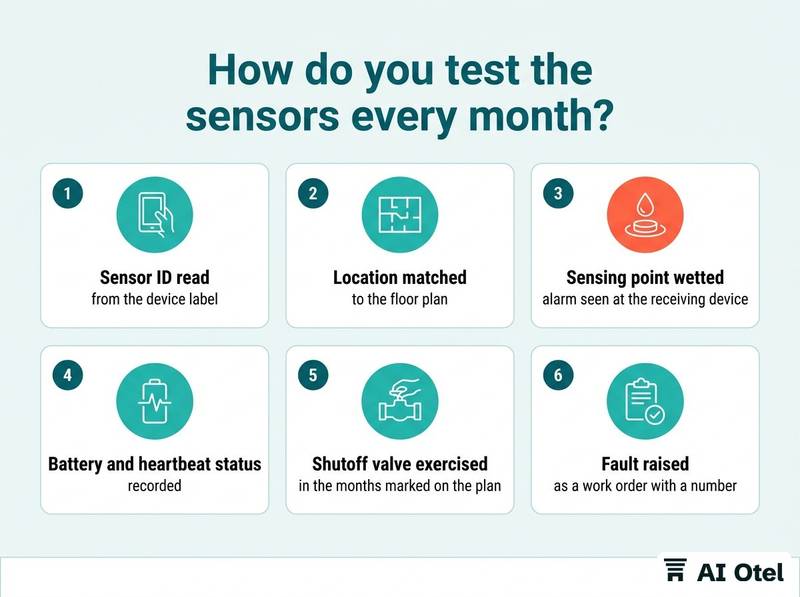
Monthly, wet the sensing point with a damp cloth or a small cup of water and confirm the alarm appears at the receiving device, not only at the sensor. Quarterly, read the battery status and the heartbeat on every wireless device, and replace batteries on a fixed cycle rather than when they fail. Twice a year, if a shutoff valve is fitted, close it and reopen it: a valve that has not moved for a year may not move on the night it matters.
Treat a failed sensor as a same-day work order, and add that spot to the manual night round until it is fixed. Fold the test into the hotel's preventive maintenance plan so it does not depend on one person remembering it. After any building or plumbing work, re-test the sensors in the affected area; a contractor may have moved one, painted over it or disconnected it.
ChecklistMonthly test sheet items
- Sensor ID read from the device label
- Location matched to the floor plan
- Sensing point wetted and alarm seen at the receiving device
- Battery and heartbeat status recorded
- Shutoff valve exercised in the months marked on the plan
- Fault raised as a work order with a number
- Tester's name and time
- Next test date written on the sheet
Wired or wireless, battery or mains: what do you check before buying?
Buy for the failure mode you can live with. A wired sensor usually fails visibly; a battery sensor fails silently unless it reports its own health.
Power comes as mains with battery backup, battery only, or powered over the network cable. Battery-only devices are the easiest to place and the hardest to keep alive across a large building. Test the radio signal at each of the ten chosen spots before ordering; plant rooms, basements and lift shafts are the worst places in any building.
Supervision matters more than brand: heartbeat, low-battery and tamper reports must arrive in the same place as the alarm, or the person on duty will never see them. Check the ingress protection rating for water and dust against the room, because a laundry or a shower area needs a tougher case than a dry riser cupboard. A sounder or a flashing light at the sensor helps the person standing in the corridor at night find the right spot. For integration, insist on a dry contact or an open protocol the hotel's BMS or alarm panel can read, and avoid a closed app that only one person's phone can see. Keep two spare sensors and a pack of the correct batteries on site, so a failed device is replaced the same day.
| Type | Power | Best for | Failure mode to plan for |
|---|---|---|---|
| Wired to an alarm panel | Mains, with the panel's backup | Plant rooms and risers | A cut cable, which reads as an alarm if the contact is normally closed |
| Wireless battery | Battery only | Guest bathrooms and retrofit | A dead battery that looks like a dry floor unless a heartbeat is configured |
| Wireless mains | Mains power | Laundry and kitchen walls near a socket | Loss of power after a trip, so check the circuit |
| Network-powered | Power over the network cable | Rooms with a network point | Loss of the network switch, so keep the sensor on the same backup as the network |
What to do next
Walk the building with the ranking table this week, mark ten spots on the floor plan, and write the response card before ordering anything. Placement and the night route decide whether a sensor helps; the device only reports what the placement lets it see. If you want the alarms, work orders and test records to live in one place with the rest of the hotel's operations, a hotel operating system that carries maintenance and compliance records in one system is worth a look, and a vendor's security and trust approach tells you how seriously it treats your building's data.
Frequently asked questions
Does a leak sensor stop the water?
No. A sensor reports; the water stops when a motorized shutoff valve closes or a person closes the isolation valve. If the hotel wants automatic shutoff, plan the valve and its location on the response card at the same time as the sensor, and exercise the valve twice a year.
How many leak sensors does a hotel need?
There is no useful rule per room. Start from the ten highest-cost spots in the ranking, add as budget allows, and count by risk rather than by room count. A hotel with a history of ceiling damage will place its first ten water leak sensors differently from a new building.
Will steam, cleaning water or a wet floor cause false alarms?
Yes, if the sensor sits in the shower splash zone or beside the floor drain where cleaning water collects. Move it to the low point away from splash, and treat repeated alarms as a placement fault to fix rather than a device to mute.
Can the alarm go to a mobile phone instead of a panel?
It can, and it often does, but a phone on silent at 03:00 is not a response route. Send the alarm to the duty phone and to a sounder where a person is present, test the route with the phone on silent, and keep a named backup for every shift.