Which languages should the hotel website have first? A choice from your own guest mix
Select hotel website languages based on your actual guest mix, not national rankings. Ensure you can answer inquiries and keep every version current before publishing.
AI draft · awaiting editorial review
Contents
Key takeaways
- A language version is a page set, not a button: prices, policies, the booking path and the confirmation email all have to exist in that language.
- Rank candidate languages by their share of your own bookings and inquiries, not by a national list of source markets.
- A language you cannot answer an inquiry in is a promise the hotel breaks at the first complaint.
- Every language needs one named owner and a review date, or it goes stale in the season it was added for.
- Türkiye's largest source markets in 2025 were Russia (6,903,981), Germany (6,745,190) and the UK (4,270,036), according to the Ministry of Culture and Tourism's 2025 border statistics, but a single hotel's mix rarely matches the national list.
Choose the languages where your own bookings and inquiries actually come from, then keep only the ones you can answer in and keep current. A language version is a full set of pages with its own prices, policies and booking path, marked so search engines can tell the versions apart. Two correct languages beat six stale ones.
A hotel adds Russian because a competitor has it, then discovers in August that nobody on the desk can answer a Russian cancellation request. The language was never the problem. The missing owner was. This article gives you a way to decide hotel website languages from your own data: how many to have, which ones first, who keeps them current, how to mark them for search engines, and how to test the booking path in each one.
How many languages should a hotel website have?
As many as the hotel can keep correct in the same season it sells them. Each language is a full page set with its own prices, policies and booking path, so the count is a maintenance decision before it is a marketing one.
Define the unit first. A language version means every page a guest needs, in that language, at its own stable address, showing the same prices and the same policy text as the original. It is not a flag icon that machine-translates the page on the fly.
Then list what has to be kept right, not just written once: rates and offers, availability, cancellation and deposit terms, seasonal closures, restaurant and spa hours, contact details, the booking engine's own interface, the confirmation email and the pre-arrival message. A version that was correct on launch day and untouched since is a liability by mid-season.
Apply three tests in order: the share of bookings and inquiries the language carries, whether the team can answer in it, and whether someone can keep it current. A language must pass all three. The third is the hardest of the three to keep. Weigh the cost of a stale version: a guest reads a price or a rule that no longer applies, and the hotel either honors it or argues about it at the desk.
A normal starting point is the language of the majority of your guests, the language of your second market, and the language of domestic guests if you sell domestically. Two or three is a full workload. Set one rule before anything is published: no language goes live without a named owner and a review date.
Key pointCount, capacity, maintenance
A language that fails any one of the three tests is not a language version; it is a page the hotel will have to correct under pressure. Cut it before the season, not during it.
Which languages should your hotel website have first? Count your own guest mix
Start from the languages your guests actually booked and wrote in over the last twelve months, not from a national ranking of source markets.
Count in two separate columns: bookings, room nights and revenue by the language the booking was made in, and inquiries by the language the guest wrote in. The two counts answer different questions and should not be merged. The inquiry column tells you what guests want to use; the booking column tells you what your current path actually produces.
Nationality is not language. A passport says where someone is from, not what they read, so record the language of the interaction as its own field rather than inferring it from the country. Use twelve months, not one season: a winter market and a summer market can differ, and a single month overweights whoever happens to be in-house.
Group the small languages. If four languages each carry a handful of bookings, one strong English version plus a fast inquiry response may serve those guests better than four thin page sets. Look for the language that appears in inquiries but not in bookings: it usually means the guest could not complete the booking path, not that they were not interested.
Use the national picture only as a sanity check. Türkiye's largest source markets in 2025 were Russia (6,903,981), Germany (6,745,190) and the UK (4,270,036), according to the Ministry of Culture and Tourism's 2025 border statistics (opens in a new tab). Your own list is the one that decides. Public data, no endorsement implied.
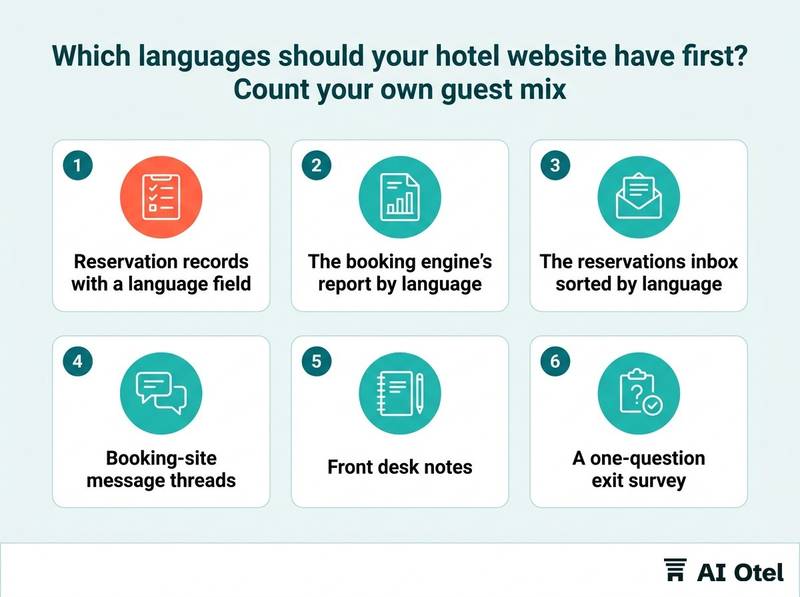
ChecklistWhere to find the count
- Reservation records with a language field
- The booking engine's report by language
- The reservations inbox sorted by the language of the message
- Booking-site message threads
- Front desk notes from the last high season
- A one-question exit survey asking which language the guest preferred
Can you answer in that language?
A language version invites contact in that language, so the test is whether someone can answer an inquiry, a change request and a complaint in it, at the hours guests write.
Name the moments that matter: a rate question before booking, a change or cancellation, a complaint during the stay, a request that arrives at two in the morning. Reading is easier than writing. Machine translation can help staff understand an incoming message; it is a poor substitute for a written answer to a complaint or a refund request.
Partial coverage is a legitimate choice when it is stated: email only, answered within one working day, with the telephone line in one language. Silence is not a coverage plan. Name people, not departments: two staff and a backup, with the languages each covers, written down and visible to the front desk.
If nobody can answer, the honest option is one strong language plus a clear statement of which languages you answer in. A guest who is told the truth will write in English; a guest who is ignored will write a review. Separate the guest-facing language plan from the website language plan: they overlap, but the service plan is what makes the website version credible. For the wider service side, see a language plan for your guest mix.
Who keeps each language version current?
One named person per language, with a review date, is the arrangement that holds through a busy season.
Name two roles. An owner of the source text decides what is true. An owner per language makes each version say it. Without the first, every translator invents a different truth. Set the order of work: the source changes first, then each language follows within a stated number of days. A version that lags by a month is a version that quotes last month's price.
Keep a change log: what changed, in which languages, on what date, by whom. A shared sheet is enough; the point is that the question "is the German page current?" has an answer. Check the least-read language as often as the most-read one. The version nobody reads is the one that goes stale unnoticed, and it is still indexed and still quoted to a guest.
Tie reviews to the season: once before the season opens, once mid-season, once at the end. Add a review whenever a facility closes, a renovation is scheduled or the rate structure changes. If the hotel cannot staff an owner for a language, cut the language. A missing version costs an inquiry; a wrong version costs an argument.
| What changes | Where it appears | Who confirms each language |
|---|---|---|
| Rates and offers | Rate pages, booking engine, offers page | Language owner, after source owner |
| Cancellation and deposit terms | Policy page, booking engine, confirmation email | Language owner, with a second check |
| Facility closures and renovation dates | Home page, facilities page, pre-arrival message | Language owner |
| Restaurant and spa hours | Facilities page, guest information | Language owner |
| Contact details and directions | Contact page, confirmation email | Language owner |
| Charges shown on the bill | Rates page, policies, confirmation email | Language owner, with a second check |
Which pages should be translated first, and who checks them?
Translate the pages a guest needs in order to decide and to pay, in that order, and put a human check on anything that carries a price, a date or a rule.
Order the work: home, rooms, rates and booking, location and contact, policies. Then facilities, food and drink, spa and activities. Offers, blog and long descriptions come last. Publish language by language rather than page by page across all languages: a complete small version is usable, a half-translated large one is not.
Use machine translation with a human check, page by page. The machine produces a draft, a person who reads the language checks it against the source, and only the checked version is published. Define what the check must cover: prices, dates, cancellation and deposit rules, the names of rooms and facilities, safety information and anything with legal weight. The mechanics of this are covered in detail in translating a hotel website with AI: which pages, who checks and how to publish.
Simplify the source before translating. Short sentences, one term per concept and no idioms produce a version that is both cheaper to check and easier to read. Keep one source per text: the same paragraph written twice in the original becomes two different paragraphs in five languages.
Watch outA translated price is a price
If the German page shows a rate the English page does not, the guest will hold the hotel to the one they read. Check prices on every version, every time the source changes.
How do you mark language versions so search engines show the right one?
Each language version gets its own stable address, and each page carries a small tag, called hreflang, that lists its siblings in the other languages.
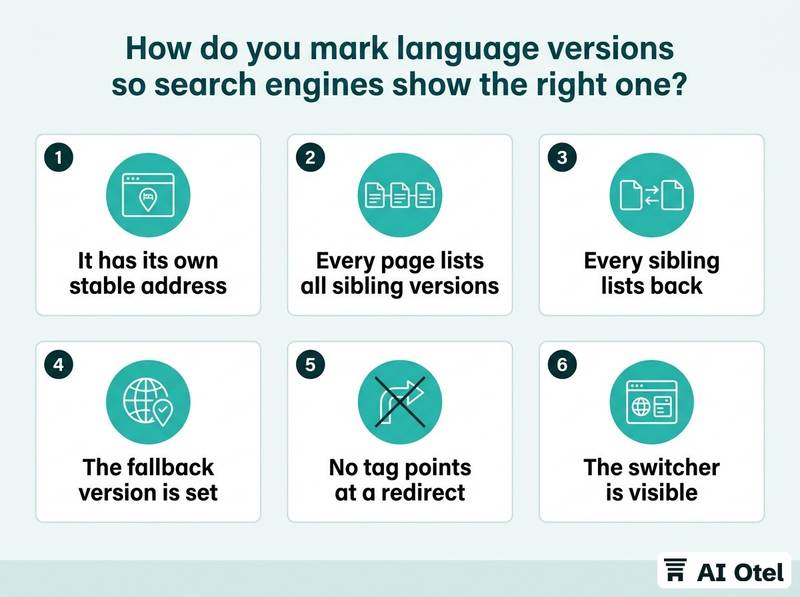
Give every language one address that does not change with the visitor, such as a folder per language or a subdomain. What matters is that the address is the same for a guest and for a search engine. The tag lists every version of that page, including the page itself, and each version must list the others back. One-way marking is ignored.
Set a fallback version, called x-default, for searchers whose language you do not publish: usually English or Turkish. Split by region only when the content really differs, for example a German version and an Austrian version with different offers or currencies. Otherwise one German version is enough.
Never point the tag at a redirect, a missing page or a page that is not the translation of that page. Each version should also declare itself the original of its own language rather than pointing everything at the English page. Be exact about what marking does: it tells a search engine which pages are the same page in other languages. It does not add pages, and it is not a way to rank for new words.
Keep the language switcher visible on every page, so a guest who lands in the wrong language can change it in one click instead of leaving.
ChecklistBefore you publish a new language version
- It has its own stable address
- Every page lists all sibling versions, including itself
- Every sibling lists back
- The fallback version is set
- No tag points at a redirect or a missing page
- The switcher is visible on every page
- The booking path has been tested in that language
Does the booking path work in every language?
The language version is finished only when a guest can search, book, pay, receive a confirmation and cancel in that language.
Test it as a guest would: pick dates, choose a room and rate, add an extra, reach the payment page, open the confirmation email, follow the cancellation link, read the pre-arrival message. Check the booking engine's own language list before promising anything. It is often shorter than the website's, and the gap appears exactly at the moment the guest decides.
Treat the confirmation email as part of the website. It is the document the guest keeps and forwards, and an English-only confirmation after a German booking reads as a half-finished job. Check the payment page separately: it may be supplied by a bank or a payment provider and may not follow the site's language.
Watch the cancellation and change path. A guest who cannot find how to cancel in their language calls, and the call costs more than the page would have. For the wider picture on direct bookings, see how to increase direct bookings on your hotel website.
Review the language list each season
Review the list each season: a new source market, a language that fell below the threshold, a change of staff, a new booking engine. Add or cut one language at a time, so the change can be checked before the next one starts.
What to do next
Pull twelve months of bookings and inquiries by language, apply the three tests, and settle the list before the season opens: keep the languages you can answer in and keep current, cut the rest, then mark each version and walk the booking path in every one. The order matters more than the number: count first, capacity second, maintenance third, and only then the technical marking.
Frequently asked questions
Should our hotel website redirect visitors based on their browser language?
A redirect can be convenient but must never trap a guest. Keep a visible language switcher and a stable address for every version, and make sure every version can be reached without a redirect. A guest who wants the English page while browsing from Germany should be able to get it in one click.
Is machine translation acceptable for a hotel website?
It is acceptable as a draft, page by page, with a named human check on anything carrying a price, a date, a rule or legal weight. It is not acceptable unchecked for cancellation terms, deposit rules or safety information, where a wrong word becomes a dispute at the desk.
Does adding more languages improve our search visibility?
Marking language versions tells a search engine which pages are the same page in other languages, so the right version can be shown to the right searcher. It does not create new content or new topics, and every added language is a page set that has to be kept correct.
Our guests hold German passports but book in English. Which language counts?
Count the language of the booking and the language of the inquiry separately. The inquiry language tells you what to answer in and what the website must serve. The booking language tells you what the booking engine actually produced, which may reflect its own limits rather than the guest's preference.
How often should we add a new language?
One at a time, and only when the count, capacity and maintenance tests all pass. Adding a language mid-season means nobody has time to check it. The natural moment is before the season opens, with a named owner and a review date already agreed.