Writing an apology to a guest: the message, the gesture and the record
A hotel apology message to a guest needs four lines: the event, the action taken, the gesture, and the follow-up. Learn how to write it, size the offer, and record the case so the next shift sees it.
AI draft · awaiting editorial review
Contents
Key takeaways
- A hotel apology carries four lines: what happened, what has been done, what is offered, and when the guest hears from you again.
- The gesture is sized by the disruption the guest actually had, and the approval ladder is written down before the shift needs it.
- An apology describes the event and the hotel's part in it; the cause belongs in the internal record unless the guest asks.
- A promise the next shift cannot keep costs more than the original fault.
- The record is what turns one apology into a fix the hotel can see, and the reason a second apology is not needed.
A hotel apology message to a guest has four lines: what happened, in the guest's own terms; what the hotel has already done; one gesture it can deliver now; and when the guest will hear from you again. Keep it to a few sentences, sign it with a name, and record it where the next shift looks.
It is 23:40, the guest has been traveling since morning, and the room is not ready. What the desk says in the next ninety seconds, and what someone writes down afterwards, decide whether the hotel hears about this once or for months. This article gives you the four-line structure for the message itself, a way to size and approve the gesture, three worked examples with tone notes, and a record format the next shift can actually use.
What should a hotel apology message contain?
Four lines and nothing else: what happened, what the hotel has already done, what it offers, and when the guest will hear from you again. Everything else is padding that weakens the four.
Line one names the event in the guest's terms, with a time and a place: the room was not ready at 23:40 on the arrival date, not "a service shortfall occurred". Line two states an action already taken, in the past tense, with the person or team who took it: the room was changed, the engineer attended, the charge was reversed. Line three offers one gesture the hotel can deliver before the guest leaves, in a single sentence, with no condition attached to it. Line four gives a name, a channel and a time for the follow-up, and the hotel keeps that time even if there is nothing new to say.
Length follows the channel, not the guilt: three to six sentences for a message, one page for a letter. The four lines are a spine, not a form to fill in. If the conversation at the desk will be hard, write the four lines first and then say them out loud, so the spoken and written versions do not contradict each other.
A guest who is angry mostly wants to know that the hotel understood the specific thing that went wrong. A general apology reads as a template and invites a second complaint. The same routine belongs inside a broader recovery routine for guest complaints at the front desk.
ChecklistCheck the four lines before sending
- Does the first line name the event with a time and a place?
- Does the second line describe something already done, in the past tense?
- Is the gesture one thing, deliverable today, with no condition?
- Does the last line carry a name, a channel and a date?
- Is the whole message shorter than the reader's patience?
- Would you be willing to read it aloud to the guest at the desk?
How do you name the problem without making excuses?
Describe the event and the hotel's part in it, and keep the cause for the internal record unless the guest asks for it. An explanation offered before the guest feels heard reads as an excuse.
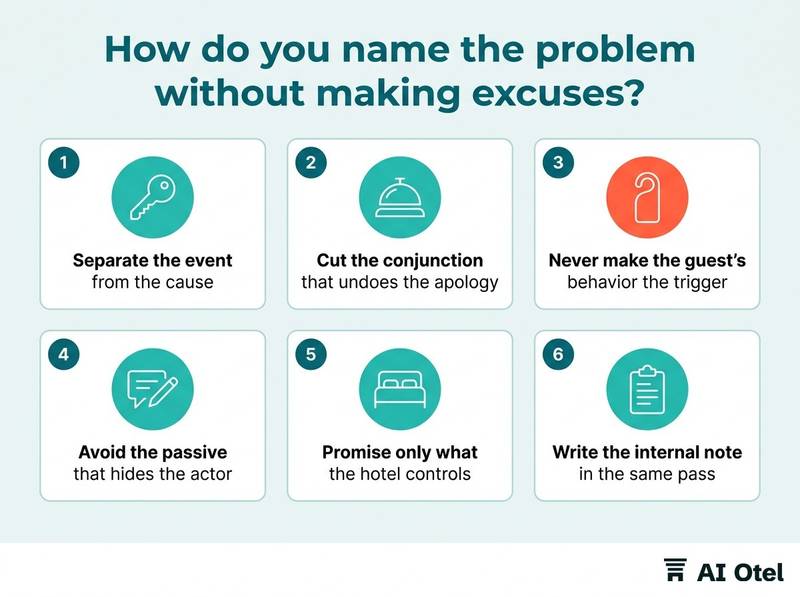
Separate the event from the cause. The guest wants the event acknowledged; the cause is usually a staffing, maintenance or process detail that belongs in the case record. Cut the conjunction that undoes the apology: a "but", a "however" or an "unfortunately" placed after "I am sorry" turns the sentence back onto the guest.
Never make the guest's behavior the trigger. If the guest's own action genuinely mattered, state it as a neutral fact or leave it out; the message is not the place to win the point. Avoid the passive that hides the actor: "the room was not ready" works because the room is the subject, while "mistakes were made" hides who made them and sounds like a press release.
Promise only what the hotel controls. "This will never happen again" is a promise the next shift cannot keep; "the engineer has checked every room on the floor" is a fact the guest can verify. Stay inside the hotel's own liability policy: an apology for the experience is not the same as an admission of a legal claim, and how far the wording may go beyond the experience is set by the hotel's own rule, with anything past that a question for its legal adviser. Write the internal note in the same pass, while the sequence is fresh, so the guest's version and the hotel's version describe the same event.
Watch outPhrases to delete, and what to put in their place
"Unfortunately, a situation occurred" becomes "The room was not ready at 23:40". "If you had told us earlier" becomes "We did not check the room before your arrival". "Mistakes were made" becomes "The housekeeping team assigned the room twice". "We will take the necessary steps" becomes "The floor supervisor now checks arrivals at 18:00". "This will never happen again" becomes "The room was taken out of sale until the engineer signed it off".
Which gesture fits the problem, and who may approve it?
Match the gesture to the disruption the guest actually had, and give the approval to the role that is on shift when the guest is. A gesture the desk cannot approve until Monday is not a gesture.
Size by time lost and by what the guest came for. A sleepless night, a missed meal, a spoiled occasion and a billing error are four different problems with four different answers. Prefer what the hotel can deliver tonight: a room move, a late checkout, a table held at a set time, a transfer, a written note from the manager on duty.
Write the approval ladder down before the shift needs it: what the front desk may offer without asking, what needs the duty manager, what needs the general manager. The ladder is the hotel's own rule, not a legal threshold. A gesture with a condition is not a gesture: "if you stay with us again" moves the cost to the guest's next decision and reads as a sales offer. Do not reach for cash at the desk as a reflex; a waived charge, a discount on the bill and a future stay are different instruments with different records and different effects on how the guest reads the apology.
Record the gesture at the moment it is given, with the name of the person who approved it. An unrecorded gesture becomes an untraceable cost and an unrepeatable decision. If the guest refuses the gesture, record the refusal: it matters more than the offer when the case is reviewed later. Over a month, these gestures should show up as a number, the way allowances, upgrades and comps are tracked as a monthly figure.
| What went wrong | Gesture that fits | Who may approve | What to record |
|---|---|---|---|
| Room not ready at arrival | Room move plus late checkout | Duty manager | Time of the move, room numbers |
| Noise through the night | Move for remaining nights plus a manager's note | Duty manager | Noise source, action on the other room |
| Meal late or wrong | Dish remade, cover removed from the bill | Restaurant supervisor | Table, time, item removed |
| Billing error | Charge voided and reversed | Front office manager | Original entry, reversal reference |
| Occasion spoiled | Occasion repeated before departure | General manager | What was promised, who delivered it |
| Maintenance fault in the room | Fault fixed, room out of sale meanwhile | Duty manager | Fault, fix, sign-off |
In person, in a message, or in a letter?
Apologize in the channel where the guest is, at the first moment the hotel can do it properly. Put it in writing when the guest is no longer in the building or when the case needs a record that outlives the shift.
In person first when the guest is in-house. The conversation carries the tone; the written note carries the record. Doing only one of the two leaves half the job done. A message suits a guest who is out of the building, asleep or in a meeting: keep it short, name the sender, and send it from an address the guest can reply to. A letter suits an escalated case and a guest who has already left: one page, signed by the person who owns the decision, with a direct contact rather than a general address.
Set the hotel's own timing rule and publish it internally: an in-house complaint gets a spoken apology within the hour and a written follow-up before checkout; a complaint that arrives after departure gets an answer inside the window the hotel has chosen. Cases that arrive after the guest has gone have their own dynamics, covered in handling guest complaints that arrive after checkout.
Write in the guest's language only if someone on the team can write it natively. A machine-translated apology reads as one more thing the hotel did not do properly; English plus a spoken apology in the guest's language is the safer pair. If the hotel runs its own guest app, the message can sit next to the bill, so the guest finds it without opening an email. Never let a written apology arrive after the guest has already posted publicly: the order of events is part of what the guest is judging.
Three invented examples, with tone notes
The three below are invented to show the shape of the four lines, not to be copied word for word. Names, times and details are placeholders.
Example one, room not ready at a late arrival: "Your room was not ready when you arrived at 23:40, and you had been traveling since morning. We have moved you to a room on the same floor and the luggage is already there. We have extended your checkout to 14:00 on your departure day. I am on duty until 08:00 and will check with you at breakfast. Selin, duty manager." The time, the move and the extension are facts; the offer comes before the apology is asked for. What not to write: "Unfortunately, due to high occupancy, your room was delayed." That sentence blames the hotel's own success and gives the guest nothing to hold.
Example two, noise through the night from a terrace event: "The music from the terrace was audible in your room until 01:20, and you told us at 07:00 that you had not slept. We have moved the remaining event to the indoor saloon and the terrace is closed after 23:00 for the rest of your stay. We have held a quiet room on the top floor for your next two nights if you prefer to move. I will come to your table at dinner. Emre, general manager." It does not blame the other guests or the events team, and it states what changed rather than what the hotel regrets. What not to write: "We apologize for any inconvenience caused by other guests." It shifts the fault to someone the hotel invited and removes the hotel from the sentence.
Example three, an unrecognized charge on the bill: "The minibar charge of the two items on your bill was entered against your room on the wrong date and belongs to the room next door. We have voided and reversed the entry and the corrected bill is at the desk for you. If anything else looks wrong, ask for me directly. Ayça, front office manager." There is no apology for "any confusion", which would apologize for the guest's reading rather than the hotel's error; the correction and its timing are stated. What not to write: "We are sorry you feel the charge is incorrect." It makes the guest's perception the problem and leaves the entry in place.
NoteAll three examples are invented for this article
The names, times, room details and charges are placeholders; the structure is the part worth copying.
Which words should you avoid?
Delete anything that blames the guest, hides who acted, or promises something the next shift cannot deliver. A calm, specific sentence reads as more sincere than a warm, vague one.
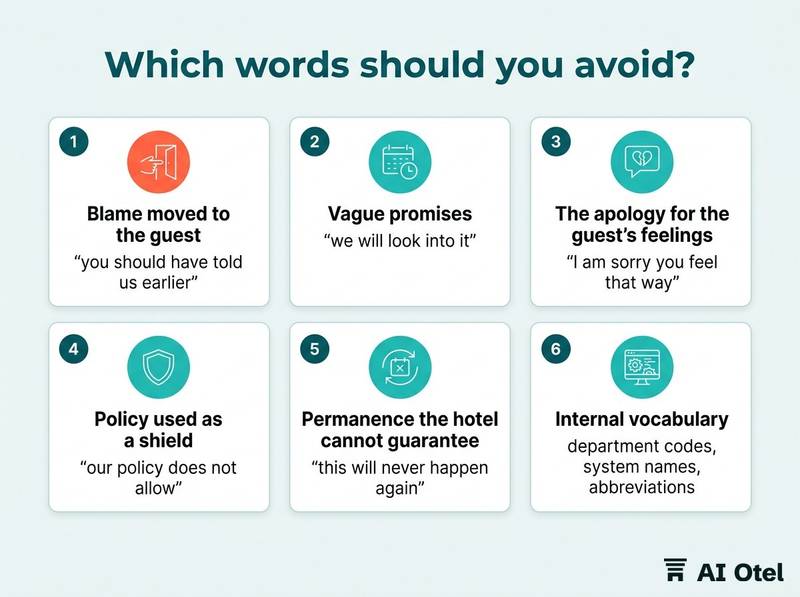
Blame moved to the guest: "if you had booked directly", "as you know", "you should have told us earlier". Each one asks the guest to accept part of the fault for the hotel's process. Vague promises: "we will look into it", "we will take the necessary steps", "your feedback is important to us". None of them tells the guest what will be different.
The apology for the guest's feelings, "I am sorry you feel that way", apologizes for the reaction and leaves the event untouched. Policy used as a shield, "our policy does not allow", with no alternative in the same sentence: state the limit and the alternative together, or do not raise the limit. Permanence the hotel cannot guarantee, "this will never happen again": say what was checked and by whom instead. Internal vocabulary, department codes, system names and abbreviations the guest has never seen: translate them into what happened in the room. And no superlatives, exclamation marks or stacked adjectives; they raise the temperature of a message that should lower it.
ChecklistRead the draft once and delete
- any sentence beginning with "but", "however" or "unfortunately" after the apology
- any reference to what the guest should have done
- any promise without a person and a date attached
- any internal system or department name
- any policy statement without an alternative beside it
- any exclamation mark
- any sentence you would not say to the guest's face
How do you record the case so the next shift sees it?
Write the case into the same system the next shift already opens, with the four lines, the gesture and the follow-up date, and close it only when the guest has been answered.
The fields are fixed: date and time of the event, the guest's room and stay dates, what happened in one sentence, what was done, what was offered, who approved it, who spoke to the guest, and the follow-up date. Put it where the next shift looks: the guest's own record in the hotel system, not a notebook at the desk and not a personal message thread on one person's phone. Hand over open cases by name at shift change, and have the incoming duty manager read them before the briefing ends, not after the first queue.
Follow-up is a task with a date, not a sentiment. The person who wrote the message closes it, and the closure records what the guest said. Take the recurring cases to the weekly meeting and to the monthly line for allowances, upgrades and comps, so the same fault shows up as a cost before it shows up as a review. If the guest writes publicly afterwards, the reply follows the same four lines: what happened, what was done, what is offered, and how to reach the hotel. The public reply is shorter, not different in substance; example replies by complaint type are collected in how to reply to hotel reviews.
Key pointThe record is not the apology
It is what makes the second apology unnecessary, because the next shift can see what was promised and by whom.
What to do next
Write the hotel's own four-line template and its approval ladder this week, then test both against the last three complaints the hotel handled. The four lines fix the message, the ladder fixes the gesture, and the record fixes the handover, so the next shift starts where this one finished instead of starting over.
If you are reading this as a traveler rather than a hotelier, you can use the same four lines to judge how a hotel responds when something goes wrong, and choose a hotel in Türkiye (opens in a new tab) with that standard in mind.
Frequently asked questions
How quickly should a hotel apologize after a complaint?
There is no single external deadline that fits every case, so the hotel sets its own and writes it down. A practical rule: a guest in the building gets a spoken apology within the hour and a written follow-up before checkout; a guest who has left gets an answer inside the window the hotel has chosen and published internally. The important part is that the stated time is kept even when there is nothing new to report.
Should an apology include a refund or a free night?
The gesture should match the disruption, and the hotel's own policy decides which instruments exist and who may approve them. A waived charge, a room move, a late checkout and a future stay are different tools with different records. The hotel apology message to a guest should offer only what the person writing it is authorized to give, and should never promise something that needs approval the guest will not see before departure.
Can a hotel apologize without admitting fault?
Yes, by apologizing for the experience and describing the event and the hotel's part in it, without characterizing it as a legal claim. How far the wording may go is set by the hotel's own liability policy, and anything beyond that belongs with its legal adviser. The apology and the internal record are separate documents with separate purposes.
Who should sign a written apology to a guest?
The person who owns the decision in the case. A routine in-house complaint is signed by the duty manager or guest relations; an escalated case, a spoiled occasion or a complaint from a guest who has already left is signed by the general manager. One name, one direct contact, and the same person closes the follow-up.
Should the apology be written in the guest's language?
Only if someone on the team can write it natively. A machine-translated apology adds a second failure to the first one. The safer pair is a short written message in English plus a spoken apology in the guest's language, delivered by whoever can manage it sincerely.