A 14-day menu cycle for the hotel staff canteen: planning, portions and variety
Turn daily improvisation into a structured 14-day rotation. This guide explains how to build the menu grid, set portions from your own recipes, and count eaters accurately by shift.
AI draft · awaiting editorial review
Contents
Key takeaways
- A cycle menu replaces daily improvisation with a fixed grid the kitchen can order, prep and cost before the week starts.
- Portion size comes from the kitchen's own standard recipe card and its yield, not from a national standard or a supplier's pack size.
- Count meals by shift and by roster, not by payroll headcount, or the kitchen cooks for people who are on their day off.
- Whether guest buffet food may be reused for staff meals is decided by the hotel's food safety plan, not by the chef on the day.
- One monthly review with three numbers and five written staff comments keeps the cycle honest without turning it into a survey project.
A 14-day menu cycle is a repeating two-week rotation in which each day's staff meal is built from fixed slots: soup, a main with protein, a vegetable or legume dish, a starch, salad, and fruit or dessert. The kitchen costs it once from its own recipes, then repeats it with seasonal quantity changes.
The staff meal is the one menu a hotel kitchen cooks every single day, and usually the one menu nobody plans. It starts as whatever the guest buffet leaves behind, ends as a complaint from the night shift, and rarely appears on a cost report at all. This article shows how to turn that improvisation into a 14-day hotel staff canteen menu cycle: how to build the grid, set portions from your own recipe cards, count eaters by shift, handle leftovers safely, and review the whole thing once a month in twenty minutes.
Why do hotel staff meals drift without a plan?
Because nobody owns the menu. The staff meal sits between the kitchen, human resources and purchasing, so it defaults to whatever the guest buffet leaves behind.
The ownership problem is structural. The executive chef owns the food, human resources owns the headcount and purchasing owns the order, so the staff menu is decided at ten in the morning by whoever happens to be free. The result is a leftover-driven menu: the same dish appears three days running, then disappears for a week, because it follows the guest buffet rather than the people eating it.
The night shift gets the worst of it. Food cooked for lunch service is held or reheated for people eating at two in the morning, and the kitchen plans for none of it. Cost is invisible too, because staff meals rarely sit on their own cost line, so nobody can say what a meal costs or compare one month with the next. Complaints arrive as corridor remarks rather than written notes, and purchasing reacts with same-morning orders instead of planning batches around yield.
If you want to understand who decides what in a hotel kitchen, from executive chef to commis, the staff meal is a good test case: it falls exactly in the gaps between roles.
NoteName one owner
Name one person, usually the executive chef or the chef de cuisine, as the owner of the staff menu, and write it into the job description. The owner signs the 14-day grid, signs the monthly review and answers for the cost per meal.
What is a 14-day cycle menu and how does the repeat rule work?
A cycle menu is a fixed rotation: the same 14 days repeat, so day 15 is day 1 again. Every day is filled from the same six slots, which makes variety structural rather than accidental.
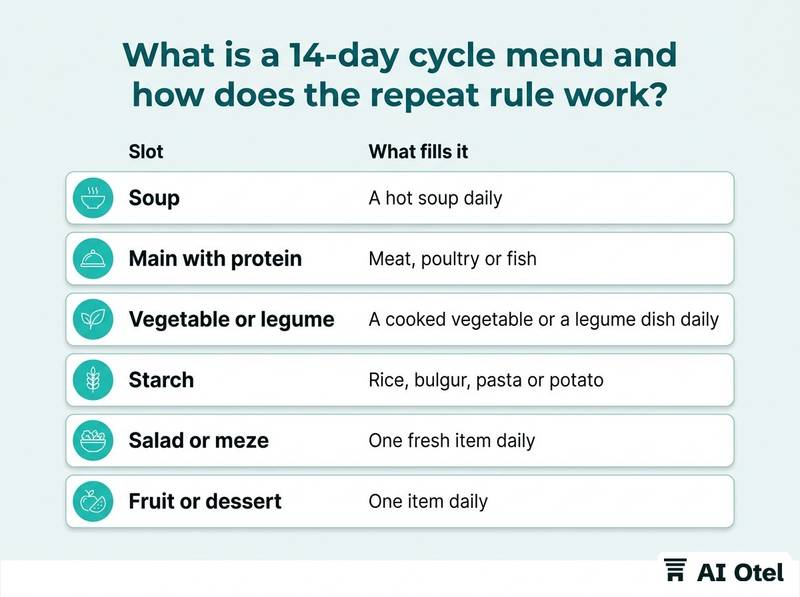
The six slots are soup, a main carrying the protein, a vegetable or legume dish, a starch (rice, bulgur, pasta or potato), salad or meze, and fruit or dessert. The repeat rule does the rest: the grid repeats every 14 days, and inside each slot no dish appears twice within seven days. Staff feel the rotation as variety even though the structure never changes.
Build it on paper first: 14 rows and six columns, filled in one sitting by the chef and the purchasing manager together, because the grid is a buying document as much as a cooking one. Two weeks, not one: a seven-day cycle repeats a dish too often, and staff notice by the third week, which is exactly when complaints start. Once the grid is approved, freeze it. Changes go through the monthly review, not through the morning, or the cycle quietly dissolves back into improvisation.
Some days break the pattern on purpose: public holidays, the hotel's low season or closing period, Ramadan iftar and sahur, and one fixed weekly day such as Friday, when a traditional dish is expected. Keep a swap list as well, three replacement dishes per slot, for the days when a delivery fails or a supplier substitutes.
| Slot | What fills it | Variety rule across 14 days | Where the cost sits |
|---|---|---|---|
| Soup | A hot soup daily | At least four different soups | Low cost, high volume |
| Main with protein | Meat, poultry or fish | Set the number of protein days deliberately | The main cost driver |
| Vegetable or legume | A cooked vegetable or a legume dish daily | Fix the number of legume days | Cheapest protein |
| Starch | Rice, bulgur, pasta or potato | One per day, portion controlled | Low cost, easy to over-serve |
| Salad or meze | One fresh item daily | Seasonal | Low cost, high waste risk |
| Fruit or dessert | One item daily | Fruit in season, dessert on fixed days | The slot most often cut first |
How do you set a portion per person from your own recipes?
From the kitchen's standard recipe card. The batch yield divided by the number of portions the recipe is written for gives the portion weight, and the ingredient cost divided by the same number gives the cost per portion.
The standard recipe card holds the ingredients, the quantities, the batch yield, the number of portions and the method. Without it, portioning is a guess repeated by every cook on every shift. If the card is new to your kitchen, the same logic behind standard recipes and portion cost in hotel kitchens applies here unchanged.
Yield changes the maths. Meat shrinks in cooking and rice swells, so weigh the served item after cooking, not the raw ingredient. Portion by service ware: one ladle size for soup, one scoop for starch, one plate for the main. When the tool is fixed, the portion stops drifting between shifts.
Cost per portion is the ingredient cost of the batch divided by the portions it yields, plus a wastage allowance the kitchen agrees and records rather than assumes. Set the protein grammage first, then fill the plate with starch, vegetable and salad: protein decides the cost of the meal, and the other slots decide whether people feel fed. Recost when supplier prices move, and at every monthly review, because a cycle menu whose costs were set once is a menu nobody can defend.
For example, a kitchen that writes its lentil soup card as a 40-liter batch yielding 160 portions knows both the ladle size and the cost per bowl without weighing anything on the day.
ChecklistA portion card for each dish in the cycle
- Dish name and slot
- Ingredients and quantities for the batch
- Batch yield in liters, kilograms or trays
- Number of portions the batch yields
- Portion weight, or ladle and scoop size
- Serving ware
- Ingredient cost of the batch
- Cost per portion
- Allergen list
- Whether the dish may be reused from a previous service, and under which conditions
How many meals should you cook? Counting headcount by shift
Count eaters per shift per day, not payroll headcount. The roster, not the staff list, tells the kitchen how many portions to prepare.
The roster is the source because days off, annual leave, sick leave and part-time schedules all change the number, and the payroll list knows none of them. Contractors eat too: outsourced housekeeping, security, animation and maintenance teams arrive with the season and are invisible on the staff list until they queue at the counter.
The night shift needs a decision, not a remainder. Either a separate hot dish is cooked for it, or a portion is plated and held before the lunch service ends. Leaving the end of the pot is not a plan. Season changes the quantity, not the menu: the same hotel may feed a very different number of people in August and in February, so the 14-day grid stays and the batch sizes move.
Agree an over-production margin with the chef and write it on the production sheet, so the margin is a decision someone made rather than a habit nobody questions. Then record meals actually served every day. That number is the denominator for cost per meal and the only honest check on the headcount count.
TipWrite the count the evening before
Write the next day's count on the production sheet the evening before, shift by shift, and let the purchasing order follow that number. A count written at the start of the shift is already wrong.
How do you check variety, allergens and religious or health needs?
With a written check across the 14-day grid, not with memory. Count the protein days, the legume days and the vegetable days, and keep one allergen list that covers the staff kitchen as carefully as the guest kitchen.
Protein first: count how many of the 14 days carry meat, poultry or fish, and decide that number on purpose. If it is left to chance, it follows the guest buffet's surplus. Legumes are the cheapest protein and the fastest source of complaint when overused, so set the number of legume days deliberately and keep the dishes different from each other. A cooked vegetable or a fresh salad belongs on every day, not only on the days the guest kitchen has some left over.
Default the grid to pork-free and state it on the sheet, so a new cook does not have to ask and a staff member does not have to check. Allergens get one list per dish, posted where staff serve themselves, using the same allergen categories as the guest menu. A staff canteen is a food service like any other, and the same hygiene and record-keeping duties that apply to the guest kitchen apply here; the specifics for Turkish hotel kitchens are covered in hotel kitchens and food law in Türkiye.
Health and belief need a plan, not good intentions: a vegetarian option every day, a Ramadan plan for iftar and sahur, and a written note on how far the hotel goes beyond that, which is its own policy decision. Finally, agree a weekly limit on fried dishes and keep the salt on the table rather than in the pot, because both are easy to add and hard to take back.
ChecklistVariety checks to run across the 14 days before the grid is approved
- Number of days with meat, poultry or fish
- Number of legume days
- Number of days with a cooked vegetable
- Number of days with a fresh salad
- Number of fried dishes per week
- Vegetarian option present every day
- Pork-free confirmed
- Allergen list written for every dish
- Ramadan or holiday plan noted on the affected days
- No dish repeated within seven days
Can guest buffet leftovers be used for staff meals?
Only where the hotel's food safety plan allows it. The plan, not the chef's judgment on the day, decides which foods may be reused and how they are cooled, stored, reheated and for how long.
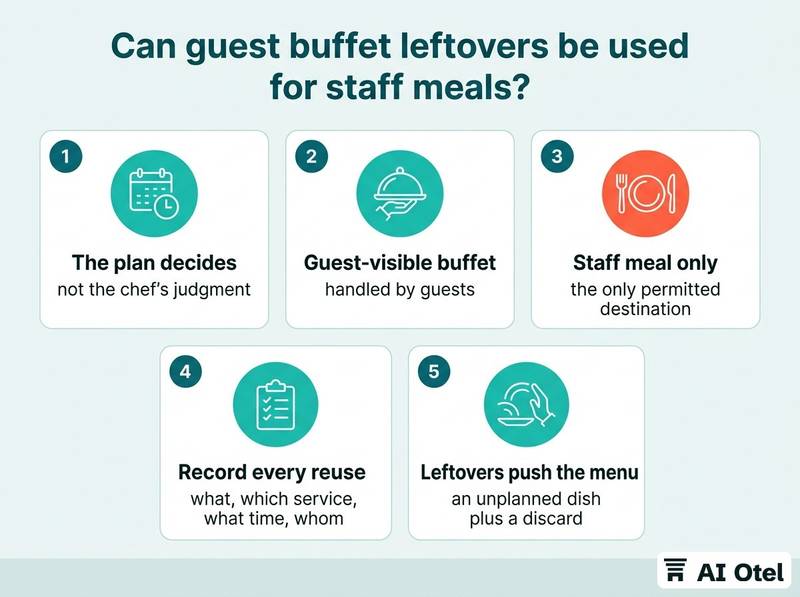
A food safety plan normally covers which food categories may be reused at all, the time and temperature limits, cooling and reheating rules, labelling and the discard point. The line that matters most: food that has left the kitchen and stood on a guest-visible buffet has been handled by guests, and many plans exclude it entirely for that reason. If reuse is allowed at all, the staff meal is the only permitted destination, and the plan should say so in writing. Nothing reused ever goes back to guests.
Record every reuse: what was reused, from which service, at what time, decided by whom. A reuse nobody wrote down is a reuse nobody can defend later. Temperature and time limits belong to the hotel's food safety plan, so do not take a number from an article, including this one.
The cost logic is also weaker than it looks. Leftovers appear free, but they push the menu around, and an unplanned dish plus a discard often costs more than a planned one. The same measurement discipline that helps with buffet food waste and quantity planning from covers shows why: what is not measured is assumed, and assumptions are expensive.
Watch outReuse is a food safety decision, not a cost decision
The food safety plan and the person responsible for it decide, and the staff menu is written around that answer rather than the other way round. Where the plan is silent, the safe default is not to reuse.
What should the monthly review look like?
Three numbers and five comments, once a month, in about twenty minutes: meals served against meals planned, cost per meal, waste, and five written comments from staff.
Meals served against meals planned comes first, because the gap tells you the headcount count is wrong, in one direction or the other, and by how much. Cost per meal is the total food cost of the staff kitchen divided by the meals served, and it is only meaningful if the staff kitchen has its own cost line. For waste, use weight or a bin count per service; if the hotel already measures guest buffet waste, use the same method so the two numbers can be read together.
The five comments are the human part. Ask five people from different shifts and departments, in writing, one question about the past month. Five is enough to hear a pattern and small enough to actually happen.
When something changes, change one slot, not the cycle. Keep the other thirteen days stable so next month's comparison means something. Recost and re-run the variety check after every change, because a swap in one slot moves the protein, legume and allergen counts. A season change is a quantity change: adjust batch sizes and the headcount count, and leave the grid alone unless the review says otherwise.
What to do next
Sit down this week with the chef and the purchasing manager, draw 14 rows and six columns, and fill the grid before anything else changes. Then cost one day of it from the kitchen's own recipe cards, run one full cycle with the production sheet and the daily served count, and hold the first monthly review when the cycle ends. The grid, the portion cards, the shift count and the review are the same four documents a hotel already keeps for the guest kitchen; the staff canteen only needs them written down.
Frequently asked questions
How long should a staff canteen menu cycle be?
Fourteen days is the practical length: long enough that no dish repeats within a week, short enough that the kitchen can hold the whole grid in mind and buy for it. A seven-day cycle repeats too often; a 28-day cycle is hard to cost and hard to check for variety.
How do you work out the cost of a staff meal per person?
Take the ingredient cost of the batch from the standard recipe card, divide it by the portions the batch yields, add the wastage allowance the kitchen has agreed, and divide the month's total staff kitchen food cost by the meals actually served. This article deliberately gives no market price, because the only defensible figure is the hotel's own.
Is a hotel legally required to provide staff meals?
This article makes no legal claim about a duty to feed staff, and none is asserted here. Whether a meal is owed, and on what terms, depends on the employment contract, any collective agreement and the hotel's own practice; confirm your position with a legal adviser or your human resources lead before writing it into a policy.
How do you handle the night shift in a staff menu cycle?
Decide it in the grid rather than at the end of service: either a separate hot dish is cooked for the night shift, or a portion is plated and held before the lunch service closes. The night shift is part of the headcount count, and its meal is a planned slot, not the remainder of the pot.
Can the same 14-day menu be used all year?
The structure stays and the contents move. Keep the 14 days and the six slots, then change dishes inside the slots with the seasons and adjust batch sizes with the headcount. Re-run the variety check and recost after every swap, because one changed dish moves the protein, legume and allergen counts.