A children’s birthday party at the hotel: the slot, the cake, the room and the price
A hotel children's birthday party requires five fixed parts: a time slot, a dedicated room, a food plan, a guaranteed headcount and a cost-based price. This guide provides the rules and checklists to build a safe, profitable package.
AI draft · awaiting editorial review
Contents
Key takeaways
- A party is a slot, a room, a menu, a guarantee and a price; a hotel that cannot fix all five in writing should decline the enquiry.
- The guaranteed headcount, confirmed at the kitchen's cut-off and billed at the greater of guarantee and actual, protects both the kitchen's order and the parent's budget.
- Every child's allergies belong on a form the parent fills in at booking, and the kitchen reads it before the order is placed, not the server at the table.
- An outside cake is accepted only under a written rule: the kitchen keeps the label, cuts and plates it, and the hotel vouches for nothing it did not make.
- The price floor is the cost of the slot divided by the number of children the room holds comfortably, checked against what the room would earn in its next-best use.
A hotel children's birthday party is sold as one package with five fixed parts: a time slot with a hard end, a room of its own, a food and cake plan with an allergy form per child, a guaranteed headcount with a cut-off and deposit, and a price built from the cost of the slot. If you cannot fix all five in writing, decline the enquiry.
Saturday, 15:40. Twenty children are standing in the lobby because the party room is still being cleaned, a parent is holding a cake the kitchen has never seen, and a guest on the second floor has called reception twice about the noise. None of this is a catering problem. It is a package that was never written down. This article builds that package for a children birthday party at a hotel: the slot, the room, the cake, the headcount and the price, each with a rule you can print on one sheet.
Which hotels can host a children's birthday party, and which should say no?
A hotel can host when it can give the party a room of its own, control the food and the cake in its own kitchen, and name one person who owns the event from enquiry to departure. If any of the three is missing, the honest answer is no.
Run five tests before you accept any enquiry. The room test: a space with its own entrance or its own corridor, so twenty children never cross the lobby or the main restaurant during service. The kitchen test: the ability to prepare and plate separately, keep labels, and answer a parent's allergen question from a written list rather than from memory. The owner test: one named person in food and beverage or guest relations who owns the event from the first enquiry to the last child leaving, and who has the authority to stop an activity.
The noise test asks what the party does to the guests in the rooms above and beside it. If the honest answer is that they will hear it, the room or the slot is wrong, not the party. The entertainer test: an outside entertainer needs a written brief, an identity check at the door and a list of what they may not do on the property. Anyone who simply arrives on the day is not a plan.
| Test | What passes | What means decline |
|---|---|---|
| Room | Own entrance or corridor, no crossing of lobby or restaurant service | Only the lobby or the main restaurant at service time |
| Kitchen | Separate preparation, written allergen list, labels kept | One shared line and no written ingredient list |
| Owner | One named person with authority to stop | The event owned by whoever is on shift |
| Noise | Party contained, neighbours unaffected | Guests in nearby rooms will hear it |
| Entertainer | Written brief, ID check, insurance | Anyone who arrives on the day |
Keep a decline list: no separable room, no kitchen control, no named owner, or a date that collides with a wedding or a full house. Saying no to those enquiries protects the ones you accept.
Which day and time should a hotel sell for a children's party?
The best slot is a fixed window in the quiet band of the week, usually a weekend afternoon between lunch service and dinner service, with an hour of set-up before it and an hour of strip-down after it.
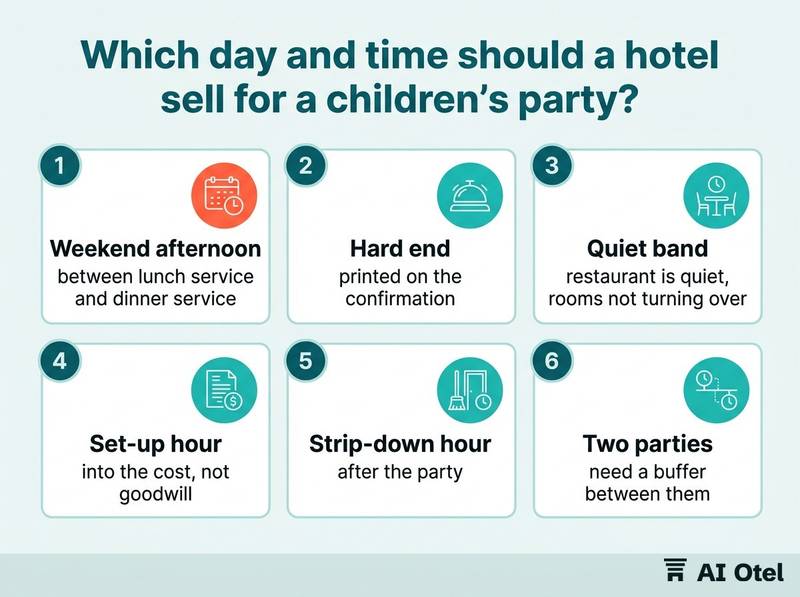
Sell a window with a hard end, printed on the confirmation. The cleaning, the next booking and the staff rota all depend on it. Choose the band when the restaurant is quiet and the rooms are not turning over, so the party does not compete with service. Check the front-desk and housekeeping peaks: a party that ends as check-in starts puts twenty families into the lobby at the worst hour of the day.
Put the set-up hour and the strip-down hour into the cost, not into the staff's goodwill. They are the hours that make the slot work. Two parties in one day need a buffer between them for cleaning, restocking and changing the decorations.
Ask what the slot displaces. If the room would otherwise sell as a meeting room or a restaurant section, that lost revenue is the real cost of the afternoon, and it belongs in the price you quote.
What does the party room need before the first child arrives?
The room needs a layout that separates the cake table, the play floor and the adult seating, and a route in and out that does not pass through the lobby.
Set the zones first. The cake and the gifts go on one table children cannot reach unsupervised, the play floor stays clear, and adult seating sits at the edge where parents can see the whole room. Buggy and shoe parking belongs at the door, because both arrive in volume and both end up in the walkway if there is no place for them.
Decide the toilet rule before the day: identify the nearest ones, decide who escorts children there, and make the rule that an adult always goes with them. Know what the room does to noise, and keep the music and the entertainer's microphone inside it. Furniture should clear in ten minutes, and the sales team should have a scale plan it can send with the quote so the parent can see the room before the day. For a garden party, name the indoor alternative in the contract, so the decision is not made in the rain.
ChecklistRoom readiness checklist
- Separate entrance or corridor confirmed
- Cake and gift table out of children's reach
- Clear play floor
- Adult seating with sightlines to the whole room
- Buggy and shoe parking at the door
- Nearest toilets identified and escort rule agreed
- Sound checked with the entertainer's microphone
- Furniture clear plan timed
- Indoor backup named in the contract
- First-aid kit located and the trained person's name on the sheet
How do you handle the cake and the allergies?
The cake is either made in the hotel's own kitchen or accepted from outside under a written rule, and every child's allergies are recorded on a form the parent fills in before the party, not on the day.
The in-house cake is the cleanest option and the easiest to price: the kitchen knows the ingredients, can list them, and can make one version without the common allergens. If the hotel accepts an outside cake, the rule is written. The cake goes to the kitchen, stays in its packaging with its label, is cut and plated by staff, and the label is kept for the day. The hotel vouches for nothing it did not make.
The allergy form is one per child, filled in at booking by the parent, naming the allergen, the reaction and the action to take. It reaches the kitchen before the order is placed. Make a nut-free party menu the house standard, with the allergen list printed for the parents at the door. The same routine that protects guests in the restaurant, described in our guide to food allergies in hotel restaurants and buffets, applies here with children, who are less able to describe their own reaction.
Separate preparation means a clean surface, separate utensils, and one named person in the kitchen who owns the party's food from order to plating. Train staff on the sentence they never say: that there is nothing in it. They say what is in it, read from the list, and offer the alternative when they cannot control an ingredient. Remember that food is not the only route: the cake, the biscuits, the sweets in the party bags and the ice cream all carry allergens, and all of them belong on the list.
Watch outThe outside cake
A cake made elsewhere arrives with ingredients the kitchen has not seen and a label nobody has read. Accept it only under the written rule: hand it to the kitchen on arrival, keep the packaging and the label, cut and plate it behind the line, and record it on the party sheet. If the hotel cannot do that on the day, it should not accept the cake at all.
How do you fix the headcount, the cut-off and the deposit?
The hotel sells a guaranteed number of children, confirmed at a cut-off the kitchen sets, and bills the greater of the guaranteed number and the children who actually arrive.
The guarantee protects the kitchen's order and the cake size; the actual count protects the parent from paying for empty chairs. The greater-of rule is the standard compromise and belongs in the confirmation. The cut-off date comes from the kitchen's ordering lead time and the cake's lead time, not from the sales team's convenience.
Count adults separately: they eat and drink differently and they change what the room can hold. Set the age bands that decide who counts as a paying child and who does not, and print them next to the price, the same way a hotel child policy fixes age bands for rooms and meals. The deposit is a share of the estimated total at booking, with a cancellation ladder that says what is refunded at which point.
The guest list is a safety record as much as a billing one: the hotel knows how many children are in the building and which adult collects each of them. The final count drives party bags, chairs, place settings and the number of staff on the floor, so it has to be fixed before the order goes out.
| When | What is fixed | Who confirms |
|---|---|---|
| At booking | Slot, room, package, deposit taken | Sales |
| At the kitchen's cut-off | Guaranteed number, cake, menu, allergy forms complete | Kitchen and the event owner |
| The day before | Layout, staff on the floor, party bags, entertainer brief | Event owner |
| On the day | Sign-in against the guest list, extra children billed per child if the kitchen can cover | Event owner |
| At the end | Actual count, extras, balance, sign-out | Front desk |
The same structure of house rules, deposit and noise control that works for hen and bachelor-party groups works here, with one difference: the guests are children, so the sign-out rule matters more than the noise rule.
Who is responsible for the children during the party?
The parents are. The hotel provides a room, food, a named host and a safe environment, and says in writing that children remain their parents' responsibility for the whole party.
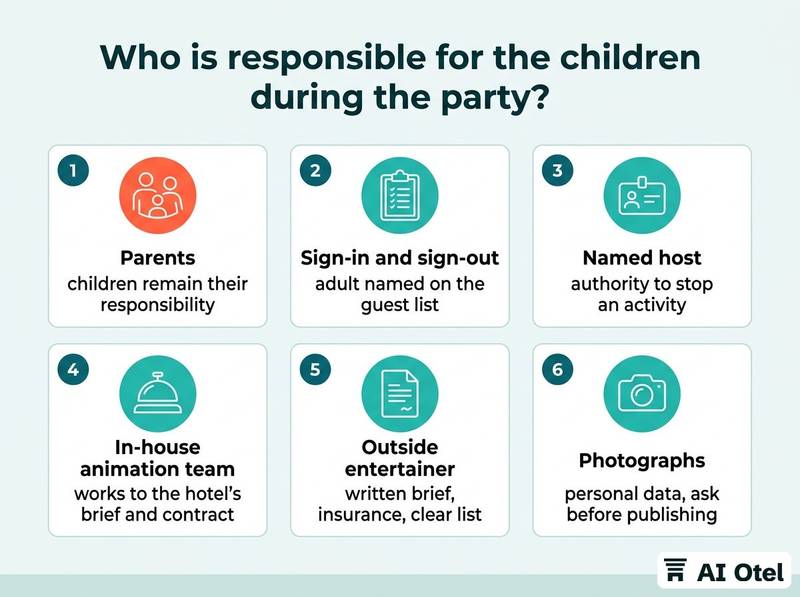
Sign-in and sign-out is the mechanism: children are checked in and collected by an adult named on the guest list, and nobody leaves with someone who is not on it. The host is one hotel person in the room for the whole party, introduced to the parents at the start, with the authority to stop an activity.
An in-house animation team works to the hotel's brief and contract, and it is the easier option to manage inside a weekly plan like the one described for hotel animation programs. An outside entertainer needs a written brief, insurance and a clear list of what they may not do. Set your own staff-to-children ratio as a house rule and print it in the package, so the parent knows what they are buying.
Photographs of other people's children are personal data. The hotel asks before it takes or publishes any, records a refusal, and writes the rule into its own policy; the details belong with its data protection adviser. For first aid, name the trained person on duty, the location of the kit and the route to the nearest clinic, and put all three on the party sheet.
How do you price a children's birthday party from cost and capacity?
Build the price from the cost of the slot divided by the number of children the room holds comfortably, then check it against what the room would earn in its next-best use.
The cost stack, in order: room hours including set-up and strip-down, food and drink per child, the cake, the entertainer or animation hours, staff hours on the floor, cleaning after, decoration and breakage. Capacity, not ambition, sets the divisor: the comfortable number of children the room holds under the layout you actually use, which is lower than the number the room holds when empty.
The floor is the total cost of the slot divided by the comfortable headcount: the price below which a full party still loses money. The alternative use is the comparison with what the same room would earn as a meeting room, a restaurant section, or nothing at all on a quiet afternoon. Set a minimum number of children or a minimum spend, so a party of six does not consume a room built for thirty.
State what is included and what is extra once, in a list on the quote. The extras quoted separately are the ones that cause the argument at the end. The structure that works: a price per child with a minimum, a room fee if the slot is prime, and a deposit that is a share of the estimate rather than a fixed token.
TipThe four-line test of a party price
Line one, the full cost of the slot including the hours nobody bills. Line two, the comfortable headcount for the layout. Line three, the floor price that follows from dividing one by the other. Line four, the contribution the same room would make in its next-best use. If the quoted price sits below line three, the package is losing money before anything goes wrong.
Write the party sheet this week
Write the one-page party sheet this week: the slot with its hard end, the room and its layout, the menu with its allergen list, the guaranteed number and cut-off, the deposit and cancellation ladder, and the floor price from the cost of the slot. Then run the next enquiry through it before you quote. The five parts only work as one package, and the package is what the parent is actually buying. A hotel that keeps its party terms, allergy forms and guest lists in one system, such as a hotel operating system built and working, ahead of launch, with a guest app parents can use before arrival, prints that sheet from its own records instead of from memory.
If you are reading this as a parent rather than a hotelier, you can find a hotel in Türkiye (opens in a new tab) for the party and ask for exactly these five parts in writing.
Frequently asked questions
Can parents bring their own cake to a hotel birthday party?
It depends on the hotel's own written rule, which should appear on the confirmation. If the hotel accepts an outside cake, the cake goes to the kitchen on arrival, stays in its packaging with the label, is cut and plated by staff, and the label is kept for the day. The hotel vouches only for what it made, and the allergy form still covers every child at the table.
How many children can a hotel party room hold?
The comfortable number under the layout actually used, which is lower than the number the empty room holds. The hotel sets it, prints it in the package and uses it as the divisor for the price floor. A room filled beyond that number breaks the zones, the sightlines and the staff ratio at the same time.
Do parents have to stay for a children's party at a hotel?
That is the hotel's rule, and it should be stated in writing before booking. Children remain their parents' responsibility throughout, so a hotel may require an adult on the premises for younger age groups, and should say so in writing. Sign-in and sign-out against a named guest list keeps the rule enforceable.
What happens if fewer children come than the hotel booked for?
The confirmation sets a guaranteed number at the kitchen's cut-off, and the bill is the greater of that guarantee and the children who actually arrive. The guarantee covers the cake, the food order and the staffing. Extra children on the day are billed at the per-child price if the kitchen can still cover them.
Should a hotel take a deposit for a birthday party?
Yes, a share of the estimated total at booking, with a cancellation ladder that says what is refunded at which point. The deposit protects the slot and the kitchen's order, and the ladder gives the parent a clear answer instead of a negotiation. Both belong in the written terms, not in a phone call.