Hen and bachelor-party groups: house rules, deposit and noise without spoiling the weekend
Manage hen and bachelor parties with a one-page agreement, separate deposits, and strategic room placement. Keep the weekend profitable and other guests happy.
AI draft · awaiting editorial review

Contents
Key takeaways
- A hen or bachelor-party group is bookable when the date, the building and one named contact all fit; if any of the three fails, refer the group instead of taking the risk.
- One page signed by one named organizer does more work than a list of warnings pinned to a corridor wall.
- Keep the advance payment and the refundable security deposit as two separate sums with two separate words, on the agreement and on the bill.
- Room placement is the cheapest noise control a hotel has: a group held on one corridor with no other guests on it can be loud for an hour and bother nobody.
- Inspect the rooms with the organizer present and charge from a written price list, so a damage charge is a price and not an argument.
Hotel hen party group rules work as a short written agreement, signed by one named organizer, that sets the group's size, quiet hours, the visitor rule, a refundable security deposit separate from the advance payment, and a room block away from other guests. The hotel decides the terms; the organizer owns them for the group.
The enquiry arrives on a Tuesday for a block of rooms on a weekend that would otherwise sit quiet, and it ends with the line every reservations manager knows: we are a fun group. By Saturday midnight there is a complaint from the second floor, the night manager is improvising at a corridor door, and nobody has the organizer's mobile number written down anywhere. This article gives you the four gate questions to ask before quoting, the one-page agreement, the deposit structure, the room plan and the night plan, so the next group arrives on your terms.
Should you take a hen or bachelor-party group booking?
Take the booking when the date, the building and one named person all fit. If any of the three fails, refer the group to a property that is built for it rather than accept a weekend you cannot hold.
Ask what the group replaces. A group that fills rooms in a soft week is revenue; the same group on a sold-out Saturday pushes regular guests out and buys nothing. Ask whether the group can be held together on one corridor with no other guests on it, because fourteen people in a house with thin walls and families on the same floor is a different decision from the same fourteen in a separate annex or a garden block.
Ask who signs and who answers the phone at one in the morning. If no single organizer will put a name and a mobile number on the booking, the group is not bookable yet. Ask who is on shift that weekend and whether that person has the authority to end a stay: a group accepted on a night with one junior staff member and no manager on call is a risk taken on someone else's behalf.
Let reservations propose and the duty manager or general manager sign, and write the rule down so the answer does not change with the person on the phone. Price the work, not just the rooms: extra housekeeping, night attention and deposit administration are costs, and a group rate that ignores them is a loss dressed as occupancy.
ChecklistBefore quoting, the reservations team runs four gate questions
- Date: does the group fill rooms that would otherwise be empty, or displace guests who would have paid more?
- Building: can the group be held on one corridor with no other guests on it?
- Person: will one named organizer sign the agreement and take the calls at night?
- Cover: is there a duty manager on shift with the authority to end a stay?
A no to any of the four means refer, not decline silently. Keep a short list of properties that take celebration groups and send the enquiry there with the group's details. A referred group often comes back later as a quieter booking. For the rules themselves, see hotel house rules and where guests actually see them.
What should a group agreement say?
One page, plain words, signed by the named organizer, covering who is responsible, how many people are coming, when quiet starts, who may enter the building and what happens if the terms do not hold.
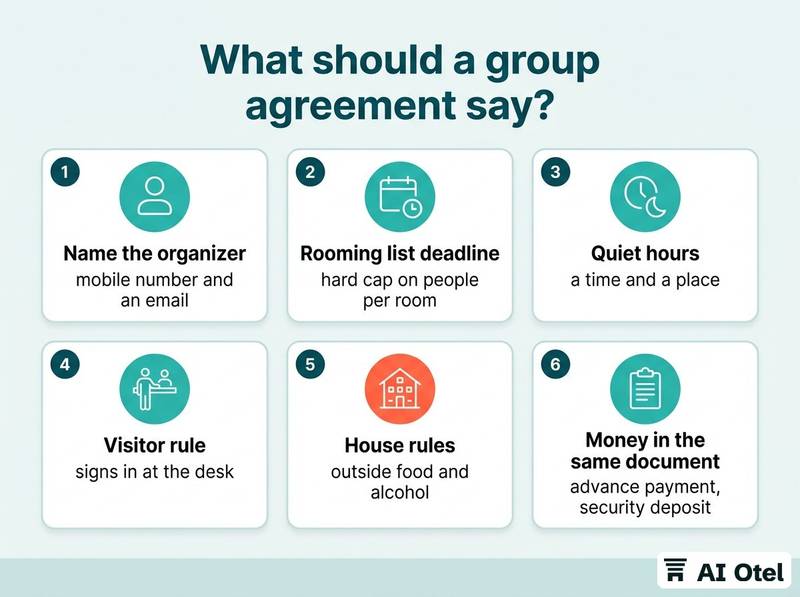
Name the organizer with a mobile number and an email, and write that this person is the contact for the group. The agreement binds a person, not a mood. Set a rooming list deadline and a hard cap on people per room: the headcount at signing is the number you plan housekeeping, breakfast and night cover for.
Write quiet hours as a time and a place, corridors, balconies, courtyard and pool deck, with the hour stated. A rule that says please respect other guests gives staff nothing to point at. Add the visitor rule: a person who is not on the rooming list signs in at the desk and leaves by a stated hour. This is the clause that stops a twelve-person booking from becoming a forty-person party in a corridor.
Restate the house rules the hotel already has, on outside food and alcohol, smoking and pool hours, instead of inventing new ones for this group. The same rule, written once for everyone, is easier to defend. If you are unsure what a food or alcohol rule rests on, read whether a hotel can restrict outside food and alcohol.
Put the money in the same document: the advance payment, the refundable security deposit, the damage price list and the day the deposit goes back. The guest should read all of it once, not sign three separate papers. Send a signed copy back to the organizer and keep it with the reservation, so the night manager can open it at midnight without calling anyone.
TipWrite to a person, in the present tense
For example: "You are the contact for the group. Quiet hours start at 23:00 in the courtyard and on the balconies. Your guests sign in at the desk and leave by 01:00." A rule addressed to a named person gives that person something to do; a warning addressed to nobody gives no one anything.
If your property uses software for this, the agreement and the group's schedule can live in a guest app that carries the house rules and the group's schedule, built and working, ahead of launch, rather than in a paper folder behind the desk.
How should the deposit and damage terms work?
Take a refundable security deposit from the organizer, keep it separate from the advance payment, say in writing what it covers and when it goes back, and price the damage from a list the guest has already seen.
Two sums, two words. The advance payment (kapora) is part of the room bill, paid ahead and counted toward the stay. The security deposit (depozito) is held against damage and extras and returned. Never swap the two words, in the agreement or on the bill. A card pre-authorization holds an amount without taking it; a cash deposit takes the money, which means a receipt at check-in and a refund path at checkout. Choose one and write it into the agreement. For the mechanics, see card pre-authorization and deposits at check-in.
The amount is the hotel's decision. A practical way to size it is the cost of the damage that actually happens in your building, a burned carpet, a broken door, a smoked-in room, rather than the size of the room bill. Write a short damage price list: four or five items with prices, the ones your housekeeping team has seen more than once. A charge then reads as a price list line, not as a number invented at the desk.
State the inspection time and the refund day, and say how long the card's own posting takes, so the guest is not calling the hotel about a bank delay. Say once, without moralizing, what the deposit does not buy: it does not purchase the right to disturb other guests. The quiet hours clause stands on its own.
| Sum | What it is | When it is taken | When it goes back |
|---|---|---|---|
| Advance payment (kapora) | Part of the room bill, paid ahead | At booking | Not returned; it is spent on the stay |
| Security deposit (depozito) | Refundable, held against damage and extras | At signing or check-in | After inspection, within the stated days |
| Card pre-authorization | A hold on the card, not a charge | At check-in | Released by the hotel, posted by the bank |
| Damage charge | A price list item, after inspection | At checkout | Not returned; itemized on the bill |
Where should the group sleep?
Together, on one corridor, away from families and light sleepers, with the organizer's room placed where staff pass most often during the night.
One floor or one corridor end, not scattered. A group spread over three floors creates three noise problems and three sets of complaints to answer. Keep the group away from the quiet block: families with small children, long-stay guests and anyone who has asked for a quiet room should not share a wall with a celebration.
Put the organizer's room at the junction, near the lift lobby or the stair, where night staff walk most. The first conversation of the night then happens early and quietly. Check the physical joins: connecting doors to non-group rooms, adjoining balconies, a shared terrace. A door that closes properly and a carpeted corridor do more than a printed warning.
Mark the block in the reservation system so housekeeping, night audit and the breakfast team see it without asking. A note in a staff messaging group is not a system and disappears with the shift. Move the group's breakfast slightly later or into a corner of the room, so the first morning does not collide with early breakfast and the guests who want silence with their coffee.
NotePlacement is the cheapest noise control
A group held on a corridor with no other guests on it can be loud for an hour and bother nobody; the same group on a mixed floor produces complaints before midnight and a night manager who spends the shift in a corridor instead of at the desk.
What does the night plan look like?
One named person on shift owns the group from check-in to checkout, with a first approach, a second step and a decision point written down before the weekend starts.
Exchange two phone numbers at check-in: the duty manager's number goes to the organizer, and the organizer's number goes on the shift handover sheet. Both directions, not one. Enforce the quiet hour in steps: a friendly word from night staff, then the duty manager, then the choice between the group settling and the stay ending. Written steps stop the second step from being improvised at two in the morning.
Answer the noise call properly: thank the caller, say what you will do and when, do it, then tell them it is done. The guest who is kept informed rarely calls twice. Watch the door: the desk checks arrivals against the rooming list, and anyone not on it follows the visitor rule. Most of the night's problems walk in through the lobby, not out of a guest room.
Never send one staff member alone down a group's corridor. Two people, or the duty manager with the security contact to hand. Log every incident as it happens, with the time and the room number; the log is what turns the damage conversation at checkout into a factual one. Write the handover note at the end of the shift: what happened, what was said, what was promised to whom. For the complaint itself, the steps are in answering a noise complaint at night and preventing the next one.
Watch outAct on the first complaint, not the third
A group spoken to at the first call usually settles and often apologizes; a group left until midnight has an audience, a corridor and a reason to perform for it.
What happens at checkout: the damage check and the record
Inspect the rooms with the organizer present, charge from the price list, return the deposit on the day you promised, and write the outcome into the group's record so the next booking starts from knowledge.
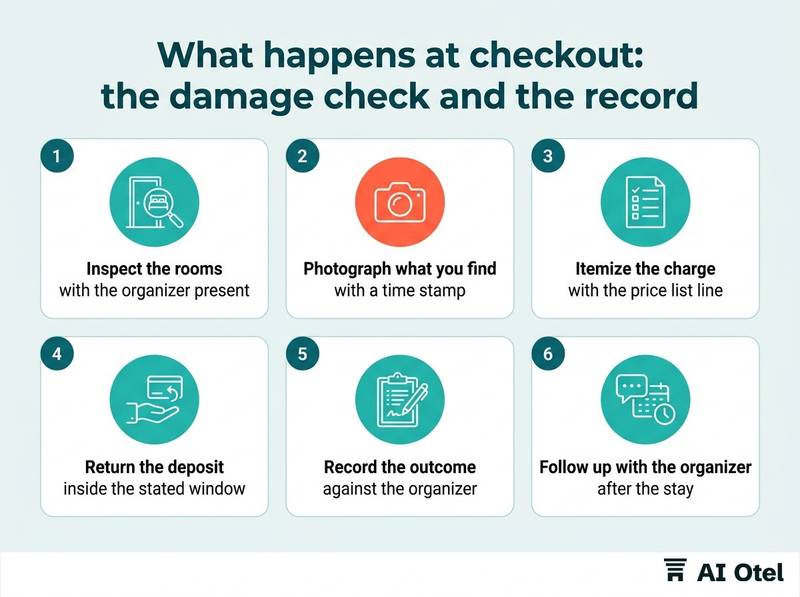
Inspect before the group leaves the building, room by room, from the rooming list, with the organizer walking beside you. A charge raised after the bus has gone is a dispute, not a conversation. Photograph what you find, with a time stamp. The photograph is the evidence; the price list is the amount. Neither one alone settles anything.
Itemize the charge on the bill with the price list line, never as a lump sum called damages. A guest can argue with a lump sum; a guest can read a price list. Return the deposit inside the stated window even when a charge is in dispute, and hold back only the disputed amount. Holding the whole deposit over one argument costs more in reviews than it recovers.
Record the outcome against the organizer, not against every guest who stayed. A group is a returning customer or it is not, and the note decides which. Review the agreement once a season: which clause was tested, which price list line was wrong, which room placement worked. The second version of the document is the one that earns its keep. Follow up with the organizer after the stay: a group that settled well is a good booking for the same soft week next year, and saying so is cheaper than finding them again.
Write the one-pager this week
Write the one-page group agreement this week: the four gate questions as the front page, the deposit table as the money section and the night plan as the last page, then use it unchanged for the next group that asks. The point is not to keep celebration groups out; it is to take them on terms the hotel has already decided, so the weekend fills the rooms and the rest of the house never notices.
If you want the same structure inside your software, a hotel operating system, built and working, ahead of launch, can carry the rooming list, the deposit lines and the block marking in one place instead of across a folder, a spreadsheet and a messaging group.
And if you are a traveler planning the weekend rather than running the hotel, you can find a hotel in Türkiye (opens in a new tab) that suits your group.
Frequently asked questions
Can a hotel refuse a hen party booking?
A hotel contracts on its own booking conditions, so it can decline a group it cannot place, staff or supervise. The workable version is a written group policy applied the same way to every group, so the answer does not depend on who is on the phone that day. Reply in plain words and offer the referral. Whether a particular refusal is lawful is a question for your legal adviser.
How much should a party group deposit be?
The hotel sets the amount; there is no standard figure to copy. Size it to the damage that actually happens in your building and to the extras the group is likely to run up, not to the room bill. Keep it separate from the advance payment, name it as a refundable security deposit, and write the inspection and the return day into the agreement.
Should hen and bachelor parties sign a different contract from other groups?
One group agreement used for every group, sports teams, wedding parties, school groups and celebration groups, is easier to explain, easier to apply and easier to defend when a guest asks why they are treated differently. A party-specific annex is worth adding only if the property takes many of them and the standard page keeps missing something.
What if the group damages a room and disputes the charge?
Inspect with the organizer present, photograph the damage with a time stamp, and charge from the price list the organizer signed. Apply the deposit to the charge and hold back only the disputed amount, returning the rest on the promised day. The signed agreement and the photographs are what let the hotel pursue the remainder through its normal process.
Should the hotel tell other guests that a group is in house?
No announcement is needed, and identifying a group to other guests is a bad idea. The protection is placement and staffing: the group on its own corridor, a duty manager on shift, the visitor rule enforced at the desk. A short line at check-in to guests on the same corridor, inviting them to call the desk if anything bothers them, is optional and should name nobody.