The games room: billiards, table tennis and darts, with rules, noise and upkeep
A hotel games room fails on management, not equipment. Learn how to set hours, assign ownership, run weekly checks, and control noise to keep the space usable all season.
AI draft · awaiting editorial review
Contents
Key takeaways
- A games room fails on management, not on equipment: the table is rarely broken, the key is lost and nobody owns the room.
- Write the rules on one page and post them at the door: hours, who signs out cues and darts, the age rule, and what happens when equipment is damaged.
- Check cues, balls, cloth, nets and darts on the same day each week and log the result, so wear is replaced before a guest finds it.
- Treat noise as a room-location decision first and a rule second: a solid wall, no shared ceiling with guest rooms, and a closing time that matches the building.
- Children play with an accompanying adult and the evening belongs to a different crowd; say which is which before the season starts.
A hotel games room is a supervised indoor space with billiards, table tennis and darts. It stays usable when three things are fixed in writing: opening hours and who holds the equipment, a weekly wear check on cues, balls, felt and nets, and a noise rule tied to the rooms above and beside it.
The billiard table arrives, the cues go behind the bar, and by August the cloth is torn, the key has moved three times and the rooms above complain every night. The equipment was never the problem. This article covers how to plan a hotel games room with billiards, table tennis and darts: where to put it, who owns it, what the weekly check covers, how noise is controlled, and the rules for children and evening play. You will finish with a one-page rule set and a weekly log you can start the same day.
What belongs in a hotel games room, and where should it go?
Pick two or three games that need different amounts of space and movement, then place the room where the noise reaches no guest bed. The layout decides most of what follows.
Billiards is the space-hungry game. At every cushion, take a full stroke with the longest cue you own, and whatever the cue touches is the clearance the table needs. Seating and drink tables stay outside that line. If the room cannot give it, a smaller table or a different game is the better answer than letting players improvise.
Table tennis needs clear floor behind each end for the backstep, a floor that does not slide, and light that does not shine into a player's eyes at the serve. Darts needs a protected wall, a marked throw line and a board fixed into something solid. A board hung on plasterboard is a repair job every month.
Put the room where a hard floor and a solid wall separate it from guest beds: not under a guest room and not beside a lift shaft. The cheapest noise fix is the room you did not choose. Plan for drinks, chalk and dropped darts with a wipeable floor, a bin, and a shelf that keeps glasses away from the cloth. Leave space for waiting guests, because a room with one table and no chairs turns every busy hour into an argument. Decide what the room is not: a winter store, a staff break area, or overspill from the bar. Each of those ends with equipment missing in spring.
ChecklistLayout check before the table is fixed in place
- Full stroke taken at all four cushions with the longest cue
- Clear floor behind both ends of the table tennis table
- Dart board on a solid wall with a marked throw line
- Door that closes on its own without slamming
- Hard, wipeable floor
- Seating outside the stroke line
- Drinks shelf away from the cloth
- Sight of the door from the corridor or a camera
- Light over the playing surface, not in the player's eyes
The same planning logic applies to outdoor play spaces: see a padel or tennis court at the hotel: booking, lighting, noise and upkeep for the outdoor version of these decisions.
Who opens the games room, and who holds the equipment?
One named person holds the key and the equipment list, and the room opens and closes at fixed hours printed where guests already look for information.
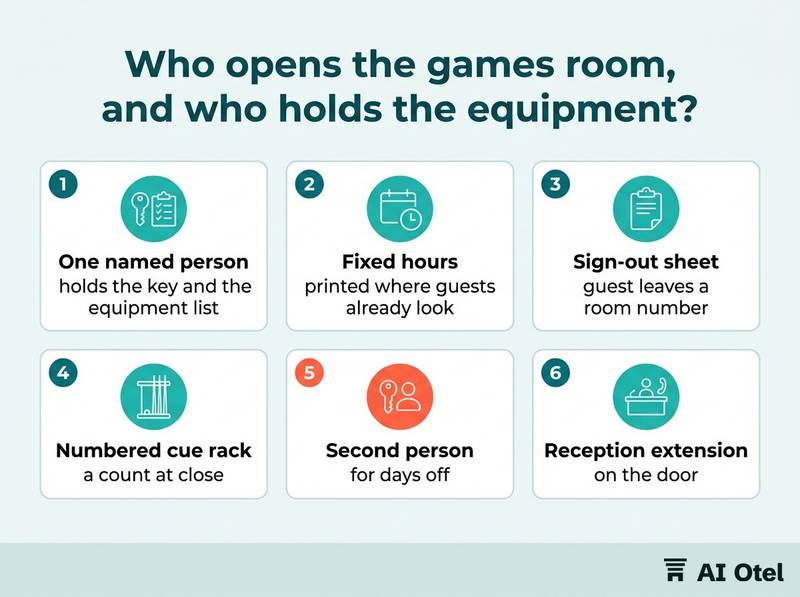
Choose one model and keep it: open access with equipment on a shelf, or a sign-out sheet at the desk where a guest leaves a room number and takes a cue, a bat or a set of darts. Sign-out wins on losses. A numbered cue rack and a count at close tell you by the next morning what walked away.
Name a second person for days off, and put the handover on the shift sheet so the closing count does not depend on memory. Set the hours against the bar and the restaurant rather than the animation program; a room that closes with the bar keeps the last hour quiet. Give staff a clear right to stop play, and one sentence they can say when they do. Put a reception extension on the door, so a broken cue at eight in the evening does not become a complaint at breakfast. Group bookings go into the same calendar as the other public spaces, with a start time and an end time.
TipThe ownership test
If the room is locked tomorrow morning, who is the first person who notices? If the answer is a guest, the room has no owner yet.
The pattern is the same as other shared hotel facilities; the hotel fitness room: rules, equipment checks and who watches it covers the same questions for gym equipment.
What does the weekly equipment check cover?
Check the same items in the same order every week and write the result down: cue tips and shafts, balls, cloth and cushions, nets and bats, darts and board.
Cues fail at the tip, the ferrule and the shaft. A lifting tip, a cracked ferrule or a shaft that rolls unevenly on the cloth takes a cue out of honest play. Keep spare tips, glue and sandpaper, and a box for anything pulled out of service. Roll each ball across the table and listen: a chipped or out-of-round ball makes every shot a lie and blames the guest's aim. On the cloth, look for tears at the pocket mouths, chalk burn and a cushion that no longer rebounds. A small tear patched in the same week stays small.
Anything that fails goes out of service the same day. A guest who finds a broken cue first has already decided what the room is like.
| Item | What to look for | Out of service if | Weekly action |
|---|---|---|---|
| Cues | Tip, ferrule, shaft roll | Tip lifting or shaft warped | Retip or retire the cue |
| Balls | Roll and sound | Chipped or out of round | Replace from stock |
| Cloth and cushions | Pocket mouths, chalk burn, rebound | Tear spreading or dead cushion | Patch and report to maintenance |
| Table tennis net and bats | Height, tension, clamps, rubber | Net sags or clamp slips | Swap net or bat |
| Dart board and darts | Rotation, bristles, points, flights | Darts fall out or bounce | Rotate board, replace points and flights |
| Room fittings | Lights, scoreboard, door closer, floor, seating | Light out or door slams | Raise a maintenance job |
Keep spare dart shafts and flights at the desk, not in a drawer upstairs, so a small failure does not take the board out of play for a week.
How do you keep games-room noise out of the guest rooms?
Decide the room's position and its closing time before you buy the table. A rule on the door cannot undo a billiard table under a guest bed.
Billiard balls and cue butts send impact through the structure, so the ceiling above and the wall behind matter more than the door. Test it the way a guest would: someone plays a normal frame while you stand in the nearest guest room with the door shut, at the busiest hour, and listen. If the room has to sit near beds, shorten the evening, put a soft covering under the table, keep the table off the shared wall, and fit a door closer that does not slam.
Separate the loud hours from the quiet ones: family play in the afternoon, adults in the early evening, closed after the time you set. Give the front desk a script and a response; when a guest calls about noise, staff attend the room, not the telephone. Record noise complaints on the same page as the equipment, so a pattern shows before it reaches a review.
Watch outThe noise test is a listening test, not a decibel reading
Stand in the nearest guest room with the door closed while a normal game is played, at the hour you plan to close. If you can follow the game by ear, the closing time or the room is wrong.
What rules apply to children and to evening play?
Children play with an accompanying adult, evening play is for older guests, and both rules are printed at the door and given at booking.
Set an age band for play without an adult and write it down. Staff apply the rule, and the accompanying adult stays responsible for the child. Darts is the one to control: sharp points, a board that can throw a dart back, and a set that is signed out and counted at close rather than left on a shelf. Cues are long and swing at head height for a small child, so keep a short cue for younger players and a waiting area outside the stroke line.
For the evening, choose one of two models and keep it all season: a later start for guests under a stated age, or the room closes to children after a set hour. Add one line that no money is staked on any game, and one line that staff may end a game that breaks the rules. Post the rules in the languages the hotel already uses, at the door and in the room information, not only on a website. Tell group organizers the rules before they arrive; a group that knows the closing time does not argue about it at midnight.
Key pointThe one-page house rules
Opening and closing hours; who signs equipment out and in; age rule and the accompanying adult; darts signed out only; no money staked on a game; drinks off the table; staff may stop play; a number to call.
For the outdoor equivalent of these rules and checks, see hotel playground and outdoor play equipment: a weekly safety check and the record.
What goes in the weekly upkeep log?
One page a week: who opened and closed, what was checked, what failed, what was replaced, and what a guest reported.
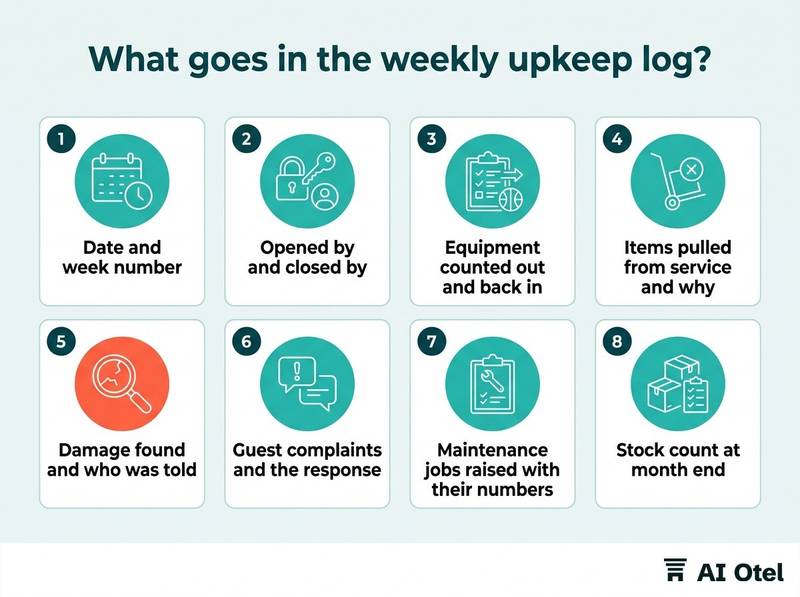
The fields are date, opening and closing staff, equipment counted in and out, items pulled from service, replacements used, damage found, complaints and the action taken. Keep the log where the equipment is, not in an office; a page filled in at the table gets filled in. Tie a failed item to the maintenance system the hotel already uses, so a repair has a number and an owner.
Charge damage to a guest's bill only where the rule was posted and the guest was told at the time. Otherwise treat it as wear and replace the item. Count stock monthly: tips, chalk, flights, shafts, balls, bats. Running out in August is a planning failure, not a supply problem. At the end of the season, read the log: the item that failed three times is the item to replace with a better grade next year. Keep the previous season's pages, because they are the argument for the budget.
ChecklistThe weekly page
- Date and week number
- Opened by and closed by
- Equipment counted out and back in
- Items pulled from service and why
- Replacements used from stock
- Damage found and who was told
- Guest complaints and the response
- Maintenance jobs raised with their numbers
- Stock count at month end
- Signature of the person who holds the key
The same record discipline applies to loaned equipment of every kind; renting bicycles to guests: the fleet, helmets, daily checks and the return shows the pattern for a bigger, more valuable fleet.
Before the season opens
Walk the room with the person who will hold the key: take a full stroke at every cushion with the longest cue, stand in the nearest guest room while someone plays, write the one-page rules, and start the log that same week. The table is the cheap part. The owner, the hours and the record are what keep the room usable in August.
If you are planning how a games room, sports facilities and other guest services fit into the wider guest experience, the guest app overview and the platform pages describe how offers and requests are built to be brought together in one place, ahead of launch.
If you are a traveller rather than a hotel manager, you can find a hotel in Türkiye (opens in a new tab) that suits the kind of stay you want.
Frequently asked questions
How much space does a billiard table need in a hotel room?
Clearance is measured, not guessed: take a full stroke with the longest cue at every cushion and keep that space empty. Seating, drink tables and the door swing stay outside that line. If the room cannot give it, choose a smaller table or a different game rather than letting players improvise.
Should guests pay for billiards, or borrow the equipment free?
Both models work if the hotel picks one and keeps it all season. A free loan with a numbered sign-out keeps the count and the responsibility clear. A charge adds a billing step and a deposit question the front desk has to handle, so it needs a written answer before the first guest asks.
Does someone have to staff the games room at all times?
Not necessarily. What matters is a named owner, a closing round, a reachable number on the door, and sight of the entrance from the corridor or a camera. Children stay with their accompanying adult, and staff supervise the room and its rules rather than each child.
How do we know the noise is a problem before guests complain?
Run the listening test: someone plays a normal game while a staff member stands in the nearest guest room with the door closed, at the hour the room is busiest. If the game can be followed by ear, change the closing time, the floor covering or the table position, then test again.
How often should a dart board be rotated or replaced?
Rotate the board on a fixed interval so the treble twenty does not wear into a hole, and record the date on the weekly page. Replace it when darts fall out or bounce back. Keep spare shafts and flights at the desk so a small failure does not take the board out of play for a week.