Renting bicycles to guests: the fleet, helmets, daily checks and the return
Hotel bike rental is a small operation, not a free extra. This guide covers fleet sizing, daily checks, hand-out forms and the return process to keep the service running.
AI draft · awaiting editorial review
Contents
Key takeaways
- Free or paid is the first decision, because it sets the price list, the record and the person who owns the service.
- Fleet size comes from peak demand at the desk at the same hour, not from the room count.
- Every bike gets a signed daily check before the first hand-out, and a failed check takes it off the rack with a dated tag.
- The hand-out form records the bike number, the helmet, the time out and the condition, so the return has something to compare against.
- Describe the route; never rate the rider or promise that a road is safe.
Hotel bike rental is a small operation, not a free extra: decide whether the bikes are lent free or rented, size the fleet to observed demand, check every bike each morning, record each hand-out with helmet and route briefing, and inspect the bike at return. Written terms, a repair log and a named owner keep it running.
The bike comes back at seven in the evening with a soft rear tire, no key and a scratch that was not there this morning, and nobody at the desk knows which room it went out to. It was never a free extra; it was an operation without a record. This guide sets up hotel bike rental as a small, costable service: the free-or-paid decision, the fleet and its types, the morning check, the hand-out form, the return routine and the route cards. Follow the pieces in order and the service stops depending on whoever happens to be at the desk.
Should a hotel lend bikes for free or rent them?
Decide this first, because it changes the paperwork, the price list, the deposit question and who is accountable for the fleet. A free loan is an amenity with a cost; a paid rental is a sale with a record.
A free loan has low friction at the desk. But every repair, tire and lost key comes out of another budget line, and the guest reads a broken bike as a broken promise rather than a closed service. There is no record, so the fleet has a memory instead of a history, and the memory belongs to whoever worked the morning shift.
A paid rental makes the bike a sale. It needs a price list the guest sees before taking the bike, a fiscal document for the amount, and a person who reconciles the money at the end of the day. Confirm with your accountant how the income and any deposit are recorded in your books.
What changes when the bike is paid
| Free loan | Paid rental | |
|---|---|---|
| Who it attracts | Guests who try it once | Guests who plan the ride |
| Staff time at the desk | Low, until something breaks | Higher: terms, money, return |
| Record kept | None, usually | Hand-out form and a receipt |
| Repair budget | Fights for space with others | Comes from the service itself |
| Damage conversation | Awkward, no basis | Written terms, noted condition |
| What the guest expects | A working bike, loosely | A working bike, strictly |
A middle option works for many hotels: free for a short window, for example two hours, and paid beyond it. The amenity stays, and the guest who wants the bike all day pays for it. Decide the unit before the price: per hour, per half day, per day, and what a late return means. Write it in one sentence the desk can repeat.
The one-page terms
Whichever way you go, put the terms on one page: who may ride, the helmet rule, where the bike may go, the return time, what happens after it, and how damage is handled. These are your own house rules, confirmed with your legal adviser so they hold in your jurisdiction and your insurance setup. Name the owner of the service: front desk, guest relations or the activity desk. A service shared by everyone is checked by nobody. And keep the hand-over in a log even when the bike is free, the same discipline as a lending log that gets borrowed items back, so the fleet has a history rather than a memory.
How many bikes does a hotel need, and which types?
Size the fleet from the requests the desk actually receives at the same hour, not from the room count. The number that matters is the peak, not the daily total.
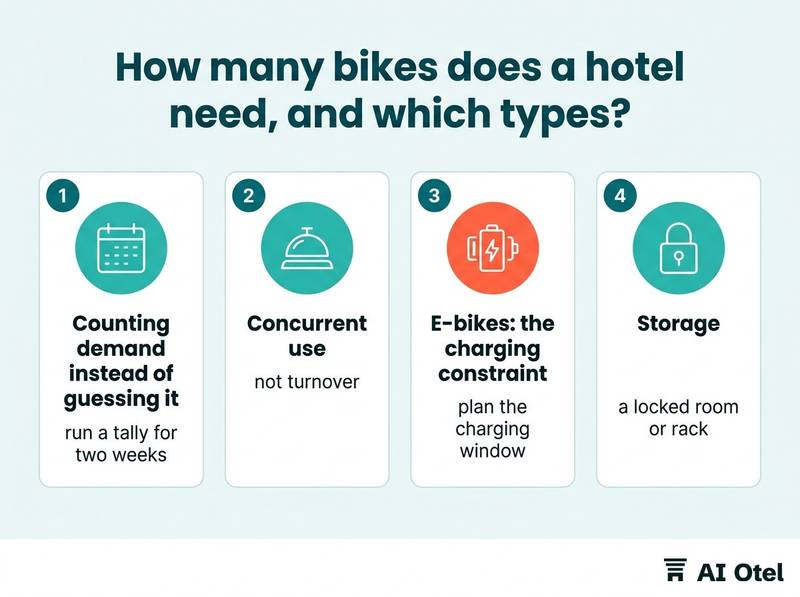
Counting demand instead of guessing it
Run a tally for two weeks: every request, every refusal, and the hour it came. Ten requests spread across a day need fewer bikes than six arriving between nine and ten in the morning. Look at concurrent use, not turnover: if bikes go out at nine and come back at one, the fleet must cover the morning wave, and a second wave in the afternoon is free capacity.
On types, keep it simple. Step-through city bikes serve casual riders. A few e-bikes earn their place where the terrain is hilly or the summer heat is heavy. Children's sizes and child seats matter if families dominate your mix. Every extra type adds a spare-parts line and a skill the mechanic needs; two well-maintained types serve better than five neglected ones.
E-bikes: the charging constraint
An e-bike on charge is not available, so plan the charging window and decide whether a second battery is worth it for fast turnover. Charge where the manufacturer's instructions say, away from guest rooms, and log each charge. E-bikes are also heavier to store and lift, the battery needs securing, and repairs cost more.
Storage is a locked room or rack out of direct sun and rain, with the same key control as other hotel equipment. On owning versus leasing: leasing moves maintenance to a contractor but ties you to their response time; owning needs a mechanic or a written service agreement with a local workshop, agreed with a response time in it.
TipBuy for the busiest hour, not the busiest day
Count requests and refusals for two weeks at the desk, note the hour, and size the fleet for the busiest hour. The same booking logic as booking a court slot and keeping the facility in condition applies here: one named slot per bike, so two guests are never promised the same frame. Write the count down as it happens, not from memory at the end of the shift, and keep the refusals in the same list as the requests: a refusal is the only record of demand you could not serve.
What does the daily bike check cover?
A named person checks every bike before the first hand-out, signs a one-page sheet, and takes any failed bike off the rack with a dated tag. The check is short; skipping it is what costs.
Brakes first: both levers, cable tension, pads above the wear line. A brake that holds at walking pace can still fade under a rider's weight on a descent. Then tires: pressure to the figure on the sidewall, tread, no cuts or bulges. A slow puncture usually shows as a soft tire in the morning, which is exactly why the check is in the morning. Lights and reflectors come next: front and rear working, batteries present, because a bike that goes out at dusk without a rear light is the failure guests report.
Check the lock and key: the lock opens and closes, the key matches the tag on the frame, the spare is in the drawer and accounted for. Then the frame and contact points: saddle and seat post tight, handlebar and stem tight, quick releases closed, bell working, basket or rack secure. On e-bikes add charge level, display and assist working, charger present, battery mount tight, and the assist setting the hotel has chosen. Anything failed goes out of service with a tag showing the date and the fault, and the desk's availability list is corrected the same morning.
Who signs, and when
One person signs, before the first hand-out, and the signature is the point: it makes the check a duty rather than an intention. Keep the sheets with the hand-out forms, because the two together answer most questions after an incident.
ChecklistDaily bike check sheet, one line per bike
- Brakes, front and rear
- Tire pressure and tread
- Front light
- Rear light and reflector
- Bell
- Lock and key number
- Saddle and handlebar tight
- Quick releases closed
- Chain and gears
- E-bike charge and display
- Charger present
- Frame tag matches the sheet
Signature: ____________________ Time: ____
What goes on the bike hand-out form?
The form records a hand-over, not an identity: the guest is already registered at check-in, so the form carries the room, the bike, the helmet, the time out and the condition at hand-out.
The header holds the guest name, room number, bike number from the frame tag, date, time out, expected return time, and the staff member handing over. The helmet gets its own line: size issued, fitted at the desk with the straps shown, and recorded. A helmet handed over loose is a helmet that stays in the basket.
Condition at hand-out is the field that earns its keep: existing scratches, a missing bell, tire pressure noted. This is what makes the return a comparison rather than an argument.
The briefing at the desk
Give the route briefing out loud and on paper: the route card, the distance, the surface, the hills, where to find water, and the number to call if the bike fails. The terms sit on the same page as the form: return time, what happens after it, where the bike may go, and the guest's signature or initials. One copy stays at the desk, one goes with the guest. The same care applies here as with the briefing cycling guests get at check-in: say it, hand it over, and note that you did.
| Field on the form | Why it is there |
|---|---|
| Room number | Links the bike to a registered guest |
| Bike number | Identifies the frame, its check and its history |
| Helmet size | Proves a helmet was fitted and issued |
| Time out and expected return | Sets the late-return rule in advance |
| Condition at hand-out | Makes the return a comparison |
| Route card issued | Shows the briefing happened |
| Terms and signature | The guest saw the rules before riding |
| Staff initials | Someone owned the hand-over |
| Condition at return | Closes the loop on the same page |
Where the form lives
If the hotel runs its own guest app, the offer, the terms and the route card can sit there, so the guest reads them before arriving and the desk only confirms. The hotel's own guest app is built and working, ahead of launch, and you can see how it is designed on the hotel's own guest app, where an accepted offer goes onto the guest's bill; the paper form still gets signed at the desk. Keep the completed forms for the period your adviser recommends, together with the daily check sheets.
The return, the cleaning and the repair log
The return is a second inspection, done with the guest present, against what the hand-out form recorded. Everything is counted back before the guest leaves the desk.
Count back the bike, the key, the lock, the helmet and any basket or charger. A missing key is a lock change, not a note. Inspect in front of the guest: brakes, tires, wheels, frame, lights. Compare with the hand-out notes and write the result on the same form.
Clean before the bike goes back on the rack: a five-minute wipe, a chain check and a re-inflate. Sand, salt and dust from a coastal route shorten a chain's life faster than distance does. On damage: describe it, photograph it, and tell the guest what happens next before anything is added to the bill. A charge that appears after the guest has left is a complaint, not a recovery.
What the repair log is for
One line per fault: bike number, fault, date reported, who fixed it, part used, date back in service. The log is what tells you when a bike costs more than it earns. The bike stays tagged out of service until the repair is signed off, and the desk's availability list is corrected at the same time as the rack. Review the log monthly with the person who owns the service: repeat faults on the same bike, repeat damage from the same route, and parts that keep failing are the three signals worth acting on.
Watch outNever add a damage charge without the record
A damage charge needs a hand-out note describing the condition at issue, a return note describing the change, and a conversation with the guest before departure. Otherwise the charge reads as arbitrary and costs more in complaints than it recovers.
What can you tell guests about routes and traffic?
Describe the route and let the guest judge the ride. The hotel can say what the road is like; it cannot say whether a particular rider should be on it.
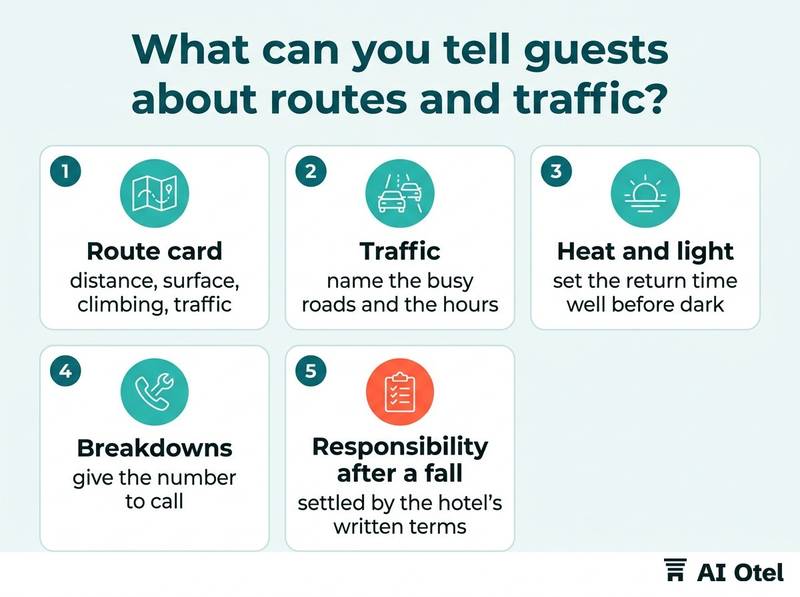
Build a route card for each route you offer: distance, surface, climbing, traffic at which hours, shade, water points, and a clear turn-back point for a shorter ride. State on the card what it is: a description prepared by the hotel from its own knowledge, not an assessment of the guest's ability and not a report on road conditions on the day.
On traffic, name the busy roads and the hours to avoid them, and tell the guest which side of the road to ride on. Do not tell a guest that a road is safe. On heat and light: in summer, set the return time well before dark and warn about the midday hours; the return time on the form should match the daylight. On breakdowns, give the number to call, what the guest should do with the bike, and whether the hotel collects it. Say it at the desk and print it on the card.
Responsibility after a fall is settled by the hotel's written terms, its insurer's view of lent or rented bikes, and the facts of the case. Confirm the insurance position and the wording of the form with your insurer and your legal adviser before the first hand-out. Keep the route cards current: a road closed for works or a new one-way system makes an old card worse than no card.
NoteDescribe, do not promise
Write "this road carries fast traffic between 17:00 and 19:00" rather than "this route is safe"; write "the climb is steep for about one kilometer" rather than "easy for everyone". The card describes the road, the guest decides.
Where to start on Monday
Start with one bike, one page of terms and one daily check sheet, run them for two weeks, and let the tally of requests, refusals and repairs decide whether the service stays free, becomes paid, or grows. The pieces fit together in one order: the free-or-paid decision sets the record, the record makes the daily check and the hand-out form worth keeping, and the return and repair log turn a scattered extra into a service you can cost and defend. If you want the offer, the terms and the route cards to sit in one place guests can read before they arrive, the same thinking is behind the hotel operating system these services are designed to run on, which is built and working, ahead of launch. And if you are reading this as a traveler rather than a hotelier, you can look for a hotel in Türkiye (opens in a new tab) that offers what you need for the ride.
Frequently asked questions
Do guests have to sign anything to borrow a hotel bike?
The signature is the hotel's own control, not a legal formality. It records the bike number, the helmet issued, the time out and the condition at hand-out, which is what makes the return inspection and any damage conversation possible. Keep it to one page and keep the completed forms with the daily check sheets.
How do you stop hotel bikes from disappearing?
One key per bike, matched to a numbered tag on the frame; the key number written on the hand-out form; a return time agreed at the desk; a count of the rack at the end of the shift against the forms. Whether to hold a deposit or a card pre-authorization is the hotel's own decision, taken with its accountant and card provider.
Are e-bikes worth it for a hotel fleet?
They widen the group who can ride, which matters on hilly terrain and in summer heat. They also add a charging window, a heavier bike to store and lift, a battery to secure, and a higher repair cost. A bike on charge cannot be rented, so the fleet size has to cover the charging time.
Who is responsible if a guest falls off a hotel bike?
That is settled by the hotel's written terms, its insurer's view of lent or rented bikes, and the facts of the case, so confirm both with your insurer and your legal adviser before the first hand-out. What the hotel controls is the record: the daily check, the helmet fitted at the desk, the route briefing and the condition noted at hand-out and return.
Should the bike offer appear in the guest app?
It helps when the guest can read the terms and the route card before arriving, so the desk only confirms and hands over. The offer, the return time and the route description belong on the same page as the rest of the hotel's own offers, and the paper form still gets signed at the desk.